
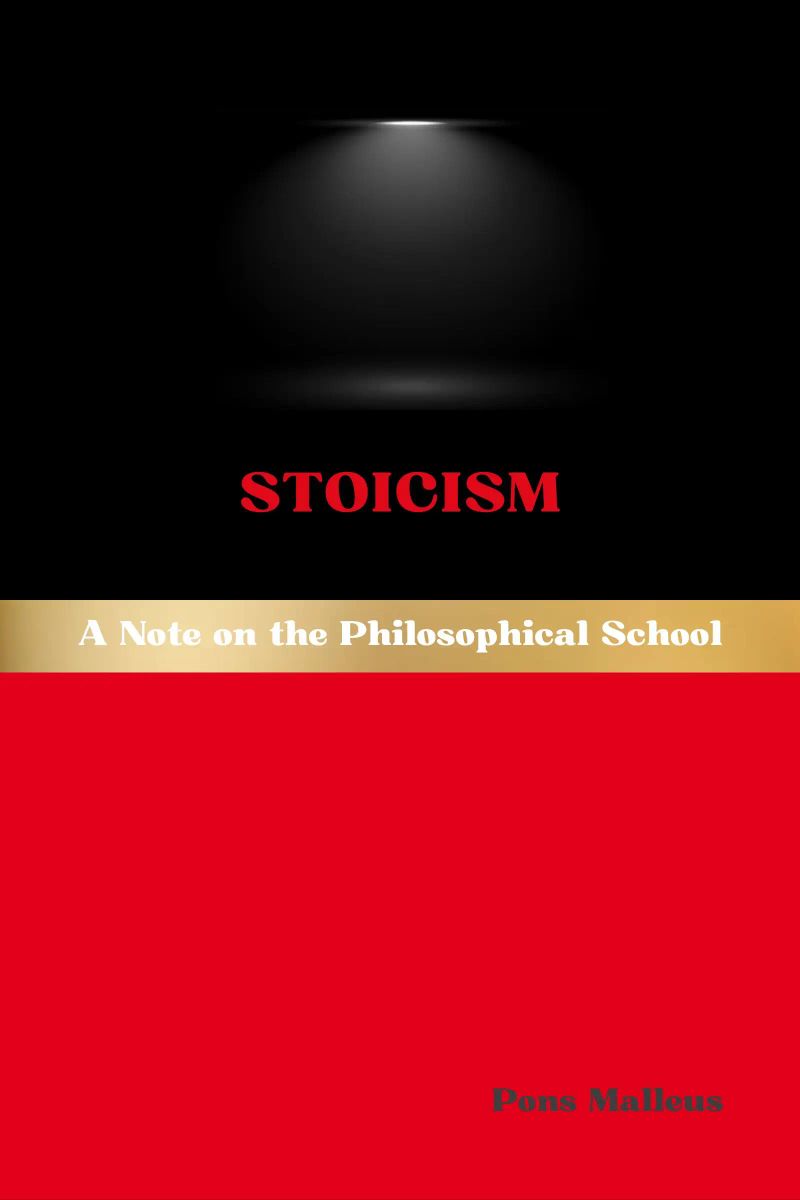
Stoicism
A Note on the Philosophical SchoolBy Pons Malleus

Length3h 13m
About this audiobook
In a world characterized by rapid change, constant distraction, and increasing uncertainty, the ancient philosophical school of Stoicism has experienced a remarkable resurgence. Though born in the bustling agora of Athens over two millennia ago, Stoicism’s principles resonate powerfully in the modern age. This book is both an exploration and a celebration of that enduring relevance—a journey into the heart of Stoic thought, its history, its thinkers, and its transformative potential for our lives today.
Stoicism emerged in the early 3rd century BCE, founded by Zeno of Citium, and was later refined and expanded by thinkers such as Cleanthes, Chrysippus, Seneca, Epictetus, and Marcus Aurelius. Unlike many abstract schools of philosophy, Stoicism was always meant to be practical—a guide for how to live well, how to face adversity, and how to cultivate inner peace regardless of external circumstances. At its core lies a deceptively simple idea: that while we cannot control what happens to us, we can control how we respond. The Stoics taught that virtue—defined as the alignment of our reason with nature—is the only true good, and that external things like wealth, health, and reputation are indifferent, neither inherently good nor bad.
This book aims to provide both a comprehensive overview and a deeply human account of Stoicism. We begin by tracing its historical roots in Hellenistic Greece and its transmission into Roman thought, where it was adopted not merely by philosophers but by statesmen, slaves, and emperors. We examine the lives and writings of the key Stoic thinkers, exploring how their experiences shaped their insights and how those insights remain relevant today. We unpack central Stoic concepts such as the dichotomy of control, the role of reason, the nature of emotions, the importance of virtue, and the art of living in accordance with nature.
Yet, this is not merely a historical or theoretical survey. At every turn, we draw connections to contemporary life: to the stresses of modern work, the noise of social media, the challenges of personal relationships, and the pursuit of meaning in an increasingly materialistic world. In the reflections of Marcus Aurelius, we find counsel for resilience. In the teachings of Epictetus, we find tools for self-discipline. And in the letters of Seneca, we discover profound meditations on time, mortality, and the art of living deliberately.
Stoicism is often misunderstood as a philosophy of emotional suppression or detached indifference. This book challenges those misconceptions. True Stoicism is not about apathy but about clarity. It is not a denial of feeling but a cultivation of emotional intelligence. It is not a rejection of life’s joys and sorrows but a commitment to face them with wisdom, courage, and grace.
Whether you are encountering Stoicism for the first time or deepening an existing interest, this book invites you to engage with its principles not merely as intellectual exercises but as living practices. Philosophy, in the Stoic tradition, is not a matter of speculation but of action. The Stoic sage is not one who talks about virtue, but one who strives to embody it.
In reading these pages, may you find not only insight but also inspiration. May the Stoic path offer you clarity in confusion, strength in adversity, and a deeper understanding of what it means to live a good life. This is the promise of Stoicism—timeless, humble, and powerful.
Audiobook details
GenrePhilosophy, Politics and Government
Length3 hrs 13 mins
Narrated byListen with 1,000+ voices
FormateBook with Audio
Publish dateNov 7, 2025
LanguageEnglish
Table of contents
1STOICISM
2Introduction to Stoicism
3Historical Context and Development
4Key Ideas and Theories
5Major Figures in Stoic Philosophy
Show all chaptersShow less
6Stoic Epistemology – Knowledge and Reason
7Stoic Ethics - Virtue, Happiness, The Good Life
8Stoic Metaphysics - Nature, Cosmos, Logos
9Comparative Analysis with other Schools
10Stoicism in Modern Thought
Series

TranscendentalismPons Malleus2h 57m$6
ScholasticismPons Malleus3h$6
SkepticismPons Malleus3h 16m$6
RationalismPons Malleus2h 47m$6
EmpiricismPons Malleus2h 49m$6
StructuralismPons Malleus2h 57m$6
CoherentismPons Malleus3h 1m$6
FoundationalismPons Malleus3h 17m$6
DeterminismPons Malleus3h 29m$6
NaturalismPons Malleus3h 26m$6
PragmatismPons Malleus3h 7m$6
ConstructivismPons Malleus3h 16m$6
Milesian SchoolPons Malleus3h 17m$6
ObjectivismPons Malleus3h 31m$6
EpicureanismPons Malleus3h 17m$6
EleaticismPons Malleus2h 51m$6
NominalismPons Malleus2h 59m$6
Dialectical MaterialismPons Malleus3h 6m$6
French NietzscheanismPons Malleus3h 4m$6
Ionian SchoolPons Malleus3h 1m$6
IlluminationsWalter Benjamin10h 12m4.4 (16.2K)$20 · $0.00
That Bird Has My WingsJarvis Jay Masters9h 49m4.4 (13.7K)$29 · $0.00

Tâo Teh KingLaozi2h 34m4.4 (230.9K)$2 · $0.00

Buddhist Boot CampTimber Hawkeye2h 39m4.4 (8.4K)$18 · $0.00
Enchiridion & The Discourses of Epictetus (Annotated)Arrian Epictetus18h 9m4.4 (3.5K)$2 · $0.00

The Meditations of the Emperor Marcus Aurelius AntoninusEmperor of Rome Marcus Aurelius5h 41m4.4 (1.8M)$1 · $0.00
Crime and PunishmentFyodor Dostoevsky23h 11m4.4 (1.3M)$12 · $0.00
MeditationsMarcus Aurelius5h 52m4.4 (433.7K)$1 · $0.00
Everyday DharmaSuneel Gupta5h 2m4.5 (761)$20 · $0.00
The Joyful Wisdom ("La Gaya Scienza")Friedrich Wilhelm Nietzsche11h 37m4.4 (26.6K)$1 · $0.00
The Art of LivingEpictetus, Sharon Lebell3h 16m4.4 (50.1K)$18 · $0.00

Sadhana: the realisation of lifeRabindranath Tagore3h 49m4.4 (8.6K)$6 · $0.00
SapiensYuval Noah Harari15h 18m4.3 (1.4M)$33 · $0.00
You BelongSebene Selassie8h 35m4.4 (2.7K)$26 · $0.00
The Song Celestial; Or, Bhagavad-Gîtâ (from the Mahâbhârata)Anonymous2h 18m4.4 (3.2K)$2 · $0.00

Chuang Tzu: Mystic, Moralist, and Social ReformerZhuangzi14h 42m4.4 (1.2K)$1 · $0.00

High-RisersBen Austen13h 33m4.4 (2.8K)$33 · $0.00

The Great OmissionDallas Willard7h 45m4.4 (4K)$26 · $0.00

The Grand InquisitorFyodor Dostoyevsky2h 24m4.3 (10.7K)$1 · $0.00
Praying with the PsalmsEugene H. Peterson7h 20m4.5 (312)$24 · $0.00

KrantikariSanjeev Sanyal11h 44m4.6 (1.3K)$16 · $0.00

Unbroken Bonds of BattleJohnny Joey Jones8h 31m4.6 (2.6K)$8 · $0.00

On Democracies and Death CultsDouglas Murray10h 38m4.6 (6.5K)$29 · $0.00

Balcony Over Jerusalem: A Middle East Memoir - Israel, Palestine and BeyondJohn Lyons12h 37m4.6 (1.4K)$33 · $0.00

RiggedMollie Hemingway12h 48m4.6 (4.2K)$23 · $0.00

SledgehammerDavid Friedman8h 21m4.7 (589)$26 · $0.00

Citizenship in a Republic (Annotated)Theodore Roosevelt2h 44m4.6 (1.4K)$2 · $0.00

No EscapeNury Turkel9h 30m4.6 (809)$28 · $0.00

Always FaithfulThomas Schueman, Zainullah Zaki12h 12m4.6 (977)$29 · $0.00

UnthinkableJamie Raskin15h 8m4.5 (9.3K)$8 · $0.00

My Fourth Time, We DrownedSally Hayden13h 59m4.6 (2.9K)$23 · $0.00

A Revolution of Common SenseScott Jennings9h 29m4.6 (528)$29 · $0.00

Statement From the Dock at the Rivonia TrialNelson Mandela2h 18m4.6 (1.3K)$1 · $0.00

Lessons from the EdgeMarie Yovanovitch17h 11m4.5 (5.9K)$40 · $0.00

To Rescue the American SpiritBret Baier10h 12m4.5 (2.7K)$8 · $0.00

StonewalledSharyl Attkisson15h 19m4.5 (4.3K)$33 · $0.00
The World According to Orwell: 1984 & Animal FarmGeorge Orwell15h 42m4.6 (1.1K)$1 · $0.00
Basic EconomicsThomas Sowell18h 32m4.5 (29.3K)$28 · $0.00
To Rescue the RepublicBret Baier, Catherine Whitney11h 42m4.5 (8.6K)$29 · $0.00

Modern WarriorsPete Hegseth7h 10m4.5 (4.7K)$24 · $0.00
You may also like

DialoguesSeneca22h 48m4.4 (2.1K)$0.60 · $0.00

The Science of Being WellWallace D. Wattles2h 32m4.0 (3.1K)$1 · $0.00

Everyday Chanakya | Stress Management S01E06Radhakrishnan Pillai50m4.4 (1.5K)$4
Hatha YogaWilliam Walker6h 56m4.0 (286)$4.60 · $0.00

On the SoulAristotle3h 26m4.2 (8.1K)$1.80 · $0.00
A Handbook for New StoicsMassimo Pigliucci, Gregory Lopez10h 45m4.2 (2.6K)$23

The Inner SecretWilliam Walker Atkinson4h 32m4.3 (264)$2 · $0.00

Younger for LifeAnthony Youn8h 7m4.2 (718)$26 · $0.00

Things No One Taught Us About LoveVex King5h 55m4.2 (2.8K)$24 · $0.00

Hatha YogaWilliam Walker6h 56m4.4 (188)$3.50 · $0.00
Accept Criticism - Hypnosis and Guided MeditationJohn Flatcher14m$4 · $0.00

The Cortisol Reset PlanMarina Wright7h 1m3.6 (114)$24 · $0.00

The Power of MusicAnonymous2h 21m$2 · $0.00
On Old Age - Cicero de Senectute (Annotated)Marcus Tullius Cicero4h 13m$2 · $0.00

Doctor and PatientS. Weir Mitchell3h 1m$2 · $0.00

The Ethics of DietHoward Williams20h 58m4.1 (185)$1 · $0.00

Essays: First Series. PrudenceRalph Waldo Emerson29m4.2 (56)$2 · $0.00

Keeping Fit (Unabridged) (Annotated)Orison Swett Marden8h 45m3.6 (10)$2 · $0.00
De Medicina (All 8 Volumes) (Annotated)Aulus Cornelius Celsus22h 6m$1.99 · $0.00
The Enlightened ManagerVishwanath Alluri6h 7m$24 · $0.00