
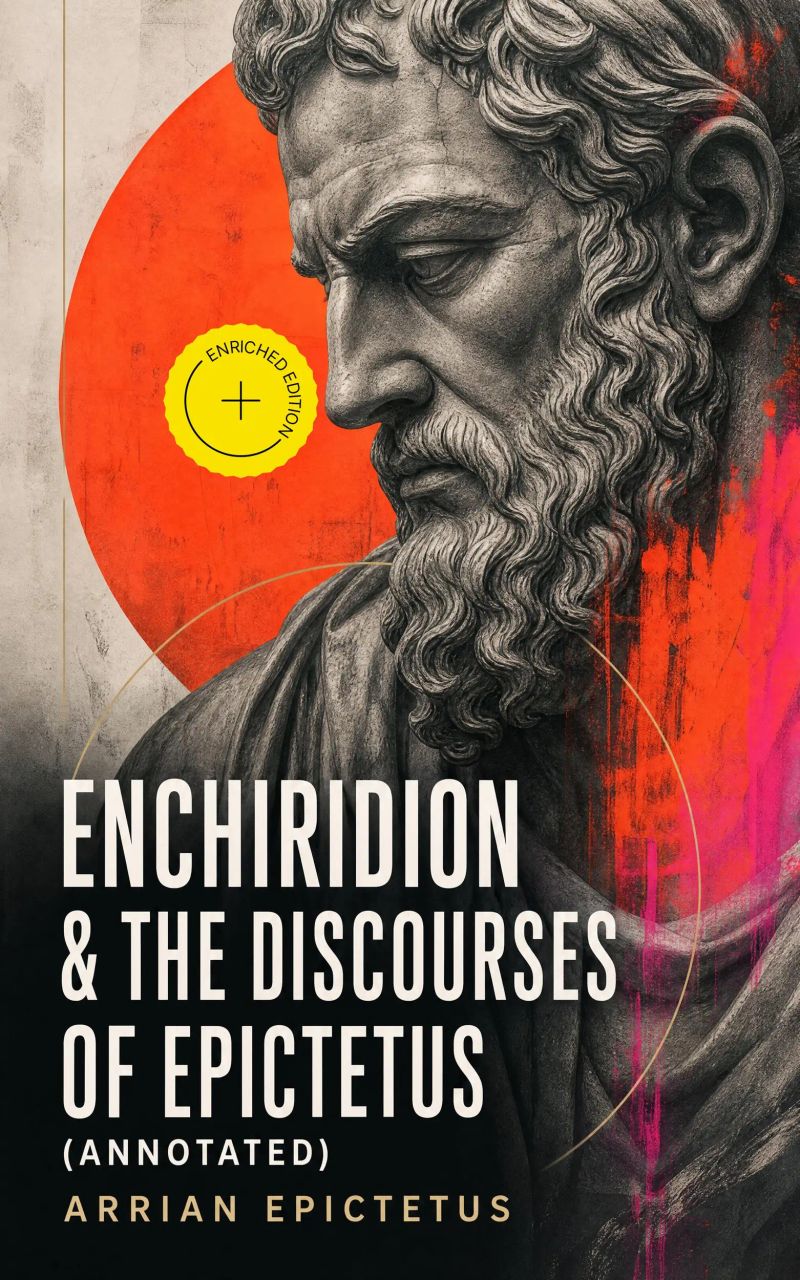
Enchiridion & The Discourses of Epictetus (Annotated)
Enriched Edition. Including the FragmentsBy Arrian Epictetus


Length18h 9m
About this audiobook
The Enchiridion and Discourses present the moral philosophy of Epictetus in its most influential forms: the former a compact manual of Stoic practice, the latter a vivid record of classroom exhortation, argument, and correction. Their style is austere yet forceful, combining Socratic questioning, practical analogies, and memorable aphorism. Set within the Roman Imperial Stoic tradition, these works redirect philosophy from speculation toward disciplined judgment, freedom from passion, and the distinction between what is "up to us" and what is not. Epictetus, born enslaved in Hierapolis and later freed in Rome, taught philosophy at Nicopolis after Domitian's expulsion of philosophers from the capital. His experience of dependence, vulnerability, and political displacement profoundly informs his insistence that true liberty lies in moral agency rather than circumstance. The texts survive through Arrian, his devoted student, whose careful transcription and arrangement preserved the urgency of Epictetus's spoken teaching. This volume is indispensable for readers of philosophy, classics, ethics, and spiritual literature. It offers not consolation alone, but a rigorous training in self-command, responsibility, and inner freedom—an ancient guide whose clarity remains strikingly modern.
This enriched edition has been carefully crafted to add value to your reading experience.
- A comprehensive Introduction outlines these selected works' unifying features, themes, or stylistic evolutions.
- The Author Biography highlights personal milestones and literary influences that shape the entire body of writing.
- A Historical Context section situates the works in their broader era—social currents, cultural trends, and key events that underpin their creation.
- A concise Synopsis (Selection) offers an accessible overview of the included texts, helping readers navigate plotlines and main ideas without revealing critical twists.
- A unified Analysis examines recurring motifs and stylistic hallmarks across the collection, tying the stories together while spotlighting the different work's strengths.
- Reflection questions inspire deeper contemplation of the author's overarching message, inviting readers to draw connections among different texts and relate them to modern contexts.
- Lastly, our hand‐picked Memorable Quotes distill pivotal lines and turning points, serving as touchstones for the collection's central themes.
Audiobook details
Rating★★★★ 4.4 (3.5K)
Includes Goodreads, Amazon, LibraryThing, StoryGraph
GenrePhilosophy
Length18 hrs 9 mins
Narrated byListen with 1,000+ voices
FormateBook with Audio
Publish dateMay 11, 2018
LanguageEnglish
Table of contents
1Introduction
2Introduction
3Author Biography
4Historical Context
5Synopsis (Selection)
Show all chaptersShow less
6Enchiridion & The Discourses of Epictetus
7Introduction
8Enchiridion, or the Manual
9Preface
10Enchiridion of Epictetus
11Discourses, as reported by Arrian
12Book 1
13I. Of the things which are under our control and not under our control
14II. How may a man preserve his proper character upon every occasion?
15III. From the thesis that God is the father of mankind how may one proceed to the consequences?
16IV. Of progress
17V. Against the Academics1
18VI. Of providence
19VII. Of the use of equivocal premisses, hypothetical arguments and the like
20VIII. That the reasoning faculties, in the case of the uneducated, are not free from error
21IX. How from the thesis that we are akin to God may a man proceed to the consequences?
22X. To those who have set their hearts on preferment at Rome
23XI. Of family affection
24XII. Of contentment
25XIII. How may each several thing be done acceptably to the gods?
26XIV. That the Deity oversees all men
27XV. What does philosophy profess?
28XVI. Of providence
29XVII. That the art of reasoning is indispensable
30XVIII. That we ought not to be angry with the erring
31XIX. How ought we to bear ourselves toward tyrants?
32XX. How the reasoning faculty contemplates itself
33XXI. To those who would be admired
34XXII. Of our preconceptions
35XXIII. In answer to Epicurus
36XXIV. How should we struggle against difficulties?
37XXV. Upon the same theme
38XXVI. What is the rule of life?
39XXVII. In how many ways do the external impressions arise, and what aids should we have ready at hand to deal with them?
40XXVIII. That we ought not to be angry with men; and what are the little things and the great among men?
41XXIX. Of steadfastness
42XXX. What aid ought we to have ready at hand in difficulties?
43Book 2
44I. That confidence does not conflict with caution
45II. On tranquillity
46III. To those who recommend persons to the philosophers
47IV. To the man who had once been caught in adultery
48V. How are magnanimity and carefulness compatible?
49VI. Of indifference in things
50VII. How should one employ Divination?
More from Arrian Epictetus

WitnessAriel Burger8h 1m4.6 (1.3K)$20 · $0.00

The Magic PresenceGodfré Ray King10h 21m4.6 (307)$1.20 · $0.00
The Art of LivingThich Nhat Hanh5h 1m4.5 (14.2K)$24 · $0.00
Moral Letters to LuciliusLucius Annaeus Seneca24h 26m4.5 (71.7K)$0.99 · $0.00

Lessons in TruthH. Emilie Cady3h 50m4.5 (2.4K)$20 · $0.00
Letters from a StoicSeneca6h 5m4.4 (80.4K)$6 · $0.00
The Discourses of EpictetusP. E. MATHESOM12h 47m4.4 (17.7K)$1.20 · $0.00

IlluminationsWalter Benjamin10h 12m4.4 (16.2K)$20 · $0.00

That Bird Has My WingsJarvis Jay Masters9h 49m4.4 (13.7K)$29 · $0.00

Tâo Teh KingLaozi2h 34m4.4 (230.9K)$2 · $0.00
SymposiumPlato3h 26m4.4 (97.9K)$1.20 · $0.00

Buddhist Boot CampTimber Hawkeye2h 39m4.4 (8.4K)$18 · $0.00

The Meditations of the Emperor Marcus Aurelius AntoninusEmperor of Rome Marcus Aurelius5h 41m4.4 (1.8M)$1 · $0.00

Crime and PunishmentFyodor Dostoevsky23h 11m4.4 (1.3M)$12 · $0.00

MeditationsMarcus Aurelius5h 52m4.4 (433.7K)$1 · $0.00

Everyday DharmaSuneel Gupta5h 2m4.5 (761)$20 · $0.00

The Joyful Wisdom ("La Gaya Scienza")Friedrich Wilhelm Nietzsche11h 37m4.4 (26.6K)$1 · $0.00
The Art of LivingEpictetus, Sharon Lebell3h 16m4.4 (50.1K)$18 · $0.00
MeditationsEmperor Of Rome Marcus Aurelius7h 23m4.3 (477.5K)$1.20 · $0.00

The Imitation of ChristThomas à Kempis6h 27m4.3 (84.6K)$21 · $0.00
You may also like

Dynamic Thought (Annotated)Henry Thomas Hamblin6h 34m4.4 (1.2K)$2 · $0.00

Short and Easy Method of Prayer (Annotated)Madame Guyon12h 20m4.5 (360)$2 · $0.00

The Existentialist's Survival GuideGordon Marino6h 2m3.8 (1.6K)$24 · $0.00

The Way of PeaceJames Allen2h 1m4.3 (792)$2.30 · $0.00
Disputation on the Power of Indulgences (Annotated)Martin Luther3h 46m4.1 (15.2K)$2 · $0.00

The Wisdom of LifeArthur Schopenhauer3h 54m4.2 (32.8K)$1.20 · $0.00

DialoguesSeneca22h 48m4.4 (2.1K)$0.60 · $0.00
The Path of LoveOSHO14h 37m4.4 (12K)$20 · $0.00

The Power of SilenceRobert Cardinal Sarah10h 4m4.6 (10.6K)$20

Life of God in the Soul of Man (Annotated)Henry Scougal3h 15m4.6 (1.9K)$2 · $0.00

The power of awareness (translated)Neville Goddard2h 23m4.5 (25K)$4.70 · $0.00

The Science of Wallace D. Wattles (Complete Trilogy)Wallace D. Wattles8h 1m4.4 (2K)$2 · $0.00
The Golden Sayings of EpictetusEpictetus3h 8m4.2 (13K)$3 · $0.00

The Science of Wallace D. Wattles (Complete Trilogy)Wallace D. Wattles8h 11m4.3 (3.1K)$1.99 · $0.00

The wisdom of life (translated)Arthur Schopenhauer4h 5m4.2 (18.9K)$4.60 · $0.00

Where Is God in All of This?Jeff Brown3h 47m$20

In Search of Enlightenment: 50 Spiritual MasterworksLeo Tolstoy, William Blake, Kahlil Gibran, John of the Cross, Saint Augustine, U. G. Krishnamurti, C. H. Spurgeon, Ignatius of Loyola, Ralph Waldo Emerson, Thomas Browne, Basil the Great, Gregory of Nyssa, St. Teresa of Ávila, Thomas à Kempis, Thomas More, Blaise Pascal, George Müller, Ludwig Feuerbach, Jonathan Edwards, Evelyn Underhill, Charles Spurgeon, G. K. Chesterton, Fyodor Dostoyevsky, George MacDonald, Miguel de Unamuno, Reynold A. Nicholson, Frances Ridley Havergal, H. Emilie Cady, Anne Catherine Emmerich, Henry Scougal, Florence Scovel Shinn, Andrew Murray, Henry Drummond, Epictetus, Mahatma Gandhi, William James, Emanuel Swedenborg, William Walker Atkinson, Joseph Benner, Charles Fillmore, Edwin Sir Arnold, Ignatius of Antioch, John Donne, John Wesley, Helena Blavatsky481h 12m4.4 (17)$0.99
Spiritual GraffitiJeff Brown3h 1m4.4 (144)$15

Henry Harrison Brown: Dollars Want Me and Other New Thought Classics (Annotated)Henry Harrison Brown8h 29m$0.99 · $0.00
Stillness- Divine MeditationBrahma Khumaris51m$4 · $0.00