
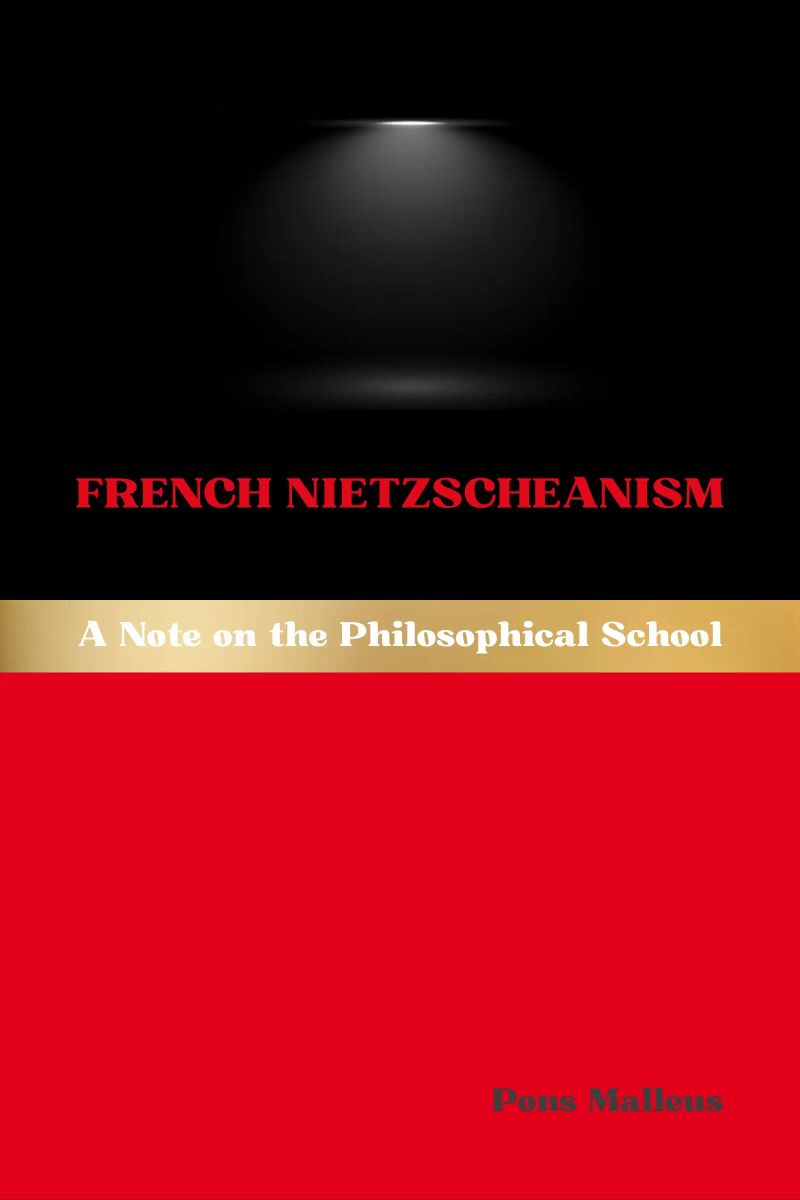
French Nietzscheanism
A Note on the Philosophical SchoolBy Pons Malleus

Length3h 4m
About this audiobook
The story of French Nietzscheanism is not merely one of philosophical inheritance; it is a tale of reinvention, provocation, and enduring transformation. Emerging in the intellectual crucible of twentieth-century France, this movement represents one of the most creative appropriations of Friedrich Nietzsche’s thought—an appropriation that did not seek to preserve his philosophy as sacred doctrine, but instead treated it as a living force, a weapon of critique, and a source of existential and conceptual liberation.
This book explores the broad and complex terrain of French Nietzscheanism, tracing its influence across the works of Jacques Derrida, Michel Foucault, Gilles Deleuze, and others. It charts the way in which Nietzsche’s ideas—on power, morality, language, subjectivity, and history—were reinterpreted and reassembled in response to the unique philosophical, political, and cultural tensions of twentieth-century France. Nietzsche’s call for the revaluation of values, his suspicion of absolute truths, and his celebration of becoming over being resonated profoundly with French thinkers grappling with the legacies of Hegelianism, Marxism, psychoanalysis, and structuralism.
To speak of a "school" of French Nietzscheanism is both necessary and misleading. Necessary, because there is a discernible trajectory in which Nietzsche’s philosophy serves as a catalyst for a sustained critique of Western metaphysics and humanist subjectivity. Misleading, because the thinkers gathered under this label are marked as much by their differences as by their shared admiration for Nietzsche. Each figure selected his Nietzsche—Dionysian or ascetic, anti-Christian or aesthetic, genealogist or tragic philosopher—to serve his own philosophical project. Yet their divergence is precisely what makes French Nietzscheanism philosophically fertile: it resists dogma, encourages experimentation, and invites us to rethink thought itself.
What unites these thinkers is less a doctrinal fidelity to Nietzsche than a methodological affinity: a shared commitment to genealogy, to the unmasking of hidden power structures, and to the disruption of static conceptual binaries. For Foucault, Nietzsche provided the key to understanding how knowledge and power are historically constructed. For Deleuze, Nietzsche was the philosopher of difference and affirmation, a figure capable of overturning the reactive forces that govern modern thought. For Bataille and Blanchot, Nietzsche opened the door to the experience of limit, transgression, and the dissolution of the subject.
In the aftermath of World War II, as France reeled from the trauma of fascism and colonialism, Nietzsche’s work offered an alternative to the stifling moralism of traditional philosophy and the deterministic schemas of orthodox Marxism. French Nietzscheanism became a philosophy of resistance—not only political resistance, but resistance to philosophical complacency, linguistic conformity, and the very structures of identity and reason that once underpinned Enlightenment thinking.
This book does not aim to provide a comprehensive history of Nietzsche reception in France, nor to defend a single reading of Nietzsche’s philosophy. Rather, it invites readers into a conversation—between Nietzsche and his French interlocutors, between past and present, between philosophy and life. In doing so, it hopes to reveal how Nietzsche’s thought, far from being a closed system, remains a provocation: a challenge to reimagine the possibilities of freedom, thought, and becoming.
Audiobook details
GenrePhilosophy, Politics and Government
Length3 hrs 4 mins
Narrated byListen with 1,000+ voices
FormateBook with Audio
Publish dateDec 3, 2025
LanguageEnglish
Table of contents
1FRENCH NIETZSCHEANISM
2Introduction to French Nietzscheanism
3Historical Context and Emergence
4Key Principles, Theories, and Ideas
5Nietzsche’s Influence on French Philosophy
Show all chaptersShow less
6Key Thinkers - Deleuze, Foucault, and Derrida
7Core Debates within the school
8Critiques and Rebuttals in Academic Circles
9Impact on Contemporary Philosophy
10Future Directions for French Nietzscheanism
Series

TranscendentalismPons Malleus2h 57m$6
ScholasticismPons Malleus3h$6
SkepticismPons Malleus3h 16m$6
RationalismPons Malleus2h 47m$6
EmpiricismPons Malleus2h 49m$6
StructuralismPons Malleus2h 57m$6
CoherentismPons Malleus3h 1m$6
FoundationalismPons Malleus3h 17m$6

DeterminismPons Malleus3h 29m$6
NaturalismPons Malleus3h 26m$6
PragmatismPons Malleus3h 7m$6
ConstructivismPons Malleus3h 16m$6
Milesian SchoolPons Malleus3h 17m$6
ObjectivismPons Malleus3h 31m$6
EpicureanismPons Malleus3h 17m$6
EleaticismPons Malleus2h 51m$6
NominalismPons Malleus2h 59m$6
Dialectical MaterialismPons Malleus3h 6m$6
Ionian SchoolPons Malleus3h 1m$6

IlluminationsWalter Benjamin10h 12m4.4 (16.2K)$20 · $0.00

That Bird Has My WingsJarvis Jay Masters9h 49m4.4 (13.7K)$29 · $0.00

Tâo Teh KingLaozi2h 34m4.4 (230.9K)$2 · $0.00

Buddhist Boot CampTimber Hawkeye2h 39m4.4 (8.4K)$18 · $0.00
Enchiridion & The Discourses of Epictetus (Annotated)Arrian Epictetus18h 9m4.4 (3.5K)$2 · $0.00

The Meditations of the Emperor Marcus Aurelius AntoninusEmperor of Rome Marcus Aurelius5h 41m4.4 (1.8M)$1 · $0.00

Crime and PunishmentFyodor Dostoevsky23h 11m4.4 (1.3M)$12 · $0.00

MeditationsMarcus Aurelius5h 52m4.4 (433.7K)$1 · $0.00

Everyday DharmaSuneel Gupta5h 2m4.5 (761)$20 · $0.00

The Joyful Wisdom ("La Gaya Scienza")Friedrich Wilhelm Nietzsche11h 37m4.4 (26.6K)$1 · $0.00
The Art of LivingEpictetus, Sharon Lebell3h 16m4.4 (50.1K)$18 · $0.00

Sadhana: the realisation of lifeRabindranath Tagore3h 49m4.4 (8.6K)$6 · $0.00

SapiensYuval Noah Harari15h 18m4.3 (1.4M)$33 · $0.00
You BelongSebene Selassie8h 35m4.4 (2.7K)$26 · $0.00

The Song Celestial; Or, Bhagavad-Gîtâ (from the Mahâbhârata)Anonymous2h 18m4.4 (3.2K)$2 · $0.00

Chuang Tzu: Mystic, Moralist, and Social ReformerZhuangzi14h 42m4.4 (1.2K)$1 · $0.00

High-RisersBen Austen13h 33m4.4 (2.8K)$33 · $0.00

The Great OmissionDallas Willard7h 45m4.4 (4K)$26 · $0.00

The Grand InquisitorFyodor Dostoyevsky2h 24m4.3 (10.7K)$1 · $0.00

Praying with the PsalmsEugene H. Peterson7h 20m4.5 (312)$24 · $0.00

KrantikariSanjeev Sanyal11h 44m4.6 (1.3K)$16 · $0.00

Unbroken Bonds of BattleJohnny Joey Jones8h 31m4.6 (2.6K)$8 · $0.00

On Democracies and Death CultsDouglas Murray10h 38m4.6 (6.5K)$29 · $0.00

Balcony Over Jerusalem: A Middle East Memoir - Israel, Palestine and BeyondJohn Lyons12h 37m4.6 (1.4K)$33 · $0.00

RiggedMollie Hemingway12h 48m4.6 (4.2K)$23 · $0.00

SledgehammerDavid Friedman8h 21m4.7 (589)$26 · $0.00

Citizenship in a Republic (Annotated)Theodore Roosevelt2h 44m4.6 (1.4K)$2 · $0.00

No EscapeNury Turkel9h 30m4.6 (809)$28 · $0.00

Always FaithfulThomas Schueman, Zainullah Zaki12h 12m4.6 (977)$29 · $0.00

UnthinkableJamie Raskin15h 8m4.5 (9.3K)$8 · $0.00

My Fourth Time, We DrownedSally Hayden13h 59m4.6 (2.9K)$23 · $0.00

A Revolution of Common SenseScott Jennings9h 29m4.6 (528)$29 · $0.00

Statement From the Dock at the Rivonia TrialNelson Mandela2h 18m4.6 (1.3K)$1 · $0.00

Lessons from the EdgeMarie Yovanovitch17h 11m4.5 (5.9K)$40 · $0.00

To Rescue the American SpiritBret Baier10h 12m4.5 (2.7K)$8 · $0.00

StonewalledSharyl Attkisson15h 19m4.5 (4.3K)$33 · $0.00
The World According to Orwell: 1984 & Animal FarmGeorge Orwell15h 42m4.6 (1.1K)$1 · $0.00

Basic EconomicsThomas Sowell18h 32m4.5 (29.3K)$28 · $0.00

To Rescue the RepublicBret Baier, Catherine Whitney11h 42m4.5 (8.6K)$29 · $0.00

Modern WarriorsPete Hegseth7h 10m4.5 (4.7K)$24 · $0.00
You may also like
Political IdealsBertrand Arthur William Russell2h 29m4.0 (1.3K)$2 · $0.00

The War on the WestDouglas Murray12h 42m4.3 (15.4K)$33 · $0.00

Civil DisobedienceHENRY DAVID, THOREAU THOREAU58m4.1 (33.6K)$3.50 · $0.00

LeviathanThomas Hobbes23h3.9 (68.7K)$2.30

The Essays of Arthur Schopenhauer; On Human NatureArthur Schopenhauer4h 22m4.2 (923)$2 · $0.00
The True BelieverEric Hoffer5h 17m4.3 (18.7K)$24 · $0.00

On LibertyJohn Stuart Mill5h 9m4.2 (112.9K)$20 · $0.00

In the Name of IdentityMaalouf, Amin4h 1m4.2 (14.8K)Free
OpinionsRoxane Gay9h 59m4.1 (5.3K)$29 · $0.00

Dress CodeVéronique Hyland9h 21m4.4 (1K)$29 · $0.00

Capital and IdeologyThomas Piketty48h 57m4.4 (7.2K)$40

Democracy in America (Annotated)Alexis de Toqueville36h 35m4.3 (1.3K)$2 · $0.00

The Ego and His OwnMax Stirner16h 36m4.2 (5.9K)$2 · $0.00

A Room of One's Own + Three Guineas (2 extended essays) (Annotated)Virginia Woolf13h 15m4.2 (5.4K)$2 · $0.00

Feel My Big GuitarUnknown Author7h 26m$25 · $0.00

Enfranchisement of women (Annotated)Harriet Taylor Mill2h 6m4.0 (60)$2 · $0.00

The Political Works of Thomas Hobbes (4 Books in One Edition)Thomas Hobbes48h 15m4.1 (12)$2 · $0.00

The Unexpurgated Case Against Woman SuffrageAlmroth Edward Wright3h 51m$1 · $0.00

Advancing Towards Gender Equality in Academia and Scientific Research, a Perspective from Higher Education InstitutionsMarta Ochman, Gerhard Niedrist, Miluska Orbegoso Silva6h 40m$13 · $0.00

Campus Speech and Academic FreedomErwin Chemerinsky, Howard Gillman8h 50m4.2 (15)$23