
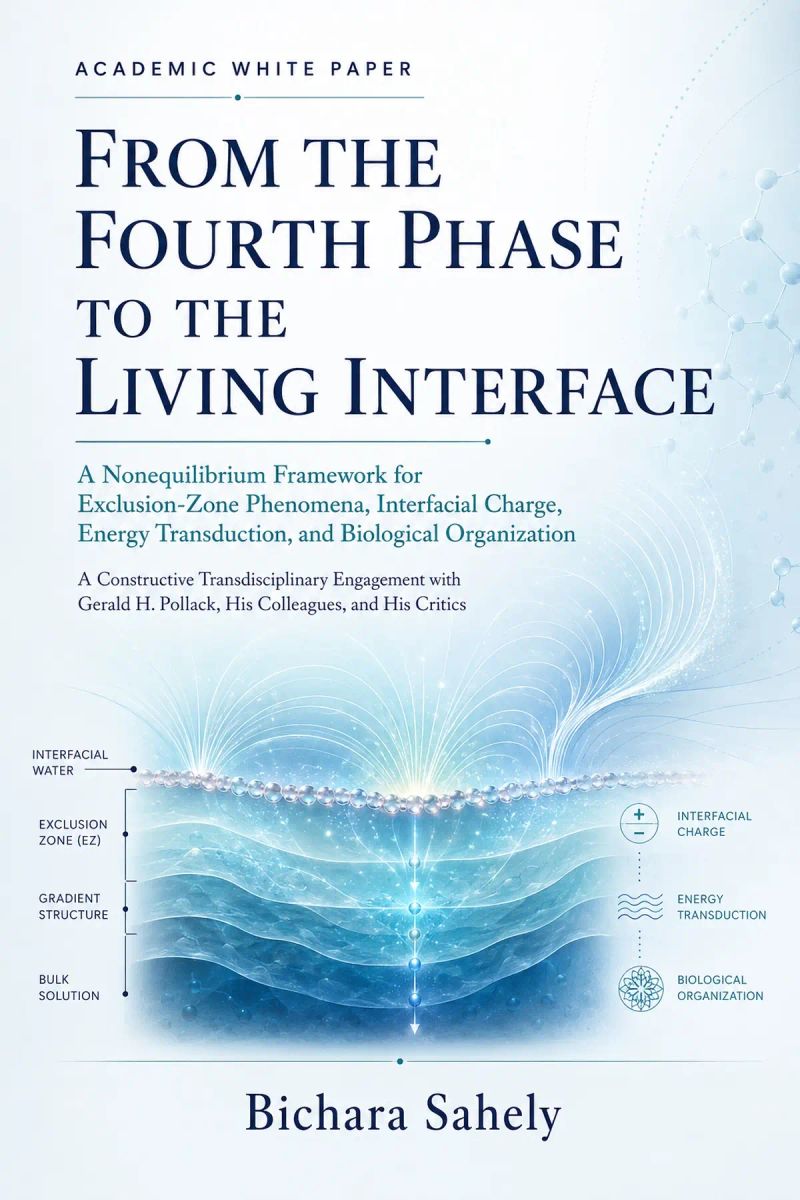
From the Fourth Phase to the Living Interface
A Nonequilibrium Framework for Exclusion-Zone Phenomena, Interfacial Charge, Energy Transduction, and Biological OrganizationBy Dr. Bichara Sahely

Length2h 52m
About this audiobook
A scholarly audio edition of From the Fourth Phase to the Living Interface. This white paper reconstructs the controversy around exclusion-zone water and Gerald H. Pollack’s fourth-phase hypothesis, then proposes a third model: the emergent nonequilibrium interface. It argues that hydrated surfaces, water dynamics, ions, charge separation, gradients, energy input, and material flow may form a dynamically maintained interfacial organization worthy of rigorous adversarial testing. The paper remains careful: Model C is presented as a falsifiable research hypothesis, not an established theory.
Audiobook details
GenreScience and Nature
Length2 hrs 52 mins
Narrated byListen with 1,000+ voices
FormateBook with Audio
Publish dateJul 7, 2026
LanguageEnglish
Table of contents
1Chapter 1
2Abstract: CENTRAL THESIS
3Original Contribution
4Part I — The Scientific Problem
51. The Unresolved Status of Exclusion-Zone Phenomena
Show all chaptersShow less
62. Pollack’s Copernican Proposition
73. What the Critics Have Established
84. What the Critics Have Not Yet Established
9Part II — Reconstructing the Ontology
105. The False Binary Between Phase and Transport
116. From Equilibrium Phase to Nonequilibrium Organization
127. Model C: The Emergent Nonequilibrium Interface
138. Constraints, Relations, and Causal Organization
14Part III — Seeing Without Destroying
159. The Observability Problem
1610. Lessons from the Interstitium and Other Preparation-Dependent Discoveries
1711. Relational and Process-Preserving Methods
1812. Perturbation, Recovery, Memory, and Hysteresis
19Part IV — Three Models, Discriminating Predictions
2013. Spatial Extent and Coordinated Boundaries
2114. Spectral and Dynamical Signatures
2215. Gradient Neutralization and Persistence
2316. Wavelength Dependence and Matched Thermal Controls
2417. Geometry, Topology, and Surface Chemistry
2518. Hysteresis, History, and State Memory
2619. Energy Storage, Release, and Work
2720. Correspondence with Biological Function
28Part V — The Decisive Experimental Programme
2921. Principles of Adversarial Collaboration
3022. Phase I: Physical Benchmark and Replication
3123. Phase II: Simultaneous Multimodal Measurement
3224. Phase III: Orthogonal Manipulation of Structure and Gradients
3325. Phase IV: Translation from Nafion to Biological Interfaces
3426. Phase V: Coupling Interfacial State to Function
3527. Open Data, Preregistration, and Shared Falsification Criteria
36Part VI — From Hydrated Interfaces to Living Organization
3728. Biomolecular Hydration and the Limits of the Passive-Solvent Model
3829. Membranes as Water–Ion–Protein–Energy Ensembles
3930. Mitochondria, Proton Organization, and Energy Transduction
4031. Glycocalyx, Extracellular Matrix, Fascia, and Interstitial Flow
4132. Microbial Biofilms, Roots, Soils, and Ecological Interfaces
4233. Deacon: Constraints, Absence, and the Generation of Work
4334. Maturana: Boundary Production and the Physical Realization of Autopoiesis
44Part VII — Stressors, Toxicants, and Loss of Interfacial Coherence
4535. Chemical Perturbation of Living Interfaces
4636. Glyphosate Formulations as an Exploratory Test Case
4737. Low-Dose, Mixture, and Nonlinear Effects
4838. From Molecular Disruption to Loss of Biological Resilience
49Part VIII — Scientific Judgment and Research Governance
5039. Explanatory Surplus Versus Fragmented Adequacy

Preserving Life, Transforming Power in GazaDr Bichara Sahely1h 42mFree

Preserving Life, Transforming PowerDr. Bichara Sahely1h 4mFree

Putting the Missing Bridge to WorkDr. Bichara Sahely2h 12mFree

The Missing BridgeDr. Bichara Sahely1h 5mFree
Transformational Laboratories ProtocolDr. Bichara Sahely2h 33mFree
Artificial Intelligence and the Epistemic CommonsDr Bichara Sahely3h 12mFree

Conflict, Repair, and Non-DominationDr Bichara Sahely2h 21mFree
Institutions of Reflexive TransformationDr Bichara Sahely1h 51mFree

The Politics of Civilizational HealingDr. Bichara Sahely2h 13mFree
The Missing Grammar of Modern CivilizationDr. Bichara Sahely2h 8mFree
Civilizational Healing Research ArchitectureDr. Bichara Sahely1h 24mFree
How Does a Civilization Learn to Heal?Dr. Bichara Sahely1h 16mFree

From Competent Physicians to Healing SocietiesDr. Bichara Sahely2h 20mFree

Competence Is Necessary, but Not SufficientDr. Bichara Sahely1h 15mFree

Life-Grounding CanMEDSDr. Bichara Sahely1h 13mFree
The Dynamic Architecture of ViabilityDr Bichara Sahely2h 1mFree

Completing the Life-Value Onto-Axiology ProgramDr. Bichara Sahely1h 9m5.0 (1)Free

BEYOND GLOBAL JUSTICEDr. Bichara Sahely1h 25mFree

The Sweetness That Consumed the WorldBichara Sahely16h 14mFree

THE SOVEREIGNTY OF CREDITDr. Bichara Sahely3h 56mFree

A Brief History of IntelligenceMax S. Bennett12h 18m4.6 (6.6K)$29 · $0.00

The Story of BirdsSteve Brusatte11h 49m4.6 (401)$29 · $0.00

What It Takes to Save a LifeKwane Stewart6h4.6 (556)$24 · $0.00

Pastoral SongJames Rebanks8h 35m4.5 (12K)$26 · $0.00

How Stella Learned to TalkChristina Hunger7h4.5 (10.9K)$24 · $0.00

Craig & FredCraig Grossi8h 6m4.5 (9.6K)$26 · $0.00

Celebrating BirdsNatalia Rojas, Ana Maria Martinez6h 47m4.6 (330)$24 · $0.00

Saving JemimaJulie Zickefoose4h 59m4.5 (749)$20 · $0.00

Will's Red CoatTom Ryan8h 23m4.5 (2.3K)$26 · $0.00

Of Time and TurtlesSy Montgomery10h 34m4.5 (5K)$29 · $0.00

THE WOLF TRILOGY: Call of the Wild, White Fang & The Son of the WolfJack London17h 31m4.5 (2.4K)$1.99 · $0.00

Zen and the Art of Saving the PlanetThich Nhat Hanh9h 20m4.5 (3.9K)$29 · $0.00

BLACK BEAUTY (With Original Illustrations)Anna Sewell7h 31m4.5 (1.3K)$1.99 · $0.00

Bottle of LiesKatherine Eban14h 25m4.4 (12K)$33 · $0.00

IngrainedCallum Robinson8h 10m4.5 (1.1K)$26 · $0.00

The Lion Tracker's Guide To LifeBoyd Varty3h 1m4.4 (4.8K)$18 · $0.00

Born for LoveBruce D. Perry, Maia Szalavitz11h 42m4.4 (4K)$29 · $0.00

The Mountains of California (With Original Drawings & Photographs) (Annotated)John Muir11h 35m4.5 (1.1K)$2 · $0.00

The New GuysMeredith Bagby16h 50m4.4 (1.2K)$40 · $0.00

Blue PasturesMary Oliver3h 23m4.4 (3.8K)$18 · $0.00
You may also like
Fossil MenKermit Pattison15h 21m4.3 (2.9K)$33 · $0.00

Kant's Prolegomena to Any Future MetaphysicsImmanuel Kant4h 21m4.1 (12.1K)$1 · $0.00
Kant's Prolegomena to Any Future MetaphysicsImmanuel Kant5h 2m4.1 (12.3K)$2.30

Hegel: The Science of LogicGeorg Wilhelm Friedrich Hegel17h 53m4.3 (4.5K)$1.99 · $0.00

ParmenidesPlato4h 7m4.0 (13.1K)$2.30

1434Gavin Menzies9h 53m3.6 (2.4K)$29 · $0.00

Kant's Prolegomena to Any Future Metaphysics (Annotated)Immanuel Kant6h 3m4.1 (12.9K)$2 · $0.00
Before The Big BangLaura Mersini-Houghton5h 46m4.1 (1.3K)$24 · $0.00
Questions Are the AnswerHal Gregersen8h 45m4.1 (682)$29 · $0.00

On the Motion of the Heart and Blood in Animals (Annotated)William Harvey3h 31m4.0 (742)$1.20 · $0.00

The Origin of VertebratesWalter Holbrook Gaskell22h 22m$2 · $0.00
The Cyclic Universe - A Conversation with Roger PenroseHoward Burton2h 20m4.3 (39)$3 · $0.00

The Distinction between Mind and Its ObjectsBernard Bosanquet2h 4m$2 · $0.00

On the Philosophy of Discovery, Chapters Historical and CriticalWilliam Whewell21h 23m$1 · $0.00

Radio-Active Substances (Annotated)Marie Curie5h 54m4.4 (105)$2 · $0.00

The Copernicus of Antiquity (Aristarchus of Samos)Thomas Little Sir Heath2h 42m4.1 (18)$1 · $0.00

Cathode RaysJoseph John Thomson2h 21m$1 · $0.00

Experiments on the Absence of Mechanical Connexion between Ether and MatterOliver Joseph Lodge1h 34m$1 · $0.00

The Letter of Petrus Peregrinus on the Magnet, A.D. 1269De Maricourt active 13th century Pierre1h 41m$2 · $0.00
The New Physics and Its EvolutionLucien Poincaré6h 18m3.7 (87)$1 · $0.00