
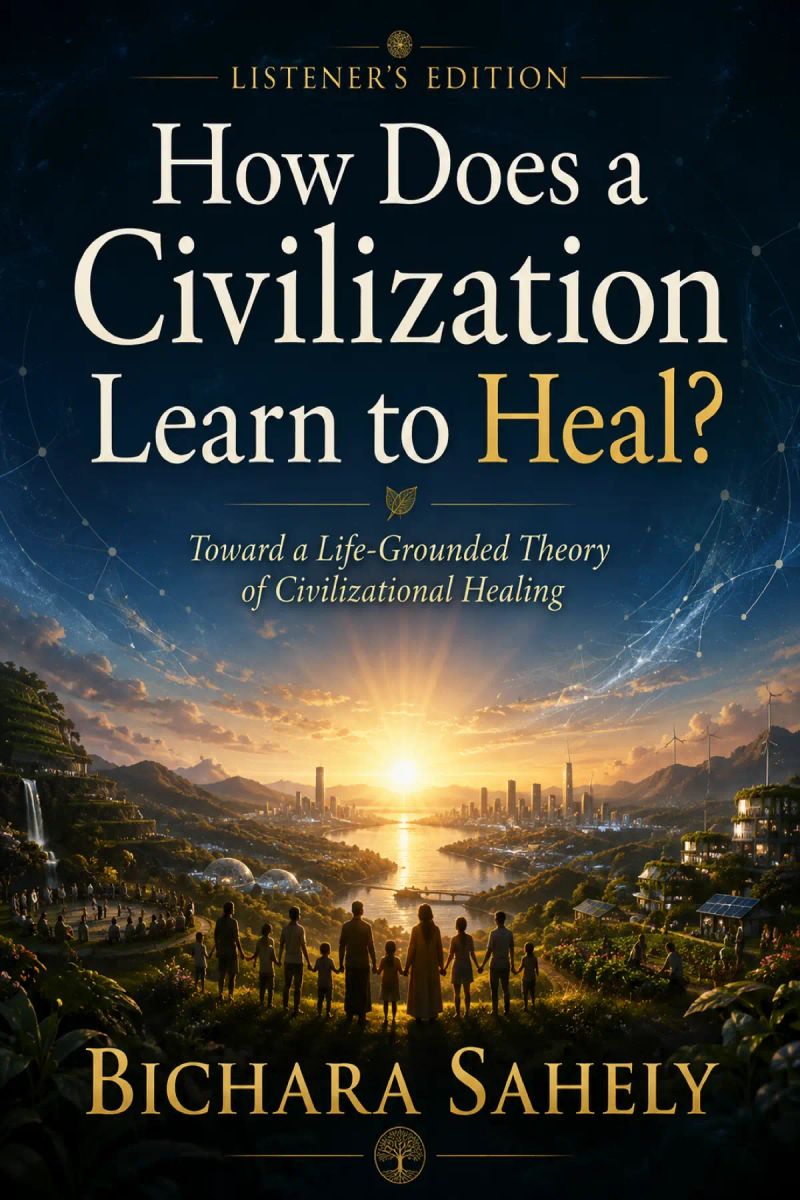
How Does a Civilization Learn to Heal?
Toward a Life-Grounded Theory of Civilizational HealingBy Dr. Bichara Sahely


Length1h 16m
About this audiobook
Humanity faces converging crises of war, inequality, democratic erosion, public-health failure, collective trauma, and ecological breakdown. But what would it mean for a civilization — not merely an individual — to heal? Bichara Sahely develops a life-grounded theory of civilizational healing: the collective capacity to recognize injury, interrupt harm, repair damaged capacities, transform the systems that reproduce suffering, regenerate life-supporting conditions, and learn without exporting burdens elsewhere. Integrating insights from salutogenesis, peacebuilding, planetary health, capabilities, resilience, and regenerative development, this work offers a practical architecture for life-coherent self-correction across persons, institutions, societies, and the biosphere. This Listener’s Edition translates the paper’s figures, tables, and formal concepts into clear spoken prose.
Audiobook details
GenreHealth and Wellness, Education and Learning
Length1 hr 16 mins
Narrated byListen with 1,000+ voices
FormateBook with Audio
Publish dateAug 27, 2026
LanguageEnglish
Table of contents
1Introduction
2Listener's Note
3Listening Orientation
41. Introduction: from polycrisis to a healing question
52. Adjacent traditions and the unresolved gap
Show all chaptersShow less
62.1 Biological repair and salutogenesis
72.2 Violence, trauma, reconciliation, and societal healing
82.3 Capabilities, life value, and planetary health
92.4 Resilience, transitions, and transformation
102.5 Existing uses of "healing civilization": Listening synthesis: five adjacent traditions
113. Conceptual foundations and boundaries
123.1 Civilization as a socio-ecological order
133.2 Healing as disciplined, collaborative reorganization
143.3 Life capacity and life-ground
153.4 What the healing analogy does not authorize
164. A life-grounded normative architecture
174.1 From ultimate concern to institutional purpose
184.2 Value pluralism within life-protective boundaries
194.3 Justice is constitutive of healing
204.4 Non-displacement across space, scale, and time
215. Civilizational pathology: organized life-disconnection
22Listening synthesis: five pathology lenses
235.1 Generative mechanisms
245.2 Protective margins and cumulative vulnerability
256. The civilizational healing architecture
26Listening map of the architecture
276.1 The recursive grammar of civilizational healing
28Recognition
29Diagnosis
30Protection
31Repair
32Transformation
33Regeneration
34Learning
356.2 Nested sites: from self to biosphere
366.3 Civilizational healing capabilities: Listening synthesis: seven durable capabilities
376.4 Civil commons and durable healing infrastructure
387. Governance: responsibility with power, resources, and feedback
397.1 Affected-community authority
407.2 Refusal as diagnostic evidence
418. Evaluation without a single civilizational score
428.1 Four complementary forms of evidence
438.2 Thresholds, distributions, and trajectories
448.3 Corrigibility and adversarial testing
459. Propositions for empirical research: Eight contestable propositions
4610. Practical implications
4710.1 For policy and governance
4810.2 For institutions and professions
4910.3 For education and culture
5011. Objections, risks, and limitations
Preserving Life, Transforming Power in GazaDr Bichara Sahely1h 42mFree

Preserving Life, Transforming PowerDr. Bichara Sahely1h 4mFree
Putting the Missing Bridge to WorkDr. Bichara Sahely2h 12mFree

The Missing BridgeDr. Bichara Sahely1h 5mFree
Transformational Laboratories ProtocolDr. Bichara Sahely2h 33mFree
Artificial Intelligence and the Epistemic CommonsDr Bichara Sahely3h 12mFree
Conflict, Repair, and Non-DominationDr Bichara Sahely2h 21mFree
Institutions of Reflexive TransformationDr Bichara Sahely1h 51mFree
The Politics of Civilizational HealingDr. Bichara Sahely2h 13mFree
The Missing Grammar of Modern CivilizationDr. Bichara Sahely2h 8mFree
Civilizational Healing Research ArchitectureDr. Bichara Sahely1h 24mFree
From Competent Physicians to Healing SocietiesDr. Bichara Sahely2h 20mFree
Competence Is Necessary, but Not SufficientDr. Bichara Sahely1h 15mFree

Life-Grounding CanMEDSDr. Bichara Sahely1h 13mFree
The Dynamic Architecture of ViabilityDr Bichara Sahely2h 1mFree
Completing the Life-Value Onto-Axiology ProgramDr. Bichara Sahely1h 9m5.0 (1)Free
BEYOND GLOBAL JUSTICEDr. Bichara Sahely1h 25mFree

The Sweetness That Consumed the WorldBichara Sahely16h 14mFree
THE SOVEREIGNTY OF CREDITDr. Bichara Sahely3h 56mFree

The Complete Herbal (Annotated)Nicholas Culpeper29h 8m4.5 (1.4K)$2 · $0.00

A Plague Upon Our HouseScott W. Atlas MD10h 37m4.5 (3.4K)$20 · $0.00

The Cancer CodeDr. Jason Fung10h 48m4.5 (5.3K)$29 · $0.00

The Gift of TherapyIrvin Yalom7h 39m4.5 (38.8K)$26 · $0.00

EarlySarah DiGregorio9h 47m4.5 (1.3K)$29 · $0.00

Bottle of LiesKatherine Eban14h 25m4.4 (12K)$33 · $0.00
The 36-Hour DayNancy L. Mace, Peter V. Rabins17h 13m4.4 (9.2K)$28 · $0.00

FlooredSara Reardon10h 36m4.5 (1K)$29 · $0.00
Radical RemissionKelly A. Turner9h 26m4.4 (8.1K)$29 · $0.00
The Sinatra SolutionStephen T. Sinatra MD9h4.5 (899)$20 · $0.00

The Songaminute ManSimon McDermott6h 12m4.5 (280)$24 · $0.00
Sometimes BrilliantLarry Brilliant12h 27m4.5 (954)$29 · $0.00

Live Your LifeAmanda Kloots, Anna Kloots10h 54m4.4 (13.7K)$29 · $0.00

All in Her HeadElizabeth Comen13h 25m4.4 (18.2K)$33 · $0.00
The Wisdom of Your BodyHillary McBride9h 14m4.4 (6.7K)$29 · $0.00

The Alzheimer's SolutionDean Sherzai, Ayesha Sherzai9h 47m4.4 (1.9K)$29 · $0.00
Rewire Your MindsetBrian Keane6h 49m4.5 (896)$23 · $0.00
Tuning The Human Biofield: Healing With Vibrational MedicineCENTER FOR SOUND THERAPY13h 28m4.4 (2.5K)$35 · $0.00

VaccinatedPaul A. Offit8h 30m4.4 (3.7K)$26 · $0.00

Hot and UnbotheredYana Tallon-Hicks10h 44m4.5 (600)$29 · $0.00
A Brief History of IntelligenceMax S. Bennett12h 18m4.6 (6.6K)$29 · $0.00
HomeschooledStefan Merrill Block7h 10m3.6 (18.5K)$28 · $0.00

Parents and Children (Annotated)Charlotte Mason9h 23m4.6 (988)$2 · $0.00

Children Under FireJohn Woodrow Cox10h 17m4.5 (1.6K)$29 · $0.00

The State Must ProvideAdam Harris7h 15m4.5 (775)$24 · $0.00

The Call of the Wild and FreeAinsley Arment9h 7m4.4 (21.2K)$29 · $0.00
The Freelance WayRobert Vlach19h 48m4.5 (528)$40 · $0.00
Race to the BottomLuke Rosiak9h 20m4.5 (600)$29 · $0.00

They Came for the SchoolsMike Hixenbaugh9h 5m4.5 (2.6K)$8 · $0.00

Find Me UnafraidKennedy Odede, Jessica Posner11h 11m4.5 (2.7K)$29 · $0.00

Asking for ItKate Harding8h 55m4.4 (5.3K)$20 · $0.00
Defining Moments in Black HistoryDick Gregory7h 37m4.4 (6K)$26 · $0.00

The Emerald Tablets of Thoth the AtlanteanMaurice Doreal3h 4m4.4 (8.8K)$6 · $0.00

Learning AmericaLuma Mufleh6h 37m4.4 (564)$24 · $0.00
Math-ishJo Boaler7h 21m4.4 (588)$24 · $0.00
It Worked For MeColin Powell7h 42m4.3 (9.8K)$26 · $0.00

Little SoldiersLenora Chu11h 30m4.3 (3.1K)$29 · $0.00

Financial FeministTori Dunlap8h 3m4.2 (22.2K)$8 · $0.00

Grammar-land; Or, Grammar in Fun for the Children of Schoolroom-shireM. L. Nesbitt2h 36m4.4 (487)$1 · $0.00

DarkwaterWilliam Edward Burghardt Du Bois6h 40m4.3 (1.4K)$11 · $0.00
You may also like
Not Too Latevarious authors6h 38m4.1 (1.4K)$17
Animal, Vegetable, JunkMark Bittman12h 53m4.0 (5.3K)$33 · $0.00
A Call for RevolutionDalai Lama, Sofia Stril-Rever1h 30m4.2 (1.4K)$16 · $0.00
MetabolicalRobert H. Lustig12h 4m4.4 (12.8K)$29 · $0.00

Go GentlyBonnie Wright5h 35m4.2 (1.7K)$24 · $0.00
Silent Spring (Annotated)Rachel Carson13h 32m4.2 (222K)$2 · $0.00

The BondWayne Pacelle12h 39m4.1 (963)$33 · $0.00
How the Other Half BanksMehrsa Baradaran9h 35m4.2 (961)$20 · $0.00

The Ginseng HunterJeff Talarigo4h 16m3.6 (1.2K)$20 · $0.00
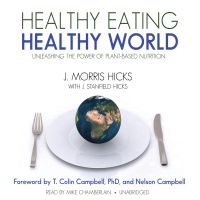
Healthy Eating, Healthy WorldJ. Morris Hicks, Ken Kurson7h 39m4.1 (672)$17

A Bigger PictureVanessa Nakate8h 24m4.4 (1.2K)$26 · $0.00

The Green AmendmentMaya K. van Rossum11h 29m4.5 (134)$16 · $0.00

Poverty: Its Illegal Causes and Legal CureLysander Spooner4h 49m$2 · $0.00
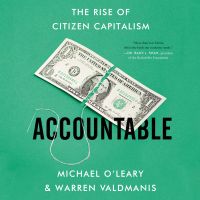
AccountableMichael O'Leary, Warren Valdmanis9h 5m4.0 (255)$29 · $0.00
A Blue New DealChris Armstrong9h4.1 (50)$20 · $0.00
Current Trends in Open ScienceNicola Cavalli3h 4m$8 · $0.00

Our Only HomeDalai Lama, Franz Alt3h 1m3.7 (700)$18 · $0.00
When Rent Is Too HighImad Muratspahic41m$5.10 · $0.00
Cop30:Everaldo Santos Silva2h 51m$7 · $0.00

GREENpeace VIEWSUnknown Author6h 28m$19 · $0.00