
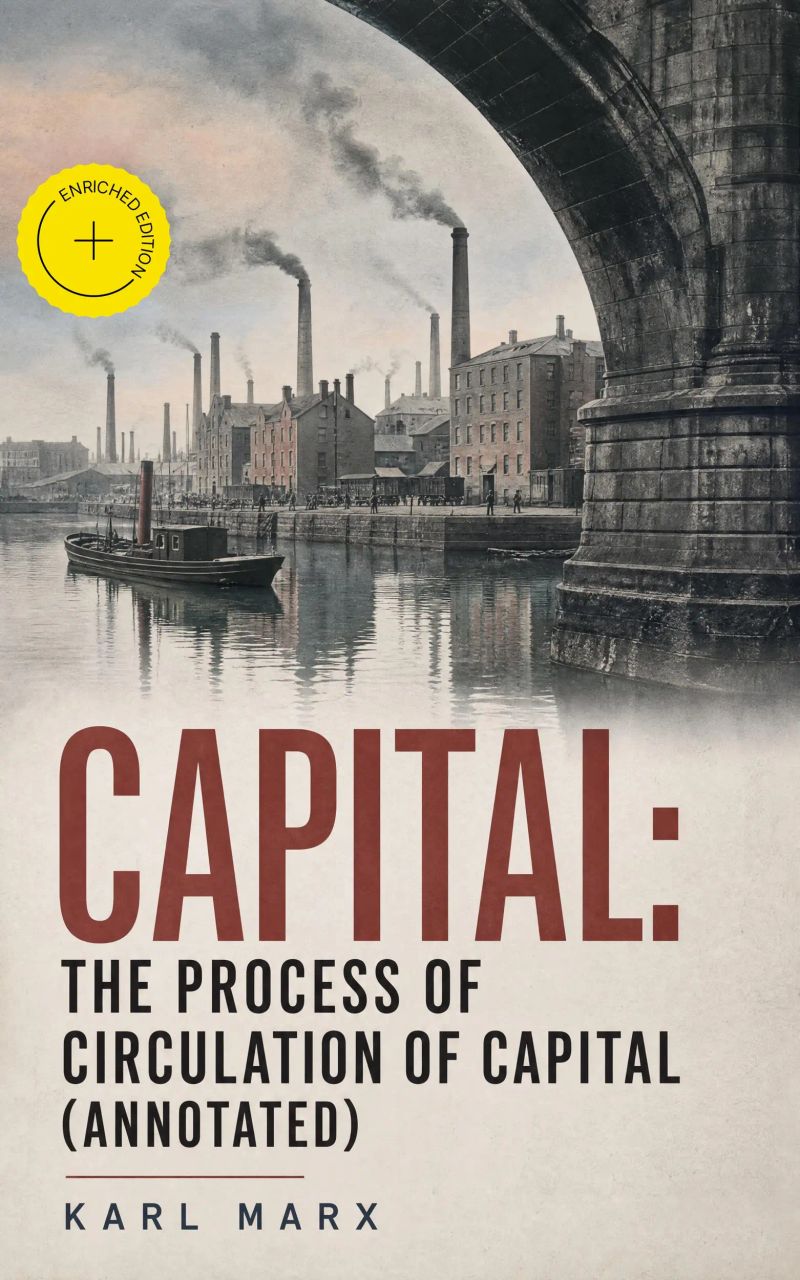
Capital: The Process of Circulation of Capital (Annotated)
Enriched Edition. Circuits, Turnover, and Social Reproduction in the Critique of Political EconomyBy Karl Marx


Length23h 38m
About this audiobook
Capital: The Process of Circulation of Capital, the second volume of Marx's great critique of political economy, shifts attention from the production of surplus value to the movement of capital through its successive forms: money, productive activity, and commodities. More analytic than polemical, the work develops a rigorous vocabulary of circuits, turnover time, reproduction schemes, and the interdependence of departments of social production. In the context of nineteenth-century political economy, it deepens and unsettles classical theories of exchange, accumulation, and crisis. Karl Marx wrote these manuscripts after decades of engagement with Hegelian philosophy, British economics, French socialism, and the realities of industrial capitalism. His exile in London, proximity to the British Museum, and observation of England's advanced capitalist system supplied both evidence and urgency. Published posthumously by Friedrich Engels in 1885, the volume reflects Marx's unfinished but extraordinarily systematic attempt to reveal capitalism as a dynamic totality. This book is essential for readers who wish to understand capitalism beyond the factory floor. Demanding yet rewarding, it is recommended to students of economics, history, sociology, and political theory seeking a profound account of circulation, reproduction, and structural instability.
This enriched edition has been carefully crafted to add value to your reading experience.
- A succinct Introduction situates the work's timeless appeal and themes.
- The Synopsis outlines the central plot, highlighting key developments without spoiling critical twists.
- A detailed Historical Context immerses you in the era's events and influences that shaped the writing.
- An Author Biography reveals milestones in the author's life, illuminating the personal insights behind the text.
- A thorough Analysis dissects symbols, motifs, and character arcs to unearth underlying meanings.
- Reflection questions prompt you to engage personally with the work's messages, connecting them to modern life.
- Hand‐picked Memorable Quotes shine a spotlight on moments of literary brilliance.
- Interactive footnotes clarify unusual references, historical allusions, and archaic phrases for an effortless, more informed read.
Audiobook details
Rating★★★★ 4.3 (18)
Includes Amazon, Goodreads
GenreBusiness and Economics
Length23 hrs 38 mins
Narrated byListen with 1,000+ voices
FormateBook with Audio
Publish dateMay 1, 2018
LanguageEnglish
Table of contents
1Introduction
2Part 1 - The Metamorphoses of Capital and Their Cycles
31. The Circulation of Money-Capital
4I. First Stage. M-C
5II. Second Stage. Functions of Productive Capital
Show all chaptersShow less
6III. Third Stage. C'-M'
7IV. The Rotation as a Whole
82. The Rotation of Productive Capital
9I. Simple Reproduction
10II. Accumulation and Reproduction on an Enlarged Scale
11III. Accumulation of Money
12IV. Reserve Funds
133. The Circulation of Commodity-Capital
144. The Three Diagrams of the Process of Circulation
155. The Time of Circulation
166. The Expenses of Circulation.
17I. Genuine Expenses of Circulation.
18II. Expenses of Storage.
19III. Expenses of Transportation
20Part 2 - The Turn-Over of Capital
217. The Period and Number of Turn-Overs
228. Fixed Capital and Circulating Capital
23I. Distinctions of Form
24II. Composition, Reproduction, Repair, and Accumulation of Fixed Capital
259. The Total Turn-Over of Advanced Capital
2610. Theories of Fixed and Circulating Capital. The Physiocrats and Adam Smith
2711. Theories of Fixed and Circulating Capital. Ricardo
2812. The Working Period
2913. The Time of Production
3014. The Time of Circulation
3115. Influence of the Time of Circulation on the Magnitude of an Advance of Capital
32I. The Working Period Equal to the Period of Circulation
33II. The Working Period Greater Than the Period of Circulation
34III. The Working Period Smaller Than the Circulation Period
35IV. Conclusions
36V. The Effect of a Change of Prices
3716. The Turn-Over of the Variable Capital
38I. The Annual Rate of Surplus-Value
39II. The Turn-Over of the Individual Variable Capital
40III. The Turn-Over of the Variable Capital, Considered from the Point of View of Society
4117. The Circulation of Surplus-Value
42I. Simple Reproduction
43II. Accumulation and Reproduction on an Enlarged Scale
44Part 3 - The Reproduction and Circulation of the Aggregate Social Capital
4518. Introduction
46I. The Object of the Analysis
47II. The Role of Money-Capital
4819. Former Discussions of the Subject
49I. The Physiocrats
50II. Adam Smith
Lohnarbeit und KapitalKarl Marx1h 49m4.3 (5.6K)$1 · $0.00
CAPITAL (All 3 Books)Karl Marx92h 37m4.5 (16.5K)$2.99 · $0.00

Manifiesto ComunistaKarl Marx, Friederich Engels1h 57m$15 · $0.00

The Communist ManifestoKarl Marx1h 13m$3 · $0.00

Differenz der demokritischen und epikureischen Naturphilosophie (Kommentiert)Karl Marx4h 16m3.8 (141)$1.50 · $0.00

Das Kapital (Kommentiert)Karl Marx96h 18m$1 · $0.00

Das Elend der Philosophie (Kommentiert)Karl Marx7h 51m3.9 (1.4K)$1 · $0.00

Karl Marx: Die deutsche Ideologie (Kommentiert)Karl Marx, Friedrich Engels28h 10m4.3 (1.7K)$1 · $0.00
Manifesto of the Communist Party (Annotated)Karl Marx3h 31m3.8 (381)$2 · $0.00

CAPITAL (Annotated)Karl Marx105h 33m$2 · $0.00

The Collected Works of Karl Marx (Annotated)Karl Marx134h 35m4.6 (321)$2 · $0.00

Zweites Kaiserreich (Kommentiert)Karl Marx15h 30m4.3 (26)$1 · $0.00

Zur Kritik der politischen Ökonomie (Kommentiert)Karl Marx10h 56m4.1 (3.9K)$1 · $0.00

Lohn, Preis und Profit (Kommentiert)Karl Marx4h 15m4.3 (2.4K)$1 · $0.00

Das Kapital: Band 1-3 (Kommentiert)Karl Marx93h 42m4.2 (1.4K)$1 · $0.00

Der Bürgerkrieg in Frankreich (Kommentiert)Karl Marx4h 57m4.3 (4.5K)$1 · $0.00

Zur Judenfrage (Kommentiert)Karl Marx3h 18m3.8 (3.9K)$1 · $0.00

Lohnarbeit und Kapital (Kommentiert)Karl Marx3h 32m$1 · $0.00

El Capital: tomo I (Anotado)Karl Marx42h$1.99 · $0.00
The Marxian Economics (Annotated)Karl Marx114h 47m4.3 (18)$2 · $0.00

Never Split the DifferenceChris Voss, Tahl Raz8h 7m4.4 (277.7K)$26 · $0.00
The Intelligent Investor Rev Ed.Benjamin Graham17h 48m4.3 (191.5K)$40 · $0.00

The Hard Thing About Hard ThingsBen Horowitz7h 57m4.2 (134.3K)$26 · $0.00

Boundaries for LeadersHenry Cloud7h 36m4.3 (3.6K)$26 · $0.00

The Ambuja StoryNarotam Sekhsaria13h 59m4.5 (830)$33 · $0.00

The Secret Door to SuccessFlorence Scovel Shinn2h 25m4.5 (2.1K)$1.20 · $0.00

This Is Going to HurtAdam Kay5h 47m4.4 (444.7K)$24 · $0.00

Big TrustShadé Zahrai, Fayçal Sekkouah8h 36m4.6 (406)$26 · $0.00
The Intelligent Investor Third EditionBenjamin Graham, Jason Zweig20h4.4 (156.6K)$46 · $0.00

Bottle of LiesKatherine Eban14h 25m4.4 (12K)$33 · $0.00

The Antiracist Business BookTrudi Lebrón6h 10m4.6 (275)$17 · $0.00

The FormulaJoshua Robinson, Jonathan Clegg10h 41m4.4 (6.9K)$29 · $0.00

Let Them LeadJohn U. Bacon7h 10m4.5 (1.4K)$24 · $0.00

Secrets of the Millionaire MindT. Harv Eker5h 11m4.4 (301.4K)$24 · $0.00

The Person You Mean to BeDolly Chugh9h 6m4.4 (7.2K)$29 · $0.00

BoundlessNick Kostov, Sean McLain9h 17m4.5 (1.1K)$29 · $0.00

Everyday DharmaSuneel Gupta5h 2m4.5 (761)$20 · $0.00

Let's Talk Mutual FundsMonika Halan7h 5m4.4 (2.4K)$16 · $0.00

Secret PowerDwight Lyman Moody3h 7m4.4 (1.4K)$1.20 · $0.00

The Law of Success in Sixteen LessonsNapoleon Hill2h 39m4.4 (17.2K)$2 · $0.00
You may also like
The Process of Circulation of Capital (Capital Vol. II)Karl Marx25h 8m4.3 (3K)$1.99 · $0.00

MetaphysicsAristotele Aristotele11h 42m4.2 (22.2K)$3.50 · $0.00

The CategoriesAristotle1h 36m4.0 (2.2K)$1.80 · $0.00

Aestheticism in ArtWilliam Hogarth5h 4m$18 · $0.00

On the Continuity of Effect of Light and Electric Radiation on MatterJagadish Chandra Bose47m$1 · $0.00

The Anatomy of BridgeworkWilliam Henry Thorpe4h 14m$2 · $0.00

How to Make Money Flipping Bicycles - How to Find Underpriced Bikes, Plan Profitable Repairs, and Take Advantage of Seasonal DemandJACK FLIPWELL7h 57m$7.80 · $0.00

Simple Physical And ObjectivePaulo Byron Oliveira Soares Neto4h 30m$5 · $0.00

Experiments and Observations Tending to Illustrate the Nature and Properties of ElectricityWilliam Sir Watson1h 1m$1 · $0.00

The Story Of The Sun, Moon, And StarsAgnes Giberne11h 22m$2.40

Fossil ButterfliesSamuel Hubbard Scudder3h 18m$2 · $0.00

VegetarianNaumann & Göbel Verlag3h 23m4.4 (15)$5 · $0.00

Pasta SaucesNaumann & Göbel Verlag3h 1m4.5 (12)$5 · $0.00

Party FoodNaumann & Göbel Verlag3h 25m4.4 (12)$5 · $0.00

On Generation and CorruptionAristotle2h 58m3.5 (307)$1.80 · $0.00

The Ultimate Burger BookNaumann & Göbel Verlag2h 56m4.1 (19)$9 · $0.00

How to Play Chess (Annotated)Charlotte Boardman Rogers2h 43m4.1 (12)$2 · $0.00

Painting technique (Translated)Vincent Tyler9h 28m$7.90 · $0.00

Bluebeam revu 21 Construction Takeoff & Estimating HandbookStephen Dave18h 31m$10

ABLETON LIVE 12 MUSIC PRODUCTION HANDBOOKStephen Dave21h 55m$10