
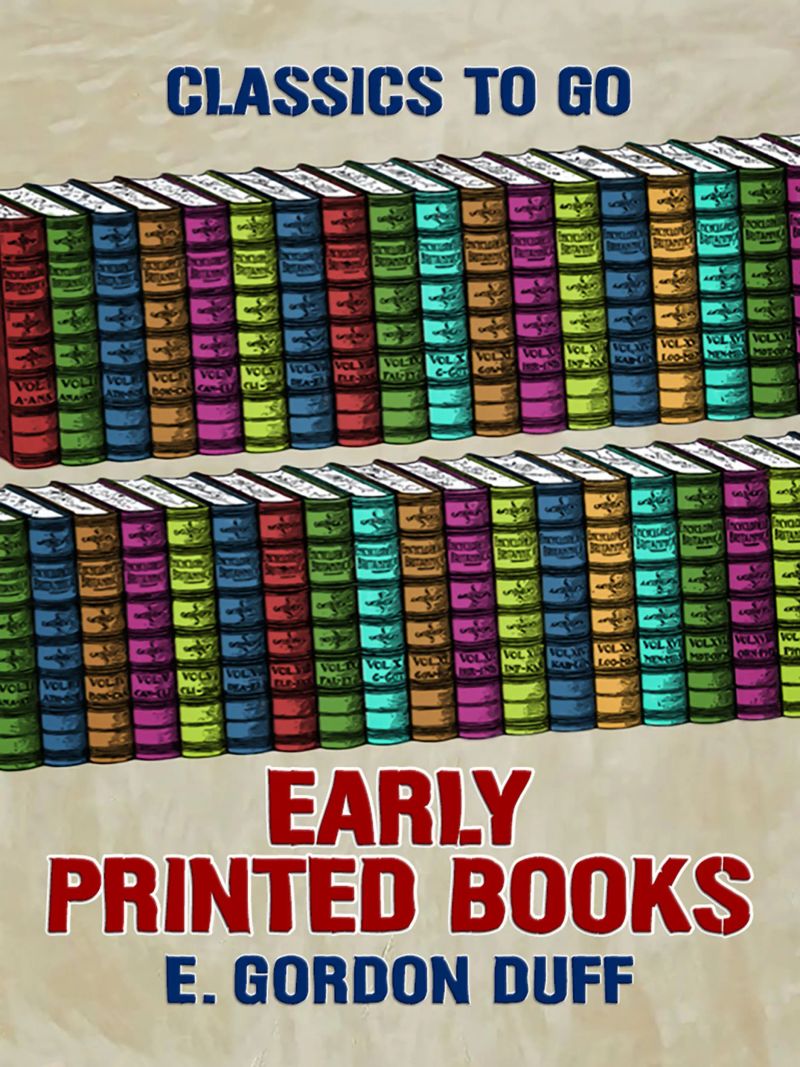


Length5h 54m
About this audiobook
Excerpt: "When we speak of the invention of printing, we mean the invention of the art of multiplying books by means of single types capable of being used again and again in different combinations for the printing of different books. Taking the word printing in its widest sense, it means merely the impression of any image; and the art of impressing or stamping words or pictures seems to have been known from the very earliest times. The handles of Greek amphoræ, the bases of Roman lamps and vases, were often impressed with the maker's name, or other legend, by means of a stamp. This was the basis of the art, and Cicero (De Nat. Deorum, ii. 37) had suggested the combination of single letters into sentences. Quintilian refers to stencil plates as a guide to writing; and stamps with letters cut in relief were in common use amongst the Romans. The need for the invention, however, was not great, and it was never made. The first practical printing, both from blocks and mov[2]able type, was done in China. As early as a.d. 593 the more important texts were printed from engraved wooden plates by the order of the Emperor Wên-ti, and in the eleventh century printing from movable type was introduced by a certain smith named Picheng. The multiplicity of Chinese characters rendered the discovery of movable type of little economical value, and the older system of block printing has found favour even up to the present time. In the same way, Corea and Japan, though both had experimented with movable type, returned to their former custom of block printing."
Audiobook details
Rating★★★★ 3.7 (18)
Includes LibraryThing, Goodreads
GenreHistory
Length5 hrs 54 mins
Narrated byListen with 1,000+ voices
FormateBook with Audio
Publish dateJan 13, 2021
LanguageEnglish
Table of contents
1Preface
9CHAPTER VII.
2Illustrations
10CHAPTER VIII.
3CHAPTER I.
11CHAPTER IX.
4CHAPTER II.
12CHAPTER X.
5CHAPTER III.
13CHAPTER XI.
Show all chaptersShow less
6CHAPTER IV.
14CHAPTER XII.
7CHAPTER V.
15CHAPTER XIII.
8CHAPTER VI.
Series

A Brief History of IntelligenceMax S. Bennett12h 18m4.6 (6.6K)$29 · $0.00

The Gulag Archipelago Volume 3Aleksandr I. Solzhenitsyn21h 56m4.7 (8.9K)$46 · $0.00

Pearl of Great PriceJoseph Smith3h 8m4.7 (7.2K)$1.20 · $0.00

The Happiest Man on EarthEddie Jaku3h 48m4.6 (178K)$7 · $0.00

MotherlandJulia Ioffe17h 52m4.7 (2.5K)$40 · $0.00

Where Cowards Go to DieBenjamin Sledge8h 42m4.7 (351)$20 · $0.00

RevolutionariesSanjeev Sanyal11h 23m4.6 (2.6K)$29 · $0.00

We Crossed a Bridge and It TrembledWendy Pearlman6h4.6 (5.2K)$24 · $0.00

Unbroken Bonds of BattleJohnny Joey Jones8h 31m4.6 (2.6K)$8 · $0.00

The Daughter of AuschwitzTova Friedman, Malcolm Brabant7h 54m4.6 (16.7K)$26 · $0.00

Lily's PromiseLily Ebert, Dov Forman8h 54m4.6 (16.1K)$29 · $0.00

On Democracies and Death CultsDouglas Murray10h 38m4.6 (6.5K)$29 · $0.00

Across the RiverKent Babb11h 40m4.6 (927)$29 · $0.00

Balcony Over Jerusalem: A Middle East Memoir - Israel, Palestine and BeyondJohn Lyons12h 37m4.6 (1.4K)$33 · $0.00

BeyondStephen Walker15h 39m4.6 (3.2K)$33 · $0.00
Kings and PawnsHoward Bryant10h 9m4.6 (678)$29 · $0.00

No EscapeNury Turkel9h 30m4.6 (809)$28 · $0.00

Jubal Stone: U.S. Marshal: Blood Trail To Hell: A Western Adventure NovelCasey Nash3h 42m4.6 (3.2K)$18 · $0.00

Fall and RiseMitchell Zuckoff17h 23m4.6 (9.8K)$40 · $0.00

The SurvivorJosef Lewkowicz, Michael Calvin9h 22m4.6 (2.5K)$29 · $0.00
You may also like

Marie Curie: The Radio-Active SubstancesMarie Curie5h 50m4.3 (288)$1.99 · $0.00

The Principle of RelativityAlbert Einstein, H. Minkowski7h 43m4.4 (1.4K)$1 · $0.00

TubesAndrew Blum7h 21m3.6 (4.9K)$24 · $0.00

Kant's Prolegomena to Any Future MetaphysicsImmanuel Kant4h 21m4.1 (12.1K)$1 · $0.00

A Silent FireShilpa Ravella12h 2m4.0 (1.3K)$23

Neutrino HuntersRay Jayawardhana6h 4m4.1 (955)$17

Manual on Music FormPercy Goetschius5h 14m4.2 (126)$1.99 · $0.00

Become a Power BI Data AnalystVictor Espinoza6h 51m$5 · $0.00

How to Make Money Flipping Fishing Gear - How to Evaluate Rods, Reels, and Accessories, Build Complete Kits, and Resell for ProfitJACK FLIPWELL6h 41m$7.80 · $0.00
Reading Electrical Symbols and Circuit DiagramsMarcus Adeyemi11h 27m$66
Make Slow Queries FastGregory Whitlock7h 44m$5 · $0.00

How to Make Money Flipping Used Construction Machinery - How to Verify Mechanical Condition, Work History, Transport Costs, and Resale PotentialJACK FLIPWELL2h 5m$7.70 · $0.00

An examination of some methods employed in determining the atomic weight of CadmiumJohn Emery Bucher59m$2 · $0.00

How to Make Money Flipping Motorhomes and Travel Trailers - How to Assess Structure and Systems, Plan Profitable Renovations, and Resell SafelyJACK FLIPWELL2h 2m$7.70 · $0.00

AP Macroeconomics Exam Study GuideMarie Peterson9h 52m$10
Shafting, Pulleys, Belting and Rope TransmissionHubert E. Collins3h 15m$1 · $0.00
The Every-Machine Bread Maker CookbookCerys J. Chamberlain11h 10m$11.50
Mobile Hydraulic Fluid PowerRoy Vandermeer10h 53m$45
Structural Civil PE Exam Questions AnsweredGordon Fairweather14h 8m4.8 (10)$80
Value A CoinRichard W. Avery1h 31m3.1 (18)$2.30