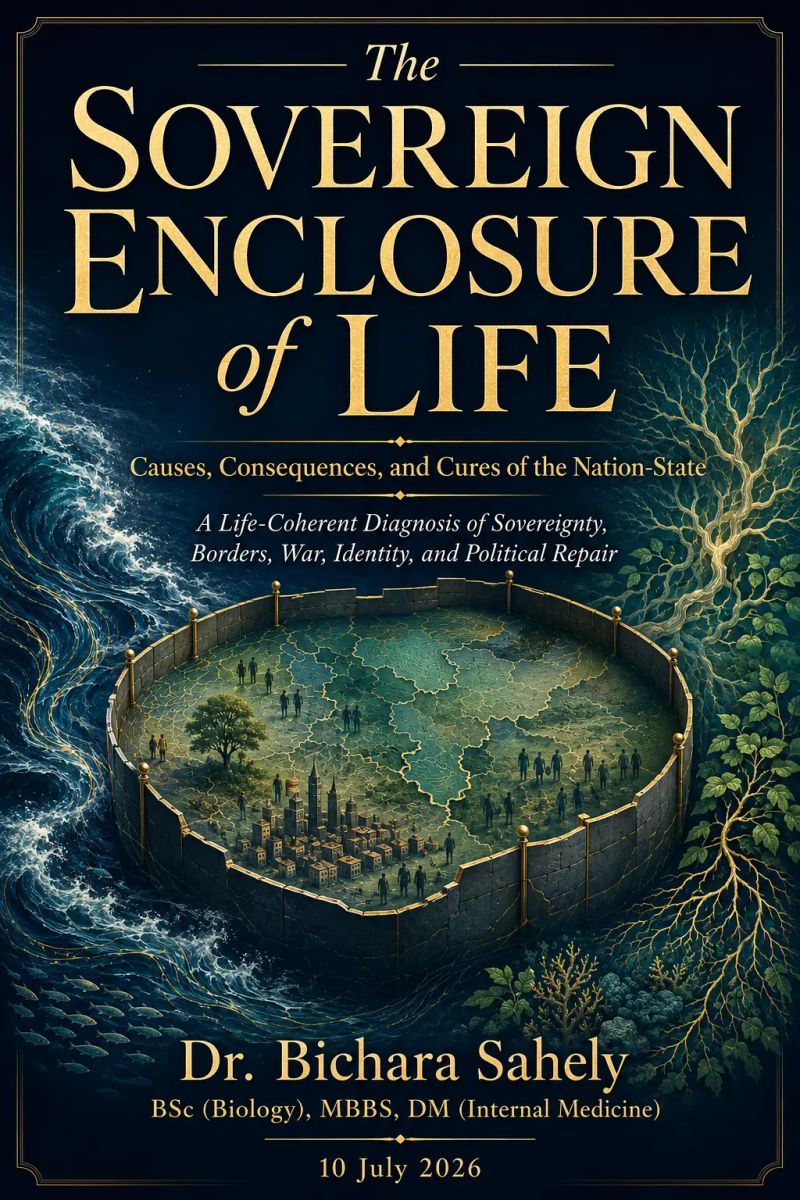
The Sovereign Enclosure of Life

The Sovereign Enclosure of Life

Causes, Consequences, and Cures of the Nation-StateBy Dr. Bichara Sahely
Michael Caine
Listen with Sir Michael Caine™ and 1,000+ voices
Length9h 51m

About this audiobook

The Sovereign Enclosure of Life is a life-coherent diagnosis of the nation-state as a human-made political form that can both protect and harm life. Dr. Bichara Sahely traces how state, nation, territory, sovereignty, law, borders, development, identity, and memory fuse into a sovereign container. The central claim is that the nation-state becomes a life-harm machine when sovereign self-maintenance overrides life-correction. Rather than romanticizing statelessness, the work proposes a constructive alternative: conditional sovereignty, civil commons constitutionalism, bioregional and island-nested governance, plural belonging, demilitarized security, transnational life-accountability, and participatory repair. This listener’s edition presents the argument as a continuous audiobook, with figures, tables, scholarly notes, and references omitted for listening clarity.

Audiobook details

GenrePolitics and Government, Education and Learning
Length9 hrs 51 mins
Narrated byListen with 1,000+ voices
FormateBook with Audio
Publish dateJul 10, 2026
LanguageEnglish

Table of contents

1Chapter 1
1828. Legal Denial and the Confusion of Lawfulness with Right
2Listener's Note
1839. Domestic Jurisdiction and the Abandonment of the Vulnerable
3AI Transparency Note
18410. Denial Through Fragmentation
4Abstract
18511. Denial Through Blame
5Keywords
18612. The Wound That Must Update the Model
Show all chapters
6Executive Summary
18713. Conclusion: From Sovereign Denial to Institutional Learning
7What the Nation-State Gets Right
188Part II has traced the consequences of the nation-state as sovereign enclosure.
8What the Nation-State Gets Wrong
189Part III now turns to ambivalence. The state is not only a life-harm machine. It can also protect public goods, rights, health, education, infrastructure, and the civil commons. To cure the nation-state, we must understand what must be preserved, what must be transformed, and why statelessness alone is not the answer.
9Causes of Sovereign Enclosure
190Part III: Ambivalence
10Consequences of Sovereign Enclosure
191Chapter 13
11Why Statelessness Is Not Enough
192What the State Gets Right: Public Goods, Rights, and Collective Capacity
12The Cures
1931. The Civil Commons as the State’s Best Justification
13The Life-State
1942. Public Health: The State as Collective Body Protector
14Final Claim
1953. Education: The State as Capacity Builder
15Preface: Why Question the Nation-State Now?
1964. Law: The State as Restraint on Private Domination
16Introduction
1975. Infrastructure: The State as Builder of Shared Conditions
17Part I: Causes
1986. Social Protection: The State as Buffer Against Life-Shock
18Chapter 1
1997. Disaster Response: The State as Emergency Coordinator
19The State, the Nation, and Sovereignty: A Necessary Distinction
2008. Environmental Regulation: The State as Guardian Against Ecological Harm
201. The State: Apparatus, Administration, and Coercive Capacity
2019. Democratic Participation: The State as Forum for Collective Decision
212. The Nation: Imagined Peoplehood and Symbolic Belonging
20210. Rights: The State as Guarantor and Threat
223. Territory: Living Geography Converted into Jurisdiction
20311. Redistribution and the Pooling of Risk
234. Sovereignty: Final Authority and Its Temptation
20412. The State as Memory-Keeper
245. Statehood in International Law: The Montevideo Form
20513. What Must Be Preserved
256. The Fusion: How the Nation-State Becomes Sacred
20614. Conclusion: Collective Capacity Without Idolatry
267. The Life-Coherent Reversal
207Part III continues by examining what the state gets wrong when its life-protective capacities are subordinated to self-maintenance without life-correction. The problem is not that the state has power. The problem is that power can become more loyal to itself than to life.
27Chapter 2
208Chapter 14
28War Made the State: Coercion, Taxation, and Protection
209What the State Gets Wrong: Self-Maintenance Without Life-Correction
291. The Protection Problem
2101. The State as Self-Reproducing System
302. War-Making and the Fiscal State
2112. Legitimacy Management
313. The Internal Enemy and State-Making
2123. The Budget as Institutional Autobiography
324. The Sacrificial Citizen
2134. Procedure Without Transformation
335. War as Organizer of Moral Perception
2145. Institutional Loyalty and Moral Drift
346. War, Debt, and the Political Economy of Extraction
2156. The State’s Fear of Precedent
357. The Colonial Extension of the War-State
2167. Centralization and the Loss of Ground-Truth
368. The Security State and Permanent Emergency
2178. The Permanent Expansion of Security
379. From War-State to Life-State
2189. National Reputation Over Truth
3810. Conclusion: The Coercive Memory of the State
21910. Donor, Creditor, and Investor Capture
39Chapter 3
22011. The Illusion of Neutral Administration
40Industrial Society and the Manufacture of National Culture
22112. The Cure: Life-Correction as Institutional Design
411. From Local Worlds to National Populations
22213. Conclusion: The State Must Become Teachable
422. Gellner’s Industrial Nation
223Chapter 15
433. Print, Language, and Imagined Community
224Why Statelessness Is Not the Cure
444. The Standard Language as Political Technology
2251. The Anti-State Temptation
455. The National School as Factory of Belonging
2262. The Vacuum Problem
466. Invented Traditions and the Emotional State
2273. Markets Are Not a Substitute for Public Authority
477. Labor Mobility and the Interchangeable Citizen
2284. The Need for Scale
488. National Time and Historical Selection
2295. Rights Require Institutional Guarantees
499. The Manufacture of “Natural” Borders
2306. Public Goods and the Free-Rider Problem
5010. The Colonial School and the Postcolonial Nation

2317. Violence Without the State
5111. From Manufactured National Culture to Life-Coherent Belonging
2328. Commons Without Romanticism
5212. Conclusion: The Nation as School of Perception
2339. Indigenous Governance and Plural Authority
53Chapter 4
23410. Small States and the Need for Public Capacity
54Seeing Like a State: Legibility, Mapping, and Administrative Simplification
23511. Stateless Peoples and the Right to Political Form
551. The Necessity and Danger of Simplification
23612. The Cure: Post-Sovereign Life-Governance
562. The Census: Population Made Countable
23713. Conclusion: The Cure Is Not Absence, but Right Relationship
573. The Map: Territory Made Governable
238Part IV now turns to that cure directly: conditional sovereignty, civil commons constitutionalism, bioregional nesting, plurinational belonging, demilitarized security, transnational life-accountability, and participatory repair.
584. Property Titles: Relationship Made Ownable
239Part IV: Cures
595. Official Names and the Capture of Identity
240Chapter 16
606. Standard Measures and the Conversion of Life into Units
241Conditional Sovereignty and Life-Ground Accountability
617. Planning Schemes and High-Modernist Confidence
2421. From Final Authority to Conditional Responsibility
628. The Administrative Production of the “Illegal”
2432. Sovereignty as Stewardship, Not Ownership
639. Legibility and Colonial Rule
2443. The Life-Ground Standard
6410. Legibility in the Digital State
2454. The Right of the Wound to Be Heard
6511. From Legibility to Responsiveness
2465. Sovereignty Against Empire, Not Against Accountability
6612. Conclusion: The State’s Eye and the Living World
2476. The State as Trustee of the Civil Commons
67Chapter 5
2487. Conditional Sovereignty and Future Generations
68The Westphalian Myth and the Ideology of Sovereignty
2498. Conditional Sovereignty and the Non-Human World
691. The Mythic Function of Westphalia
2509. Conditional Sovereignty and Plural Peoples
702. Sovereignty as Supreme Authority
25110. Conditional Sovereignty in Small Island and Postcolonial Contexts
713. Internal Sovereignty: The State Above Its People
25211. Institutional Forms of Life-Ground Accountability
724. External Sovereignty: The State Against the World
25312. The Life-Coherent Sovereignty Test
735. Sovereign Equality and Material Inequality
25413. Conclusion: Sovereignty Made Teachable
746. The Sovereign Right to Define Emergency
255Chapter 17
757. The Sovereign Right to Exclude
256Civil Commons Constitutionalism
768. The Sovereign Right to Forget
2571. The Civil Commons as Constitutional Ground
779. Sovereignty and the Ecological Contradiction
2582. Rights Must Be Material, Not Merely Formal
7810. The Postcolonial Ambivalence of Sovereignty
2593. Constitutionalizing Water, Food, Health, and Housing
7911. From Sovereign Impunity to Conditional Sovereignty
2604. Ecological Integrity as Constitutional Condition
8012. Conclusion: The State Does Not Have the Last Word
2615. The Budget as Constitutional Instrument
81Chapter 6
2626. Constitutional Limits on Commodification
82Colonial Borders and the Inheritance of Enclosed Life
2637. Constitutional Protection of Care
831. Empire as State Formation from Outside
2648. Public Knowledge and the Right to Truth
842. The Colonial Border as Life-Cutting Line
2659. Democratic Participation as Life-Ground
853. Uti Possidetis: Stability and Frozen Harm
26610. Constitutional Standing for Future Generations
864. The Plantation as Proto-State
26711. Constitutional Repair for Historical Harm
875. Slavery, Property, and the Legalization of Life-Harm
26812. Constitutional Design Principles
886. Colonial Education and the Manufacture of Inferiority
26913. Conclusion: The Constitution as Life-Covenant
897. Extractive Economies and Dependent Sovereignty
270Chapter 18
908. Colonial Categories and the Production of Governable Peoples
271Bioregional and Island-Nested Governance
919. The Small Island State and the Inherited Vulnerability
2721. The Scale Problem of the Nation-State
9210. The United Nations and Incomplete Decolonization
2732. Watersheds as Political Teachers
9311. Reparations as Political Redesign
2743. Coastlines, Reefs, and the Land-Sea Continuum
9412. From Colonial Enclosure to Life-Coherent Self-Determination
2754. Foodsheds and Nourishment Sovereignty
9513. Conclusion: The Wound Inside the Container
2765. Island-Nested Governance
96Part II turns to the consequences: how the nation-state, once formed, produces bordered moral perception, legalized violence, identity enclosure, ecological abstraction, developmental sacrifice, and institutional denial.
2776. Regional Seas and Shared Marine Responsibility
97Part II: Consequences
2787. Bioregional Democracy
98Chapter 7
2798. Subsidiarity and the Lowest Competent Level
99Bordered Moral Perception
2809. Public Finance for Bioregional Life
1001. The Border as Moral Technology
28110. Law Across Boundaries
1012. Citizenship and the Unequal Distribution of Life-Capacity
28211. Bioregional Knowledge Commons
1023. The Foreigner as Reduced Person
28312. From National Development Plans to Life-System Plans
1034. National Grief and Unequal Mourning
28413. Conclusion: Political Authority Must Learn Its Place
1045. Media, Distance, and the Hierarchy of Attention
285Chapter 19
1056. Bordering the Civil Commons
286Plurinational Belonging and Indigenous Self-Determination
1067. The Migrant as the Truth of the System
2871. The False Innocence of One People
1078. Statelessness and the Violence of Non-Belonging
2882. Plurinationalism as Truthful Political Form
1089. Enemy Production and the Narrowing of Moral Imagination
2893. Indigenous Self-Determination as Life-Correction
10910. Humanitarianism and the Limits of Pity
2904. Land as Relation, Not Merely Territory
11011. The Border Inside the Nation
2915. Free, Prior, and Informed Consent
11112. The Cure: Expanding the Moral Field Without Abolishing Near Care
2926. Language, Memory, and the Survival of Worlds
11213. Conclusion: The Border Is Not the Edge of the Good
2937. Legal Pluralism and Shared Authority
113Chapter 8
2948. Citizenship Without Assimilation
114Legalized Violence and the Sacrificial Citizen
2959. Public Memory in a Plurinational State
1151. The Monopoly of Legitimate Force
29610. Plurinationalism and the Risk of Fragmentation
1162. Killing as Duty
29711. Shared Life-Grounds as the Basis of Unity
1173. The Soldier as Sacrificial Citizen
29812. Institutional Forms of Plurinational Belonging
1184. Civilian Death and the Language of Collateral Damage
29913. Conclusion: Unity Without Erasure
1195. Policing and Domestic Sovereign Violence
300Chapter 20
1206. Prison as Civic Exile
301Demilitarized Security and Peace Infrastructure
1217. Border Violence and Death by Policy
3021. Security as Life-Protection
1228. Emergency Powers and the Suspension of Rights
3032. Militarized Security and Its Self-Fulfilling Logic
1239. The Security Budget and the Starved Commons
3043. The Enemy as Administrative Necessity
12410. The Nation as Emotional Cover for Violence
3054. Peace as Infrastructure, Not Sentiment
12511. International Criminal Law and the Limits of Accountability
3065. Public Health as Security
12612. From Legalized Violence to Life-Protective Authority
3076. Food and Water as Peace Infrastructure
12713. Conclusion: Sovereignty Must Not Sanctify Harm
3087. Housing, Land, and the Security of Home
128Chapter 9
3098. Restorative Justice and the Repair of Harm
129Identity Enclosure and the Production of Internal Others
3109. Trauma Healing as Security Policy
1301. The Nation as Authorized Story
31110. Education for Peaceful Citizenship
1312. The Majority as the Nation
31211. Demilitarizing the Budget
1323. Assimilation as Conditional Recognition
31312. Regional Peace and Shared Security
1334. Indigenous Peoples and the Prior Political Reality
31413. Conclusion: Security Must Serve Life, Not Sovereignty
1345. Migrants and the Anxiety of National Purity
315Chapter 21
1356. The Dissident as Internal Enemy
316Transnational Institutions for Transboundary Harms
1367. Racialized Belonging and the Marked Body
3171. The Limits of Sovereign Competition
1378. Religion and the Sacred Nation
3182. Climate as the Paradigm Transboundary Harm
1389. Gender, Reproduction, and the National Body
3193. Oceans as Shared Civil Commons
13910. Language Minorities and the Loss of Worlds
3204. Pandemics and the Public Health Commons
14011. The Internal Other as Sacrifice Zone
3215. Migration Beyond Border Management
14112. Plural Belonging as Cure
3226. Financial Extraction and Debt Across Borders
14213. Conclusion: The Nation Must Be Capable of Learning from Its Others
3237. Arms Systems and the Internationalization of Violence
143Chapter 10
3248. Digital Infrastructures and Algorithmic Sovereignty
144Ecological Abstraction: When Borders Cut Through Living Systems
3259. Supply Chains and Hidden Life-Harms
1451. Territory Is Not Ecosystem
32610. Transnational Institutions Must Be Democratic
1462. The Border as Ecological Falsehood
32711. Regionalism as Intermediate Cure
1473. Resource Thinking and the Reduction of the Living World
32812. Principles for Transnational Life-Accountability
1484. Development and the Sacrifice of Place
32913. Conclusion: The Border Cannot Contain Responsibility
1495. National Accounting and the Invisibility of Depletion
330Chapter 22
1506. Climate Change and the Collapse of Sovereign Imagination
331Participatory Repair and the End of Sovereign Impunity
1517. Small Islands and the Violence of Externalized Harm
3321. Repair Is Not the Same as Compensation
1528. The Ocean Against the State
3332. The Harmed as Knowledge-Bearers
1539. Food Systems and the Sovereign Illusion
3343. Truth Before Reconciliation
15410. Ecological Knowledge and the Silencing of Place
3354. Reparations as Capacity Restoration
15511. Future Generations and the Time-Border
3365. Ecological Repair and More-Than-Human Standing
15612. From Ecological Abstraction to Bioregional Responsibility
3376. Land Return, Land Reform, and the Repair of Place
15713. Conclusion: The Earth Does Not Recognize the Flag
3387. Participatory Budgeting as Repair
158Chapter 11
3398. Institutional Guarantees of Non-Repetition
159Development, Debt, and Sacrifice Zones
3409. Repair Beyond the Nation
1601. Development as Secular Salvation
34110. The Role of Memory, Ritual, and Public Symbol
1612. The Sacrifice Zone
34211. Repair and Forgiveness
1623. Infrastructure and the Politics of Visibility
34312. Repair as Political Redesign
1634. Debt as Future Extraction
34413. Conclusion: The Wound as Constituent Power
1645. Austerity and the Starving of the Civil Commons
345Part IV has developed the cures for sovereign enclosure: conditional sovereignty, civil commons constitutionalism, bioregional and island-nested governance, plurinational belonging, demilitarized security, transnational life-accountability, and participatory repair.
1656. Competitiveness and the Race to the Bottom
346Conclusion
1667. Tourism Enclaves and the Commodification of Place
347From Sovereign Enclosure to Life-Coherent Political Form
1678. Extractive Development and Ecological Debt
3481. What the Diagnosis Has Shown
1689. Displacement and the Loss of Home
349Part I traced the causes of the nation-state.
16910. Public-Private Development and the Capture of the State
350Part II traced the consequences.
17011. Development as Depoliticization
351Part III examined ambivalence.
17112. Life-Coherent Development as Capacity Restoration
352Part IV developed that cure.
17213. Conclusion: Progress Must Be Judged by the Living
3532. The Life-Coherence Test
173Chapter 12
3543. What Must Be Preserved
174Institutional Denial: When Sovereignty Blocks Learning
3554. What Must Be Dismantled
1751. The Difference Between Error and Denial
3565. The Special Lesson of Small Islands
1762. Sovereignty as Epistemic Shield
3576. From Nation-State to Life-State
1773. National Interest as Moral Closure
3587. From Sovereign Enclosure to Life-Coherent Political Form
1784. Security as the Silencing of Wounds
3598. The Final Reversal
1795. Development as Deferred Accountability
3609. Closing Statement
1806. Procedure as Denial
361End of Listener's Edition
1817. Statistical Denial and the Loss of the Person

You may also like

Sermons by the late Rev. Richard de Courcy
Sermons by the late Rev. Richard de CourcyRichard De Courcy8h 19m$2 · $0.00
There's A Spiritual Solution to Every Problem
There's A Spiritual Solution to Every ProblemWayne W. Dyer2h 36m$18 · $0.00
How We Can Build a Better World: The Worldshift Manual
How We Can Build a Better World: The Worldshift ManualErvin Laszlo3h 19m$15
Moving the Mountain
Moving the MountainCharlotte Perkins Gilman5h 13m$11 · $0.00
Reclaiming Patriotism in an Age of Extremes
Reclaiming Patriotism in an Age of ExtremesSteven B. Smith6h 53m$17 · $0.00
The Message and the Man
The Message and the ManJ. Dodd Jackson5h 54m$2 · $0.00

How to Stop Complaining
How to Stop ComplainingSteve Pavlina18m$4 · $0.00

Toxic Charity
Toxic CharityRobert D. Lupton5h 7m$24 · $0.00
Feel Good - Feel Your Heart
Feel Good - Feel Your HeartUnknown Author1h 1m$7 · $0.00
Courage for Today
Courage for TodayAnn White12h 55m$10 · $0.00
The Law of Success in Sixteen Lessons
The Law of Success in Sixteen LessonsNapoleon Hill1h 31m$2 · $0.00
HONORING OBAMA
HONORING OBAMAU.S. Government7h 36m$2 · $0.00
In Tune with the Infinite; or, Fullness of Peace, Power, and Plenty
In Tune with the Infinite; or, Fullness of Peace, Power, and PlentyRalph Waldo Trine5h 42m$2 · $0.00
Education as Service
Education as ServiceJ. Krishnamurti8m$2 · $0.00
An Effort to Understand
An Effort to UnderstandDavid Murray5h 21m$20 · $0.00
Move
MoveRosabeth Moss Kanter11h 13m$20
Don't Miss Your Life
Don't Miss Your LifeAaron Tredway4h 29m$10 · $0.00
It's Worth It
It's Worth ItMasey McLain2h 13m$10 · $0.00
365 Daily Prayers and Declarations for Men
365 Daily Prayers and Declarations for MenBroadStreet Publishing Group LLC7h 23m$10 · $0.00
The Secrets of Self Management
The Secrets of Self ManagementBrahma Khumaris1h 13m$4 · $0.00