
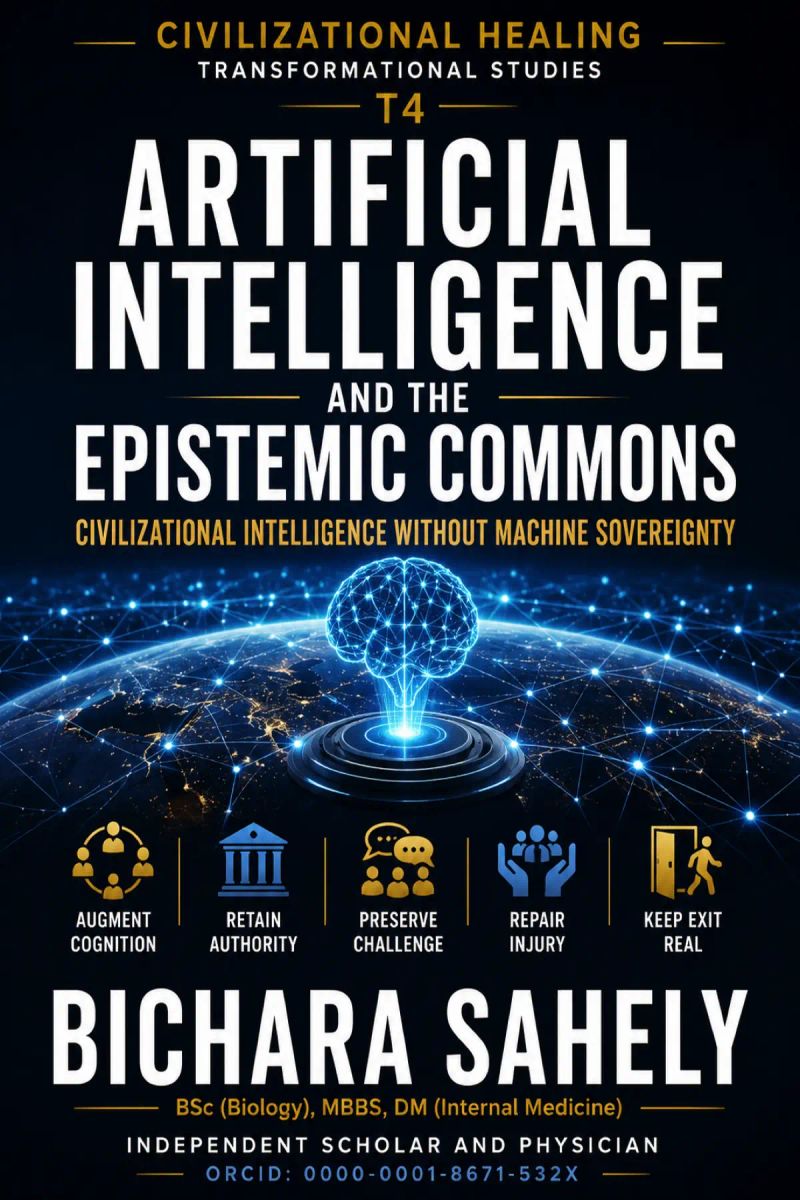
Artificial Intelligence and the Epistemic Commons
Civilizational Intelligence Without Machine SovereigntyBy Dr Bichara Sahely

Length3h 11m
About this audiobook
How can a civilization think with artificial intelligence without being thought for by it? Artificial Intelligence and the Epistemic Commons examines how AI can enlarge collective intelligence without becoming sovereign over what societies know, value, authorize, or do. T4 shifts attention from AI models alone to the wider ecology of data, knowledge, compute, infrastructure, institutions, authority, affected persons, and remedies. It develops a constitutional framework for governed epistemic commons, contestable synthesis, meaningful institutional control, persistent responsibility, public counter-capacity, usable plurality, epistemic independence, material accountability, and repair. Its governing principle: augment cognition; retain authority—AI may participate in civilizational intelligence, but must remain corrigible within it.
Audiobook details
GenreEducation and Learning, Technology
Length3 hrs 11 mins
Narrated byListen with 1,000+ voices
FormateBook with Audio
Publish dateFeb 22, 2020
LanguageEnglish
Table of contents
1Introduction
2Listener’s Edition
3Series relationship
4Listening roadmap
51. Introduction — How Can a Civilization Think with AI Without Being Thought For?
Show all chaptersShow less
62. From Political Ethics to Constitutional Epistemology
72.1 Analytical strategy
82.2 Final novelty audit
92.3 Normative restraint
103. The Artificial-Intelligence Hinge
113.1 System intelligence
123.2 Civilizational intelligence: Listener's Synthesis — Figure
133.3 Neither human romanticism nor machine exceptionalism
144. The Augmentation–Sovereignty Dilemma
15Listener's Synthesis — Figure
164.1 Tool, intermediary, infrastructure
174.2 The infrastructure threshold
184.3 Epistemic quality is not epistemic legitimacy
195. The AI-Mediated Epistemic Configuration
205.1 The epistemic commons
215.2 The civilizational epistemic loop
22Listener's Synthesis — Figure
23Listener's Synthesis — Figure
246. Governed Openness: FAIR, CARE, and Nested Authority
256.1 FAIR is not unrestricted access
266.2 CARE and Indigenous data sovereignty
276.3 The hard conflict
287. Capability Does Not Confer Authority
29Listener's Synthesis — AI Functions, Warrants, Authority, and Constitutional Dangers
307.1 Responsibility Non-Transfer after delegation
317.2 Institutional-warrant laundering
328. Beyond the Human in the Loop
338.1 Epistemic oversight and operational control
348.2 Control under capability asymmetry
358.3 Human–AI combinations are empirical questions
369. Contestable Synthesis
379.1 Beyond explanation
389.2 The burden of contestability
399.3 Public memory
4010. Recognition Power, Personhood, and Dual Error
4110.1 The Person–Model Principle
4210.2 Dual-Error Governance
4311. AI, Public Reason, and Democratic Deliberation
4411.1 Deliberative augmentation and substitution
4511.2 The Habermas Machine
4611.3 Persuasion and synthetic consensus
4712. Usable Plurality, Public Counter-Capacity, and Epistemic Independence
4812.1 Public counter-capacity: Listener's Synthesis — Public Counter-Capacity and Usable Plurality
4912.2 Formal and epistemic independence
5013. The Material Political Economy of Artificial Intelligence

Preserving Life, Transforming Power in GazaDr Bichara Sahely1h 42mFree

Preserving Life, Transforming PowerDr. Bichara Sahely1h 4mFree

Putting the Missing Bridge to WorkDr. Bichara Sahely2h 12mFree
The Missing BridgeDr. Bichara Sahely1h 5mFree
Transformational Laboratories ProtocolDr. Bichara Sahely2h 33mFree

Conflict, Repair, and Non-DominationDr Bichara Sahely2h 21mFree
Institutions of Reflexive TransformationDr Bichara Sahely1h 51mFree

The Politics of Civilizational HealingDr. Bichara Sahely2h 13mFree
The Missing Grammar of Modern CivilizationDr. Bichara Sahely2h 8mFree
Civilizational Healing Research ArchitectureDr. Bichara Sahely1h 24mFree

How Does a Civilization Learn to Heal?Dr. Bichara Sahely1h 16mFree
From Competent Physicians to Healing SocietiesDr. Bichara Sahely2h 20mFree

Competence Is Necessary, but Not SufficientDr. Bichara Sahely1h 15mFree

Life-Grounding CanMEDSDr. Bichara Sahely1h 13mFree
The Dynamic Architecture of ViabilityDr Bichara Sahely2h 1mFree
Completing the Life-Value Onto-Axiology ProgramDr. Bichara Sahely1h 9m5.0 (1)Free
BEYOND GLOBAL JUSTICEDr. Bichara Sahely1h 25mFree

The Sweetness That Consumed the WorldBichara Sahely16h 14mFree
THE SOVEREIGNTY OF CREDITDr. Bichara Sahely3h 56mFree
A Brief History of IntelligenceMax S. Bennett12h 18m4.6 (6.6K)$29 · $0.00

HomeschooledStefan Merrill Block7h 10m3.6 (18.5K)$28 · $0.00
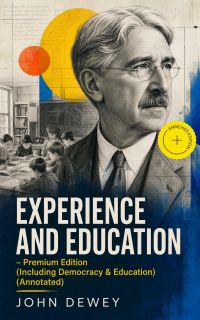
EXPERIENCE AND EDUCATION – Premium Edition (Including Democracy & Education) (Annotated)John Dewey19h 17m4.6 (1K)$2 · $0.00

WitnessAriel Burger8h 1m4.6 (1.3K)$20 · $0.00

EducationEllen G. White9h 41m4.6 (1.5K)$2 · $0.00

Parents and Children (Annotated)Charlotte Mason9h 23m4.6 (988)$2 · $0.00

Children Under FireJohn Woodrow Cox10h 17m4.5 (1.6K)$29 · $0.00

The State Must ProvideAdam Harris7h 15m4.5 (775)$24 · $0.00

The Call of the Wild and FreeAinsley Arment9h 7m4.4 (21.2K)$29 · $0.00
The Freelance WayRobert Vlach19h 48m4.5 (528)$40 · $0.00
Race to the BottomLuke Rosiak9h 20m4.5 (600)$29 · $0.00

They Came for the SchoolsMike Hixenbaugh9h 5m4.5 (2.6K)$8 · $0.00

Find Me UnafraidKennedy Odede, Jessica Posner11h 11m4.5 (2.7K)$29 · $0.00

Asking for ItKate Harding8h 55m4.4 (5.3K)$20 · $0.00
Defining Moments in Black HistoryDick Gregory7h 37m4.4 (6K)$26 · $0.00

The Emerald Tablets of Thoth the AtlanteanMaurice Doreal3h 4m4.4 (8.8K)$6 · $0.00

Learning AmericaLuma Mufleh6h 37m4.4 (564)$24 · $0.00
Math-ishJo Boaler7h 21m4.4 (588)$24 · $0.00

Daddy-Long-LegsJean Webster12h 18m4.2 (91K)$1.99 · $0.00
It Worked For MeColin Powell7h 42m4.3 (9.8K)$26 · $0.00

The Honey BusMeredith May9h 31m4.4 (16.6K)$25 · $0.00
Collected Writings of Nikola TeslaThomas Commerford Martin, Nikola Tesla19h 42m4.4 (2.8K)$1.99 · $0.00

Operation PedestalMax Hastings12h 29m4.4 (5.2K)$29 · $0.00

When the Heavens Went on SaleAshlee Vance18h 20m4.4 (3K)$40 · $0.00

Everybody Has a Podcast (Except You)Justin McElroy, Travis McElroy, Griffin McElroy5h 9m4.3 (2.3K)$24 · $0.00

Hands of TimeRebecca Struthers8h 8m4.4 (1.3K)$26 · $0.00
Never Lost AgainBill Kilday10h 1m4.4 (805)$29 · $0.00
How the Internet HappenedBrian McCullough13h 28m4.3 (2.7K)$23 · $0.00
Collected Writings of Nikola TeslaNikola Tesla, Thomas Commerford Martin21h 50m4.3 (1.7K)$1 · $0.00
Just AspireAjai Chowdhry9h 13m4.4 (260)$29 · $0.00

The Little Book of AliensAdam Frank8h 20m4.3 (1.3K)$26 · $0.00
The inventions, researches and writings of Nikola Tesla (Annotated)Thomas Commerford Martin16h 59m4.3 (1.3K)$2 · $0.00

KargilV.P. Malik15h 18m4.3 (2K)$24 · $0.00
Experiments with Alternating CurrentsNikola Tesla9h 16m4.3 (874)$1.99 · $0.00

Fire on the HorizonTom Shroder, John Konrad8h 23m4.3 (858)$26 · $0.00

The Smell of Kerosene (Annotated)National Aeronautics and Space Administration, Donald L. Mallick, Peter W. Merlin11h 32m4.3 (523)$2 · $0.00

The Boy Who Harnessed the WindWilliam Kamkwamba, Bryan Mealer10h 5m4.2 (78.9K)$29 · $0.00

Across the Airless WildsEarl Swift10h 8m4.3 (1.3K)$29 · $0.00
Console WarsBlake J. Harris20h 41m4.2 (13.7K)$46 · $0.00

Improvised Munitions HandbookU.S. Department of Defense4h 49m4.3 (1.6K)$0.99 · $0.00
You may also like

Big DataViktor Mayer-Schönberger, Kenneth Cukier9h 41m4.0 (27.3K)$29 · $0.00
Making SenseSam Harris22h 27m4.1 (3K)$46 · $0.00
The Technological SocietyJacques Ellul21h 21m4.3 (2.3K)$30
The NumeratiStephen Baker7h 55m3.6 (2K)$17 · $0.00

We Have Been HarmonizedKai Strittmatter10h 29m4.3 (4.3K)$29 · $0.00
The MANIACBenjamín Labatut9h 51m4.3 (32.8K)$26 · $0.00

AI ValleyGary Rivlin11h 18m4.1 (452)$29 · $0.00
Some RemarksNeal Stephenson11h 36m3.9 (2.4K)$29 · $0.00
Mother of InventionKatrine Marçal6h 54m$17 · $0.00
No More WorkJames Livingston3h 16m3.7 (449)$15
Ai Revolution And Its Unstoppable Global ImpactEveraldo Santos Silva1h 27m$7 · $0.00
Masters or Slaves?Jeremy Peckham6h 44m4.2 (23)$23

The Information TradeAlexis Wichowski8h 56m3.9 (156)$29 · $0.00
Pay AttentionDavid Pakman9h 27m$29 · $0.00
BitwiseDavid Auerbach9h 54m3.8 (431)$23 · $0.00
ARTIFICIAL INTELLIGENCE AND THE GLOBAL SOUTHGATHU KAMAU2h 1m4.8 (54)$4.99 · $0.00
I Am Not a RobotJoanna Stern8h 2m4.0 (403)$28 · $0.00

What is AI?Will Douglas Heaven1h 17m4.7 (42) · 2916Free
ReplacedDisrupt.co.nz4h 4m$1.20 · $0.00
The True Creator of EverythingMiguel Nicolelis14h 41m3.9 (314)$23 · $0.00