
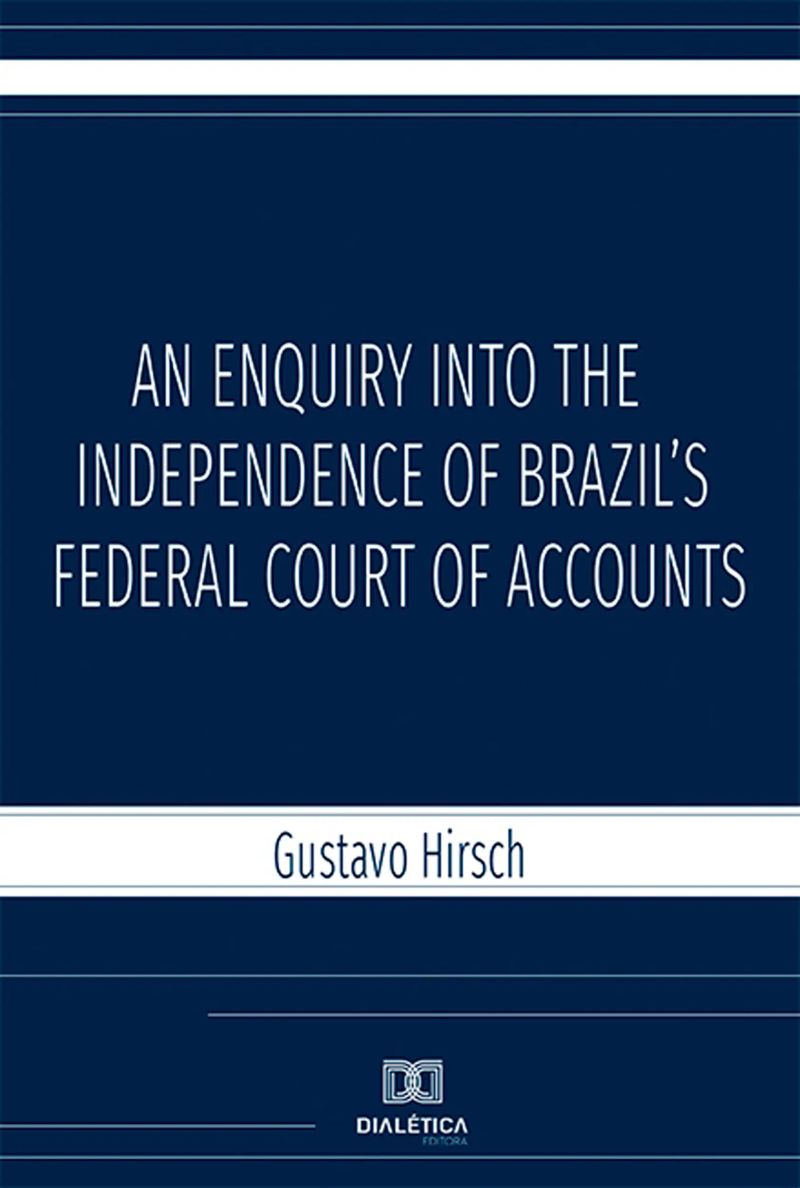
An enquiry into the independence of Brazil's federal court of accounts
By Gustavo Hirsch


Length1h 16m
About this audiobook
The Federal Court of Accounts (TCU) is Brazil's "leading government audit institution"; it is the only one dealing exclusively with auditing. The TCU is part of the federal legislative branch, which the TCU assists in its constitutional attribution of overseeing the government finances (Article 71 of the Federal Constitution). Grosso modo, its structure includes, on one side, a professional corps with 1,576 auditors and, on the other, a college of nine judges called ministers that decide on cases. These ministers are chosen by Congress (six) and by the president (three, upon confirmation by the Senate). The requirements for becoming a member are rather loose: the appointees need only be between 35 and 65 years of age, have good reputation and knowledge on a number of topics, and ten years of work experience in a relevant area (Art. 73, §1). Observers say they usually are at the height or the end of their political career when chosen to join the TCU. Further, nominations are highly politicised. With all that, the connections to politics that most of its ministers have – five in the current composition have run for office – seem to be a perfect formula for partisan dominance of the Tribunal. However, the TCU has shown relative independence from daily politics. The book attempts at demonstrating how.
Audiobook details
GenrePolitics and Government
Length1 hr 16 mins
Narrated byListen with 1,000+ voices
FormateBook with Audio
Publish dateJun 2, 2021
LanguagePortuguese
Table of contents
1Introduction
2INTRODUCTION
3RESEARCH QUESTION AND PUZZLE
4SUGGESTION THAT THE TCU IS RELATIVELY INDEPENDENT FROM POLITICAL PARTIES
5RESEARCH DESIGN
Show all chaptersShow less
6LITERATURE REVIEW AND THE CONTRIBUTION OF THIS WORK
7CONCEPTUALISATION OF INDEPENDENCE
8THE CASE OF THE TCU
9THE 1988 CONSTITUTION
10MERITOCRACY
11POLICY OF HIGH WAGES
12THE MANDATE
13MODE OF SELECTION
14THE BRAZILIAN MACRO-POLITICS
15INCREMENTAL INSTITUTIONAL CHANGE
16INTERNAL MANAGERIAL TRANSFORMATIONS
17INCREASE IN THE FEDERAL SPENDING
18MEDIA EXPOSURE AND THE LAVA-JATO
19INTER-INSTITUTIONAL EXCHANGE
20CONCLUSIONS
21EXOGENOUS VARIABLES
22ENDOGENOUS VARIABLES

Mitologia SoviéticaThiago Braga8h 44m4.8 (539)$9 · $0.00

Dos Delitos E Das PenasCesare Beccaria E Alexandre Zanca Bacich4h 49m4.5 (1.3K)$7 · $0.00

Sobre a liberdadeStuart Mill8h 7m4.3 (4.9K)$8 · $0.00

A arte da guerraNicolau Maquiavel9h 47m4.1 (16.4K)$12 · $0.00

Como Hitler Seduziu A AlemanhaDireita Conservadora Cristã12h 43m4.8 (10)$5 · $0.00

Brasil: mito fundador e sociedade autoritáriaMarilena Chaui4h 10m3.7 (40)$3 · $0.00

Conversas sobre política para todos os temposRubem Alves3h 37m$4 · $0.00

O Problema Do Ser, Do Destino E Da Dor (versão Ampliada)Léon Denis14h 41m4.7 (2.9K)$5 · $0.00

Irmãs do inhamebell hooks7h 38m4.7 (3.6K)$9 · $0.00

Os Tentáculos Malignos Da Esquerda BrasileiraO Historiador2h 36m4.7 (1K)$6 · $0.00

O Que Todo Revolucionário Deve Saber Sobre A RepressãoVictor Serge - Tradução Thaelman Carlos4h 31m4.7 (297)$7 · $0.00

Atrás Da MuralhaSol Soares3h 3m4.6 (2.5K)$5 · $0.00

Criminologia - Teoria e PráticaPaulo Sumariva13h 35m4.6 (364)$20 · $0.00

Por que o Brasil é um país atrasado?Luiz Philippe de Orleans e Bragança9h 39m4.5 (1.5K)$6 · $0.00

O diálogo possívelFrancisco Bosco12h 49m4.4 (1.4K)$17 · $0.00

A Alma Do Homem Sob O Socialismo.Professor Doutor Fernando Antonio Dal Piero3h 39m4.4 (566)$7 · $0.00

Islã, Autoritarismo e SubdesenvolvimentoAhmet T. Kuru14h 35m4.4 (557)$19 · $0.00

A Arte Da GuerraJadir Vieira5h 34m4.2 (13K)$8 · $0.00

A hora dos predadores (do mesmo autor de Os engenheiros do caos e Mago do Kremlin)Giuliano da Empoli3h 26m4.2 (6.8K)$8 · $0.00

Biografia do abismoFelipe Nunes, Thomas Traumann5h 14m4.2 (703)$11 · $0.00
You may also like
Os Tentáculos Malignos Da Esquerda BrasileiraO Historiador2h 36m4.7 (1K)$6 · $0.00

Objetos trágicos, objetos estéticosFriedrich Schiller7h 18m$5.99 · $0.00
A fraude como elemento essencial para a configuração da tipicidade objetiva dos crimes contra a ordem tributária praticados por particularesLuciano Cirino dos Santos22h 30m$21 · $0.00

Foro por Prerrogativa de Função em ações penais no STFJoão Marcello Costa6h 3m$18 · $0.00
2026 Repetirá 2014? Uma Análise Comparativa dos Cenários Político-Eleitorais BrasileirosMarcos Freitas Pereira2h$11 · $0.00

Incentivos legais a programas de compliance anticorrupção efetivosPatricie Barricelli9h 8m$15 · $0.00

Contratação de pessoal pelas OSs e OSCIPsJuliana Bortoncello Ferreira5h 26m$12 · $0.00

Populismo Penal Legislativo no BrasilMariana Azevedo Couto Vidal5h 7m$11 · $0.00

A prisão após a segunda instância no Supremo Tribunal FederalMarcelo José do Monte5h 16m$12 · $0.00
Impeachment da Presidenta Dilma RousseffElba Silveira Chagas Silva4h 38m$20 · $0.00

Lei De 07 De Novembro De 1831: "uma Lei Para Inglês Ver"Murillo Henrique Girotti Chagas3h 24m$6 · $0.00

Não Me Faça Rir, Fala Sério!Marco Antonio Heredia Viveros14h 1m$5 · $0.00

A Teoria do Domínio do Fato de Claus Roxin e sua aplicabilidade ao Direito Penal EconômicoThiago Rodrigues de Faria5h 3m$8 · $0.00

Lei De 07 De Novembro De 1831: "uma Lei Para Inglês Ver"Murillo Henrique Girotti Chagas3h 27m$7 · $0.00

Stf, Paulo Coelho E A Biografia De Roberto CarlosSelmo Machado Pereira2h 55m$6 · $0.00

O MensalãoNemuel Muniz Da Silva4h 59m$7 · $0.00

O Dia Do GolpeClério Júnior3h 49m$5 · $0.00

A História Do Videogame No BrasilProfessor Ricardo De Souza51m$5 · $0.00
ImpeachmentAugusto César Nunes Costa1h 18m$5 · $0.00
Votando E Sendo VotadoFrancisco Tito Do Nascimento49m$6 · $0.00