
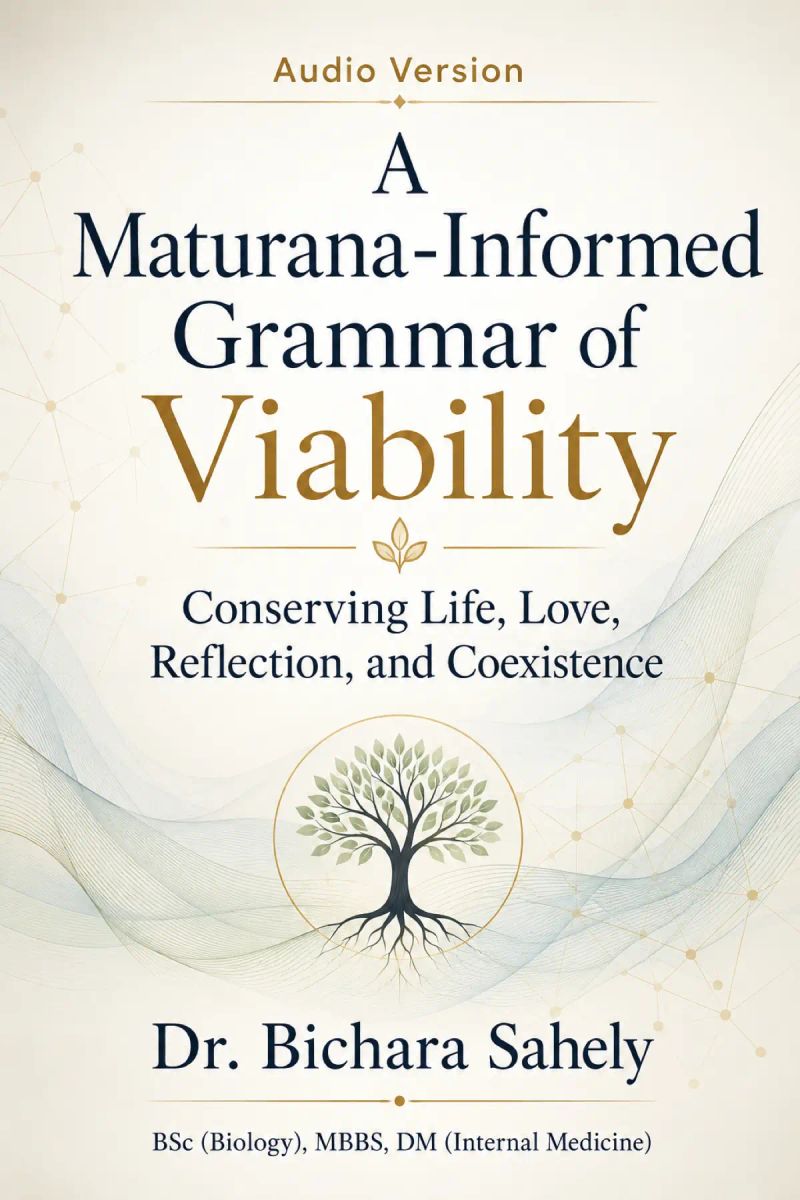
A Maturana-Informed Grammar of Viability
Conserving Life, Love, Reflection, and CoexistenceBy Dr. Bichara Sahely

Length4h 26m
About this audiobook
A Maturana-Informed Grammar of Viability develops a slow, reflective way of asking what kind of world we conserve through our living. Drawing from Humberto Maturana’s biology of love, it moves from living, structural coupling, emotioning, languaging, conversation, and culture toward a practical grammar for seeing whether families, institutions, economies, and civilizations conserve life or negate it. At its center is one question: What manner of living is being conserved here, and does it keep life livable?
Audiobook details
GenreHealth and Wellness, Philosophy
Length4 hrs 26 mins
Narrated byListen with 1,000+ voices
FormateBook with Audio
Publish dateMay 21, 2026
LanguageEnglish
Table of contents
1Chapter 1
2A Guide for Listeners
3Introduction: The Question of the Manner of Living
4Methodological Orientation: Distinctions, Domains, and Explanations
5The Guiding Inquiry
Show all chaptersShow less
6Living: Conservation-Through-Change
7Living and the Medium
8Living and the Manner of Living
9The First Derivation
10Medium and Niche: The Relational Place of Living
11The Organism–Niche Relation as Manner of Living
12Medium, Niche, and the Human Child
13Diagnostic Consequence
14Structural Coupling: The History of Congruent Change
15Structural Coupling and Non-Instruction
16Structural Coupling and the Human Relational Medium
17Structural Coupling and the Possibility of Transformation
18Diagnostic Consequence
19Behavior: The Relational Flow of Organism and Medium
20Behavior and the Observer
21Behavior and Domain Confusion
22Behavior and Possible Doings
23Diagnostic Consequence
24Emotioning: The Relational Domain of Possible Behavior
25Emotioning and the Character of Action
26Emotioning and Reasoning
27Emotioning and Culture
28Emotioning and Life-Coherence
29Diagnostic Consequence
30Languaging: Recursive Coordination of Doings
31Languaging and Consensuality
32Languaging and Emotioning
33Languaging as Expansion of Possible Living
34Languaging and Symbolic Worlds
35Diagnostic Consequence
36Conversation: The Human Medium of World-Conservation
37Conversation as Braided Languaging and Emotioning
38Conversation and the Conservation of Worlds
39Conversation and Institutional Life
40Conversation and Life-Coherence
41Diagnostic Consequence
42Culture: The Conserved Network of Conversations
43Culture and Conserved Emotioning
44Culture as Medium
45Cultural Change
46Culture and the Child
47Culture and Life-Incoherence
48Diagnostic Consequence
49Love: The Relational Domain of Legitimate Coexistence
50Love Is Not Blind Acceptance

Preserving Life, Transforming Power in GazaDr Bichara Sahely1h 42mFree

Preserving Life, Transforming PowerDr. Bichara Sahely1h 4mFree

Putting the Missing Bridge to WorkDr. Bichara Sahely2h 12mFree

The Missing BridgeDr. Bichara Sahely1h 5mFree

Transformational Laboratories ProtocolDr. Bichara Sahely2h 33mFree

Artificial Intelligence and the Epistemic CommonsDr Bichara Sahely3h 12mFree

Conflict, Repair, and Non-DominationDr Bichara Sahely2h 21mFree

Institutions of Reflexive TransformationDr Bichara Sahely1h 51mFree

The Politics of Civilizational HealingDr. Bichara Sahely2h 13mFree

The Missing Grammar of Modern CivilizationDr. Bichara Sahely2h 8mFree

Civilizational Healing Research ArchitectureDr. Bichara Sahely1h 24mFree
How Does a Civilization Learn to Heal?Dr. Bichara Sahely1h 16mFree

From Competent Physicians to Healing SocietiesDr. Bichara Sahely2h 20mFree

Competence Is Necessary, but Not SufficientDr. Bichara Sahely1h 15mFree

Life-Grounding CanMEDSDr. Bichara Sahely1h 13mFree

The Dynamic Architecture of ViabilityDr Bichara Sahely2h 1mFree

Completing the Life-Value Onto-Axiology ProgramDr. Bichara Sahely1h 9m5.0 (1)Free

BEYOND GLOBAL JUSTICEDr. Bichara Sahely1h 25mFree

The Sweetness That Consumed the WorldBichara Sahely16h 14mFree

THE SOVEREIGNTY OF CREDITDr. Bichara Sahely3h 56mFree

Consent Laid BareChanel Contos7h 11m4.5 (1.7K)$24 · $0.00

How to Make Disease DisappearRangan Chatterjee5h 26m4.5 (3.5K)$24 · $0.00

The Complete Herbal (Annotated)Nicholas Culpeper29h 8m4.5 (1.4K)$2 · $0.00

A Plague Upon Our HouseScott W. Atlas MD10h 37m4.5 (3.4K)$20 · $0.00

The Cancer CodeDr. Jason Fung10h 48m4.5 (5.3K)$29 · $0.00

The Gift of TherapyIrvin Yalom7h 39m4.5 (38.8K)$26 · $0.00

EarlySarah DiGregorio9h 47m4.5 (1.3K)$29 · $0.00

Bottle of LiesKatherine Eban14h 25m4.4 (12K)$33 · $0.00

The 36-Hour DayNancy L. Mace, Peter V. Rabins17h 13m4.4 (9.2K)$28 · $0.00

FlooredSara Reardon10h 36m4.5 (1K)$29 · $0.00

Radical RemissionKelly A. Turner9h 26m4.4 (8.1K)$29 · $0.00

The Sinatra SolutionStephen T. Sinatra MD9h4.5 (899)$20 · $0.00

The Songaminute ManSimon McDermott6h 12m4.5 (280)$24 · $0.00
Sometimes BrilliantLarry Brilliant12h 27m4.5 (954)$29 · $0.00

Live Your LifeAmanda Kloots, Anna Kloots10h 54m4.4 (13.7K)$29 · $0.00

All in Her HeadElizabeth Comen13h 25m4.4 (18.2K)$33 · $0.00
The Wisdom of Your BodyHillary McBride9h 14m4.4 (6.7K)$29 · $0.00

The Alzheimer's SolutionDean Sherzai, Ayesha Sherzai9h 47m4.4 (1.9K)$29 · $0.00
Rewire Your MindsetBrian Keane6h 49m4.5 (896)$23 · $0.00

Tuning The Human Biofield: Healing With Vibrational MedicineCENTER FOR SOUND THERAPY13h 28m4.4 (2.5K)$35 · $0.00

Lessons in TruthH. Emilie Cady3h 50m4.5 (2.4K)$20 · $0.00

The Discourses of EpictetusP. E. MATHESOM12h 47m4.4 (17.7K)$1.20 · $0.00

IlluminationsWalter Benjamin10h 12m4.4 (16.2K)$20 · $0.00

That Bird Has My WingsJarvis Jay Masters9h 49m4.4 (13.7K)$29 · $0.00

Tâo Teh KingLaozi2h 34m4.4 (230.9K)$2 · $0.00

SymposiumPlato3h 26m4.4 (97.9K)$1.20 · $0.00

Buddhist Boot CampTimber Hawkeye2h 39m4.4 (8.4K)$18 · $0.00

Enchiridion & The Discourses of Epictetus (Annotated)Arrian Epictetus18h 9m4.4 (3.5K)$2 · $0.00

The Meditations of the Emperor Marcus Aurelius AntoninusEmperor of Rome Marcus Aurelius5h 41m4.4 (1.8M)$1 · $0.00

Crime and PunishmentFyodor Dostoevsky23h 11m4.4 (1.3M)$12 · $0.00

MeditationsMarcus Aurelius5h 52m4.4 (433.7K)$1 · $0.00
Everyday DharmaSuneel Gupta5h 2m4.5 (761)$20 · $0.00

The Joyful Wisdom ("La Gaya Scienza")Friedrich Wilhelm Nietzsche11h 37m4.4 (26.6K)$1 · $0.00
The Art of LivingEpictetus, Sharon Lebell3h 16m4.4 (50.1K)$18 · $0.00

MeditationsEmperor Of Rome Marcus Aurelius7h 23m4.3 (477.5K)$1.20 · $0.00

The Imitation of ChristThomas à Kempis6h 27m4.3 (84.6K)$21 · $0.00

Sadhana: the realisation of lifeRabindranath Tagore3h 49m4.4 (8.6K)$6 · $0.00

SapiensYuval Noah Harari15h 18m4.3 (1.4M) · 1210$33 · $0.00

You BelongSebene Selassie8h 35m4.4 (2.7K)$26 · $0.00

The Song Celestial; Or, Bhagavad-Gîtâ (from the Mahâbhârata)Anonymous2h 18m4.4 (3.2K)$2 · $0.00
You may also like

Your Invisible Power (Annotated)Geneviève Behrend4h 57m4.5 (2.7K)$1.99 · $0.00

Eat Sleep Work RepeatBruce Daisley7h 31m3.8 (1.7K)$26 · $0.00
Heart Intelligencevarious authors, Howard Martin, Doc Childre, Deborah Rozman, Rollin McCraty5h 42m4.3 (1.2K)$17

EMILE COUE: Self Mastery Through Conscious Autosuggestion & The Practice of AutosuggestionEmile Coue6h 46m4.1 (2.1K)$2 · $0.00

There's A Spiritual Solution to Every ProblemWayne W. Dyer2h 36m4.4 (9.3K)$18 · $0.00

Lebensfreude - Jeden Tag LebenUnknown Author49m4.5 (2.2K)$12 · $0.00

Be rich - Subliminal-Hypnose um Geld zu manifestierenMichael Bauer59m$35 · $0.00

Breaking Free from Self-DoubtWillow R.3h 55m$6.40 · $0.00
The Stoic LeaderDorian Frinch30m$14 · $0.00

Bible Promises for TeachersBroadStreet Publishing Group LLC1h 27m$5 · $0.00

Abundance vs. Scarcity - How to Use Financial Education to Make the Right ChoicesDigital World37m$18

The Victorious Attitude (Annotated)Orison Swett Marden7h 37m3.9 (136)$1.20 · $0.00

The Practice of AutosuggestionC. Harry Brooks3h 8m4.3 (66)$1.99 · $0.00

The Code Of SalomonWagner Garcia1h 38m$8 · $0.00
Leading a confident life: Subliminal-programMichael Bauer53m$35 · $0.00
Motivation on Demand (a Book in the "Quick Solutions for Life" Series)Ai Percy10m5.0 (1)$4 · $0.00

The Optimistic OutlookMason U. Delaney7h 35m$4.10 · $0.00

The Way OutJoseph Benner1h 29m4.6 (45)$1.99 · $0.00

EngagedAmy Brann6h 8m3.6 (18)$17

Zen: A Beginner's Guide to Mindfulness and the Art of Living in the Present Moment (A Daily One-page Guide to Buddhist Philosophy for Mindfulness, Compassion, and Inner Peace)Alexander Bailey1h 13m$3.50 · $0.00