
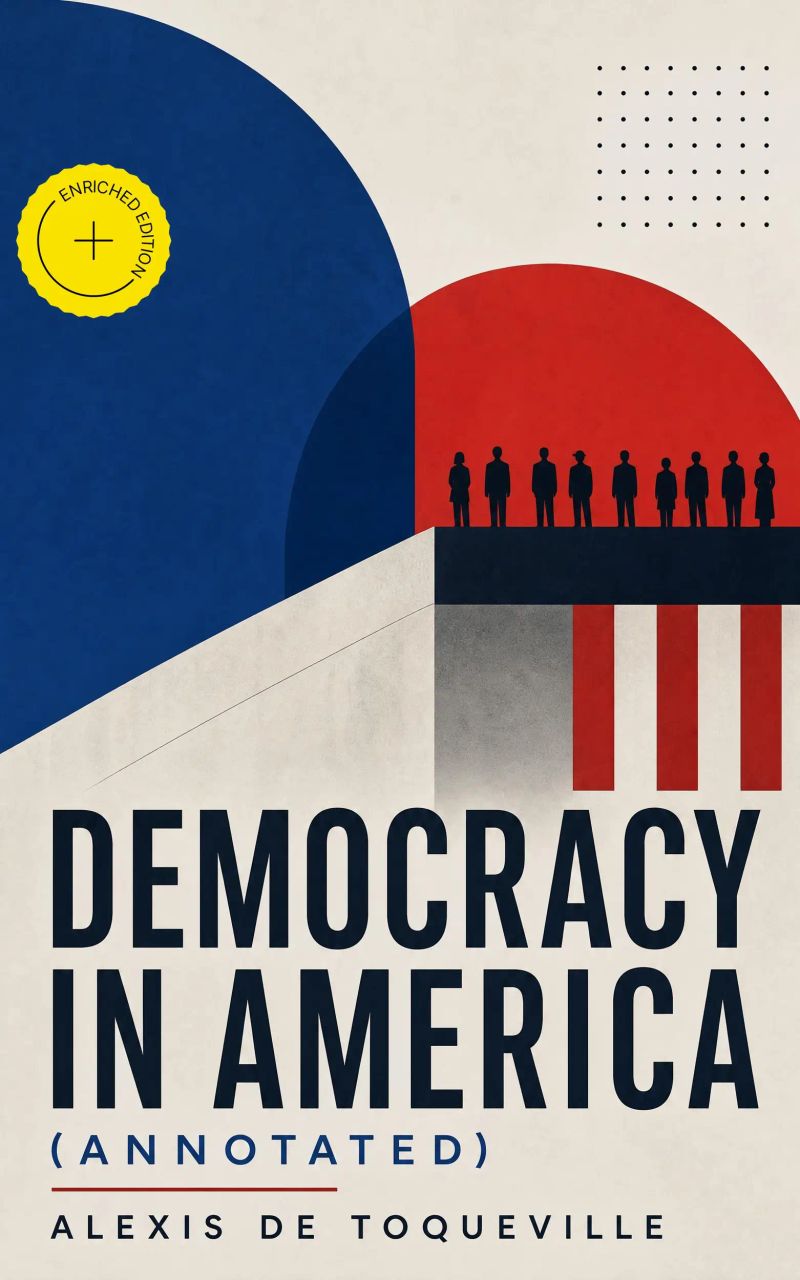
Democracy in America (Annotated)
Enriched Edition. Equality, Liberty, and the Tyranny of the Majority in American Civic LifeBy Alexis de Toqueville


Length36h 34m
About this audiobook
Democracy in America is a foundational analysis of the political, social, and moral consequences of democratic equality in the United States. Combining travel narrative, political theory, sociology, and philosophical reflection, Alexis de Tocqueville examines federalism, local self-government, religion, civil associations, the press, and the "tyranny of the majority." Written in a lucid, comparative style, the work belongs to the great nineteenth-century tradition of liberal political inquiry, yet it remains strikingly modern in its attention to culture, habits, and institutions. Tocqueville, a French aristocrat born after the Revolution, visited America in 1831 ostensibly to study its prison system, but his deeper concern was the democratic future of Europe. His background in a society marked by revolution, centralization, and class upheaval sharpened his perception of America's experiment. He wrote not as an uncritical admirer, but as a liberal thinker seeking to understand how freedom might survive in an age of equality. This book is essential for readers interested in democracy, American identity, political liberty, and modern society. Its insights into individualism, civic life, religion, public opinion, and administrative power continue to illuminate contemporary political dilemmas with unusual clarity.
This enriched edition has been carefully crafted to add value to your reading experience.
- A succinct Introduction situates the work's timeless appeal and themes.
- The Synopsis outlines the central plot, highlighting key developments without spoiling critical twists.
- A detailed Historical Context immerses you in the era's events and influences that shaped the writing.
- An Author Biography reveals milestones in the author's life, illuminating the personal insights behind the text.
- A thorough Analysis dissects symbols, motifs, and character arcs to unearth underlying meanings.
- Reflection questions prompt you to engage personally with the work's messages, connecting them to modern life.
- Hand‐picked Memorable Quotes shine a spotlight on moments of literary brilliance.
- Interactive footnotes clarify unusual references, historical allusions, and archaic phrases for an effortless, more informed read.
Audiobook details
Rating★★★★ 4.3 (1.3K)
Includes Amazon, Goodreads
GenrePolitics and Government
Length36 hrs 34 mins
Narrated byListen with 1,000+ voices
FormateBook with Audio
Publish dateJul 3, 2020
LanguageEnglish
Table of contents
1Introduction
2Introduction
3Synopsis
4Historical Context
5Author Biography
Show all chaptersShow less
6BOOK ONE
7Introductory Chapter
8Chapter I: Exterior Form Of North America
9Chapter II: Origin Of The Anglo-Americans And Its Importance, in Relation to Their Future Condition
10Chapter III: Social Conditions Of The Anglo-Americans
11Chapter IV: The Principle Of The Sovereignty Of The People In America
12Chapter V: Necessity Of Examining The Condition Of The States Before That Of The Union At Large.
13Chapter VI: Judicial Power In The United States And Its Influence On Political Society
14Chapter VII: Political Jurisdiction In The United States
15Chapter VIII: The Federal Constitution (pt. 1)
16Chapter VIII: The Federal Constitution (pt. 2)
17Chapter IX
18Chapter X: Parties In The United States
19Chapter XI: Liberty Of The Press In The United States
20Chapter XII: Political Associations In The United States
21Chapter XIII: Government Of The Democracy In America
22Chapter XIV: What The Real Advantages Are Which American Society Derives From The Government Of The Democracy
23Chapter XV: Unlimited Power Of Majority, And Its Consequences
24Chapter XVI: Causes Mitigating Tyranny In The United States
25Chapter XVII: Principal Causes Maintaining The Democratic Republic In The United States
26Chapter XVIII: The Present And Probable Future Condition Of The Three Races Which Inhabit The Territory Of The United States (pt. 1)
27Chapter XVIII: The Present And Probable Future Condition Of The Three Races Which Inhabit The Territory Of The United States (pt. 2)
28Conclusion
29BOOK TWO:Influence Of Democracy On Progress Of Opinion in The United States
30De Tocqueville's Preface To The Second Part
31Section I: Influence of Democracy on the Action of Intellect in The United States.
32Chapter I: Philosophical Method Among the Americans
33Chapter II: Of The Principal Source Of Belief Among Democratic Nations
34Chapter III: Why The Americans Display More Readiness And More Taste For General Ideas Than Their Forefathers, The English.
35Chapter IV: Why The Americans Have Never Been So Eager As The French For General Ideas In Political Matters
36Chapter V: Of The Manner In Which Religion In The United States Avails Itself Of Democratic Tendencies
37Chapter VI: Of The Progress Of Roman Catholicism In The United States
38Chapter VII: Of The Cause Of A Leaning To Pantheism Amongst Democratic Nations
39Chapter VIII: The Principle Of Equality Suggests To The Americans The Idea Of The Indefinite Perfectibility Of Man
40Chapter IX: The Example Of The Americans Does Not Prove That A Democratic People Can Have No Aptitude And No Taste For Science, Literature, Or Art
41Chapter X: Why The Americans Are More Addicted To Practical Than To Theoretical Science
42Chapter XI: Of The Spirit In Which The Americans Cultivate The Arts
43Chapter XII: Why The Americans Raise Some Monuments So Insignificant, And Others So Important
44Chapter XIII: Literary Characteristics Of Democratic Ages
45Chapter XIV: The Trade Of Literature
46Chapter XV: The Study Of Greek And Latin Literature Peculiarly Useful In Democratic Communities
47Chapter XVI: The Effect Of Democracy On Language
48Chapter XVII: Of Some Of The Sources Of Poetry Amongst Democratic Nations
49Chapter XVIII: Of The Inflated Style Of American Writers And Orators
50Chapter XIX: Some Observations On The Drama Amongst Democratic Nations

Black AF HistoryMichael Harriot15h 43m4.7 (14.6K)$33 · $0.00

The Gulag Archipelago Volume 3Aleksandr I. Solzhenitsyn21h 56m4.7 (8.9K)$46 · $0.00

MotherlandJulia Ioffe17h 52m4.7 (2.5K)$40 · $0.00

HostageEli Sharabi5h 25m4.6 (10.8K)$24 · $0.00

KrantikariSanjeev Sanyal11h 44m4.6 (1.3K)$16 · $0.00

Unbroken Bonds of BattleJohnny Joey Jones8h 31m4.6 (2.6K)$8 · $0.00

On Democracies and Death CultsDouglas Murray10h 38m4.6 (6.5K)$29 · $0.00

Balcony Over Jerusalem: A Middle East Memoir - Israel, Palestine and BeyondJohn Lyons12h 37m4.6 (1.4K)$33 · $0.00
RiggedMollie Hemingway12h 48m4.6 (4.2K)$23 · $0.00

SledgehammerDavid Friedman8h 21m4.7 (589)$26 · $0.00

Citizenship in a Republic (Annotated)Theodore Roosevelt2h 44m4.6 (1.4K)$2 · $0.00

No EscapeNury Turkel9h 30m4.6 (809)$28 · $0.00

Always FaithfulThomas Schueman, Zainullah Zaki12h 12m4.6 (977)$29 · $0.00

UnthinkableJamie Raskin15h 8m4.5 (9.3K)$8 · $0.00

My Fourth Time, We DrownedSally Hayden13h 59m4.6 (2.9K)$23 · $0.00

A Revolution of Common SenseScott Jennings9h 29m4.6 (528)$29 · $0.00

Statement From the Dock at the Rivonia TrialNelson Mandela2h 18m4.6 (1.3K)$1 · $0.00

Lessons from the EdgeMarie Yovanovitch17h 11m4.5 (5.9K)$40 · $0.00

To Rescue the American SpiritBret Baier10h 12m4.5 (2.7K)$8 · $0.00

StonewalledSharyl Attkisson15h 19m4.5 (4.3K)$33 · $0.00
You may also like

The War on the WestDouglas Murray12h 42m4.3 (15.4K)$33 · $0.00
Capitalism, Socialism and DemocracyJoseph A. Schumpeter18h 23m4.1 (4.3K)$8 · $0.00

LeviathanThomas Hobbes23h3.9 (68.7K)$2.30

Capital and IdeologyThomas Piketty48h 57m4.4 (7.2K)$40

Rock Me on the WaterRonald Brownstein16h 15m4.0 (2.4K)$33 · $0.00

Rebel in the RanksBrad S. Gregory9h 46m4.1 (502)$29 · $0.00
On the Duty of Civil DisobedienceHenry David Thoreau52m4.1 (27.5K)$5

Bad FeministRoxane Gay11h 47m4.0 (127.1K)$29 · $0.00

The History of Rome: From the Abolition of the Monarchy in Rome to the Union of ItalyTheodor Mommsen5h 33m4.4 (775)$2 · $0.00

Fichte (Annotated)Robert Adamson7h 28m$1.99 · $0.00

Constitution of the Republic of BelarusGovernment of Belarus2h 29m3.8 (10)$2 · $0.00

Readings on Fascism and National SocialismVarious2h 33m4.1 (28)$2 · $0.00

Science, Faith, and the Victorian MindSantiago Machain10h 41m$29 · $0.00

Frida Kahlo & Diego RiveraGerry Souter10h 43m4.1 (181)$19 · $0.00

Issues In Health CareJohn Warwick Montgomery, John Warwick Montgomery3h 34m$12 · $0.00

Democracy: Clarifying the Muddle - A Conversation with John DunnHoward Burton1h 23m$3 · $0.00

The Collected WorksW.E.B. Du Bois35h 35m4.6 (53)$2 · $0.00

The reformation in Poland : Some social and economic aspectsPaul Fox6h 34m$2 · $0.00

The Unexpurgated Case Against Woman SuffrageAlmroth Edward Wright3h 51m$1 · $0.00

The Relations of the Advanced and the Backward Races of MankindJames Bryce2h 3m$2 · $0.00