
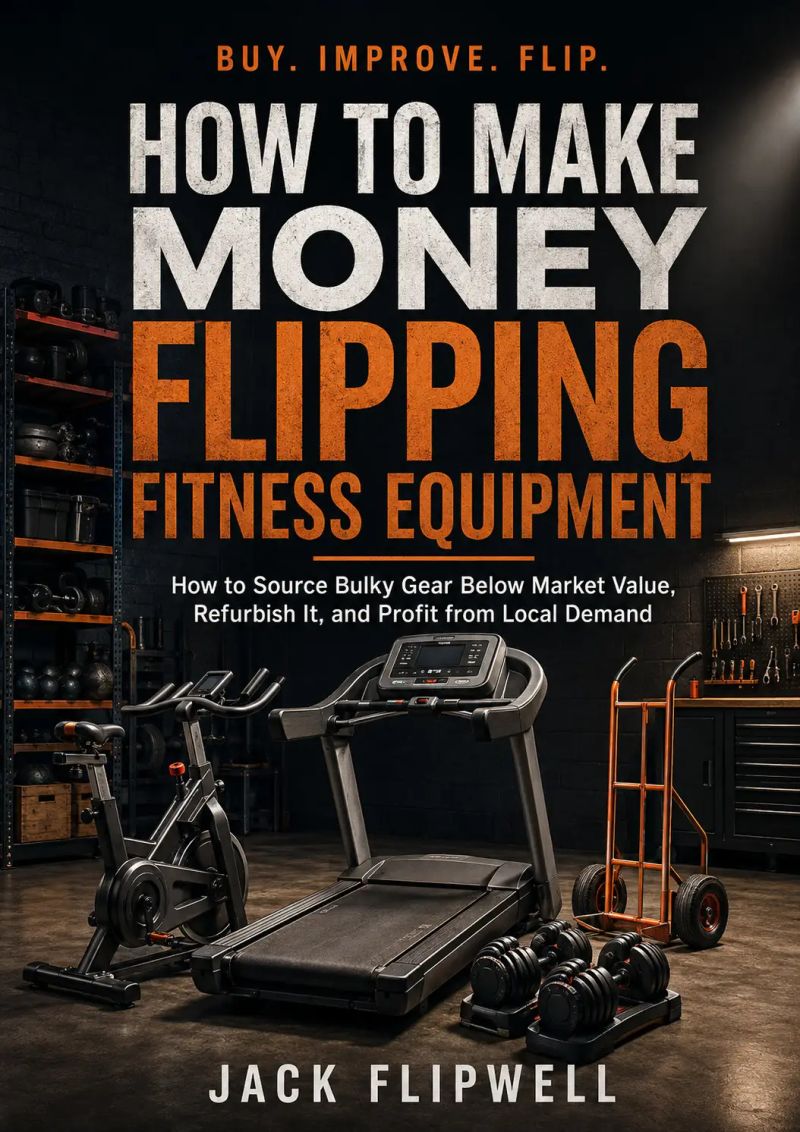
How to Make Money Flipping Fitness Equipment - How to Source Bulky Gear Below Market Value, Refurbish It, and Profit from Local Demand
By JACK FLIPWELL


Length8h 23m
About this audiobook
Bulky used fitness equipment creates a unique resale opportunity because the same characteristics that make it inconvenient for the owner can create margin for an organized buyer. Treadmills take up space. Weight plates are heavy. Power racks need disassembly. Exercise bikes require transport. Entire home gyms can become a major problem during a move, renovation, or downsizing.
That inconvenience is exactly where a prepared reseller can create value.
How to Make Money Flipping Fitness Equipment is a practical guide to sourcing, evaluating, transporting, refurbishing, and reselling used fitness equipment for profit. It is not built around guaranteed returns, unrealistic income claims, or the assumption that every cheap machine is a bargain. Instead, it focuses on building a repeatable decision-making process that helps you buy more selectively and avoid expensive mistakes.
You will learn how to research local demand without confusing asking prices with actual resale value. The book shows how to estimate realistic selling prices, understand inventory liquidity, and calculate a maximum purchase price before you negotiate with the seller.
You will also learn why the purchase price alone tells you very little about the true economics of a deal. Transport, paid help, replacement parts, cleaning, platform fees, delivery, storage, and labor all affect the final result. A treadmill bought for a fraction of its original retail price can still be a terrible investment if it needs expensive repairs, occupies half your garage, and takes months to sell.
The book covers the major fitness equipment categories separately, including dumbbells, barbells, weight plates, kettlebells, benches, stands, power racks, treadmills, exercise bikes, ellipticals, rowing machines, multi-gyms, and larger commercial machines. Each category is examined through the same practical lens: demand, condition, technical risk, completeness, transport difficulty, storage requirement, and exit strategy.
A major section is devoted to pre-purchase inspection. You will learn what a reseller can reasonably check independently and where the line should be drawn before specialist expertise is required. The book clearly separates basic cleaning, visual inspection, and straightforward assembly from electrical repairs, structural welding, safety-system modifications, and other work that should only be performed by properly qualified people.
Transport receives equally serious attention. Bulky fitness equipment can destroy a good deal if you discover too late that the machine does not fit through the doorway, cannot be carried down the stairs, exceeds the vehicle's payload, or requires several people to move safely. The book walks through measurements, collection planning, disassembly documentation, labeling hardware, protecting electronics, securing loads, and preparing the product for both storage and final delivery.
You will also learn how to manage storage as a limited business resource. One large machine can occupy the space of several faster-moving products. The book explains how to build simple intake, preparation, ready-to-sell, parts, and dispatch zones, how to track inventory age, and how to identify stock that is becoming dead capital.
Refurbishment is treated as a business decision rather than a hobby project. Cleaning, replacing the correct minor part, organizing accessories, improving presentation, and documenting the equipment can add substantial value without risky technical intervention. You will learn how to decide which improvements are worth doing and when additional work is unlikely to produce enough return.
The book also explains bundling and part-out strategies. A bench, rack, barbell, and matching plates may create a stronger home-gym package than the individual components. A large mixed lot may be more profitable when divided into smaller groups. A broken machine may sometimes have recoverable parts value, but only when there is a real market for those parts and the storage and labor costs make sense.
Once the equipment is ready, the focus moves to selling. You will learn how to photograph bulky products clearly, show defects honestly, write listings that reduce buyer uncertainty, set asking, target, minimum, and fast-exit prices, and handle negotiation without making emotional decisions.
Local delivery can become a major competitive advantage. Many buyers want fitness equipment but lack the vehicle, lifting help, or experience required to move it. The book explains how to price transport, separate delivery from carrying and assembly, avoid hidden labor costs, and use professional partners where appropriate.
This publication was prepared with the assistance of tools that support the creative process, including artificial intelligence-based solutions. The final concept, structure, and editing belong to the author.
Audiobook details
GenreBusiness and Economics
Length8 hrs 23 mins
Narrated byListen with 1,000+ voices
FormateBook with Audio
Publish dateSep 27, 2026
LanguageEnglish
Table of contents
1INTRO
2Chapter 1 - The Used Fitness Equipment Market
3Chapter 2 - What Is Worth Flipping
4Chapter 3 - Where to Source Equipment Below Market Value
5Chapter 4 - How to Measure Local Demand and Real Prices
Show all chaptersShow less
6Chapter 5 - Deal Math and Maximum Purchase Price
7Chapter 6 - Seller Communication and Negotiation
8Chapter 7 - Inspecting Equipment Before You Buy
9Chapter 8 - Dumbbells, Barbells, Plates, and Kettlebells
10Chapter 9 - Benches, Stands, Racks, and Strength Equipment
11Chapter 10 - Treadmills
12Chapter 11 - Ellipticals, Exercise Bikes, and Other Cardio
13Chapter 12 - Multi-Gyms and Large Commercial Equipment
14Chapter 13 - Transport, Disassembly, and Safe Handling
15Chapter 14 - Storage and Space Management
16Chapter 15 - Cleaning, Cosmetic Work, and Refurbishment
17Chapter 16 - Bundling, Part-Out, and Adding Value
18Chapter 17 - Photos, Listings, and Pricing
19Chapter 18 - Local Selling, Negotiation, and Delivery
20Chapter 19 - The Numbers That Show Whether You Are Actually Making Money
21Chapter 20 - From Individual Deals to a Flipping System
More from JACK FLIPWELL

Jak zarabiać na kupnie i sprzedaży luksusowych torebek - Przewodnik po autentykacji, ocenie stanu, bezpiecznym czyszczeniu, wycenie i odsprzedażyJACK FLIPWELL9h 42m$7.90 · $0.00
How to Make Money Flipping Golf Equipment - How to Identify In-Demand Clubs, Avoid Counterfeits, Improve Condition, and Resell for ProfitJACK FLIPWELL8h 39m$7.90 · $0.00
How to Make Money Flipping Designer Handbags - A Guide to Authentication, Condition Grading, Safe Cleaning, Pricing, and Confident ResaleJACK FLIPWELL9h 26m$7.90 · $0.00

Jak zarabiać na kupnie i sprzedaży sprzętu fitness - Jak kupować duży sprzęt poniżej wartości rynkowej, odnawiać go i zarabiać na lokalnym popycieJACK FLIPWELL8h 9m$7.90 · $0.00

Jak zarabiać na kupnie i sprzedaży sprzętu golfowego - Jak rozpoznawać chodliwe kije, unikać podróbek, poprawiać stan i sprzedawać z zyskiemJACK FLIPWELL8h 59m$7.90 · $0.00
How to Make Money Flipping Auto Parts - A Guide to OEM Numbers, Compatibility, Condition Checks, Shipping, and Profitable ResaleJACK FLIPWELL7h 32m$7.80 · $0.00

How to Make Money Flipping Bicycles - How to Find Underpriced Bikes, Plan Profitable Repairs, and Take Advantage of Seasonal DemandJACK FLIPWELL7h 57m$7.80 · $0.00

Jak zarabiać na kupnie i sprzedaży części samochodowych - Przewodnik po numerach OEM, kompatybilności, ocenie stanu, wysyłce i opłacalnej odsprzedażyJACK FLIPWELL7h 32m$7.80 · $0.00
How to Make Money Flipping Cameras and Lenses - A Practical Guide to Evaluating Shutter Counts, Optics, Compatibility, and Resale ValueJACK FLIPWELL8h 38m$7.80 · $0.00

Jak zarabiać na kupnie, naprawie i sprzedaży rowerów - Jak znajdować niedoszacowane rowery, planować opłacalne naprawy i wykorzystywać sezonowy popytJACK FLIPWELL8h 9m$7.80 · $0.00

Jak zarabiać na kupnie i sprzedaży aparatów oraz obiektywów - Praktyczny przewodnik po ocenie przebiegu migawki, optyki, kompatybilności i wartości odsprzedażyJACK FLIPWELL8h 9m$7.80 · $0.00

How to Make Money Flipping Used Books - How to Identify Valuable Editions, Assess Condition, Build Profitable Lots, and Sell to the Right ReadersJACK FLIPWELL8h 19m$8.10 · $0.00
Never Split the DifferenceChris Voss, Tahl Raz8h 7m4.4 (277.7K)$26 · $0.00
The Intelligent Investor Rev Ed.Benjamin Graham17h 48m4.3 (191.5K)$40 · $0.00
The Hard Thing About Hard ThingsBen Horowitz7h 57m4.2 (134.3K)$26 · $0.00

Boundaries for LeadersHenry Cloud7h 36m4.3 (3.6K)$26 · $0.00
Basic EconomicsThomas Sowell18h 32m4.5 (29.3K)$28 · $0.00

The Ambuja StoryNarotam Sekhsaria13h 59m4.5 (830)$33 · $0.00

This Is Going to HurtAdam Kay5h 47m4.4 (444.7K)$24 · $0.00

Big TrustShadé Zahrai, Fayçal Sekkouah8h 36m4.6 (406)$26 · $0.00
The Intelligent Investor Third EditionBenjamin Graham, Jason Zweig20h4.4 (156.6K)$46 · $0.00

Bottle of LiesKatherine Eban14h 25m4.4 (12K)$33 · $0.00

The Antiracist Business BookTrudi Lebrón6h 10m4.6 (275)$17 · $0.00

The FormulaJoshua Robinson, Jonathan Clegg10h 41m4.4 (6.9K)$29 · $0.00

Let Them LeadJohn U. Bacon7h 10m4.5 (1.4K)$24 · $0.00

Secrets of the Millionaire MindT. Harv Eker5h 11m4.4 (301.4K)$24 · $0.00

The Person You Mean to BeDolly Chugh9h 6m4.4 (7.2K)$29 · $0.00
BoundlessNick Kostov, Sean McLain9h 17m4.5 (1.1K)$29 · $0.00

Everyday DharmaSuneel Gupta5h 2m4.5 (761)$20 · $0.00

Let's Talk Mutual FundsMonika Halan7h 5m4.4 (2.4K)$16 · $0.00
The Law of Success in Sixteen LessonsNapoleon Hill2h 39m4.4 (17.2K)$2 · $0.00

Barbarians at the GateBryan Burrough, John Helyar3h 3m4.4 (52.7K)$18 · $0.00
You may also like

I am learning PunjabiJM Gardner3h 55m4.4 (113)$18 · $0.00
An Introduction to Machine Drawing and DesignDavid Allan Low3h 13m$2 · $0.00

Gas Burners Old and NewOwen Merriman3h 1m$2 · $0.00

Early Printed BooksE. Gordon Duff5h 1m3.6 (19)$2 · $0.00

Tower's Little Primer, for the youngest class in primary schoolAnna E. Tower9m$2 · $0.00

English DemystifiedChris Fitzgerald51m$10 · $0.00

Omnibuses and cabsHenry Charles Moore5h 45m$1 · $0.00

Master Portuguese For Everyday Conversations!Mohamed Elshenawy4h 39m$26 · $0.00

Low-carb Dieting Secrets!Fernando Moreira2m$5 · $0.00

Ultimate Guide To Cupcakes 175 Selected Simply Delicious Recipes With Decorating IdeasJideon F Marques5h 58m$10 · $0.00
Omnibuses and cabsHenry Charles Moore5h 45m$1 · $0.00
Master Portuguese For Everyday Conversations!Mohamed Elshenawy4h 39m$26 · $0.00
Low-carb Dieting Secrets!Fernando Moreira2m$5 · $0.00
Ultimate Guide To Cupcakes 175 Selected Simply Delicious Recipes With Decorating IdeasJideon F Marques5h 58m$10 · $0.00

Chats on Old MiniaturesJ. J. Foster4h 44m$2 · $0.00

The Kitchen From A To Z (and The Z For Zing! So Delicious!)Betty Crocker2h 24m$7 · $0.00

A Manual of Photographic Chemistry, Including the Practice of the Collodion ProcessT. Frederick Hardwich10h 28m$1 · $0.00

Making Money Online: Lets Get StartedDaniele Moreira34m$6 · $0.00

Manual of Library CataloguingJohn Henry Quinn5h 3m$1 · $0.00

A Manual of Pyrotechny; or, A Familiar System of Recreative Fire-worksG. W. Mortimer4h 9m$1 · $0.00