
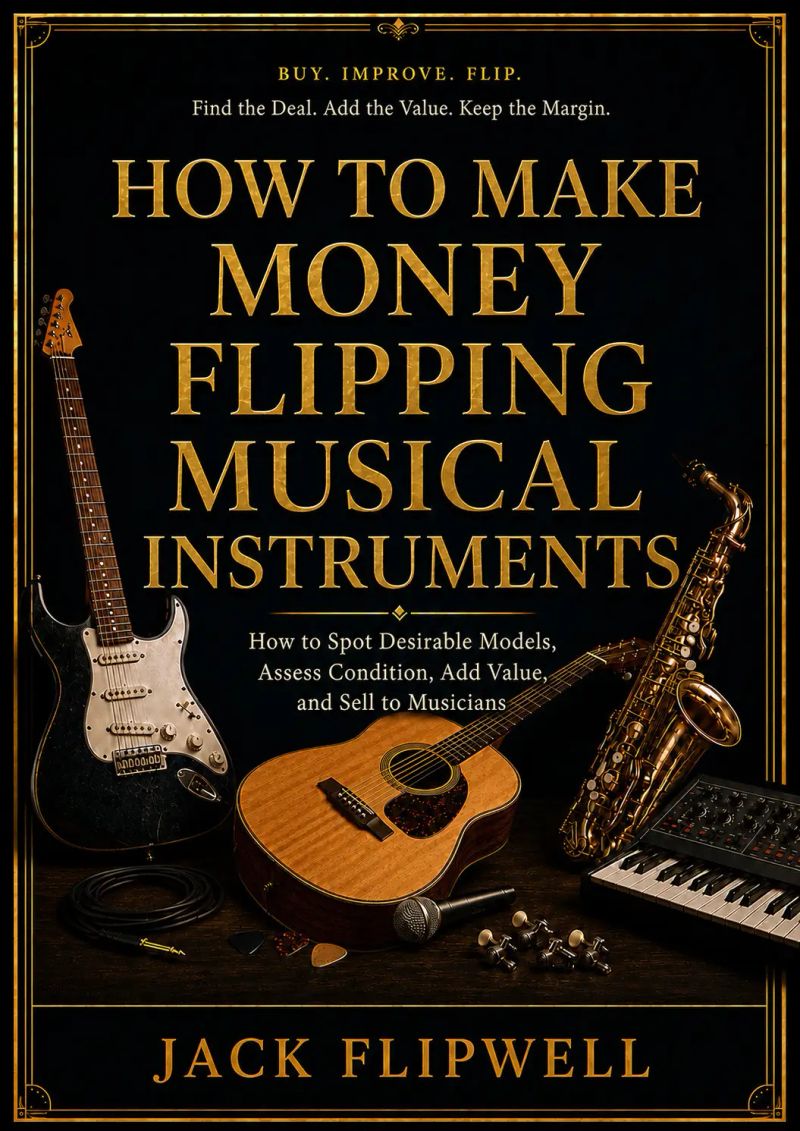
How to Make Money Flipping Musical Instruments - How to Spot Desirable Models, Assess Condition, Add Value, and Sell to Musicians
By JACK FLIPWELL


Length8h 53m
About this audiobook
The used musical instrument market is full of products that look similar but can differ in resale value by hundreds or thousands. A guitar carrying a familiar logo may belong to a completely different series from the one the seller uses as a price comparison. A keyboard can look almost perfect while several keys respond incorrectly. An old saxophone may be a genuine opportunity or an expensive service project. An amplifier described as needing "a simple fix" can consume the entire expected margin.
How to Make Money Flipping Musical Instruments is a practical guide to building a repeatable system for buying and reselling guitars, keyboards, synthesizers, amplifiers, pedals, wind instruments, drums, microphones, studio equipment, and other musical gear.
JACK FLIPWELL shows how to move beyond random bargain hunting and build a process in which every purchase begins with exact identification, current market research, condition assessment, cost calculation, risk control, and a clearly defined maximum purchase price.
You will learn how to identify exact models, generations, production variations, and configurations, why serial numbers are useful but not definitive, how to distinguish active asking prices from actual market evidence, and why a rare product is not automatically a liquid or valuable product.
The book provides practical procedures for evaluating electric, acoustic, and bass guitars, including neck condition, fret wear, electronics, bridges, modifications, structural issues, setup, and prior repairs. Dedicated chapters cover keyboards, digital pianos, and synthesizers, where value can depend on key action, displays, outputs, software support, drivers, operating-system compatibility, proprietary accessories, and current technology.
You will also learn how to test guitar pedals and amplifiers while maintaining clear safety boundaries. The book explains the difference between normal user-level testing and electrical work that should be left to qualified technicians, particularly with mains-powered and high-voltage equipment.
Wind instruments and string instruments receive separate treatment because their technical condition can be difficult to evaluate from appearance alone. You will learn when a commercial inspection is sufficient and when professional evaluation by a luthier, wind instrument technician, piano technician, or another specialist should be included directly in the purchase calculation.
The book also covers acoustic and electronic drums, cymbals, hardware, microphones, audio interfaces, monitors, mixers, and home studio equipment. You will learn how to identify valuable components hidden inside large bundles and how to decide whether a package should be sold complete or split into several products.
A major part of the system focuses on adding value without destroying the margin. This does not mean restoring everything you buy. Value can come from safe cleaning, correct accessories, professional service only where economically justified, accurate documentation, a complete test, better photographs, and reducing the buyer's uncertainty.
You will also learn how to protect yourself from counterfeits, partscasters, false model markings, mixed components, questionable certificates, and unsupported provenance stories. The book explains why a logo, serial number, or box is not enough to authenticate an expensive product and why specialist verification can be one of the cheapest forms of capital protection on high-value deals.
At the center of the book is transaction math. You will learn to separate asking price, realistic resale value, quick-sale value, liquidity, and actual profit. A practical formula helps define your buying limit:
Maximum purchase price = conservative resale value - expected costs - required profit - risk reserve.
This approach forces you to include service, replacement parts, transportation, packing, platform fees, payment costs, return risk, selling time, and unexpected problems before you buy.
Separate chapters explain how to photograph and describe instruments, negotiate with musicians, prepare products for local inspection, protect high-value transactions, package equipment safely, reduce shipping damage, verify payments, and handle post-sale problems without unnecessary conflict.
For more advanced resellers, the book covers reputation, repeat customers, inventory control, storage, cash flow, slow-moving stock, repair queues, category concentration, data analysis, operating systems, and scaling. It shows why increasing buying volume before the existing process is under control can magnify problems rather than profit.
This publication was prepared with the assistance of tools that support the creative process, including artificial intelligence-based solutions. The final concept, structure, and editing belong to the author.
Audiobook details
GenreBusiness and Economics
Length8 hrs 53 mins
Narrated byListen with 1,000+ voices
FormateBook with Audio
Publish dateSep 29, 2026
LanguageEnglish
Table of contents
1INTRO
2Chapter 1 - How the Used Musical Instrument Market Actually Works
3Chapter 2 - How to Find Deals and Build a Repeatable Sourcing System
4Chapter 3 - How to Identify the Exact Model, Version, and Real Market Value
5Chapter 4 - How to Assess Condition and Detect Expensive Problems Before Buying
Show all chaptersShow less
6Chapter 5 - How to Add Value Without Destroying Your Margin on Repairs and Upgrades
7Chapter 6 - Electric, Acoustic, and Bass Guitars - How to Buy, Assess, and Resell Them Profitably
8Chapter 7 - Keyboards, Synthesizers, and Digital Pianos - How to Evaluate Electronics, Key Action, and Demand
9Chapter 8 - Amplifiers, Pedals, and Guitar Gear - How to Profit From Products That Are Easy to Compare and Test
10Chapter 9 - Wind Instruments - How to Control Risk When Buying Saxophones, Trumpets, Clarinets, and Other Specialist Instruments
11Chapter 10 - Acoustic Drums, Electronic Drums, and Hardware - How to Evaluate Completeness, Wear, and Logistics
12Chapter 11 - Microphones, Audio Interfaces, and Studio Gear - How to Evaluate Function, Compatibility, and Bundle Value
13Chapter 12 - Violins, Cellos, and Other Acoustic Instruments - When You Need a Specialist Instead of Your Own Judgment
14Chapter 13 - Counterfeits, Partscasters, False Markings, and Unclear Provenance - How to Avoid Buying a Product Whose Value You Cannot Defend
15Chapter 14 - How to Set Your Maximum Purchase Price, Margin, and Selling Price Without Lying to Yourself
16Chapter 15 - How to Photograph, Describe, and Present Instruments So Buyers Decide Faster
17Chapter 16 - Shipping, Packaging, Payments, and Transaction Security - How to Protect Your Margin After the Sale
18Chapter 17 - How to Build Reputation, Handle Customers, and Sell to Musicians Without Unnecessary Disputes
19Chapter 18 - How to Scale Musical Instrument Flipping - Capital, Inventory, Data, Automation, and When to Grow
20Chapter 19 - How to Manage Risk, Inventory Exposure, and Decisions When the Market Changes
21Chapter 20 - The Complete JACK FLIPWELL System - From the First Alert to Reinvesting the Profit

How to Make Money Flipping Sneakers - A Guide to Sourcing, Authentication, Pricing, and Profitable ResellingJACK FLIPWELL4h 29m$7.70 · $0.00
How to Make Money Reselling Clothes - How to Source, Photograph, Price, and Sell Secondhand Fashion OnlineJACK FLIPWELL5h 4m$7.70 · $0.00

How to Make Money Flipping Houses - How to Find Undervalued Properties, Control Renovation Costs, and Sell at the Right PriceJACK FLIPWELL4h 31m$7.70 · $0.00

Jak zarabiać na samochodach używanych - Jak znajdować okazje, szacować koszty i bezpiecznie sprzedawać auta z zyskiemJACK FLIPWELL4h 45m$7.80 · $0.00

Jak zarabiać na odsprzedaży iPhone’ów - Jak kupować poniżej ceny rynkowej, wykrywać wady i sprzedawać z zyskiemJACK FLIPWELL5h 30m$7.70 · $0.00

Jak zarabiać na flipach mieszkaniowych - Jak znajdować niedoszacowane nieruchomości, kontrolować koszty remontu i sprzedawać we właściwej cenieJACK FLIPWELL4h 54m$7.70 · $0.00

Jak zarabiać na używanej elektronice - Jak kupować, testować, wyceniać i sprzedawać smartfony, laptopy, tablety oraz konsoleJACK FLIPWELL5h4.7 (12)$7.70 · $0.00

How to Make Money Flipping Furniture - Turn Cheap and Forgotten Pieces into Products Buyers WantJACK FLIPWELL4h 26m$7.70 · $0.00

How to Make Money Flipping Almost Anything - A Complete System for Finding Deals, Calculating Margins, and Building Repeatable IncomeJACK FLIPWELL5h 57m$7.70 · $0.00

Jak zarabiać na odsprzedaży sneakersów - Przewodnik po wyszukiwaniu okazji, sprawdzaniu autentyczności i dochodowej sprzedażyJACK FLIPWELL4h 32m$7.70 · $0.00

How to Make Money Flipping Used Electronics - How to Buy, Test, Price, and Resell Phones, Laptops, Tablets, and Game ConsolesJACK FLIPWELL4h 22m$7.70 · $0.00

Jak zarabiać na odsprzedaży niemal wszystkiego - Kompletny system wyszukiwania okazji, obliczania marży i budowania powtarzalnego dochoduJACK FLIPWELL5h 29m$7.70 · $0.00

Jak zarabiać na odnawianiu i sprzedaży mebli - Jak zamieniać tanie i zapomniane przedmioty w produkty, które ludzie chcą kupowaćJACK FLIPWELL4h 49m$7.70 · $0.00

How to Make Money Flipping Watches - How to Spot Valuable Models, Avoid Fakes, and Resell with ConfidenceJACK FLIPWELL5h 45m$7.80 · $0.00

How to Make Money Flipping Used Cars - A Beginner's Guide to Finding Deals, Estimating Costs, and Selling Safely for ProfitJACK FLIPWELL4h 24m$7.80 · $0.00

Jak zarabiać na ubraniach z drugiej ręki - Jak wyszukiwać, fotografować, wyceniać i sprzedawać używaną modę w internecieJACK FLIPWELL4h 49m$7.70 · $0.00
How to Make Money Flipping Collectibles - How to Find Undervalued Toys, Sets, Cards, and Limited-Edition ItemsJACK FLIPWELL6h 30m$7.80 · $0.00

Jak zarabiać na przedmiotach kolekcjonerskich - Jak znajdować niedoszacowane zabawki, zestawy, karty i limitowane przedmiotyJACK FLIPWELL5h 5m$7.80 · $0.00

Jak zarabiać na kupowaniu i sprzedaży zegarków - Jak rozpoznawać wartościowe modele, unikać podróbek i sprzedawać z odpowiednią marżąJACK FLIPWELL4h 56m$7.80 · $0.00
How to Make Money Flipping iPhones - A Practical Guide to Buying Below Market Value, Spotting Defects, and Reselling for ProfitJACK FLIPWELL5h 17m$7.70 · $0.00
Never Split the DifferenceChris Voss, Tahl Raz8h 7m4.4 (277.7K)$26 · $0.00
The Intelligent Investor Rev Ed.Benjamin Graham17h 48m4.3 (191.5K)$40 · $0.00
The Hard Thing About Hard ThingsBen Horowitz7h 57m4.2 (134.3K)$26 · $0.00

Boundaries for LeadersHenry Cloud7h 36m4.3 (3.6K)$26 · $0.00

Eat It!Jordan Syatt, Michael Vacanti4h 40m4.6 (1.5K)$20 · $0.00

Progress and Poverty, Volumes I and II (Annotated)Henry George19h 21m4.6 (574)$0.99 · $0.00

Not Everything Counts but Everything Matters: The powerful and inspirational new book about leadership and achieving success from the visionary multi-premiership winning Panthers coachIvan Cleary6h 1m4.6 (680)$24 · $0.00
BuildTony Fadell11h 5m4.5 (14.3K)$8 · $0.00

The Joys Of CompoundingGautam Baid17h 34m4.5 (2.5K)$18 · $0.00
Basic EconomicsThomas Sowell18h 32m4.5 (29.3K)$28 · $0.00

Poor Charlie’s AlmanackGrover Gardener, Charles T. Munger13h 9m4.5 (24.7K)$18 · $0.00

The Ambuja StoryNarotam Sekhsaria13h 59m4.5 (830)$33 · $0.00

The Secret Door to SuccessFlorence Scovel Shinn2h 25m4.5 (2.1K)$1.20 · $0.00

This Is Going to HurtAdam Kay5h 47m4.4 (444.7K)$24 · $0.00

Big TrustShadé Zahrai, Fayçal Sekkouah8h 36m4.6 (406)$26 · $0.00
The Intelligent Investor Third EditionBenjamin Graham, Jason Zweig20h4.4 (156.6K)$46 · $0.00

Bottle of LiesKatherine Eban14h 25m4.4 (12K)$33 · $0.00

The Antiracist Business BookTrudi Lebrón6h 10m4.6 (275)$17 · $0.00
The FormulaJoshua Robinson, Jonathan Clegg10h 41m4.4 (6.9K)$29 · $0.00

Let Them LeadJohn U. Bacon7h 10m4.5 (1.4K)$24 · $0.00
You may also like

The Washing Machine Has Seventeen Programs, and I Use One - How to Wash, Dry, and Care for Clothes Without Shrinking Sweaters, Dyeing Whites, or Studying Care Labels Like Ancient HieroglyphsMax Paradox6h 18m4.4 (131)$7.80 · $0.00

Volkswagen Transporters T4 Workshop ManualOwners Edition4m4.4 (42)$24 · $0.00

VegetarianNaumann & Göbel Verlag3h 23m4.4 (15)$5 · $0.00

The Book of CheeseWalter Warner Fisk, Charles Thom11h 9m4.4 (12)$2.30

On Generation and CorruptionAristotle2h 58m3.5 (307)$1.80 · $0.00
Mac Made SimpleWalter Hemsley4h 18m$17

Engineering Electromagnetics for Antennas and MicrowavesKarim Haddadi11h 22m$80
The Plain-English Guide to Apple KeynoteRuth Callender3h 54m$7
Roku for Beginners Made SimpleWalter Hemsley3h 39m$5
Prelude in Cm (Chopin)Bill Brown Jr.30m$2

History of SportsKenny Abdo17m$2
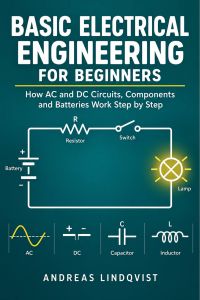
Basic Electrical Engineering for BeginnersAndreas Lindqvist9h 7m$45
How to Make Money Flipping Houses - How to Find Undervalued Properties, Control Renovation Costs, and Sell at the Right PriceJACK FLIPWELL4h 31m$7.70 · $0.00
HideawayBill Brown Jr.1h 20m$10

I'll See You in My DreamsBill Brown Jr.1h 5m$10
The Plain-English Guide to Google SlidesRuth Callender4h 32m$6

The Skater's WaltzBill Brown Jr.35m$4

Raspberry Pi for Beginners Made SimpleWalter Hemsley4h 21m$13

Garmin Watch Made SimpleWalter Hemsley4h 17m$8

Samsung Galaxy for SeniorsWalter Hemsley3h 47m$7