
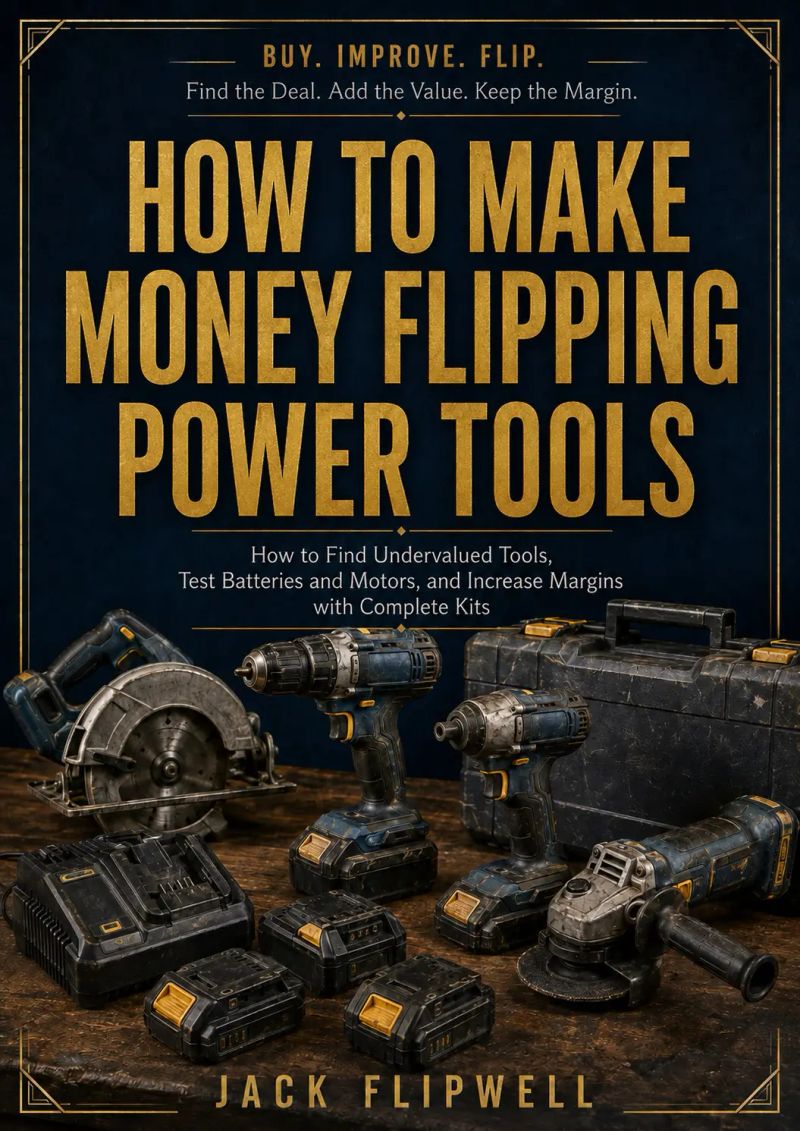
How to Make Money Flipping Power Tools - How to Find Undervalued Tools, Test Batteries and Motors, and Increase Margins with Complete Kits
By JACK FLIPWELL


Length8h 47m
About this audiobook
Can used power tools become a repeatable source of resale income? They can, but the advantage does not come from randomly buying cheap drills and listing them for more. It comes from better sourcing, disciplined pricing, safe testing, correct identification, smarter kit building, and understanding where real value sits inside a package.
How to Make Money Flipping Power Tools is a practical guide to buying and reselling drills, impact drivers, grinders, rotary hammers, saws, impact wrenches, batteries, chargers, and other secondhand power tools. It takes the reader through the complete process from finding an opportunity to closing the sale and then shows how individual transactions can become a repeatable operating system.
You will learn how to separate asking prices from realistic resale value and calculate a maximum purchase price that includes transaction costs, preparation expenses, a risk allowance, and your minimum required result. Instead of asking whether a tool looks cheap, you will learn to ask whether the complete transaction still makes sense after every cost and uncertainty is included.
The book explains where undervalued tools can appear and why poorly written listings, misspelled model numbers, mixed tool bundles, renovation clearances, workshop liquidations, and battery-platform switches can create opportunities. You will also learn how to communicate with sellers, what questions to ask before traveling, and how to reduce uncertainty before spending money.
A major section focuses on practical tool assessment. You will learn how to inspect housings, cables, switches, battery interfaces, chucks, guards, accessory-retention systems, and other important components. The book also explains how to observe motors, gearboxes, drivetrain behavior, sound, vibration, temperature, and performance without pretending that an ordinary reseller inspection is a professional service diagnosis.
Battery evaluation receives special attention because batteries can represent a substantial share of the value of a cordless kit. You will learn how to identify packs correctly, inspect housings and contacts, use the correct charger, observe normal charging behavior, compare practical performance, and recognize warning signs. The book does not encourage opening lithium-ion packs, bypassing safety systems, bridging terminals, or using improvised methods to revive damaged batteries.
You will also learn how value can be added without advanced repair work. External cleaning, better organization, correct accessories, improved documentation, useful starter kits, and smarter package configuration can increase the attractiveness of a tool while keeping technical intervention within responsible limits.
The book shows how to decide whether a package should remain complete, be split into individual components, or be rebuilt into several more useful kits. You will learn how to compare body-only sales, complete starter kits, batteries, chargers, cases, and other components based on realistic market behavior rather than assumptions.
The sales chapters cover photography, listing structure, pricing, and negotiation. You will learn how to show real wear rather than hide it, how to describe the exact scope of your tests, and how to avoid unsupported claims about batteries, motors, or future reliability. A practical three-price system using asking price, target price, and minimum acceptable price makes negotiation more disciplined.
Shipping and logistics are treated as part of the margin, not an afterthought. The book covers packaging heavy tools, protecting cases and accessories, handling battery shipments responsibly, documenting higher-value parcels, choosing between shipping and local collection, and reducing transport damage.
You will also learn how to handle returns, complaints, shipping damage, buyer misunderstandings, and after-sale technical problems. The goal is not to eliminate every possible issue. It is to create a professional process based on evidence, accurate descriptions, documentation, current marketplace rules, and appropriate legal obligations.
The later chapters move from individual transactions into inventory and capital management. You will learn why a garage full of profitable-looking tools can still create a liquidity problem, how to track inventory age, how to avoid overexposure to one model or battery platform, and why capital turnover can matter as much as percentage margin.
This publication was prepared with the assistance of tools that support the creative process, including artificial intelligence-based solutions. The final concept, structure, and editing belong to the author.
Audiobook details
GenreBusiness and Economics
Length8 hrs 47 mins
Narrated byListen with 1,000+ voices
FormateBook with Audio
Publish dateSep 29, 2026
LanguageEnglish
Table of contents
1INTRO
2Chapter 1 - The Economics of Power Tool Flipping: Where Profit Is Actually Created
3Chapter 2 - What to Buy: Choosing Categories, Brands, Battery Platforms, and Models with Resale Potential
4Chapter 3 - Where to Find Deals: Sourcing Channels and Methods for Finding Undervalued Power Tools
5Chapter 4 - How to Analyze a Listing and Talk to the Seller Before You Buy
Show all chaptersShow less
6Chapter 5 - Inspecting a Tool Before You Buy: How to Evaluate Condition Safely and Systematically
7Chapter 6 - Batteries and Chargers: How to Evaluate the Most Valuable Part of Many Tool Kits
8Chapter 7 - Motors, Gearboxes, and Drivetrains: How to Separate Normal Operation from Warning Signs
9Chapter 8 - Red Flags: When to Lower Your Offer, Use a Professional Service, or Walk Away Completely
10Chapter 9 - Cleaning, Preparing, and Making Small Improvements: How to Add Value Without Risky Intervention
11Chapter 10 - Complete Kit or Separate Parts: How to Build the Most Profitable Configuration
12Chapter 11 - Photos and Presentation: How to Make a Used Power Tool Look Credible, Not Suspicious
13Chapter 12 - Listings, Pricing, and Negotiation: How to Turn a Prepared Tool into a Profitable Sale
14Chapter 13 - Packing, Shipping, and Local Collection: How to Deliver Heavy Tools Without Losing the Margin
15Chapter 14 - After the Sale, Returns, and Complaints: How to Protect Reputation, Capital, and Time
16Chapter 15 - Inventory and Capital Management: How to Avoid Turning Good Deals into a Warehouse of Dead Stock
17Chapter 16 - Numbers, Spreadsheets, and Performance Analysis: How to Discover What Actually Makes You Money
18Chapter 17 - Building a Repeatable Sourcing System: How to Create a Pipeline of Deals Instead of Hunting Randomly
19Chapter 18 - Scaling the Operation: Procedures, Delegation, and Growth Without Losing Quality Control
20Chapter 19 - Advanced Strategy: How to Choose Better Deals, Specialize, and Improve Returns Without Increasing Risk
21Chapter 20 - The Complete BUY. IMPROVE. FLIP. System: From the First Listing to Repeatable Income

How to Make Money Flipping Sneakers - A Guide to Sourcing, Authentication, Pricing, and Profitable ResellingJACK FLIPWELL4h 29m$7.70 · $0.00
How to Make Money Reselling Clothes - How to Source, Photograph, Price, and Sell Secondhand Fashion OnlineJACK FLIPWELL5h 4m$7.70 · $0.00

How to Make Money Flipping Houses - How to Find Undervalued Properties, Control Renovation Costs, and Sell at the Right PriceJACK FLIPWELL4h 31m$7.70 · $0.00

Jak zarabiać na samochodach używanych - Jak znajdować okazje, szacować koszty i bezpiecznie sprzedawać auta z zyskiemJACK FLIPWELL4h 45m$7.80 · $0.00

Jak zarabiać na odsprzedaży iPhone’ów - Jak kupować poniżej ceny rynkowej, wykrywać wady i sprzedawać z zyskiemJACK FLIPWELL5h 30m$7.70 · $0.00

Jak zarabiać na flipach mieszkaniowych - Jak znajdować niedoszacowane nieruchomości, kontrolować koszty remontu i sprzedawać we właściwej cenieJACK FLIPWELL4h 54m$7.70 · $0.00

Jak zarabiać na używanej elektronice - Jak kupować, testować, wyceniać i sprzedawać smartfony, laptopy, tablety oraz konsoleJACK FLIPWELL5h4.7 (12)$7.70 · $0.00

How to Make Money Flipping Furniture - Turn Cheap and Forgotten Pieces into Products Buyers WantJACK FLIPWELL4h 26m$7.70 · $0.00

How to Make Money Flipping Almost Anything - A Complete System for Finding Deals, Calculating Margins, and Building Repeatable IncomeJACK FLIPWELL5h 57m$7.70 · $0.00

Jak zarabiać na odsprzedaży sneakersów - Przewodnik po wyszukiwaniu okazji, sprawdzaniu autentyczności i dochodowej sprzedażyJACK FLIPWELL4h 32m$7.70 · $0.00

How to Make Money Flipping Used Electronics - How to Buy, Test, Price, and Resell Phones, Laptops, Tablets, and Game ConsolesJACK FLIPWELL4h 22m$7.70 · $0.00

Jak zarabiać na odsprzedaży niemal wszystkiego - Kompletny system wyszukiwania okazji, obliczania marży i budowania powtarzalnego dochoduJACK FLIPWELL5h 29m$7.70 · $0.00

Jak zarabiać na odnawianiu i sprzedaży mebli - Jak zamieniać tanie i zapomniane przedmioty w produkty, które ludzie chcą kupowaćJACK FLIPWELL4h 49m$7.70 · $0.00

How to Make Money Flipping Watches - How to Spot Valuable Models, Avoid Fakes, and Resell with ConfidenceJACK FLIPWELL5h 45m$7.80 · $0.00
How to Make Money Flipping Used Cars - A Beginner's Guide to Finding Deals, Estimating Costs, and Selling Safely for ProfitJACK FLIPWELL4h 24m$7.80 · $0.00

Jak zarabiać na ubraniach z drugiej ręki - Jak wyszukiwać, fotografować, wyceniać i sprzedawać używaną modę w internecieJACK FLIPWELL4h 49m$7.70 · $0.00

How to Make Money Flipping Collectibles - How to Find Undervalued Toys, Sets, Cards, and Limited-Edition ItemsJACK FLIPWELL6h 30m$7.80 · $0.00

Jak zarabiać na przedmiotach kolekcjonerskich - Jak znajdować niedoszacowane zabawki, zestawy, karty i limitowane przedmiotyJACK FLIPWELL5h 5m$7.80 · $0.00

Jak zarabiać na kupowaniu i sprzedaży zegarków - Jak rozpoznawać wartościowe modele, unikać podróbek i sprzedawać z odpowiednią marżąJACK FLIPWELL4h 56m$7.80 · $0.00
How to Make Money Flipping iPhones - A Practical Guide to Buying Below Market Value, Spotting Defects, and Reselling for ProfitJACK FLIPWELL5h 17m$7.70 · $0.00
Never Split the DifferenceChris Voss, Tahl Raz8h 7m4.4 (277.7K)$26 · $0.00
The Intelligent Investor Rev Ed.Benjamin Graham17h 48m4.3 (191.5K)$40 · $0.00
The Hard Thing About Hard ThingsBen Horowitz7h 57m4.2 (134.3K)$26 · $0.00

Boundaries for LeadersHenry Cloud7h 36m4.3 (3.6K)$26 · $0.00

The Joys Of CompoundingGautam Baid17h 34m4.5 (2.5K)$18 · $0.00
Basic EconomicsThomas Sowell18h 32m4.5 (29.3K)$28 · $0.00

Poor Charlie’s AlmanackGrover Gardener, Charles T. Munger13h 9m4.5 (24.7K)$18 · $0.00

The Ambuja StoryNarotam Sekhsaria13h 59m4.5 (830)$33 · $0.00

The Secret Door to SuccessFlorence Scovel Shinn2h 25m4.5 (2.1K)$1.20 · $0.00

This Is Going to HurtAdam Kay5h 47m4.4 (444.7K)$24 · $0.00

Big TrustShadé Zahrai, Fayçal Sekkouah8h 36m4.6 (406)$26 · $0.00
The Intelligent Investor Third EditionBenjamin Graham, Jason Zweig20h4.4 (156.6K)$46 · $0.00

Bottle of LiesKatherine Eban14h 25m4.4 (12K)$33 · $0.00

The Antiracist Business BookTrudi Lebrón6h 10m4.6 (275)$17 · $0.00

The FormulaJoshua Robinson, Jonathan Clegg10h 41m4.4 (6.9K)$29 · $0.00

Let Them LeadJohn U. Bacon7h 10m4.5 (1.4K)$24 · $0.00

Secrets of the Millionaire MindT. Harv Eker5h 11m4.4 (301.4K)$24 · $0.00

The Person You Mean to BeDolly Chugh9h 6m4.4 (7.2K)$29 · $0.00
BoundlessNick Kostov, Sean McLain9h 17m4.5 (1.1K)$29 · $0.00

Everyday DharmaSuneel Gupta5h 2m4.5 (761)$20 · $0.00
You may also like

Evolution Gone WrongAlex Bezzerides9h 13m4.1 (1.6K)$29 · $0.00

Elements of ChemistryAntoine Lavoisier12h 24m4.1 (685)$9.10 · $0.00

The Productive Founder's WeekTheo Brennan8h 12m$11.50 · $0.00
How to Make Money Flipping Used Restaurant Equipment - How to Assess Equipment, Transport and Repair Costs, and Resell to Local BusinessesJACK FLIPWELL1h 57m$7.80 · $0.00

Florida Motorcycle Permit & License Test Prep 2026/2027Tobias Vantreese10h 58m$15

The Cost of Doing NothingInvestor Ventures3h 29m5.0 (3)$19.99

Business Plan Handbook for Start-upsArthur Lämmle39m4.8 (12)$11 · $0.00

WISCONSIN MOTORCYCLE PERMIT EXAM PREP 2026–2027Tyler Knox8h 46m$10

Langenscheidt Audio-Sprachführer EnglischLangenscheidt-Redaktion58m$10 · $0.00
Human-Centric Mechanical DesignDana Whitcombe11h 42m$66

Managing Commercial Construction ProjectsAdaeze Nwachukwu14h 51m$55

ARIZONA MOTORCYCLE PERMIT EXAM PREP 2026–2027Tyler Knox7h 32m$10

Wisconsin Motorcycle Permit & License Test Prep 2026/2027Tobias Vantreese11h 8m$15

Don’t Retire BrokeRick Rodgers7h 20m3.9 (254)$20
Financially SpeakingMade for Success3h 31m4.4 (23)$14

North Carolina CDL Permit and Endorsement Test Prep 2026/2027Wendell Tollgard15h 13m$20
Unpermitted Work and Retroactive PermitsImad Muratspahic3h 59m$14 · $0.00

Travel words and phrases in FrenchJM Gardner1h 11m$7 · $0.00

Kansas Motorcycle Permit & License Test Prep 2026/2027Tobias Vantreese11h 36m$15

New Mexico Motorcycle Permit & License Test Prep 2026/2027Tobias Vantreese11h 21m$15