
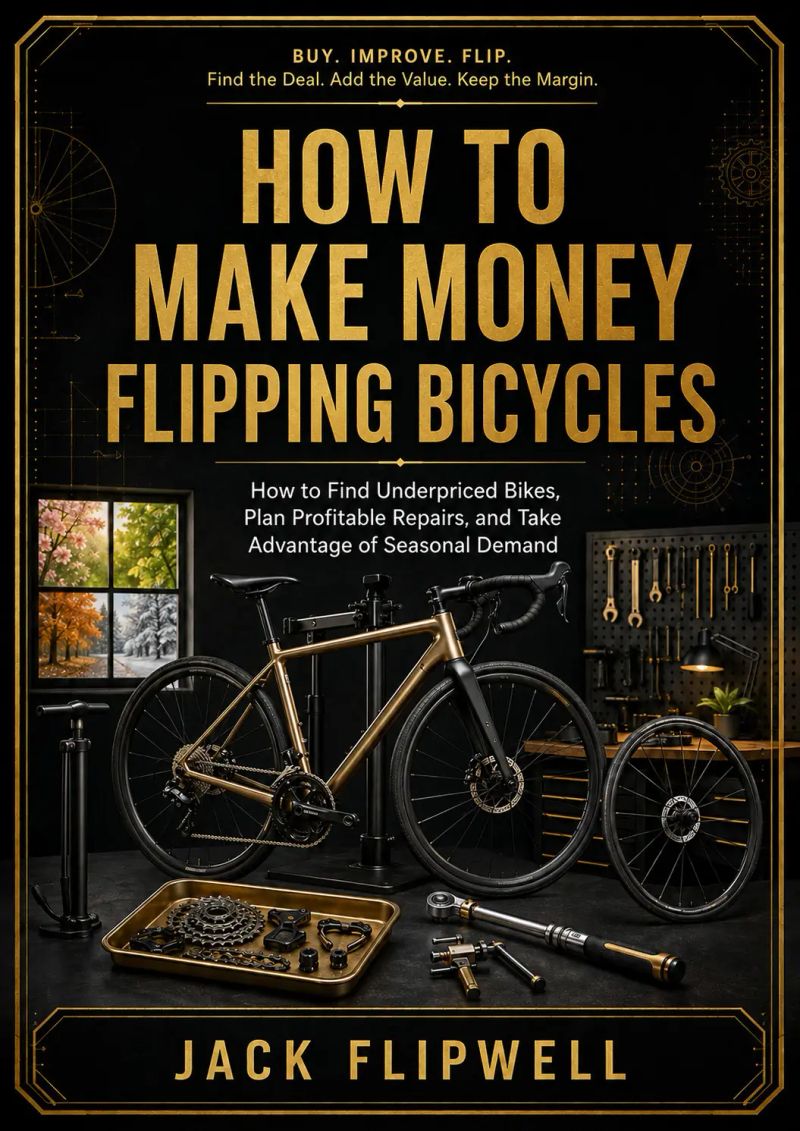
How to Make Money Flipping Bicycles - How to Find Underpriced Bikes, Plan Profitable Repairs, and Take Advantage of Seasonal Demand
By JACK FLIPWELL

Length7h 57m
About this audiobook
Can you make money flipping used bicycles? Yes, but only if you can tell the difference between a genuine opportunity and a cheap problem, calculate the real cost of preparation, and sell the right product at the right time.
How to Make Money Flipping Bicycles is a practical guide for anyone who wants to approach the used bicycle market as a repeatable business process rather than a random hunt for bargains.
JACK FLIPWELL takes you through the entire transaction cycle, from selecting the right bicycle categories and building a personal buy box to finding underpriced listings, analyzing market value, inspecting bikes, calculating the maximum purchase price, planning repairs, preparing the product, creating listings, negotiating, and closing the sale.
You will learn why a low asking price does not automatically make a bicycle underpriced and why most potential profit is created before you buy. The book shows how to compare similar bicycles, separate asking prices from realistic transaction value, and create conservative selling scenarios instead of relying on optimistic assumptions.
You will also learn how to calculate the complete economics of a project. Parts are only one expense. Transport, professional service, cleaning materials, marketplace fees, packaging, storage, time, and risk can all affect the final result. Using a simple maximum purchase price model, you can stop negotiating by instinct and begin buying according to numbers.
A major part of the book focuses on inspection and technical risk. It covers frames, forks, wheels, tires, brakes, drivetrains, bearings, suspension, wear parts, electronic systems, and other important components. The book consistently separates straightforward work that can be handled by a competent seller from repairs, measurements, and inspections that should be performed by appropriately qualified professionals.
You will learn how to plan repairs for resale economics rather than personal perfection. A new component does not automatically increase the bicycle's value by the amount you spent. Not every upgrade improves the deal. Some of the best flips come from bicycles that need thorough cleaning, a few predictable wear parts, correct adjustment, and much better presentation.
The selling process receives equal attention. You will learn how to photograph a bicycle so buyers can understand the real condition, write accurate listings, disclose defects without destroying the appeal of the offer, explain work performed, and reduce buyer uncertainty.
The book also covers negotiation in detail. You will learn how to define an asking price, target price, and minimum acceptable price, respond to low offers, avoid negotiating against yourself, and decide when faster turnover is more valuable than waiting for the absolute maximum sale price.
Seasonality is treated as a practical business variable rather than a slogan. Instead of relying on the simplistic idea of buying in winter and selling in spring, you will learn how to combine current market behavior, inventory planning, preparation capacity, cash reserves, and buyer demand.
You will also learn how to develop bicycle sources outside public listings, including repeat sellers, repair shops, bike shops, rental fleets, direct referrals, and other lawful channels. The book explains how to evaluate bundles, avoid weak inventory hidden inside package deals, and build a repeatable sourcing network.
As the process grows, the book moves from individual projects into operations. You will learn how to assign project IDs, track costs, control work in progress, identify bottlenecks, manage inventory age, and scale volume without allowing quality control to collapse.
The financial chapters show which metrics actually matter. Revenue alone does not prove that the business works. You will learn to track real project profit, percentage return, capital turnover, profit per hour, inventory value, aging stock, forecast accuracy, and loss patterns.
There is also a complete strategy for bicycles that do not sell according to plan. You will learn when to reduce price, improve the listing, expand distribution, hold inventory, sell at break-even, accept a controlled loss, or use another exit strategy.
Legal responsibility and ethical selling are treated as part of the business model. The book does not encourage hiding defects, avoiding legal obligations, selling suspicious goods, or performing dangerous repairs beyond your competence. Provenance, truthful descriptions, documentation, buyer safety, and professional inspection are treated as part of long-term profitability.
This publication was prepared with the assistance of tools that support the creative process, including artificial intelligence-based solutions. The final concept, structure, and editing belong to the author.
Audiobook details
Rating★★★★ 4.4 (11)
Includes Amazon
GenreBusiness and Economics
Length7 hrs 57 mins
Narrated byListen with 1,000+ voices
FormateBook with Audio
Publish dateSep 26, 2026
LanguageEnglish
Table of contents
1How to Make Money Flipping Bicycles
2INTRO
3Chapter 1 - Understand the Market Before You Buy Your First Bike
4Chapter 2 - How to Find Underpriced Bikes Before Someone Else Does
5Chapter 3 - How to Value a Bicycle and Calculate Your Maximum Purchase Price
Show all chaptersShow less
6Chapter 4 - Pre-Purchase Inspection - Frame, Fork, Wheels, and Safety-Critical Components
7Chapter 5 - Drivetrain, Bearings, and Wear Parts - Where Margin Disappears Fastest
8Chapter 6 - How to Plan Repairs That Add Value Instead of Just Adding Cost
9Chapter 7 - Cleaning, Cosmetic Preparation, and Getting the Bike Ready to Sell
10Chapter 8 - Photos and Listings That Turn a Prepared Bike Into a Product
11Chapter 9 - Negotiation, Buyer Communication, and Protecting Your Margin
12Chapter 10 - Safe Transaction Completion, Shipping, and Documentation
13Chapter 11 - Seasonality, Buying Timing, and Inventory Management
14Chapter 12 - Building Reliable Bicycle Sources Beyond Public Listings
15Chapter 13 - How to Scale Bicycle Flipping Without Losing Control of Costs and Quality
16Chapter 14 - The Numbers That Tell You Whether Bicycle Flipping Is Actually Profitable
17Chapter 15 - How to Manage Pricing, Discounts, and the Exit From a Bike That Is Not Selling
18Chapter 16 - Law, Ethics, Responsibility, and Seller Reputation
19Chapter 17 - Higher-Value Bikes, E-Bikes, and High-Risk Projects
20Chapter 18 - How to Increase Profit Without Buying More and More Bikes
21Chapter 19 - The Complete Bicycle Flipping System - From Listing Alert to Reinvested Capital
22Chapter 20 - From Your First Bike to a Repeatable Business

How to Make Money Flipping Sneakers - A Guide to Sourcing, Authentication, Pricing, and Profitable ResellingJACK FLIPWELL4h 29m$7.70 · $0.00
How to Make Money Reselling Clothes - How to Source, Photograph, Price, and Sell Secondhand Fashion OnlineJACK FLIPWELL5h 4m$7.70 · $0.00

How to Make Money Flipping Houses - How to Find Undervalued Properties, Control Renovation Costs, and Sell at the Right PriceJACK FLIPWELL4h 31m$7.70 · $0.00

Jak zarabiać na samochodach używanych - Jak znajdować okazje, szacować koszty i bezpiecznie sprzedawać auta z zyskiemJACK FLIPWELL4h 45m$7.80 · $0.00

Jak zarabiać na odsprzedaży iPhone’ów - Jak kupować poniżej ceny rynkowej, wykrywać wady i sprzedawać z zyskiemJACK FLIPWELL5h 30m$7.70 · $0.00

Jak zarabiać na flipach mieszkaniowych - Jak znajdować niedoszacowane nieruchomości, kontrolować koszty remontu i sprzedawać we właściwej cenieJACK FLIPWELL4h 54m$7.70 · $0.00

Jak zarabiać na używanej elektronice - Jak kupować, testować, wyceniać i sprzedawać smartfony, laptopy, tablety oraz konsoleJACK FLIPWELL5h4.7 (12)$7.70 · $0.00

How to Make Money Flipping Furniture - Turn Cheap and Forgotten Pieces into Products Buyers WantJACK FLIPWELL4h 26m$7.70 · $0.00

How to Make Money Flipping Almost Anything - A Complete System for Finding Deals, Calculating Margins, and Building Repeatable IncomeJACK FLIPWELL5h 57m$7.70 · $0.00

Jak zarabiać na odsprzedaży sneakersów - Przewodnik po wyszukiwaniu okazji, sprawdzaniu autentyczności i dochodowej sprzedażyJACK FLIPWELL4h 32m$7.70 · $0.00
How to Make Money Flipping Used Electronics - How to Buy, Test, Price, and Resell Phones, Laptops, Tablets, and Game ConsolesJACK FLIPWELL4h 22m$7.70 · $0.00

Jak zarabiać na odsprzedaży niemal wszystkiego - Kompletny system wyszukiwania okazji, obliczania marży i budowania powtarzalnego dochoduJACK FLIPWELL5h 29m$7.70 · $0.00

Jak zarabiać na odnawianiu i sprzedaży mebli - Jak zamieniać tanie i zapomniane przedmioty w produkty, które ludzie chcą kupowaćJACK FLIPWELL4h 49m$7.70 · $0.00

How to Make Money Flipping Watches - How to Spot Valuable Models, Avoid Fakes, and Resell with ConfidenceJACK FLIPWELL5h 45m$7.80 · $0.00
How to Make Money Flipping Used Cars - A Beginner's Guide to Finding Deals, Estimating Costs, and Selling Safely for ProfitJACK FLIPWELL4h 24m$7.80 · $0.00

Jak zarabiać na ubraniach z drugiej ręki - Jak wyszukiwać, fotografować, wyceniać i sprzedawać używaną modę w internecieJACK FLIPWELL4h 49m$7.70 · $0.00
How to Make Money Flipping Collectibles - How to Find Undervalued Toys, Sets, Cards, and Limited-Edition ItemsJACK FLIPWELL6h 30m$7.80 · $0.00

Jak zarabiać na przedmiotach kolekcjonerskich - Jak znajdować niedoszacowane zabawki, zestawy, karty i limitowane przedmiotyJACK FLIPWELL5h 5m$7.80 · $0.00

Jak zarabiać na kupowaniu i sprzedaży zegarków - Jak rozpoznawać wartościowe modele, unikać podróbek i sprzedawać z odpowiednią marżąJACK FLIPWELL4h 56m$7.80 · $0.00
How to Make Money Flipping iPhones - A Practical Guide to Buying Below Market Value, Spotting Defects, and Reselling for ProfitJACK FLIPWELL5h 17m$7.70 · $0.00
Never Split the DifferenceChris Voss, Tahl Raz8h 7m4.4 (277.7K)$26 · $0.00
The Intelligent Investor Rev Ed.Benjamin Graham17h 48m4.3 (191.5K)$40 · $0.00
The Hard Thing About Hard ThingsBen Horowitz7h 57m4.2 (134.3K)$26 · $0.00
Boundaries for LeadersHenry Cloud7h 36m4.3 (3.6K)$26 · $0.00

The Joys Of CompoundingGautam Baid17h 34m4.5 (2.5K)$18 · $0.00
Basic EconomicsThomas Sowell18h 32m4.5 (29.3K)$28 · $0.00

Poor Charlie’s AlmanackGrover Gardener, Charles T. Munger13h 9m4.5 (24.7K)$18 · $0.00

The Ambuja StoryNarotam Sekhsaria13h 59m4.5 (830)$33 · $0.00

The Secret Door to SuccessFlorence Scovel Shinn2h 25m4.5 (2.1K)$1.20 · $0.00

This Is Going to HurtAdam Kay5h 47m4.4 (444.7K)$24 · $0.00

Big TrustShadé Zahrai, Fayçal Sekkouah8h 36m4.6 (406)$26 · $0.00
The Intelligent Investor Third EditionBenjamin Graham, Jason Zweig20h4.4 (156.6K)$46 · $0.00

Bottle of LiesKatherine Eban14h 25m4.4 (12K)$33 · $0.00

The Antiracist Business BookTrudi Lebrón6h 10m4.6 (275)$17 · $0.00
The FormulaJoshua Robinson, Jonathan Clegg10h 41m4.4 (6.9K)$29 · $0.00

Let Them LeadJohn U. Bacon7h 10m4.5 (1.4K)$24 · $0.00

Secrets of the Millionaire MindT. Harv Eker5h 11m4.4 (301.4K)$24 · $0.00

The Person You Mean to BeDolly Chugh9h 6m4.4 (7.2K)$29 · $0.00
BoundlessNick Kostov, Sean McLain9h 17m4.5 (1.1K)$29 · $0.00

Everyday DharmaSuneel Gupta5h 2m4.5 (761)$20 · $0.00
You may also like

Hegel: Lectures on PhilosophyGeorg Wilhelm Friedrich Hegel86h 27m4.1 (12.7K)$2 · $0.00

Fale tudo em Inglês em viagens!José Roberto A. Igreja1h 6m4.0 (1.2K)$1 · $0.00

1000 essential words in Mandarin ChineseJM Gardner2h 18m$10 · $0.00

1000 essential words in Serbo-CroatianJM Gardner2h 18m$10 · $0.00

Rapid German, Vol. 2Earworms Learning1h 7m4.2 (97)$15

Wish You Were HereBill Brown Jr.55m4.8 (10)$5

Canon in DBill Brown Jr.2h 20m4.2 (18)$10

Inglês Simplicado E Para Todos.Castigo Hilário Massave1m$11 · $0.00
Couldn't Stand the WeatherBill Brown Jr.1h 14m$10

Norwegian WoodBill Brown Jr.31m$4

BeautifulBill Brown Jr.1h 14m$10

I am learning NorwegianJM Gardner3h 56m$18 · $0.00

Nobody Knows the Trouble I've SeenBill Brown Jr.16m$2

Green, Green Grass of HomeBill Brown Jr.41m$4

Everything Is BeautifulBill Brown Jr.55m$5

DivertimentoBill Brown Jr.27m$2

Prelude in F (Chopin)Bill Brown Jr.59m$5

CocaineBill Brown Jr.43m$4

1000 essential words in PortugueseJM Gardner2h 18m$10 · $0.00

On The Street Where You LiveBill Brown Jr.1h 7m$10