
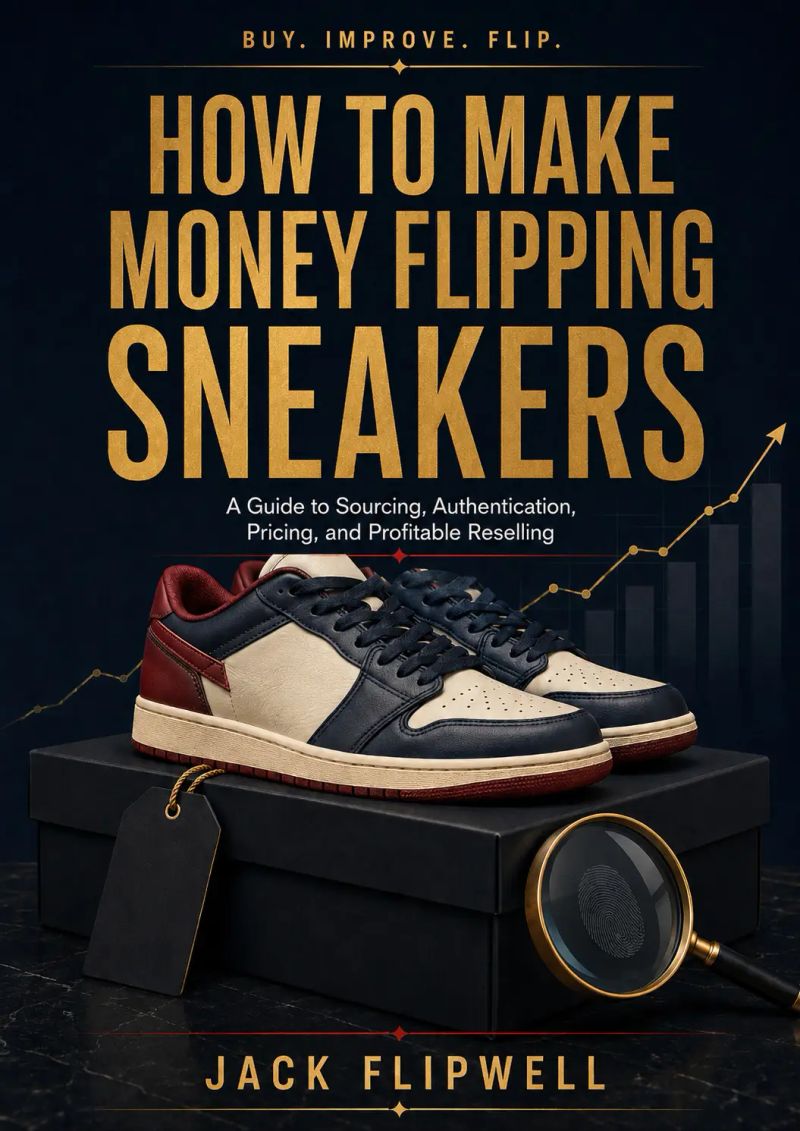
How to Make Money Flipping Sneakers - A Guide to Sourcing, Authentication, Pricing, and Profitable Reselling
By JACK FLIPWELL


Length4h 29m
About this audiobook
Sneaker flipping can look simple from the outside: buy low, sell high, keep the difference. In reality, profitable reselling depends on much more than hype, luck, or getting access to a limited release. You need to understand demand, size liquidity, actual sold prices, authentication risk, platform fees, shipping, returns, taxes, and how quickly your capital comes back. How to Make Money Flipping Sneakers is a practical guide for readers who want to approach sneaker reselling as a repeatable business process rather than a series of speculative bets.
The book shows you how to choose a market segment, identify models with real demand, study the most liquid sizes, and distinguish asking prices from completed sales. You will learn how to research current market activity, compare channels, account for restocks, and calculate your maximum buy price before you spend money. Instead of buying because something looks discounted, you will learn to buy only when the numbers leave enough room for profit and risk.
A major part of the book focuses on authentication. You will learn how SKU information, boxes, labels, materials, stitching, shape, outsole construction, insoles, accessories, and provenance fit together during verification. You will also see why no single test can prove authenticity in every situation and when professional authentication may be worth the cost. The goal is not to bypass marketplace protections or security systems, but to reduce risk and build a reputation based on accurate, responsible selling.
You will also learn how to evaluate condition, distinguish cosmetic wear from structural problems, and prepare used sneakers for resale without hiding defects. The book covers conservative cleaning, box and accessory condition, safe storage, photography, listing descriptions, pricing, negotiation, and choosing the right sales channel for each type of inventory. Clear disclosure and strong presentation help buyers make informed decisions while reducing the chance of avoidable disputes.
Different sourcing channels are examined in detail, including releases, restocks, outlets, online clearance, second-hand stores, local listings, specialist marketplaces, collector communities, and private sellers. You will learn why a large discount from retail does not automatically mean a good flip and why a poorly presented local listing can sometimes offer more opportunity than the most talked-about launch of the month. Every sourcing method is evaluated through the same lens: realistic net profit, risk, liquidity, and time.
The book also covers payment safety, shipping, documentation, scams, returns, disputes, counterfeit risk, and inventory control. You will learn how to protect high-value transactions with better records, verified payments, careful packing, and repeatable procedures. Legal, tax, consumer, import, and business obligations are addressed cautiously, with a clear reminder that requirements vary by country and should always be checked against current official rules.
Most importantly, How to Make Money Flipping Sneakers explains why profit per pair is only part of the picture. Capital rotation, days to sale, old inventory, return rates, source performance, cash reserves, and net return on capital all matter. You will learn when to hold, when to mark down, when to accept a controlled loss, and when the best decision is not to buy at all.
The final chapters turn all of these ideas into an operating system. You will get a practical first-30-days plan for choosing a segment, building a watchlist, sourcing responsibly, making your first purchases, listing and shipping correctly, recording results, and reviewing performance. The objective is not to fill a room with sneaker boxes. It is to build a disciplined process that can be measured, improved, and eventually scaled.
How to Make Money Flipping Sneakers does not promise easy money. It shows you how to find the deal, add the value, control the downside, and keep the margin after the real costs are paid. If you want a practical, realistic framework for sneaker reselling built around research, authentication, pricing, and capital discipline, this book gives you a complete starting point.
This publication was prepared with the assistance of tools that support the creative process, including artificial intelligence-based solutions. The final concept, structure, and editing belong to the author.
Audiobook details
GenreBusiness and Economics
Length4 hrs 29 mins
Narrated byListen with 1,000+ voices
FormateBook with Audio
Publish dateSep 25, 2026
LanguageEnglish
Table of contents
1INTRO
2Chapter 1 - Choose Your Segment Before You Start Buying
3Chapter 2 - Does This Model Actually Sell?
4Chapter 3 - Calculate Your Maximum Buy Price Before You Spend
5Chapter 4 - Where the Best Deals Actually Come From
Show all chaptersShow less
6Chapter 5 - Authentication: Stop Looking for One Magic Test
7Chapter 6 - Condition, Cleaning, and Preparation Without Hiding Flaws
8Chapter 7 - Photos, Description, and Pricing: Build a Listing That Sells Without Tricks
9Chapter 8 - Choose the Right Selling Channel and Complete the Transaction Safely
10Chapter 9 - Scams, Disputes, and Returns: Prepare for Problems Before They Happen
11Chapter 10 - Capital Rotation: Paper Profit Is Not Enough
12Chapter 11 - Metrics That Show Whether You Are Actually Making Money
13Chapter 12 - Scale Without Losing Control
14Chapter 13 - When to Hold, When to Mark Down, and When to Exit
15Chapter 14 - Red Flags: When the Best Decision Is Not to Buy
16Chapter 15 - Releases and Restocks: Do Not Confuse Hype With Opportunity
17Chapter 16 - Second-Hand and Local Deals: Higher Margins Require More Discipline
18Chapter 17 - Taxes, Law, and Formalities: Your Margin Is Not Really Yours Until the Business Is Properly Handled
19Chapter 18 - Build Your Own Sneaker-Flipping Operating System
20Chapter 19 - Risk Control: Protect Your Capital Before You Chase Bigger Profit
21Chapter 20 - Your First 30 Days: From Market Observation to a Repeatable Process
How to Make Money Reselling Clothes - How to Source, Photograph, Price, and Sell Secondhand Fashion OnlineJACK FLIPWELL5h 4m$7.70 · $0.00

How to Make Money Flipping Houses - How to Find Undervalued Properties, Control Renovation Costs, and Sell at the Right PriceJACK FLIPWELL4h 31m$7.70 · $0.00

Jak zarabiać na samochodach używanych - Jak znajdować okazje, szacować koszty i bezpiecznie sprzedawać auta z zyskiemJACK FLIPWELL4h 45m$7.70 · $0.00

Jak zarabiać na odsprzedaży iPhone’ów - Jak kupować poniżej ceny rynkowej, wykrywać wady i sprzedawać z zyskiemJACK FLIPWELL5h 30m$7.70 · $0.00

Jak zarabiać na flipach mieszkaniowych - Jak znajdować niedoszacowane nieruchomości, kontrolować koszty remontu i sprzedawać we właściwej cenieJACK FLIPWELL4h 54m$7.70 · $0.00

Jak zarabiać na używanej elektronice - Jak kupować, testować, wyceniać i sprzedawać smartfony, laptopy, tablety oraz konsoleJACK FLIPWELL5h4.7 (12)$7.70 · $0.00

How to Make Money Flipping Furniture - Turn Cheap and Forgotten Pieces into Products Buyers WantJACK FLIPWELL4h 26m$7.70 · $0.00

How to Make Money Flipping Almost Anything - A Complete System for Finding Deals, Calculating Margins, and Building Repeatable IncomeJACK FLIPWELL5h 57m$7.70 · $0.00

Jak zarabiać na odsprzedaży sneakersów - Przewodnik po wyszukiwaniu okazji, sprawdzaniu autentyczności i dochodowej sprzedażyJACK FLIPWELL4h 32m$7.70 · $0.00
How to Make Money Flipping Used Electronics - How to Buy, Test, Price, and Resell Phones, Laptops, Tablets, and Game ConsolesJACK FLIPWELL4h 22m$7.70 · $0.00

Jak zarabiać na odsprzedaży niemal wszystkiego - Kompletny system wyszukiwania okazji, obliczania marży i budowania powtarzalnego dochoduJACK FLIPWELL5h 29m$7.70 · $0.00

Jak zarabiać na odnawianiu i sprzedaży mebli - Jak zamieniać tanie i zapomniane przedmioty w produkty, które ludzie chcą kupowaćJACK FLIPWELL4h 49m$7.70 · $0.00

How to Make Money Flipping Watches - How to Spot Valuable Models, Avoid Fakes, and Resell with ConfidenceJACK FLIPWELL5h 45m$7.70 · $0.00

How to Make Money Flipping Used Cars - A Beginner's Guide to Finding Deals, Estimating Costs, and Selling Safely for ProfitJACK FLIPWELL4h 24m$7.70 · $0.00

Jak zarabiać na ubraniach z drugiej ręki - Jak wyszukiwać, fotografować, wyceniać i sprzedawać używaną modę w internecieJACK FLIPWELL4h 49m$7.70 · $0.00
How to Make Money Flipping Collectibles - How to Find Undervalued Toys, Sets, Cards, and Limited-Edition ItemsJACK FLIPWELL6h 30m$7.70 · $0.00

Jak zarabiać na przedmiotach kolekcjonerskich - Jak znajdować niedoszacowane zabawki, zestawy, karty i limitowane przedmiotyJACK FLIPWELL5h 5m$7.70 · $0.00

Jak zarabiać na kupowaniu i sprzedaży zegarków - Jak rozpoznawać wartościowe modele, unikać podróbek i sprzedawać z odpowiednią marżąJACK FLIPWELL4h 56m$7.70 · $0.00
How to Make Money Flipping iPhones - A Practical Guide to Buying Below Market Value, Spotting Defects, and Reselling for ProfitJACK FLIPWELL5h 17m$7.70 · $0.00
Never Split the DifferenceChris Voss, Tahl Raz8h 7m4.4 (277.7K)$26 · $0.00
The Intelligent Investor Rev Ed.Benjamin Graham17h 48m4.3 (191.5K)$40 · $0.00
The Hard Thing About Hard ThingsBen Horowitz7h 57m4.2 (134.3K)$26 · $0.00

Boundaries for LeadersHenry Cloud7h 36m4.3 (3.6K)$26 · $0.00

Not Everything Counts but Everything Matters: The powerful and inspirational new book about leadership and achieving success from the visionary multi-premiership winning Panthers coachIvan Cleary6h 1m4.6 (680)$24 · $0.00
BuildTony Fadell11h 5m4.5 (14.3K)$8 · $0.00

The Joys Of CompoundingGautam Baid17h 34m4.5 (2.5K)$18 · $0.00
Basic EconomicsThomas Sowell18h 32m4.5 (29.3K)$28 · $0.00

Poor Charlie’s AlmanackGrover Gardener, Charles T. Munger13h 9m4.5 (24.7K)$18 · $0.00

The Ambuja StoryNarotam Sekhsaria13h 59m4.5 (830)$33 · $0.00

The Secret Door to SuccessFlorence Scovel Shinn2h 25m4.5 (2.1K)$1.20 · $0.00

This Is Going to HurtAdam Kay5h 47m4.4 (444.7K)$24 · $0.00

Big TrustShadé Zahrai, Fayçal Sekkouah8h 36m4.6 (406)$26 · $0.00
The Intelligent Investor Third EditionBenjamin Graham, Jason Zweig20h4.4 (156.6K)$46 · $0.00

Bottle of LiesKatherine Eban14h 25m4.4 (12K)$33 · $0.00

The Antiracist Business BookTrudi Lebrón6h 10m4.6 (275)$17 · $0.00
The FormulaJoshua Robinson, Jonathan Clegg10h 41m4.4 (6.9K)$29 · $0.00

Let Them LeadJohn U. Bacon7h 10m4.5 (1.4K)$24 · $0.00

Secrets of the Millionaire MindT. Harv Eker5h 11m4.4 (301.4K)$24 · $0.00

The Person You Mean to BeDolly Chugh9h 6m4.4 (7.2K)$29 · $0.00
You may also like
Competing Against LuckClayton M. Christensen, Taddy Hall, Karen Dillon, David S. Duncan7h 25m4.3 (7.6K)$24 · $0.00

The Problems of PhilosophyBertrand Russell4h 32m4.0 (25.8K)Free

The Upside of IrrationalityDan Ariely8h 18m4.1 (37.4K)$26 · $0.00

Tertium OrganumP. D. Ouspensky14h 45m4.4 (633)$1.99 · $0.00

The Meaning of TruthWilliam James6h 24m4.1 (442)$2 · $0.00

On Sense and ReferenceGottlob Frege2h 14m4.1 (484)$1 · $0.00

An Enquiry Concerning the Principles of MoralsDavid Hume5h 28m4.2 (7K)$2.30

The Cloud of UnknowingAnonymous5h 19m4.2 (8K)$16 · $0.00

Fundamental Principles of the Metaphysic of Morals Immanuel Kant3h 16m4.0 (48.8K)Free
In Pursuit of EleganceMatthew E. May5h 46m3.8 (719)$14

Series 79 Exam Study GuideMarie Peterson9h 58m$13

Social Value: A Study in Economic Theory, Critical and ConstructiveBenjamin M. Anderson5h 33m$1 · $0.00

Natural History of EnthusiasmIsaac Taylor7h 23m3.7 (55)$1 · $0.00
Practical ArgumentationGeorge K. Pattee8h 27m$2 · $0.00

The Critique of Judgement Part I: Critique of Aesthetic JudgementImmanuel Kant5h 48m3.8 (679)$3.50 · $0.00
Recording, Mixing, and Sound EngineeringDesmond Achterberg15h 4m$80

Tea and the Effects of Tea DrinkingW. Scott Tebb1h 12m$2.30

Erotic Drawings 120 illustrationsVictoria Charles1h 11m3.1 (11)$15 · $0.00

Medieval MedicineJames J. Walsh5h 31m3.7 (30)$1 · $0.00

The Psychology of ReligionJoseph McCabe1h 32m$15