
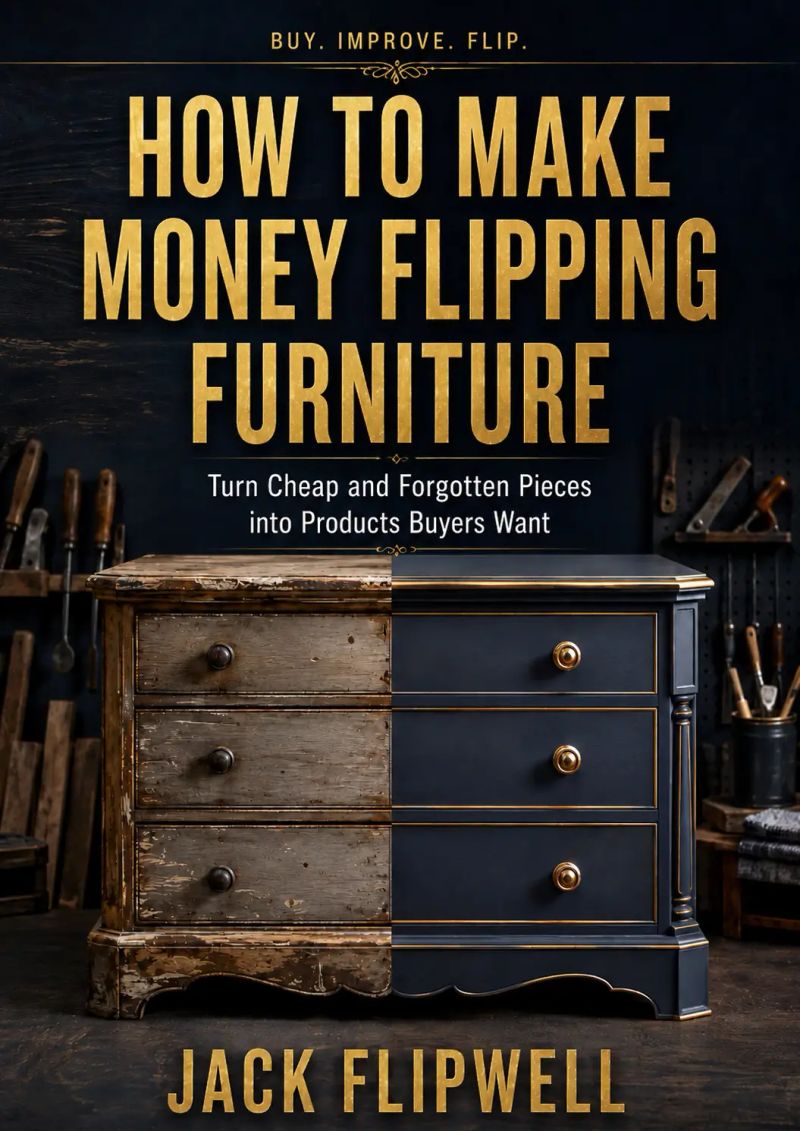
How to Make Money Flipping Furniture - Turn Cheap and Forgotten Pieces into Products Buyers Want
By JACK FLIPWELL


Length4h 25m
About this audiobook
Can an overlooked dresser bought cheaply become a piece someone is willing to pay several times more for? Yes, but only when the purchase is right, the costs are controlled, and the improvements actually increase value. Furniture flipping is not about painting every old cabinet and hoping for easy profit. It is a practical business built on sourcing, diagnosis, cost control, safe refurbishment, presentation, negotiation, and fast capital rotation.
How to Make Money Flipping Furniture is a complete beginner-friendly guide to buying used, forgotten, or undervalued furniture, improving it intelligently, and reselling it for a realistic margin. It takes you through the entire process from choosing a profitable segment and finding deals to inspecting materials, calculating costs, completing sensible improvements, creating strong listings, negotiating with buyers, and closing the sale.
You will learn how to choose furniture that fits your budget, vehicle, storage space, tools, available time, and skill level. The book explains how to separate a genuinely good deal from a cheap problem and how to evaluate dressers, tables, cabinets, chairs, and other pieces before committing money. You will also learn how to use local marketplaces, classifieds, community groups, resale stores, clearances, and personal sourcing networks more efficiently.
A major part of the book focuses on understanding what you are actually buying. You will learn the practical differences between solid wood, veneer, plywood, MDF, particleboard, laminate, and other common materials. You will see how to inspect carcasses, legs, drawer systems, hinges, tops, fixing points, and previous repairs, and how to recognize warning signs such as swelling, moisture damage, pests, mold, unstable structures, persistent odors, or damage that requires specialist diagnosis.
The financial side is treated just as seriously as the physical work. You will learn how to estimate realistic resale value, calculate complete project costs, build a contingency, and establish a maximum purchase price before negotiation begins. The book shows how to compare projects using cash margin, return on invested cash, active labor hours, and days to sale. That means you can stop judging success by the difference between purchase price and selling price alone.
The practical refurbishment chapters cover cleaning, repairs, sanding, painting, staining, clear finishes, basic upholstery, hardware, drawer slides, hinges, and furniture legs. You will learn when a simple clean and adjustment can create a better return than a complete makeover, when natural wood should stay visible, and when an expensive improvement adds less value than it costs.
The book also makes the limits of beginner work clear. Structural repairs, significant mold, active pests, unknown coatings, electrical components, complex upholstery, potentially hazardous materials, and valuable antiques may require qualified professional help. When technical, health, legal, or safety risk exceeds your competence, walking away or using a specialist can be the most profitable decision.
Safety is built into the process. The guide covers dust control, ventilation, chemicals, personal protective equipment, power tools, lifting, fire risk, storage, and safe transport. It also reminds readers to follow product instructions and check current local rules concerning workplace safety, environmental obligations, waste, taxes, consumer protection, and business activity where relevant.
Once the furniture is ready, you will learn how to sell it properly. The book explains how to photograph furniture with a phone, use light and backgrounds effectively, show scale and function, disclose defects honestly, and create a logical image sequence. You will also learn how to write listings that answer buyer questions before they are asked and choose sales channels that fit the product instead of publishing everywhere without a plan.
Pricing and negotiation receive their own practical framework. You will learn how to set an asking price, target price, and minimum price, create a sensible negotiation buffer, evaluate low offers, use bundles or delivery strategically, and manage reservations and advance payments responsibly. The objective is not to win every negotiation. It is to protect the margin while keeping capital moving.
The book also covers handover, payment, delivery, documentation, and post-sale issues. You will learn how to complete a final quality check, prepare furniture for transport, reduce misunderstandings, and respond calmly to legitimate problems after the sale. For regular commercial activity, the guide emphasizes checking current local legal, tax, consumer, and record-keeping requirements rather than relying on assumptions.
This publication was prepared with the assistance of tools that support the creative process, including artificial intelligence-based solutions. The final concept, structure, and editing belong to the author.
Audiobook details
GenreBusiness and Economics
Length4 hrs 25 mins
Narrated byListen with 1,000+ voices
FormateBook with Audio
Publish dateSep 24, 2026
LanguageEnglish
Table of contents
1INTRO
2Chapter 1 - Choose Your Segment Before You Start Buying
3Chapter 2 - Where to Find Cheap Furniture and How to Tell a Deal from a Problem
4Chapter 3 - Materials, Construction, and Quality: What You Are Really Buying
5Chapter 4 - How to Value the Potential and Price the Project Before You Buy
Show all chaptersShow less
6Chapter 5 - Transport and Storage: Logistics That Protect Your Margin
7Chapter 6 - Cleaning and Preparation: The Cheapest Way to Reveal Value
8Chapter 7 - Repairs: What to Fix Yourself and When to Stop
9Chapter 8 - Sanding and Surface Preparation Without Damaging the Furniture
10Chapter 9 - Painting: How to Create a Professional Finish That Sells
11Chapter 10 - Staining, Sealing, and Transparent Finishes: When the Wood Should Stay Visible
12Chapter 11 - Basic Upholstery: Where Simple Flipping Ends and Specialist Work Begins
13Chapter 12 - Hardware and Details: Small Changes That Can Raise Value
14Chapter 13 - Workshop Safety: Dust, Chemicals, Ventilation, and Protection You Should Not Ignore
15Chapter 14 - Photography and Styling: Show the Furniture So Buyers Understand Its Value
16Chapter 15 - Listings and Sales Channels: Turn Interest into Contact from the Right Buyer
17Chapter 16 - Pricing and Negotiation: Protect the Margin Without Scaring Buyers Away
18Chapter 17 - Handover, Payment, and Problems After the Sale
19Chapter 18 - Capital Rotation and Performance Tracking: Measure What Actually Makes Money
20Chapter 19 - Scaling and Red Flags: Grow Without Multiplying Mistakes
21Chapter 20 - Your First 30 Days: Start Furniture Flipping Without Creating Chaos

Jak zarabiać na flipach mieszkaniowych - Jak znajdować niedoszacowane nieruchomości, kontrolować koszty remontu i sprzedawać we właściwej cenieJACK FLIPWELL4h 54m$7.70 · $0.00

Jak zarabiać na używanej elektronice - Jak kupować, testować, wyceniać i sprzedawać smartfony, laptopy, tablety oraz konsoleJACK FLIPWELL5h4.7 (12)$7.70 · $0.00

How to Make Money Flipping Almost Anything - A Complete System for Finding Deals, Calculating Margins, and Building Repeatable IncomeJACK FLIPWELL5h 57m$7.70 · $0.00

How to Make Money Flipping Used Electronics - How to Buy, Test, Price, and Resell Phones, Laptops, Tablets, and Game ConsolesJACK FLIPWELL4h 22m$7.70 · $0.00

Jak zarabiać na odsprzedaży niemal wszystkiego - Kompletny system wyszukiwania okazji, obliczania marży i budowania powtarzalnego dochoduJACK FLIPWELL5h 29m$7.70 · $0.00

Jak zarabiać na odnawianiu i sprzedaży mebli - Jak zamieniać tanie i zapomniane przedmioty w produkty, które ludzie chcą kupowaćJACK FLIPWELL4h 49m$7.70 · $0.00

How to Make Money Flipping Watches - How to Spot Valuable Models, Avoid Fakes, and Resell with ConfidenceJACK FLIPWELL5h 45m$7.70 · $0.00
How to Make Money Flipping Used Cars - A Beginner's Guide to Finding Deals, Estimating Costs, and Selling Safely for ProfitJACK FLIPWELL4h 24m$7.70 · $0.00

Jak zarabiać na ubraniach z drugiej ręki - Jak wyszukiwać, fotografować, wyceniać i sprzedawać używaną modę w internecieJACK FLIPWELL4h 49m$7.70 · $0.00

How to Make Money Flipping Collectibles - How to Find Undervalued Toys, Sets, Cards, and Limited-Edition ItemsJACK FLIPWELL6h 30m$7.70 · $0.00

Jak zarabiać na przedmiotach kolekcjonerskich - Jak znajdować niedoszacowane zabawki, zestawy, karty i limitowane przedmiotyJACK FLIPWELL5h 5m$7.70 · $0.00

Jak zarabiać na kupowaniu i sprzedaży zegarków - Jak rozpoznawać wartościowe modele, unikać podróbek i sprzedawać z odpowiednią marżąJACK FLIPWELL4h 56m$7.70 · $0.00
How to Make Money Flipping iPhones - A Practical Guide to Buying Below Market Value, Spotting Defects, and Reselling for ProfitJACK FLIPWELL5h 17m$7.70 · $0.00

Jak zarabiać na kupnie, odnawianiu i sprzedaży łodzi - Jak oceniać kadłub, silnik i instalacje, kontrolować koszty renowacji oraz sprzedawać w sezonieJACK FLIPWELL2h 7m$7.70 · $0.00

How to Make Money Flipping Boats - How to Assess Hulls, Engines, and Systems, Control Renovation Costs, and Sell in SeasonJACK FLIPWELL2h 1m$7.70 · $0.00

Jak zarabiać na kupnie, odnawianiu i sprzedaży kamperów oraz przyczep kempingowych - Jak oceniać konstrukcję i instalacje, planować opłacalne renowacje oraz bezpiecznie sprzedawaćJACK FLIPWELL2h 5m$7.70 · $0.00

How to Make Money Flipping Motorhomes and Travel Trailers - How to Assess Structure and Systems, Plan Profitable Renovations, and Resell SafelyJACK FLIPWELL2h 2m$7.70 · $0.00

How to Make Money Flipping Used Construction Machinery - How to Verify Mechanical Condition, Work History, Transport Costs, and Resale PotentialJACK FLIPWELL2h 5m$7.70 · $0.00

How to Make Money Flipping Motorcycles and Scooters - How to Assess Mechanical Condition, Estimate Repair Costs, Manage Risk, and Resell for ProfitJACK FLIPWELL8h 9m$7.70 · $0.00
Never Split the DifferenceChris Voss, Tahl Raz8h 7m4.4 (277.7K)$26 · $0.00
The Intelligent Investor Rev Ed.Benjamin Graham17h 48m4.3 (191.5K)$40 · $0.00
The Hard Thing About Hard ThingsBen Horowitz7h 57m4.2 (134.3K)$26 · $0.00

Boundaries for LeadersHenry Cloud7h 36m4.3 (3.6K)$26 · $0.00

Not Everything Counts but Everything Matters: The powerful and inspirational new book about leadership and achieving success from the visionary multi-premiership winning Panthers coachIvan Cleary6h 1m4.6 (680)$24 · $0.00
BuildTony Fadell11h 5m4.5 (14.3K)$8 · $0.00

The Joys Of CompoundingGautam Baid17h 34m4.5 (2.5K)$18 · $0.00
Basic EconomicsThomas Sowell18h 32m4.5 (29.3K)$28 · $0.00

Poor Charlie’s AlmanackGrover Gardener, Charles T. Munger13h 9m4.5 (24.7K)$18 · $0.00

The Ambuja StoryNarotam Sekhsaria13h 59m4.5 (830)$33 · $0.00

The Secret Door to SuccessFlorence Scovel Shinn2h 25m4.5 (2.1K)$1.20 · $0.00

This Is Going to HurtAdam Kay5h 47m4.4 (444.7K)$24 · $0.00

Big TrustShadé Zahrai, Fayçal Sekkouah8h 36m4.6 (406)$26 · $0.00
The Intelligent Investor Third EditionBenjamin Graham, Jason Zweig20h4.4 (156.6K)$46 · $0.00

Bottle of LiesKatherine Eban14h 25m4.4 (12K)$33 · $0.00

The Antiracist Business BookTrudi Lebrón6h 10m4.6 (275)$17 · $0.00

The FormulaJoshua Robinson, Jonathan Clegg10h 41m4.4 (6.9K)$29 · $0.00

Let Them LeadJohn U. Bacon7h 10m4.5 (1.4K)$24 · $0.00

Secrets of the Millionaire MindT. Harv Eker5h 11m4.4 (301.4K)$24 · $0.00

The Person You Mean to BeDolly Chugh9h 6m4.4 (7.2K)$29 · $0.00
You may also like
The Elements of Style (Annotated)William Strunk3h 16m4.4 (100.2K)$2 · $0.00

Lord, Teach Us To Pray (Treatise On Prayer)Andrew Murray1h 28m4.4 (3.1K)$2 · $0.00
The Art of Money Getting or, Golden Rules for Making MoneyP.T. Barnum1h 17m3.9 (5.9K)$2 · $0.00
How to Speak and Write CorrectlyJoseph Devlin5h 43m3.7 (3.6K)$2 · $0.00

Born to LoseBill Brown Jr.34m4.5 (11)$4

I am learning KurdishJM Gardner3h 53m$18 · $0.00
Down on the CornerBill Brown Jr.29m$2

Marry MeBill Brown Jr.26m$2

Gods of the Silver ScreenOne World Media2h 22m$15

The Public SpeakerAnthony Ekanem1h 22m$5 · $0.00

Up from Slavery & Working With the Hands (Annotated)Booker T. Washington15h 40m4.4 (22)$2 · $0.00
Dixie McGuireBill Brown Jr.1h 10m$10

Heinrich Heine: A short biography5 Minutes, 5 Minute Biographies, George Fritsche5m$1 · $0.00
The Newsletter BusinessEstelle Bouvier4h 42m$9 · $0.00

LOUISIANA MOTORCYCLE PERMIT EXAM PREP 2026–2027Tyler Knox7h 58m$10

Der Co Trainer. Schneller Zum Optimalen Sitz Auf Dem Pferd.Unknown Author26m4.6 (13)$20 · $0.00

VIRGINIA REAL ESTATE LICENSE EXAM PREP 2026 – 2027 EDITIONDaniel Mercer8h 39m$11.50 · $0.00

Talks on Writing English. First SeriesArlo Bates6h 31m3.9 (38)$2 · $0.00

Bound by the Bridge KeeperTalia Morvane11h 36m$5
Customer LoyaltyAnthony Ekanem14m$5 · $0.00