
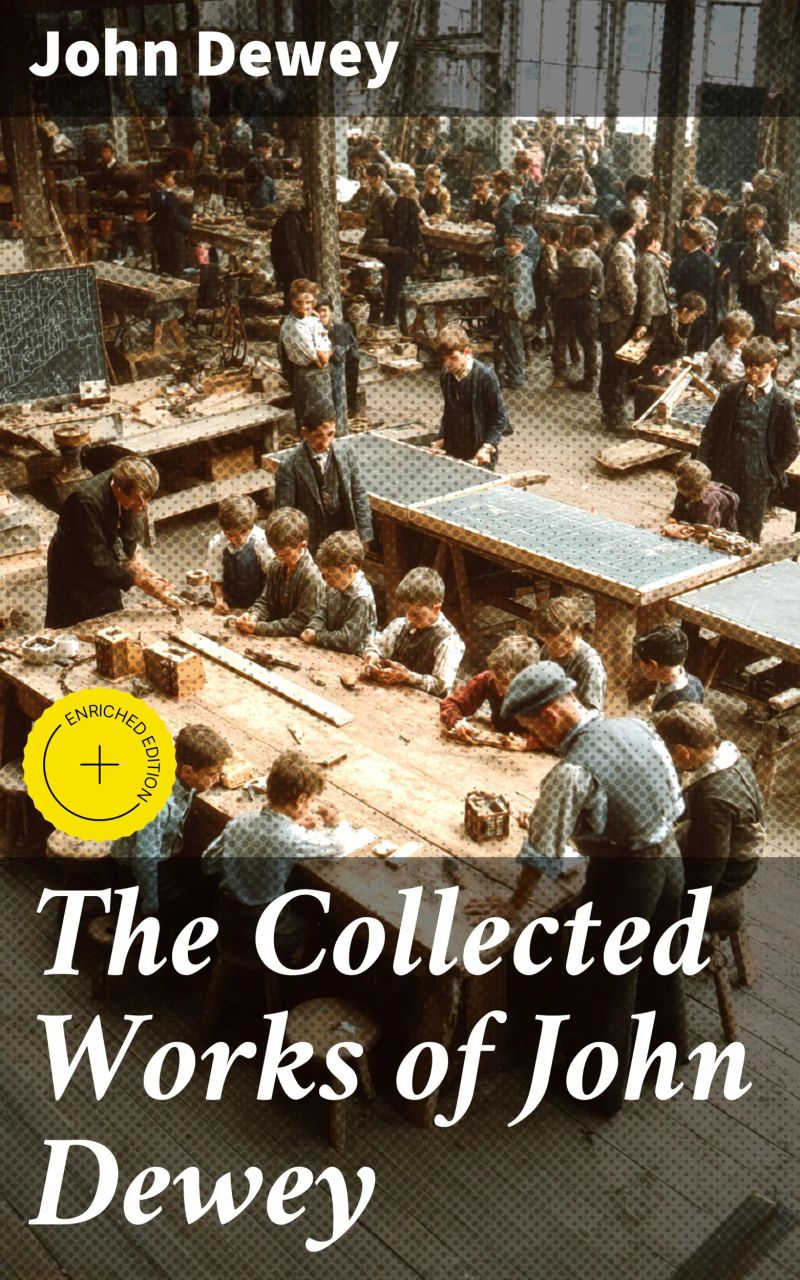
The Collected Works of John Dewey
Enriched edition. American School System, Theory of Educational, Philosophy, Psychological Works, Political Writings: 40 Titles in One VolumeBy John Dewey


Length168h 58m
About this audiobook
The Collected Works of John Dewey is a monumental compilation that encapsulates the vast intellectual breadth and philosophical insights of one of the 20th century's most influential thinkers. Spanning various themes such as education, democracy, and the interplay between experience and knowledge, these works evoke a pragmatic literary style that emphasizes the importance of human experience in shaping thought and action. Dewey's writings resonate within the modernist literary context, often reflecting the complexities of an evolving societal landscape through a lens that seeks to bring philosophical abstractions into practical application. John Dewey (1859-1952), an instrumental figure in the development of pragmatism and progressive education, was not only a philosopher but also a public intellectual guided by a commitment to social reform. His experiences as an educator and as a participant in the social issues of his times deeply informed his writings, making his views on education and democracy relevant not just philosophically, but also in practical terms for a society eager for change. For those seeking a comprehensive understanding of modern educational philosophy and democratic ideals, The Collected Works of John Dewey serves as an essential resource. It invites readers to engage with Dewey's transformative ideas and to consider their implications for contemporary society, making this collection an invaluable contribution to both scholars and general readers alike.
In this enriched edition, we have carefully created added value for your reading experience:
- A comprehensive Introduction outlines these selected works' unifying features, themes, or stylistic evolutions.
- The Author Biography highlights personal milestones and literary influences that shape the entire body of writing.
- A Historical Context section situates the works in their broader era—social currents, cultural trends, and key events that underpin their creation.
- A concise Synopsis (Selection) offers an accessible overview of the included texts, helping readers navigate plotlines and main ideas without revealing critical twists.
- A unified Analysis examines recurring motifs and stylistic hallmarks across the collection, tying the stories together while spotlighting the different work's strengths.
- Reflection questions inspire deeper contemplation of the author's overarching message, inviting readers to draw connections among different texts and relate them to modern contexts.
- Lastly, our hand‐picked Memorable Quotes distill pivotal lines and turning points, serving as touchstones for the collection's central themes.
Audiobook details
Rating★★★★ 4.1 (45)
Includes Goodreads, Amazon
GenrePhilosophy
Length168 hrs 58 mins
Narrated byListen with 1,000+ voices
FormateBook with Audio
Publish dateDec 4, 2023
LanguageEnglish
Table of contents
1Introduction
2Introduction
3Author Biography
4Historical Context
5Synopsis (Selection)
Show all chaptersShow less
6On Education
7Democracy and Education: An Introduction to the Philosophy of Education (pt. 1)
8Democracy and Education: An Introduction to the Philosophy of Education (pt. 2)
9Democracy and Education: An Introduction to the Philosophy of Education (pt. 3)
10Democracy and Education: An Introduction to the Philosophy of Education (pt. 4)
11Democracy and Education: An Introduction to the Philosophy of Education (pt. 5)
12Democracy and Education: An Introduction to the Philosophy of Education (pt. 6)
13Democracy and Education: An Introduction to the Philosophy of Education (pt. 7)
14The Child and the Curriculum
15The School and Society (pt. 1)
16The School and Society (pt. 2)
17Schools Of To-morrow (pt. 1)
18Schools Of To-morrow (pt. 2)
19Schools Of To-morrow (pt. 3)
20Schools Of To-morrow (pt. 4)
21The Schools of Utopia
22Moral Principles in Education
23Interest and Effort in Education
24Health and Sex in Higher Education
25My Pedagogic Creed
26On Philosophy
27German Philosophy and Politics (pt. 1)
28German Philosophy and Politics (pt. 2)
29Leibniz's New Essays Concerning the Human Understanding: A Critical Exposition (pt. 1)
30Leibniz's New Essays Concerning the Human Understanding: A Critical Exposition (pt. 2)
31Leibniz's New Essays Concerning the Human Understanding: A Critical Exposition (pt. 3)
32Leibniz's New Essays Concerning the Human Understanding: A Critical Exposition (pt. 4)
33Studies in Logical Theory (pt. 1)
34Studies in Logical Theory (pt. 2)
35Studies in Logical Theory (pt. 3)
36Studies in Logical Theory (pt. 4)
37Studies in Logical Theory (pt. 5)
38Studies in Logical Theory (pt. 6)
39Interpretation of Savage Mind
40Ethics (with James Hayden Tufts) (pt. 1)
41Ethics (with James Hayden Tufts) (pt. 2)
42Ethics (with James Hayden Tufts) (pt. 3)
43Ethics (with James Hayden Tufts) (pt. 4)
44Ethics (with James Hayden Tufts) (pt. 5)
45Ethics (with James Hayden Tufts) (pt. 6)
46Ethics (with James Hayden Tufts) (pt. 7)
47Ethics (with James Hayden Tufts) (pt. 8)
48Ethics (with James Hayden Tufts) (pt. 9)
49Ethics (with James Hayden Tufts) (pt. 10)
50The Problem of Values

Democracy and Education & Other Writings (A Collected Edition)John Dewey25h 20m4.1 (12.5K)$1.99 · $0.00
The Logic of ThoughtJohn Dewey52h 28m$1.99 · $0.00

The Collected Works of John Dewey (Annotated)John Dewey168h 46m4.5 (36)$2 · $0.00

Collected Writings on Education (Annotated)John Dewey24h 16m$2 · $0.00

PSYCHOLOGY & SOCIAL PRACTICE – Premium Collection (Annotated)John Dewey40h 49m$2 · $0.00

China, Japan and the U.S.A (Annotated)John Dewey8h 54m3.8 (12)$2 · $0.00

EXPERIENCE AND EDUCATION – Premium Edition (Including Democracy & Education) (Annotated)John Dewey19h 17m4.6 (1K)$2 · $0.00

Reconstruction in PhilosophyJohn Dewey6h 43m4.0 (690)$1 · $0.00

The Essential John Dewey: 20+ Books in One EditionJohn Dewey88h 54m$1 · $0.00

Leibniz's New Essays Concerning the Human Understanding: A Critical ExpositionJohn Dewey8h 57m3.9 (24)$1 · $0.00
How We Think & Other Works On LogicJohn Dewey51h 12m$2 · $0.00

John Dewey: Philosophical WorksJohn Dewey86h 57m$1 · $0.00

Schools Of To-morrow + The Schools of UtopiaJohn Dewey7h 42m3.9 (146)$1 · $0.00

John Dewey: The Philosophy of EducationJohn Dewey33h 59m4.0 (64)$1 · $0.00

The Collected Works of John DeweyJohn Dewey166h 52m4.1 (31)$2 · $0.00
CREATIVE INTELLIGENCE & Other Works on the Human Thought ProcessJohn Dewey52h 27m4.1 (25)$1.99 · $0.00

Democracy and Education & Experience and EducationJohn Dewey19h 11m4.3 (18)$1 · $0.00
John Dewey: The Philosophy of Education (Annotated)John Dewey33h 49m$1.99 · $0.00
JOHN DEWEY Premium Collection – 40+ Books in One Single Volume: Works on Psychology, Education, Philosophy & Politics (Annotated)John Dewey168h 33m4.4 (44)$1.99 · $0.00

IlluminationsWalter Benjamin10h 12m4.4 (16.2K)$20 · $0.00

That Bird Has My WingsJarvis Jay Masters9h 49m4.4 (13.7K)$29 · $0.00

Tâo Teh KingLaozi2h 34m4.4 (230.9K)$2 · $0.00

SymposiumPlato3h 26m4.4 (97.9K)$1.20 · $0.00

Buddhist Boot CampTimber Hawkeye2h 39m4.4 (8.4K)$18 · $0.00
Enchiridion & The Discourses of Epictetus (Annotated)Arrian Epictetus18h 9m4.4 (3.5K)$2 · $0.00

The Meditations of the Emperor Marcus Aurelius AntoninusEmperor of Rome Marcus Aurelius5h 41m4.4 (1.8M)$1 · $0.00

Crime and PunishmentFyodor Dostoevsky23h 11m4.4 (1.3M)$12 · $0.00

MeditationsMarcus Aurelius5h 52m4.4 (433.7K)$1 · $0.00

Everyday DharmaSuneel Gupta5h 2m4.5 (761)$20 · $0.00

The Joyful Wisdom ("La Gaya Scienza")Friedrich Wilhelm Nietzsche11h 37m4.4 (26.6K)$1 · $0.00
The Art of LivingEpictetus, Sharon Lebell3h 16m4.4 (50.1K)$18 · $0.00
MeditationsEmperor Of Rome Marcus Aurelius7h 23m4.3 (477.5K)$1.20 · $0.00

The Imitation of ChristThomas à Kempis6h 27m4.3 (84.6K)$21 · $0.00

Sadhana: the realisation of lifeRabindranath Tagore3h 49m4.4 (8.6K)$6 · $0.00
SapiensYuval Noah Harari15h 18m4.3 (1.4M) · 1193$33 · $0.00
You BelongSebene Selassie8h 35m4.4 (2.7K)$26 · $0.00

The Song Celestial; Or, Bhagavad-Gîtâ (from the Mahâbhârata)Anonymous2h 18m4.4 (3.2K)$2 · $0.00

The KybalionThe Three Initiates3h 47m4.3 (58.7K)$20 · $0.00

Chuang Tzu: Mystic, Moralist, and Social ReformerZhuangzi14h 42m4.4 (1.2K)$1 · $0.00
You may also like
The History of Rome (Volumes 1-5)Theodor Mommsen101h 1m4.4 (892)$2 · $0.00

Fiat Money Inflation in France: How it Came, What it Brought, and How it EndedAndrew Dickson White3h 41m4.2 (842)$1 · $0.00

The Collected Works of Karl Marx (Annotated)Karl Marx134h 35m4.6 (321)$2 · $0.00

How the Other Half Lives: Studies Among the Tenements of New YorkJacob A. Riis9h4.0 (5.7K)$1 · $0.00

My Weird School: Class Pet Mess!Dan Gutman7m4.2 (519)$4 · $0.00

The Art of WarNiccolò Machiavelli7h 15m4.0 (11.9K)$21 · $0.00

Perpetual Peace A Philosophical EssayImmanuel Kant4h3.9 (3.1K)$2.30

Experiments in Government and the Essentials of the Constitution (Annotated)Elihu Root2h 13m4.0 (16)$1.99 · $0.00

Constitution of the Republic of SerbiaRepublic of Serbia4h 9m$2 · $0.00

Open Letter to AmericaArthur Ransome1h$2 · $0.00

A Second Letter to the Rev. William Maskell, M.AMayow Wynell Mayow4h 55m$1 · $0.00

The Balkans: Old, New InstabilitiesGiorgio Fruscione5h 6m$7

The Sabbath and the Crystal PalaceAnonymous25m$2 · $0.00

Eighth State of the Union AddressAndrew Jackson1h 24m$1 · $0.00

Vienna Convention on the Law of TreatiesVarious Authors1h 30m$2 · $0.00

Life and Letters of Sir Wilfrid LaurierOscar Douglas Skelton15h 40m$2 · $0.00

Student Success Act ( HR5 ; 113th Congress)John Kline4h 9m$2 · $0.00
Analytic Summary of The Wealth of NationsAdam Smith22m$7 · $0.00

First State of the Union AddressWilliam Howard Taft1h 37m$2 · $0.00

Tyranny UnmaskedJohn Taylor of Caroline13h 1m4.6 (34)$1 · $0.00