
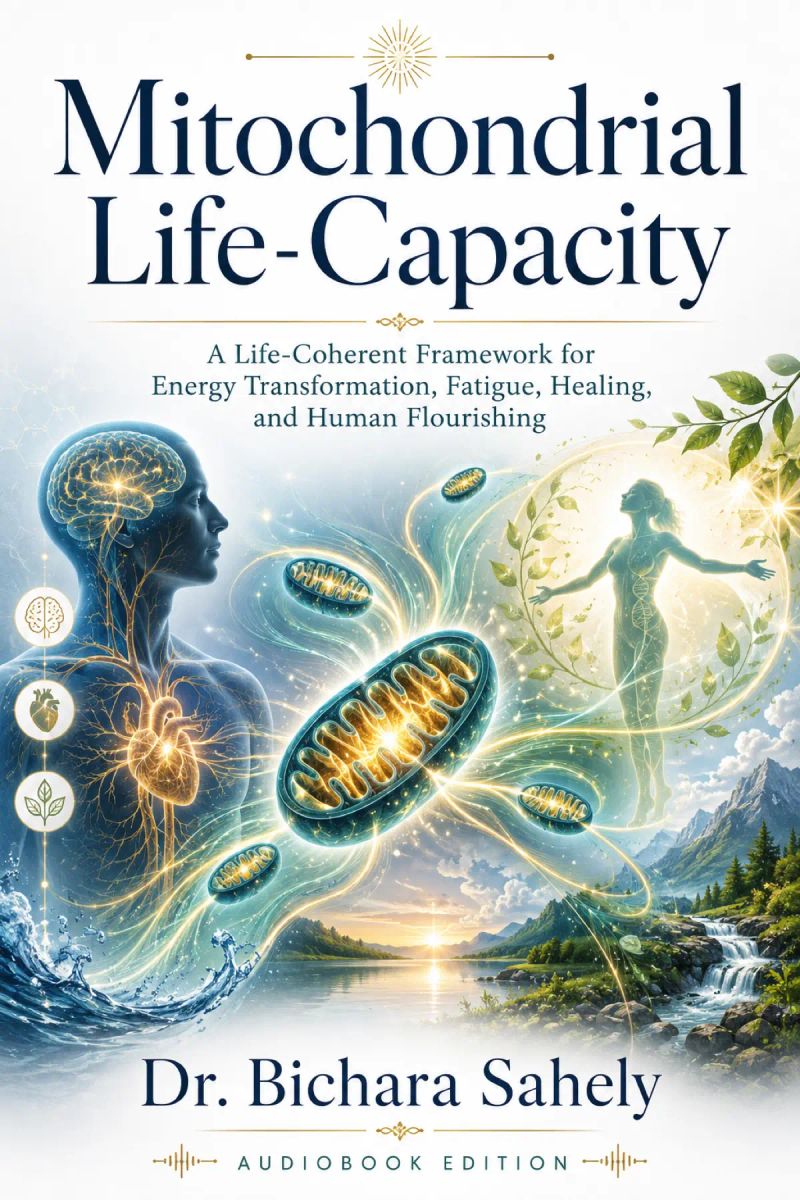
Mitochondrial Life-Capacity
A Life-Coherent Framework for Energy Transformation, Fatigue, Healing, and Human FlourishingBy Dr. Bichara Sahely


Length1h 8m
About this audiobook
Mitochondrial Life-Capacity offers a life-coherent framework for understanding energy transformation, fatigue, healing, and human flourishing. Dr. Bichara Sahely explores how mitochondria translate food, oxygen, sleep, movement, stress, safety, inflammation, and ecological conditions into the body’s capacity to think, move, repair, relate, and participate in life. Fatigue is reframed not as weakness, but as a protective signal that demand may be exceeding the body’s capacity to transform energy coherently. Drawing on mitochondrial science, metaboception, GDF15 signaling, salugenesis, allostasis, interoception, and public health, this audiobook invites listeners to rethink health as life-capacity enabled, healing as life-capacity restored, and flourishing as life-capacity expressed.
Audiobook details
GenreHealth and Wellness
Length1 hr 8 mins
Narrated byListen with 1,000+ voices
FormateBook with Audio
Publish dateJun 14, 2026
LanguageEnglish
Table of contents
1Chapter 1
2Executive Summary
3Evidence Status and Scientific Guardrails
4Chapter 1. Introduction: From Disease Management to Energy-Enabled Life-Capacity
5Chapter 2. The Core Claim: Health as Coherent Energy Transformation
Show all chaptersShow less
6Chapter 3. Organism-Niche Coupling and the Body's Energy Economy
7Chapter 4. Mitochondrial Life-Capacity Defined
8Chapter 5. Fatigue as the Felt Narrowing of Energy Affordance
9Chapter 6. Wu-Wei Physiology: Minimal Forcing as Biological Coherence
10Chapter 7. The Electron Transport Chain as Flow Architecture
11Chapter 8. Reductive and Oxidative Stress as Disturbed Flow
12Chapter 9. Cristae Structure and the Architecture of Energetic Possibility
13Chapter 10. Mitochondrial Dynamics: Fusion, Fission, Mitophagy, and Network Coherence
14Chapter 11. Autophagy, Proteostasis, and the Cost of Maintenance
15Chapter 12. Mitochondrial Quality Control and Restorative Margins
16Chapter 13. The Energy Gap: When Demand Exceeds Transformation Capacity
17Chapter 14. Local Compensation: Warburg-Like Metabolism and Redox Workarounds
18Chapter 15. Global Compensation: GDF15, FGF21, and Mitoceptive Escalation
19Chapter 16. Metaboception: The Brain's Model of the Body's Energy Budget
20Chapter 17. Fatigue as Energetic Affordance Perception
21Chapter 18. Anxiety, Valence, Arousal, and the Energetic Body Budget
22Chapter 19. Tired but Wired: Mobilization Without Resolution
23Chapter 20. From Felt Capacity to Behavior: How the Body Conditions Human Doing
24Chapter 21. Vitality as Expanded Affordance
25Chapter 22. Salugenesis as Mitochondrial Healing Completion
26Chapter 23. The Cell Danger Response and the Logic of Incomplete Healing
27Chapter 24. Autophagy, Mitophagy, and Proteostasis as Hidden Healing Labor
28Chapter 25. Sleep, Melatonin, and Circadian Repair
29Chapter 26. Movement, Pacing, and the Restoration of Flow
30Chapter 27. Nutrition, Substrate Quality, and Redox Burden
31Chapter 28. Belonging, Dignity, Meaning, and the Energetic Cost of Threat
32Chapter 29. The Salutogenic Affordance Field as Mitochondrial Infrastructure
33Chapter 30. Restorative Margins: The Space in Which Healing Becomes Possible
34Chapter 31. From Repair to Participation: Healing Must Reopen Life
35Chapter 32. From Mechanism to Practice: A Life-Coherent Clinical Method
36Chapter 33. Chronic Fatigue, ME/CFS, Long COVID, and Post-Infectious Syndromes
37Chapter 34. Dysautonomia, Chronic Pain, and Neuroimmune Sensitization
38Chapter 35. Depression, Anxiety, Burnout, and Trauma-Related Fatigue
39Chapter 36. Metabolic Disease, Obesity, Diabetes, and Fatty Liver Disease
40Chapter 37. Autoimmune, Autoinflammatory, Mast-Cell, and Inflammatory Illness
41Chapter 38. Aging, Frailty, Sarcopenia, and Cancer-Related Fatigue
42Chapter 39. Public Health Applications: Designing for Mitochondrial Life-Capacity
43Chapter 40. Civilizational Applications: Energy, Extraction, and the Life-Ground
44Chapter 41. The Life-Coherent Action Cycle for Mitochondrial Life-Capacity
45Chapter 42. Clinical Ethics: From Blame to Life-Enabling Responsibility
46Chapter 43. Why Measurement Must Serve Life-Capacity
47Chapter 44. Measuring Mitochondrial Life-Capacity
48Chapter 45. Dynamic Testing: Measuring Recovery, Not Only Resting State
49Chapter 46. Measuring Fatigue as Energetic Affordance
50Chapter 47. Measuring Restorative Margins

Preserving Life, Transforming Power in GazaDr Bichara Sahely1h 42mFree

Preserving Life, Transforming PowerDr. Bichara Sahely1h 4mFree
Putting the Missing Bridge to WorkDr. Bichara Sahely2h 12mFree

The Missing BridgeDr. Bichara Sahely1h 5mFree
Transformational Laboratories ProtocolDr. Bichara Sahely2h 33mFree
Artificial Intelligence and the Epistemic CommonsDr Bichara Sahely3h 12mFree

Conflict, Repair, and Non-DominationDr Bichara Sahely2h 21mFree

Institutions of Reflexive TransformationDr Bichara Sahely1h 51mFree
The Politics of Civilizational HealingDr. Bichara Sahely2h 13mFree

The Missing Grammar of Modern CivilizationDr. Bichara Sahely2h 8mFree
Civilizational Healing Research ArchitectureDr. Bichara Sahely1h 24mFree
How Does a Civilization Learn to Heal?Dr. Bichara Sahely1h 16mFree

From Competent Physicians to Healing SocietiesDr. Bichara Sahely2h 20mFree

Competence Is Necessary, but Not SufficientDr. Bichara Sahely1h 15mFree

Life-Grounding CanMEDSDr. Bichara Sahely1h 13mFree
The Dynamic Architecture of ViabilityDr Bichara Sahely2h 1mFree

Completing the Life-Value Onto-Axiology ProgramDr. Bichara Sahely1h 9m5.0 (1)Free

BEYOND GLOBAL JUSTICEDr. Bichara Sahely1h 25mFree

The Sweetness That Consumed the WorldBichara Sahely16h 14mFree
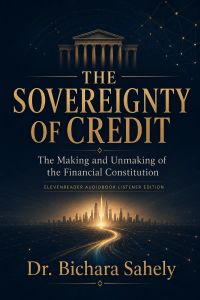
THE SOVEREIGNTY OF CREDITDr. Bichara Sahely3h 56mFree

Eat It!Jordan Syatt, Michael Vacanti4h 40m4.6 (1.5K)$20 · $0.00

Consent Laid BareChanel Contos7h 11m4.5 (1.7K)$24 · $0.00

How to Make Disease DisappearRangan Chatterjee5h 26m4.5 (3.5K)$24 · $0.00

The Complete Herbal (Annotated)Nicholas Culpeper29h 8m4.5 (1.4K)$2 · $0.00

A Plague Upon Our HouseScott W. Atlas MD10h 37m4.5 (3.4K)$20 · $0.00

The Cancer CodeDr. Jason Fung10h 48m4.5 (5.3K)$29 · $0.00

The Gift of TherapyIrvin Yalom7h 39m4.5 (38.8K)$26 · $0.00

EarlySarah DiGregorio9h 47m4.5 (1.3K)$29 · $0.00

Bottle of LiesKatherine Eban14h 25m4.4 (12K)$33 · $0.00
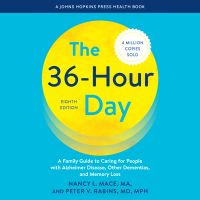
The 36-Hour DayNancy L. Mace, Peter V. Rabins17h 13m4.4 (9.2K)$28 · $0.00

FlooredSara Reardon10h 36m4.5 (1K)$29 · $0.00
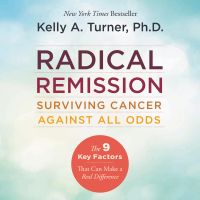
Radical RemissionKelly A. Turner9h 26m4.4 (8.1K)$29 · $0.00
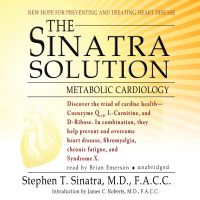
The Sinatra SolutionStephen T. Sinatra MD9h4.5 (899)$20 · $0.00

The Songaminute ManSimon McDermott6h 12m4.5 (280)$24 · $0.00
Sometimes BrilliantLarry Brilliant12h 27m4.5 (954)$29 · $0.00

Live Your LifeAmanda Kloots, Anna Kloots10h 54m4.4 (13.7K)$29 · $0.00

All in Her HeadElizabeth Comen13h 25m4.4 (18.2K)$33 · $0.00
The Wisdom of Your BodyHillary McBride9h 14m4.4 (6.7K)$29 · $0.00
The Alzheimer's SolutionDean Sherzai, Ayesha Sherzai9h 47m4.4 (1.9K)$29 · $0.00
Rewire Your MindsetBrian Keane6h 49m4.5 (896)$23 · $0.00
You may also like
How to Not Always Be WorkingCody Cook-Parrott1h 58m3.6 (2.2K)$16 · $0.00

The More or Less Definitive Guide to Self-CareAnna Borges4h 23m4.0 (1.6K)$20 · $0.00
The End of DietingJoel Fuhrman5h 57m4.1 (4.5K)$24 · $0.00
The Happiness TrackEmma Seppala5h 58m3.9 (2.3K)$24 · $0.00
How Not to Kill YourselfSet Sytes, Faith G. Harper PhD2h 41m4.2 (911)$15

Hashimoto's ProtocolIzabella Wentz10h 47m4.2 (7K)$29 · $0.00

How To Stop Worrying And Start Living (Annotated)Dale Carnegie13h 9m4.2 (149.4K)$1.99 · $0.00

Organ Speak: What It Really Means to Listen to our Bodies, from the international bestselling author of GUTGiulia Enders8h 53m4.2 (1.4K)$29 · $0.00
How To EatMark Bittman, David Katz7h 13m3.8 (4.1K)$24 · $0.00

You BelongSebene Selassie8h 35m4.4 (2.7K)$26 · $0.00
Do Hard ThingsSteve Magness8h 54m4.1 (10.7K)$29 · $0.00

Eat for LifeJoel Fuhrman9h 8m4.3 (2K)$6 · $0.00
StretchScott Sonenshein7h 58m3.9 (1.8K)$26 · $0.00
Diet CultsMatt Fitzgerald9h 23m3.9 (2K)$20
CLEAN 7Alejandro Junger7h 4m3.9 (1.5K)$24 · $0.00
Stress Management: Unlocking Inner Strength With Philosophical Insights (Simple and Practical Strategies and Techniques for Achieving Work-life Balance, Improved Well-being and Long-term Resilience)Mason g, John Yarbrough1h 9m$5.20 · $0.00

LIT: Life Ignition ToolsJeff Karp, Teresa Barker11h 25m4.0 (232)$29 · $0.00
Foundations of HealthEric Goodman5h 11m4.3 (81)$24 · $0.00

Stop Holding BackJoze Piranian7h 40m4.4 (10)$26 · $0.00

HACKING HALITOSISDan LaPray1h 13m4.4 (10)$9.99