
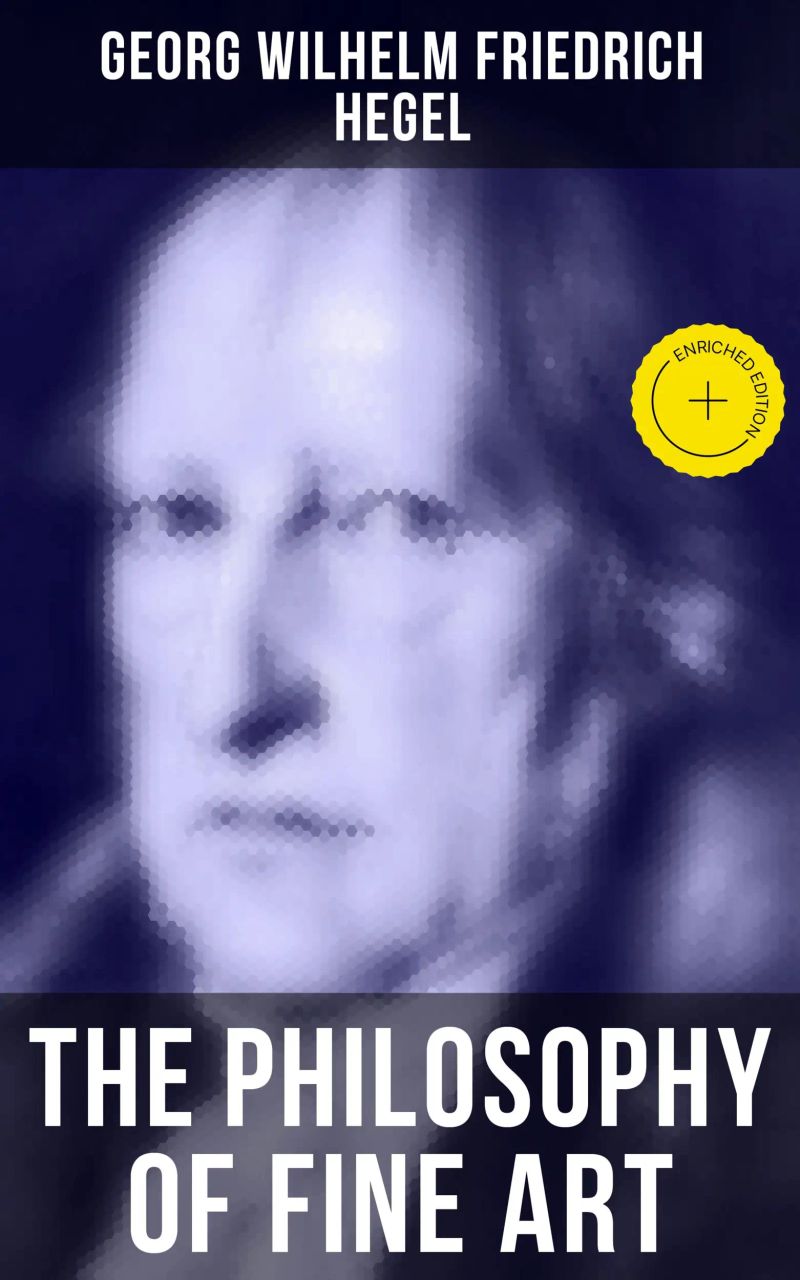
The Philosophy of Fine Art
Enriched edition. Dialectical Aesthetics, Ideal Beauty, and the Historical Evolution of Art and Absolute SpiritBy Georg Wilhelm Friedrich Hegel


Length71h 25m
About this audiobook
Georg Wilhelm Friedrich Hegel's 'The Philosophy of Fine Art' is a seminal work that delves into the intricate relationship between art and philosophy. Written with Hegel's characteristic dialectical style, this book examines the essence of beauty, the evolution of art throughout history, and the significance of artistic expression in the human experience. Hegel's exploration of the subjective nature of art, its relation to the Absolute, and its role in shaping society makes this book a must-read for anyone interested in aesthetics and intellectual culture. His dense prose and complex arguments reflect his deep understanding of art and philosophy, making this work a challenging but rewarding read for those willing to engage with Hegel's philosophical ideas. The intricate connections Hegel draws between art, history, and thought showcase his profound insights into the nature of artistic creativity and its impact on the human spirit. 'The Philosophy of Fine Art' is a timeless masterpiece that continues to inspire scholars and art lovers alike, reaffirming Hegel's enduring influence on aesthetics and philosophical thought.
In this enriched edition, we have carefully created added value for your reading experience:
- A succinct Introduction situates the work's timeless appeal and themes.
- The Synopsis outlines the central plot, highlighting key developments without spoiling critical twists.
- A detailed Historical Context immerses you in the era's events and influences that shaped the writing.
- An Author Biography reveals milestones in the author's life, illuminating the personal insights behind the text.
- A thorough Analysis dissects symbols, motifs, and character arcs to unearth underlying meanings.
- Reflection questions prompt you to engage personally with the work's messages, connecting them to modern life.
- Hand‐picked Memorable Quotes shine a spotlight on moments of literary brilliance.
- Interactive footnotes clarify unusual references, historical allusions, and archaic phrases for an effortless, more informed read.
Audiobook details
Rating★★★★ 4.3 (2K)
Includes Goodreads, LibraryThing, Amazon, StoryGraph
GenreOther
Length71 hrs 25 mins
Narrated byListen with 1,000+ voices
FormateBook with Audio
Publish dateDec 17, 2020
LanguageEnglish
Table of contents
1Euphorion (Studies of the Antique and the Mediaeval in the Renaissance)
2Introduction
3Synopsis
4Historical Context
5Author Biography
Show all chaptersShow less
6Volume 1
7Introduction (pt. 1)
8Introduction (pt. 2)
9Introduction (pt. 3)
10I. The Position of Art Relatively to Finite Reality, Religion, and Philosophy
11Chapter I The Notion of the Beautiful in Its General Significance
12Chapter II The Beauty of Nature
13Chapter III The Beauty of Art, or the Ideal (pt. 1)
14Chapter III The Beauty of Art, or the Ideal (pt. 2)
15Chapter III The Beauty of Art, or the Ideal (pt. 3)
16Chapter III The Beauty of Art, or the Ideal (pt. 4)
17Volume 2
18Introduction
19Subsection I The Symbolic Type of Art
20Chapter I Unconscious Symbolism
21Chapter II The Symbolism of the Sublime
22Chapter III The Conscious Symbolism of the Comparative Type of Art (pt. 1)
23Chapter III The Conscious Symbolism of the Comparative Type of Art (pt. 2)
24Subsection II The Classical Type of Art
25Chapter I The Coming into Being of the Classic Ideal
26Chapter II The Ideal of the Classical Type of Art
27Chapter III The Dissolution of the Classical Type of Art
28Subsection III The Romantic Type of Art
29Chapter I The Religious Domain of Romantic Art
30Chapter II Chivalry
31Chapter III The Formal Self-Subsistency of Individual Particularities
32Volume 3
33Introduction
34Division of Subject
35First Subsection Architecture
36Chapter I Independent Symbolical Architecture
37Chapter II Classical Architecture
38Chapter III Romantic Architecture
39Subsection II Sculpture
40Chapter I The Principle of Genuine Sculpture
41Chapter II The Ideal of Sculpture
42Chapter III Different Types of Presentment, Material, and Historical Stages in the Evolution of Sculpture
43Subsection III The Romantic Arts
44Chapter I The Art of Painting
452. PARTICULAR MODES OF THE DEFINITION OF PAINTING (pt. 1)
462. PARTICULAR MODES OF THE DEFINITION OF PAINTING (pt. 2)
47Chapter II Music
483. THE RELATION BETWEEN MEANS OF EXPRESSION IN MUSIC AND ITS CONTENT
49Chapter III Poetry
503. THE CREATIVE IMPULSE OF THE POET 17
Hegel's Phenomenology of MindGeorg Wilhelm Friedrich Hegel27h 45m4.1 (29.6K)$1.99 · $0.00
The Philosophy of MindGeorg Wilhelm Friedrich Hegel13h 18m4.1 (683)$1.99 · $0.00
Hegel's Phenomenology of Mind (Annotated)Georg Wilhelm Friedrich Hegel27h 34m4.4 (11)$1.99 · $0.00

Hegel - Premium Collection (Annotated)Georg Wilhelm Friedrich Hegel242h 8m$2 · $0.00
Science of Logic (Annotated)Georg Wilhelm Friedrich Hegel17h 57m4.3 (131)$2 · $0.00

The Greatest Works of G.W.F. Hegel (Annotated)Georg Wilhelm Friedrich Hegel244h 13m$2 · $0.00

The Essential Works of Georg Wilhelm Friedrich Hegel (Annotated)Georg Wilhelm Friedrich Hegel242h 56m$2 · $0.00
The Phenomenology of Mind (Annotated)Georg Wilhelm Friedrich Hegel28h 2m$3 · $0.00
The Philosophy of Fine Art (Vol. 1-3) (Annotated)Georg Wilhelm Friedrich Hegel71h 16m$2 · $0.00

Hegel: The Science of LogicGeorg Wilhelm Friedrich Hegel17h 39m4.3 (1.8K)$1 · $0.00

The Greatest Works of G.W.F. HegelGeorg Wilhelm Friedrich Hegel242h 7m3.6 (33)$1 · $0.00

Hegel's Philosophy of MindGeorg Wilhelm Friedrich Hegel14h 28m4.0 (717)$1 · $0.00

Science of LogicGeorg Wilhelm Friedrich Hegel17h 39m4.3 (2.4K)$1 · $0.00
The Introduction to Hegel's Philosophy of Fine ArtsGeorg Wilhelm Friedrich Hegel8h 26m4.2 (189)$1 · $0.00

Science of Logic (Summarized Edition)Georg Wilhelm Friedrich Hegel3h 43m$2

Hegel: The Science of LogicGeorg Wilhelm Friedrich Hegel17h 53m4.3 (4.5K)$1.99 · $0.00
Hegel: Lectures on PhilosophyGeorg Wilhelm Friedrich Hegel86h 27m4.1 (12.7K)$2 · $0.00

The Essence of Hegel's PhilosophyGeorg Wilhelm Friedrich Hegel243h 17m$2 · $0.00
Wissenschaft der Logik (Kommentiert)Georg Wilhelm Friedrich Hegel39h 16m$1 · $0.00

Mere ChristianityC. S. Lewis7h 7m4.4 (519.7K)$24 · $0.00

Her Daily BreadKate Wood12h 57m4.6 (153)$33 · $0.00

The Holy Bible - 1 SamuelKing James2h 13m4.8 (1.6K)$3 · $0.00

The American Standard Bible — The Gospel of MatthewMatthew3h 56m4.7 (3K)$2 · $0.00

Bad Fat Black GirlSesali Bowen6h 32m4.7 (2.8K)$24 · $0.00
The King James Audio Bible New Testament CompleteChristopher Glyn20h 2m4.7 (2.6K)$12 · $0.00
Faiths CheckbookCharles Spurgeon12h 44m4.7 (3.2K)$11 · $0.00

Ten Things I Wish You Knew About Your Child's Mental HealthDr. Billy Garvey4h 53m4.7 (2.4K)$20 · $0.00

Designing Terry Pratchett’s DiscworldPaul Kidby3h 52m4.7 (343)$20 · $0.00

The Chosen Book OneAmanda Jenkins, Kristen Hendricks, Dallas Jenkins3h 8m4.6 (4.9K)$10 · $0.00

The Lives of BrianBrian Johnson9h 45m4.6 (3.5K)$29 · $0.00
Expository Thoughts on the Gospel of LukeJ.C. Ryle27h 13m4.7 (536)$18 · $0.00

CrossroadsKaleb Dahlgren7h 56m4.6 (4.9K)$26 · $0.00

Across the RiverKent Babb11h 40m4.6 (927)$29 · $0.00

Brain Training for RidersAndrea Monsarrat Waldo5h 56m4.7 (550)$19 · $0.00

My Effin' LifeGeddy Lee17h 11m4.6 (13.1K)$40 · $0.00

Kings and PawnsHoward Bryant10h 9m4.6 (678)$29 · $0.00

The Elementia Chronicles #2: The New OrderSean Fay Wolfe11h 17m4.6 (841)$29 · $0.00

The ActsLuke2h 55m4.6 (19.7K)$12 · $0.00

New Testament - Easy NavigationWorld English Bible19h 35m4.6 (1.3K)$1.30 · $0.00
You may also like

Creative EvolutionHenri Bergson13h4.2 (2.4K)$20 · $0.00

The 22 Immutable Laws of MarketingAl Ries, Jack Trout1h 26m4.1 (27.5K)$16 · $0.00

How to Analyze People on Sight - Through the Science of Human Analysis: The Five Human Types (Annotated)Ralph Paine Benedict, Elsie Lincoln Benedict7h 28m3.6 (4.1K)$0.99 · $0.00

A Treatise of Human NatureDavid Hume24h 50m4.1 (20.1K)$2.30
Time and Free WillHenri Bergson8h 31m4.1 (1.8K)$1.99 · $0.00

THE PRINCIPLES OF PSYCHOLOGY (Complete Edition In 2 Volumes)William James62h 58m4.3 (895)$1 · $0.00

An Essay Concerning Human UnderstandingJohn Locke30h 12m4.0 (18K)$1.20 · $0.00
Hegel's Philosophy of MindGeorg Wilhelm Friedrich Hegel14h 28m4.0 (717)$1 · $0.00

The art of public speaking (translated)DALE CARNEGIE17h 52m4.0 (9.2K)$4.60 · $0.00

Instant ReplayJerry Kramer, Dick Schaap8h 49m4.3 (3.8K)$20 · $0.00
Maxims and ReflectionsJohann Wolfgang von Goethe3h 23m4.2 (1.4K)$2.30
Mind is a MythU.G. Krishnamurti6h 3m4.2 (630)$1.99 · $0.00

Human Nature And ConductJohn Dewey9h 22m4.1 (1.8K)$1.20 · $0.00

The Wealth of NationsAdam Smith30h 50m4.1 (130.7K)$20 · $0.00

BIOGRAPHIA LITERARIASamuel Taylor Coleridge15h 47m3.8 (1.8K)$1.99 · $0.00

Memory: How to Develop, Train, and Use ItWilliam Walker Atkinson4h 9m3.9 (1.4K)$0.99 · $0.00

The Art of SellingAnthony Ekanem1h 48m$5

American Football UnleashedMarcus B. Cole9h 4m$6.40 · $0.00

Project Manager Technology SuiteDawn Jones, Sherry Prindle4h 25m$75

Handbook of Summer Athletic SportsVarious3h 21m$1 · $0.00