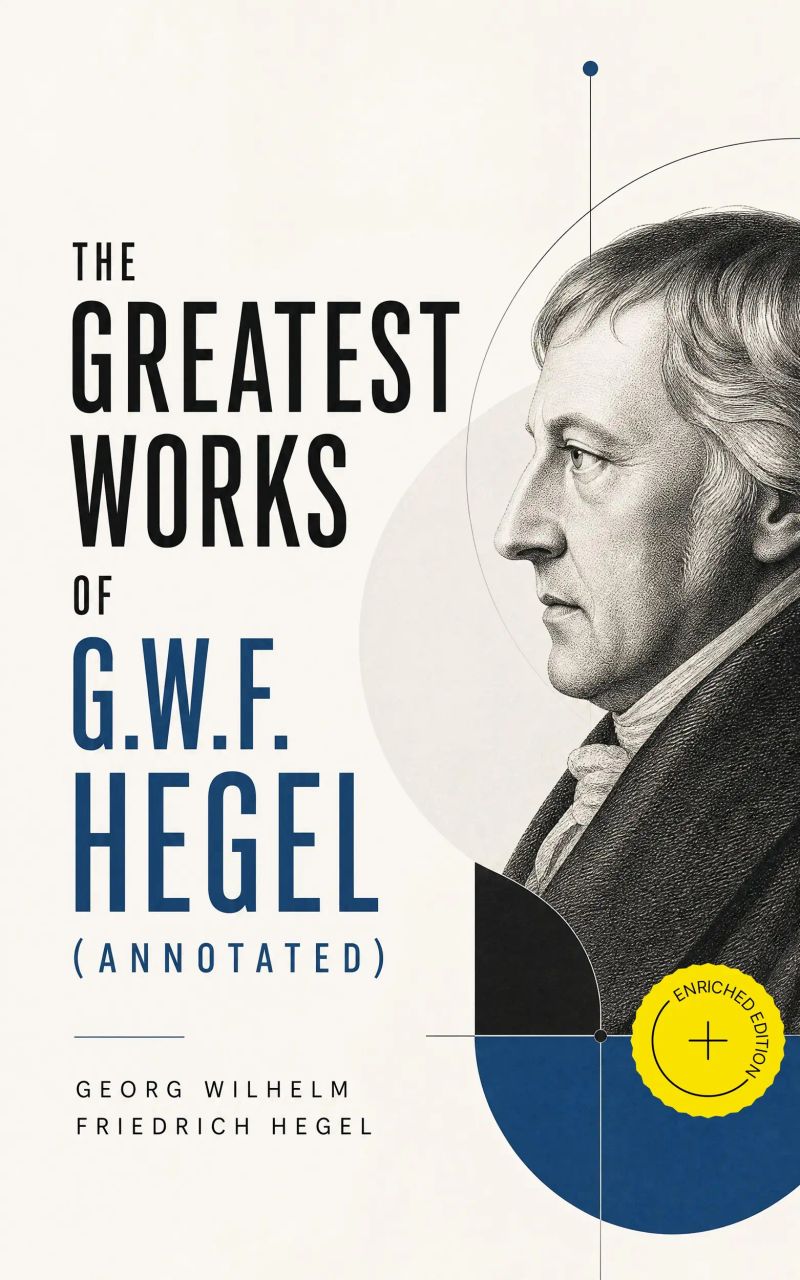
The Greatest Works of G.W.F. Hegel (Annotated)

The Greatest Works of G.W.F. Hegel (Annotated)

Enriched Edition. Phenomenology of Mind, Philosophy of Mind, Hegel's Aesthetics, The Criticism of Hegle's Work and Hegelianism by Schopenhauer, Nietzsche & MarxBy Georg Wilhelm Friedrich Hegel
Michael Caine
Listen with Sir Michael Caine™ and 1,000+ voices
Length244h 12m

About this audiobook

The Greatest Works of G.W.F. Hegel gathers the central writings through which Hegel reshaped modern philosophy: works of logic, metaphysics, political theory, aesthetics, religion, and historical consciousness. Written in a dense, dialectical style, these texts move by tension and resolution, showing thought as an unfolding process rather than a static system. Situated between Kantian critique, Romantic speculation, and the crises of post-Revolutionary Europe, Hegel's work seeks to comprehend freedom, reason, and history as internally connected. Georg Wilhelm Friedrich Hegel (1770–1831) was formed by the intellectual ferment of German Idealism and by the political upheavals of his age, especially the French Revolution and the Napoleonic transformation of Europe. His career as teacher, editor, and professor led him to construct one of philosophy's most ambitious systems, in which logic, nature, spirit, society, art, and religion are understood as moments in the self-realization of reason. This volume is recommended for readers prepared to engage patiently with a demanding but profoundly rewarding thinker. Philosophers, historians of ideas, theologians, literary scholars, and serious general readers will find here an indispensable gateway into the architecture of modern thought. This enriched edition has been carefully crafted to add value to your reading experience. - A comprehensive Introduction outlines these selected works' unifying features, themes, or stylistic evolutions. - A Historical Context section situates the works in their broader era—social currents, cultural trends, and key events that underpin their creation. - A concise Synopsis (Selection) offers an accessible overview of the included texts, helping readers navigate plotlines and main ideas without revealing critical twists. - A unified Analysis examines recurring motifs and stylistic hallmarks across the collection, tying the stories together while spotlighting the different work's strengths. - Reflection questions inspire deeper contemplation of the author's overarching message, inviting readers to draw connections among different texts and relate them to modern contexts.

Audiobook details

GenrePhilosophy
Length244 hrs 12 mins
Narrated byListen with 1,000+ voices
FormateBook with Audio
Publish dateNov 22, 2023
LanguageEnglish

Table of contents

1The Greatest Works of G.W.F. Hegel (Annotated)
205Introduction
2Introduction
206A. The Notion of the History of Philosophy
3Historical Context
2071. Common Ideas regarding the History of Philosophy
4Synopsis (Selection)
2082. Explanatory Remarks upon the Definition of the History of Philosophy
5Introduction
2093. Results obtained with respect to the Notion of the History of Philosophy
Show all chapters
6The Life and Work of Georg Wilhelm Friedrich Hegel
210B. The Relation of Philosophy to other Departments of Knowledge
7Primary Works
2111. The Historical side of this Connection
8The Phenomenology of Mind
2122. Separation of Philosophy from other allied departments of Knowledge
9Preface: On Scientific Knowledge
2133. Commencement of Philosophy and of its History
10Introduction
214C. Division, Sources, and Method adopted in treating of the History of Philosophy
11A. Consciousness
2152. Sources of the History of Philosophy
12II. Perception: Or Things and Their Deceptiveness
2163. Method of Treatment adopted in this History of Philosophy
13III. Force and the Understanding-The World of Appearance and the Supersensible World
217Oriental Philosophy
14B. Self-Consciousness
218A. Chinese Philosophy
15A. Independence and Dependence of Self-Consciousness Lordship and Bondage
219B. Indian Philosophy
16B. Freedom of Self-Consciousness Stoicism: Scepticism: The Unhappy Consciousness
220PART ONE GREEK PHILOSOPHY
17C. Free Concrete Mind
221Section One First Period, from Thales to Aristotle
18V. Reason’s Certainty and Reason’s Truth
222Chapter I Period I.—Division I.—Thales to Anaxagoras
19A. Observation as a Process of Reason
223A. The Ionic Philosophy
20a. Observation of Nature
224B. Pythagoras and the Pythagoreans
21b. Observation of Self-Consciousness in its Pure Form and in its Relation to External Reality — Logical and Psychological Laws
225C. The Eleatic School
22c. Observation of the Relation of Self-Consciousness To its Immediate Actuality — Physiognomy and Phrenology.
226D. Heraclitus
23B. The Realization of Rational Self-Consciousness Through its Own Activity
227E. Empedocles, Leucippus and Democritus
24a. Pleasure and Necessity
228F. Anaxagoras
25b. The Law of the Heart, and the Frenzy Of Self-Conceit
229Chapter II First Period, Second Division: From the Sophists to the Socratics
26c. Virtue and the Course of the World
230A. The Sophists
27C. Individuality, which Takes Itself to Be Real In and for Itself
231B. Socrates
28a. Society as a Herd of Individuals: Deceit: "Actual Fact"
232C. The Socratics
29b. Reason as Lawgiver
233Chapter III First Period, Third Division: Plato and Aristotle
30c. Reason as Testing Laws
234A. Plato
31VI. Spirit
2351. Dialectic
32A. Objective Spirit — The Ethical Order
2362. Philosophy of Nature
33a. The Ethical World: Law Human and Divine: Man and Woman
2373. Philosophy of Mind
34b. Ethical Action. Knowledge, Human and Divine. Guilt and Destiny
238B. Aristotle
35c. The Condition of Right or Legal Status
2391. The Metaphysics
36B. Spirit in Self-Estrangement — The Discipline Of Culture
2402. Philosophy of Nature
37i. The World of Spirit in Self-Estrangement
2413. The Philosophy of Mind
38ii. Enlightenment
2424. The Logic
39iii. Absolute Freedom and Terror
243Section Two Second Period: Dogmatism and Scepticism
40C. Spirit in the Condition of Being Certain of Itself: Morality
244A. The Philosophy of the Stoics
41a. The Moral View of the World
2451. Physics
42b. Dissemblance
2462. Logic
43c. Conscience: The “Beautiful Soul”: Evil and the Forgiveness of it
2473. Ethics
44VII. Religion
248B. Epicurus
45A. Natural Religion
2491. Canonical Philosophy
46a. God as Light
2502. Metaphysics
47b. Plants and Animals as Objects of Religion
2513. Physics
48c. The Artificer
2524. Ethics
49B. Religion in the Form of Art
253C. The New Academy
50a. The Abstract Work of Art
2541. Arcesilaus
51b. The Living Work of Art
2552. Carneades
52c. The Spiritual Work of Art
256D. Scepticism
53C. Revealed Religion
2571. The Earlier Tropes
54VIII. Absolute Knowledge
2582. The Later Tropes
55The Science of Logic
259Section Three Third Period: The Neo-Platonists
56Chapter I. Introduction
260A. Philo
57Chapter II. Preliminary Notion
261B. Cabala and Gnosticism
58Chapter III. First Attitude of Thought to Objectivity
2621. Cabalistic Philosophy
59Chapter IV. Second Attitude of Thought to Objectivity
2632. The Gnostics
60Chapter V. Third Attitude of Thought to Objectivity
264C. Alexandrian Philosophy
61Chapter VI. Logic Further Defined and Divided
2651. Ammonius Saccas
62Chapter VII. First Sub-Division of Logic
2662. Plotinus
63Chapter VIII. Second Sub-Division of Logic (pt. 1)
2673. Porphyry and Iamblichus.
64Chapter VIII. Second Sub-Division of Logic (pt. 2)
2684. Proclus
65Chapter IX. Third Sub-Division of Logic. The Doctrine of the Notion (pt. 1)
2695. The Successors of Proclus
66Chapter IX. Third Sub-Division of Logic. The Doctrine of the Notion (pt. 2)
270PART TWO PHILOSOPHY OF THE MIDDLE AGES
67Chapter IX. Third Sub-Division of Logic. The Doctrine of the Notion (pt. 3)
271Section One Arabian Philosophy
68The Philosophy of Mind
272A. Philosophy of the Medabberim
69Five Introductory Essays in Psychology and Ethics
273B. Commentators of Aristotle
70Essay II. Aims and Methods of Psychology
274C. Jewish Philosophers
71Essay III. On Some Psychological Aspects of Ethics
275Section Two The Scholastic Philosophy
72Essay IV. Psycho-Genesis
276A. Relationship of the Scholastic Philosophy to Christianity
73Essay V. Ethics and Politics
277B. General Historical Points of View
74Introduction
2781. The Building Up of Dogmas on Metaphysical Grounds
75Section I. Mind Subjective
2792. Methodical Representation of the Doctrinal System of the Church
76Sub-Section A. Anthropology. The Soul.
2803. Acquaintanceship with Aristotelian Writings
77Sub-Section B. Phenomenology of Mind. Consciousness.
2814. Opposition Between Realism and Nominalism
78Sub-Section C. Psychology. Mind.
2825. Formal Dialectic
79Section II. Mind Objective.
2836. Mystics
80Sub-Section A. Law.
284C. General Standpoint of the Scholastics
81Sub-Section B. The Morality of Conscience.
285Section Three Revival of the Sciences
82Sub-Section C. The Moral Life, or Social Ethics.
286A. Study of the Ancients
83Section III. Absolute Mind.
2871. Pomponatius
84Sub-Section A. Art.
2882. Bessarion, Ficinus, Picus
85Sub-Section B. Revealed Religion.
2893. Gassendi, Lipsius, Reuchlin, Helmont
86Sub-Section C. Philosophy.
2904. Ciceronian Popular Philosophy
87The Philosophy of Right
291B. Certain Attempts in Philosophy
88Author’s Preface
2921. Cardanus
89Introduction
2932. Campanella
90First Part: Abstract Right
2943. Bruno
91First Section: Property
2954. Vanini
92Second Section: Contract
2965. Petrus Ramus
93Third Section: Wrong
297C. The Reformation
94Second Part: Morality
298PART THREE MODERN PHILOSOPHY
95First Section: Purpose and Responsibility
299Section One Modern Philosophy in its First Statement
96Second Section: Intention and Well-being
300A. Bacon
97Third Section: The Good and Conscience
301B. Jacob Boehme
98Third Part: The Ethical System
302Section Two Period of the Thinking Understanding
99First Section: The Family
303Chapter I The Metaphysics of the Understanding
100Second Section: The Civic Community
304A. First Division
101Third Section: The State (pt. 1)
3051. Descartes
102Third Section: The State (pt. 2)
3062. Spinoza
103The Philosophy of Law
3073. Malebranche
104The Philosophy of Fine Art
308B. Second Division
105Introduction
3091. Locke
106II
3102. Hugo Grotius
107III
3113. Thomas Hobbes
108IV
3124. Cudworth, Clarke, Wollaston
109V
3135. Puffendorf
110FIRST PART THE IDEA OF FINE ART, OR THE IDEAL
3146. Newton
111Subdivision of Subject
315C. Third Section
112Chapter I. The Notion of the Beautiful in Its General Significance
3161. Leibnitz
113Chapter II. The Beauty of Nature
3172. Wolff
114Chapter III. The Beauty of Art, or the Ideal (pt. 1)
3183. The Popular Philosophy of Germany
115Chapter III. The Beauty of Art, or the Ideal (pt. 2)
319Chapter II Transition Period
116Chapter III. The Beauty of Art, or the Ideal (pt. 3)
320A. Idealism and Scepticism
117Chapter III. The Beauty of Art, or the Ideal (pt. 4)
3211. Berkeley
118SECOND PART EVOLUTION OF THE IDEAL IN THE PARTICULAR TYPES OF FINE ART
3222. Hume
119Subsection I. The Symbolic Type of Art
323B. Scottish Philosophy
120Chapter I. Unconscious Symbolism
3241. Thomas Reid
121Chapter II. The Symbolism of the Sublime
3252. James Beattie
122Chapter III. The Conscious Symbolism of the Comparative Type of Art (pt. 1)
3263. James Oswald
123Chapter III. The Conscious Symbolism of the Comparative Type of Art (pt. 2)
3274. Dugald Stewart
124Subsection II. The Classical Type of Art
328C. French Philosophy
125Chapter I. The Coming into Being of the Classic Ideal
3291. The Negative Aspect
126Chapter II. The Ideal of the Classical Type of Art
3302. The Positive Aspect
127Chapter III. The Dissolution of the Classical Type of Art
3313. Idea of a Concrete Universal Unity
128Subsection III. The Romantic Type of Art
332D. The German Illumination
129Chapter I. The Religious Domain of Romantic Art
333Section Three Recent German Philosophy
130Chapter II. Chivalry
334A. Jacobi
131Chapter III. The Formal Self-Subsistency of Individual Particularities
335B. Kant
132THIRD PART THE SYSTEM OF THE PARTICULAR ARTS
336C. Fichte
133Division of Subject
3371. The First Principles of Fichte’s Philosophy
134First Subsection Architecture
3382. Fichte’s System in a Re-constituted Form
135Chapter I. Independent Symbolical Architecture
3393. The more Important of the Followers of Fichte
136Chapter II. Classical Architecture
340D. Schelling
137Chapter III. Romantic Architecture
341E. Final Result
138Subsection II. Sculpture
342Lectures on the Proofs of the Existence of God
139Chapter I. The Principle of Genuine Sculpture
343First Lecture
140Chapter II. The Ideal of Sculpture
344Second Lecture
141Chapter III. Different Types of Presentment, Material, and Historical Stages in the Evolution of Sculpture
345Third Lecture
142Subsection III. The Romantic Arts
346Fourth Lecture
143Chapter I. The Art of Painting (pt. 1)
347Fifth Lecture
144Chapter I. The Art of Painting (pt. 2)
348Sixth Lecture
145Chapter I. The Art of Painting (pt. 3)
349Seventh Lecture
146Chapter II. Music (pt. 1)
350Eighth Lecture
147Chapter II. Music (pt. 2)
351Ninth Lecture
148Chapter III. Poetry
352Tenth Lecture
149I. Poetical Composition as Distinguished from that of Prose
353Eleventh Lecture
150II. The Expression of Poetry
354Twelfth Lecture
151III. The Several Generic Types of Poetry
355Thirteenth Lecture
152A. Epic Poetry
356Fourteenth Lecture
1531. The General Characteristics of the Epic Type
357Fifteenth Lecture
1542. Particular Characteristics of the Genuine Epos
358Sixteenth Lecture
1553. The Historical Development of Epic Poetry
359Amplification of the Teleological Proof
156B. Lyric Poetry
360Amplification of the Teleological and Ontological Proofs
1571. General Character of the Lyric
361Amplification of the Ontological Proof
1582. Particular Aspects of Lyrical Poetry
362The Criticism of Hegel’s Work and Hegelianism
1593. Historical Evolution of the Lyric
363The Basis of Morality by Arthur Schopenhauer
160C. Dramatic Poetry
364Translator's Introduction
1611. The Drama as a Poetical Art-Product
365The Question
1622. The External Technique of a Dramatic Composition
366Part I. Introduction
1633. The Types of Dramatic Poetry and the Principal Phases of Their Historical Development (pt. 1)
367Chapter I. The Problem
1643. The Types of Dramatic Poetry and the Principal Phases of Their Historical Development (pt. 2)
368Chapter II. General Retrospect
165Lectures on the Philosophy of History
369Part II. Critique of Kant's Basis of Ethics
166Introduction (pt. 1)
370Chapter I. Preliminary Remarks
167Introduction (pt. 2)
371Chapter II. On the Imperative Form of the Kantian Ethics
168Introduction (pt. 3)
372Chapter III. On the Assumption of Duties Towards Ourselves in Particular
169Part I: The Oriental World
373Chapter IV. On the Basis of the Kantian Ethics
170Section I: China
374Chapter V. On the Leading Principle of the Kantian Ethics
171Section II: India
375Chapter VI. On the Derived Forms of the Leading Principle of the Kantian Ethics
172Section II. (Continued). India – Buddhism
376Chapter VII. Kant's Doctrine of Conscience
173Section III: Persia
377Chapter VIII. Kant's Doctrine of the Intelligible1 and Empirical Character. Theory of Freedom
174Chapter I. The Zend People
378Chapter IX. Fichte's Ethics as a Magnifying Glass for the Errors of the Kantian
175Chapter II. The Assyrians, Babylonians, Medes, and Persians
379Part III. The Founding of Ethics
176Chapter III. The Persian Empire and its Constituent Parts
380Chapter I. Conditions of the Problem
177Part II: The Greek World
381Chapter II Sceptical View
178Section I: The Elements of the Greek Spirit
382Chapter III. Antimoral1 Incentives
179Section II: Phases of Individuality Æsthetically Conditioned
383Chapter IV. Criterion of Actions of Moral Worth
180Chapter II. The Objective Work of Art
384Chapter V. Statement and Proof of the Only True Moral Incentive
181Chapter III. The Political Work of Art
385Chapter VI. The Virtue of Justice
182Section III: The Fall of the Greek Spirit
386Chapter VII. The Virtue of Loving-Kindness
183Part III: The Roman World
387Chapter VIII. The Proof Now Given Confirmed by Experience
184Section I: Rome to the Time of the Second Punic War
388Chapter IX. On the Ethical Difference of Character
185Chapter II. The History of Rome to the Second Punic War
389Part IV. On the Metaphysical Explanation of the Primal Ethical Phaenomenon
186Section II: Rome from the Second Punic War to the Emperors
390Chapter I. How This Appendix Must Be Understood
187Section III:
391Chapter II. The Metaphysical Groundwork
188Chapter II. Christianity
392Judicium Regiae Danicae Scientiarum Societatis
189Chapter III. The Byzantine Empire
393Beyond Good and Evil by Friedrich Nietzsche
190Part IV: The German World
394Chapter I. Prejudices of Philosophers
191Section I: The Elements of the Christian German World
395Chapter II. The Free Spirit
192Chapter II. Mohametanism
396Chapter III. The Religious Mood
193Chapter III. The Empire of Charlemagne
397Chapter IV. Apophthegms and Interludes
194Section II: The Middle Ages
398Chapter V. The Natural History of Morals
195Chapter I. The Feudality and the Hierarchy
399Chapter VI. We Scholars
196Chapter II. The Crusades
400Chapter VII. Our Virtues
197Chapter III. The Transition from Feudalism to Monarchy
401Chapter VIII. Peoples and Countries
198Section III: The Modern Time
402Chapter IX. What is Noble?
199Chapter I. The Reformation
403From The Heights
200Chapter II. Influence of the Reformation on Political Development
404A Criticism of The Hegelian Philosophy of Right by Karl Marx
201Chapter III. The Éclaircissement and Revolution
405About Hegel's Work by Jacob Loewenberg
202Lectures on the History of Philosophy
406Key to Understanding Hegel by William Wallace
203Inaugural Address
407Analysis
204Prefatory Note
408Reflection
The Essential Works of Georg Wilhelm Friedrich Hegel (Annotated)
The Essential Works of Georg Wilhelm Friedrich Hegel (Annotated)Georg Wilhelm Friedrich Hegel242h 56m$2 · $0.00
The Phenomenology of Mind (Annotated)
The Phenomenology of Mind (Annotated)Georg Wilhelm Friedrich Hegel28h 2m$3 · $0.00

The Philosophy of Fine Art (Vol. 1-3) (Annotated)
The Philosophy of Fine Art (Vol. 1-3) (Annotated)Georg Wilhelm Friedrich Hegel71h 16m$2 · $0.00

Hegel: The Science of Logic
Hegel: The Science of LogicGeorg Wilhelm Friedrich Hegel17h 39m$1 · $0.00
The Greatest Works of G.W.F. Hegel
The Greatest Works of G.W.F. HegelGeorg Wilhelm Friedrich Hegel242h 7m$1 · $0.00
Hegel's Philosophy of Mind
Hegel's Philosophy of MindGeorg Wilhelm Friedrich Hegel14h 28m$1 · $0.00
Science of Logic
Science of LogicGeorg Wilhelm Friedrich Hegel17h 39m$1 · $0.00
The Introduction to Hegel's Philosophy of Fine Arts
The Introduction to Hegel's Philosophy of Fine ArtsGeorg Wilhelm Friedrich Hegel8h 26m$1 · $0.00
Science of Logic (Summarized Edition)
Science of Logic (Summarized Edition)Georg Wilhelm Friedrich Hegel3h 43m$2

Hegel: Lectures on Philosophy
Hegel: Lectures on PhilosophyGeorg Wilhelm Friedrich Hegel86h 27m$2 · $0.00
The Essence of Hegel's Philosophy
The Essence of Hegel's PhilosophyGeorg Wilhelm Friedrich Hegel243h 17m$2 · $0.00
Wissenschaft der Logik (Kommentiert)
Wissenschaft der Logik (Kommentiert)Georg Wilhelm Friedrich Hegel39h 16m$1 · $0.00
The Logic of Hegel
The Logic of HegelGeorg Wilhelm Friedrich Hegel13h 29m$1 · $0.00
Hegel's Phenomenology of Mind (Annotated)
Hegel's Phenomenology of Mind (Annotated)Georg Wilhelm Friedrich Hegel27h 55m$2 · $0.00
The Essence of Hegel's Philosophy
The Essence of Hegel's PhilosophyGeorg Wilhelm Friedrich Hegel240h 53m$2 · $0.00
The Philosophy of Hegel: Collected Works
The Philosophy of Hegel: Collected WorksGeorg Wilhelm Friedrich Hegel244h 38m$2 · $0.00
The Phenomenology of Mind (Summarized Edition)
The Phenomenology of Mind (Summarized Edition)Georg Wilhelm Friedrich Hegel5h 57m$2
Philosophy of Mind
Philosophy of MindGeorg Wilhelm Friedrich Hegel13h 7m$2 · $0.00
G.W.F. HEGEL - Ultimate Collection (Annotated)
G.W.F. HEGEL - Ultimate Collection (Annotated)Georg Wilhelm Friedrich Hegel244h 16m$2 · $0.00

You may also like

The Essence of Hegel's Philosophy
The Essence of Hegel's PhilosophyGeorg Wilhelm Friedrich Hegel241h 59m$2 · $0.00
Ethics Explored: 52 Influential Books
Ethics Explored: 52 Influential BooksBooker T. Washington, Richard Baxter, James Harold Romain, Cora May Williams, John Hamilton Moore, Aristotle, John H. Stapleton, Franz Brentano, Margaret Slattery, G. E. Moore, T. De Witt Talmage, Bernard Mandeville, William De Witt Hyde, Lucy Helen Muriel Soulsby, J. M. Judy, Thomas Fowler, M. Valentine, John Dewey, W. R. Sorley, Kenneth Ingram, S. A. D. Tissot, Robert Chenault Givler, James Hayden Tufts, Goldwin Smith, Mabel Anne McKee, Malcolm Guthrie, Maurice Francis Egan, Alfred Russel Wallace, S. M. I. Henry, Rudolf Eucken, Horatio Robinson Storer, Edward Abbott Sir Parry, Epictetus, Emil Edward Kusel, Stephen S. Wise, H. G. Wells, John Bunyan, George Horace Lorimer, Oliver Optic, Horatio Jr. Alger, Mohandas K. Gandhi, Plutarch, Arthur Christopher Benson, Benedictus de Spinoza, Felix Adler, Iamblichus, W. R. Washington Sullivan, Laurence Housman, Upton Sinclair393h 49m$2 · $0.00
The Essence of Hegel's Philosophy
The Essence of Hegel's PhilosophyGeorg Wilhelm Friedrich Hegel243h 17m$2 · $0.00
An Introduction to Hegel's Logic
An Introduction to Hegel's LogicAndy Blunden4h 53m$20
A Journey to Katmandu (the Capital of Napaul), with the Camp of Jung Bahadoor
A Journey to Katmandu (the Capital of Napaul), with the Camp of Jung BahadoorLaurence Oliphant6h 27m$1 · $0.00
G.W.F. HEGEL - Ultimate Collection (Annotated)
G.W.F. HEGEL - Ultimate Collection (Annotated)Georg Wilhelm Friedrich Hegel244h 16m$2 · $0.00
Land
LandSimon Winchester13h 47m$5 · $0.00
The Greek Philosophers (Vol.1&2) (Annotated)
The Greek Philosophers (Vol.1&2) (Annotated)Alfred William Benn32h 36m$2 · $0.00
The Land of the Blessed Virgin: Sketches and Impressions in Andalusia & On a Chinese Screen (Annotated)
The Land of the Blessed Virgin: Sketches and Impressions in Andalusia & On a Chinese Screen (Annotated)William Somerset Maugham12h$2 · $0.00
The Best American Food Writing 2023
The Best American Food Writing 2023Mark Bittman, Silvia Killingsworth8h 5m$26 · $0.00
The West Indies and the Spanish Main
The West Indies and the Spanish MainAnthony Trollope12h 34m$2.30
California and the Californians
California and the CaliforniansDavid Starr Jordan38m$1 · $0.00
Masterworks That Defined the Utilitarian Tradition – 4 Classic Moral Philosophy Texts
Masterworks That Defined the Utilitarian Tradition – 4 Classic Moral Philosophy TextsAdam Smith, David Hume, Jeremy Bentham, Henry Sidgwick54h 31m$2
The Forgotten One, and Other True Tales of the South Seas
The Forgotten One, and Other True Tales of the South SeasJames Norman Hall8h 32m$2 · $0.00
A Beginner's History of Philosophy, Vol. 1: Ancient and Mediæval Philosophy
A Beginner's History of Philosophy, Vol. 1: Ancient and Mediæval PhilosophyHerbert Ernest Cushman12h 29m$2 · $0.00
Discourse on the Origin of Inequality (Annotated)
Discourse on the Origin of Inequality (Annotated)Jean-Jacques Rousseau4h 36m$2 · $0.00
Englisch lernen Audio - Cornwall
Englisch lernen Audio - CornwallSpotlight Verlag1h$15
Gibraltar
GibraltarHenry M. Field3h 14m$1 · $0.00
Wealth, Poverty, and Politics
Wealth, Poverty, and PoliticsThomas Sowell8h 27m$20
Esto perpetua : Algerian studies and impressions
Esto perpetua : Algerian studies and impressionsHilaire Belloc3h 10m$1 · $0.00