
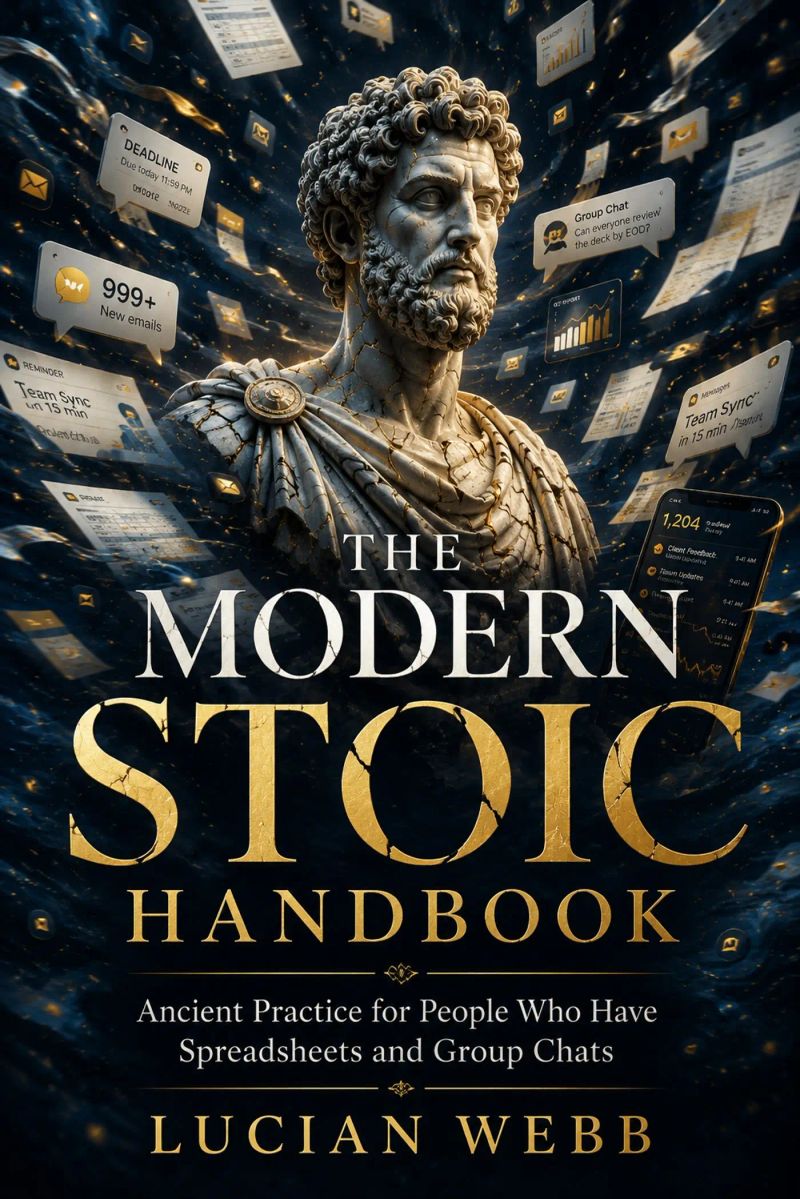
The Modern Stoic Handbook
Ancient Practice for People Who Have to Function in the Modern WorldBy Lucian Webb


Length7h 56m
About this audiobook
The Modern Stoic Handbook is practical Stoicism for everyday life: a working guide to Stoic philosophy, the dichotomy of control, and daily Stoic practice for people with spreadsheets, group chats, difficult coworkers, and 4 a.m. dread.
A man Lucian Webb used to coach kept a Marcus Aurelius quote pinned to his desktop and read it every morning. He also screamed at his assistant twice a week and could not sit in a room with his sister for forty minutes. "When I asked him what the quote meant in practice," Webb writes, "he gave me a paragraph of vocabulary and no behavior." That gap between what we know and what we do is the gap this book on Stoic philosophy was built to close.
Written by a classicist who taught Marcus Aurelius, Epictetus, and Seneca in the original Greek and Latin for twenty-three years before becoming an executive coach, this modern Stoicism handbook strips the philosophy of its gym-shirt costume and returns it to working order. Across twenty short chapters, Webb covers the one dichotomy of control, the daily examination, the view from above, the premeditation of adversity, anger as the most expensive emotion, fear, death, money and status, difficult people, aging, comparison in the algorithmic age, and grief. Every chapter ends with a single "Try this" exercise you can run this week. This is Stoic philosophy for everyday life, not a quote book you could buy for nine dollars at an airport.
Inside this practical Stoicism handbook:
• The one dichotomy of control — the single distinction the whole philosophy hangs from, with the pen-and-paper exercise Webb uses with coaching clients to sort what is up to you from what is not
• The daily Stoic practice that influencers skip — the morning preparation and the evening examination, the unglamorous private work that does not photograph well but actually changes behavior
• Anger, the most expensive emotion — why Seneca treated anger as a temporary madness, and how to interrupt it before it sends the email you will regret
• Stoicism for difficult people and difficult relationships — handling the passive-aggressive 8:47 a.m. email, the teenager who will not look up, the spouse whose moods are not yours to operate
• Death, grief, and aging without bitterness — the topics modern culture skips, met with the Stoic claim that the grief is not less, the grief is honest
• Comparison in the algorithmic age — applying ancient Stoic philosophy to the hostile new conditions of attention, status, and the feed
• A reader's guide to the source texts — where to start with Epictetus, Marcus Aurelius, and Seneca, which translations to trust, and a year of practices to keep going after the last page
This is not a philosophy that promises to make you invulnerable or to fix conditions you did not choose. It is practical Stoicism that promises a better relationship with them: steadier, more honest with yourself, less governed by your moods, less hostage to the moods of others. The practices are simple to describe and difficult to do, and the difficulty is the whole point.
For readers of Ryan Holiday's The Daily Stoic and Donald Robertson's How to Think Like a Roman Emperor.
Audiobook details
GenrePhilosophy, Self-Help
Length7 hrs 56 mins
Narrated byListen with 1,000+ voices
FormateBook with Audio
LanguageEnglish
Table of contents
1Introduction
2Chapter 1: The Stoicism That Hasn’t Actually Been Sold to You
3Chapter 2: The One Dichotomy — What’s Up to You, What Isn’t
4Chapter 3: The Daily Examination
5Chapter 4: The View From Above
Show all chaptersShow less
6Chapter 5: The Premeditation of Adversity
7Chapter 6: Negative Visualization Without the Goth Theater
8Chapter 7: Voluntary Discomfort, Properly Understood
9Chapter 8: Anger as the Most Expensive Emotion
10Chapter 9: The Reserve Clause — Acting Without Attachment
11Chapter 10: Fear and the Stories You Tell Yourself
12Chapter 11: Death — The Topic Modern Culture Skips
13Chapter 12: Money, Status, and the Stoic Compromise
14Chapter 13: Difficult People — And Whether You Are One
15Chapter 14: Parenting Through Stoic Eyes
16Chapter 15: Illness, Pain, and the Body You Are Stuck With
17Chapter 16: Aging Without Bitterness
18Chapter 17: Comparison in the Algorithmic Age
19Chapter 18: Grief and the Things You Cannot Fix
20Chapter 19: Ambition vs. Equanimity
21Chapter 20: The Stoic Routine
22Chapter 21: A Life of Practice, Not a Life of Quotes
23Conclusion
24About the Author
25Appendix A: A Reader’s Guide to the Source Texts
26Appendix B: The Stoics on Specific Modern Problems
27Appendix C: Frequently Asked Questions
28Appendix D: A Year of Practices
29Appendix E: Twelve Lines Worth Sitting With
30Appendix F: The Discipline of Assent — Working with Your Own Mind
31Appendix G: Friendship, the Underdiscussed Stoic Topic
32Appendix H: Work, and What It Asks of You
33Appendix I: Sleep, Solitude, and the Practices the Stoics Did Not Name
34Appendix J: Closing Words
35Appendix K: Stoic Practices Across the Day
36Appendix L: Reading Marcus Aurelius for the First Time
37Appendix M: Reading Epictetus and Seneca — Differences That Matter
38Appendix N: Twenty Questions Readers Ask About Stoic Practice
39Appendix O: A Closing Letter
40Appendix P: Practicing When Life Is Going Well
41Appendix Q: On Teaching Stoicism to Other People
More from Lucian Webb

IlluminationsWalter Benjamin10h 12m4.4 (16.2K)$20 · $0.00

That Bird Has My WingsJarvis Jay Masters9h 49m4.4 (13.7K)$29 · $0.00

Tâo Teh KingLaozi2h 34m4.4 (230.9K)$2 · $0.00

SymposiumPlato3h 26m4.4 (97.9K)$1.20 · $0.00

Buddhist Boot CampTimber Hawkeye2h 39m4.4 (8.4K)$18 · $0.00

Enchiridion & The Discourses of Epictetus (Annotated)Arrian Epictetus18h 9m4.4 (3.5K)$2 · $0.00

The Meditations of the Emperor Marcus Aurelius AntoninusEmperor of Rome Marcus Aurelius5h 41m4.4 (1.8M)$1 · $0.00

Crime and PunishmentFyodor Dostoevsky23h 11m4.4 (1.3M)$12 · $0.00

MeditationsMarcus Aurelius5h 52m4.4 (433.7K)$1 · $0.00

Everyday DharmaSuneel Gupta5h 2m4.5 (761)$20 · $0.00

The Joyful Wisdom ("La Gaya Scienza")Friedrich Wilhelm Nietzsche11h 37m4.4 (26.6K)$1 · $0.00
The Art of LivingEpictetus, Sharon Lebell3h 16m4.4 (50.1K)$18 · $0.00

MeditationsEmperor Of Rome Marcus Aurelius7h 23m4.3 (477.5K)$1.20 · $0.00

The Imitation of ChristThomas à Kempis6h 27m4.3 (84.6K)$21 · $0.00

Sadhana: the realisation of lifeRabindranath Tagore3h 49m4.4 (8.6K)$6 · $0.00

SapiensYuval Noah Harari15h 18m4.3 (1.4M) · 1280$33 · $0.00

You BelongSebene Selassie8h 35m4.4 (2.7K)$26 · $0.00

The Song Celestial; Or, Bhagavad-Gîtâ (from the Mahâbhârata)Anonymous2h 18m4.4 (3.2K)$2 · $0.00

The KybalionThe Three Initiates3h 47m4.3 (58.7K)$20 · $0.00

Chuang Tzu: Mystic, Moralist, and Social ReformerZhuangzi14h 42m4.4 (1.2K)$1 · $0.00

Learning to PrayJames Martin13h 24m4.5 (3.4K)$33 · $0.00

Forever BoyKate Swenson9h 27m4.7 (5K)$29 · $0.00

You Are Worth ItKyle Carpenter, Don Yaeger8h 53m4.7 (4.8K)$29 · $0.00

The Happiest Man on EarthEddie Jaku3h 48m4.6 (178K)$7 · $0.00

Finding MeViola Davis9h 15m4.6 (256.4K)$29 · $0.00

Spiritual AnatomyDaaji Kamlesh D. Patel9h 47m4.7 (319)$29 · $0.00

The Dangerous Truth about Today’s MarijuanaLaura Stack CSP, MBA9h 57m4.7 (385)$20 · $0.00

The Gospel according to Spiritualism (Translated)Allan Kardec14h 39m4.6 (3.9K)$5.70 · $0.00

Birdie & HarlowTaylor Wolfe7h 50m4.6 (6.5K)$26 · $0.00

CrossroadsKaleb Dahlgren7h 56m4.6 (4.9K)$26 · $0.00

Life on the BridgeKaelynn Partlow5h 40m4.6 (1.1K)$24 · $0.00

Keep Your Love OnDanny Silk9h 4m4.6 (8.1K)$10 · $0.00

The Tao of Joy Every DayDerek Lin10h 24m4.6 (762)$20 · $0.00

UndividedVicky Beeching9h 2m4.6 (1.3K)$29 · $0.00

HE CAN WHO THINKS HE CAN & OTHER BOOKS ON SUCCESSOrison Swett Marden5h 54m4.6 (1.2K)$1.99 · $0.00
Level UpRob Dial7h 42m4.6 (3.3K)$26 · $0.00

Burn the HaystackJennie Young, PhD9h 30m4.6 (543)$29 · $0.00

ACRES OF DIAMONDS: Our Every-day Opportunities (Wisdom & Empowerment Series) (Annotated)Russell Conwell2h 26m4.6 (1K)$2 · $0.00

Good InsideBecky Kennedy9h 55m4.5 (59.3K)$29 · $0.00

The Lost VoiceGreta Morgan8h 30m4.7 (285)$26 · $0.00
You may also like
Lessons on LivingNigel Latta7h 25m4.5 (506)$24 · $0.00

Losing MusicJohn Cotter7h 5m4.1 (395)$17 · $0.00

Unf*ck Your BrainFaith G. Harper PhD3h 39m3.8 (30.4K)$15

The EnchiridionEpictetus0m4.4 (41.3K)$1 · $0.00

Redundancy SurvivalDeacon B. Ellis12h 36m$6.40 · $0.00

Why We Can't Stop CaringRobert Bates5h 33m4.9 (12)$4.99 · $0.00

The First 30 DaysAriane de Bonvoisin5h 49m3.9 (279)$24 · $0.00

Let Love LeadJackson Michael48m5.0 (50) Only with Ultra

Empath No MoreDelia Fontaine3h 33m$15 · $0.00

Dbt: Interpersonal Effectiveness and Distress Tolerance With Practical dbt Exercises (Practical dbt Skills to Build Emotional Permanence, Overcome Rsd, and Stop Spiraling in Relationships)Garry Corry2h 15m$3.50 · $0.00

The Grip That Breaks You - Why Control Feels Like Safety and Costs You EverythingMax Paradox5h 27m$7.90 · $0.00

A Better YouElijah C. Prescott7h 16m$4.10 · $0.00

Moments of Transition. Conversations about career changeAnna Firlej2h$14 · $0.00

Bipolar Disorder: Step by Step Techniques to Manage Bipolar Disorder (The Truth About Bipolar Disorder and How to Understand and Find the Best Ways to Gain Control)Mason g, Bruce Walters1h 54m$8.10 · $0.00

The Resilient FounderSloane Whitford7h 24m$11.50 · $0.00

Hyper IndipendentDiletta Armstrong1h 41m$5.70 · $0.00

Beyond The Shadows: Understanding, Living With, and Overcoming DepressionIBRAHIM ABDULRAZAK NUGWA14h 38m$26 · $0.00

NURSING THE WHOLE PATIENTAngelina H. M. Peterson (Prof)4h 35m$9

Difficult Conversations at WorkEzra Whitcomb10h 21m$7

LeapTess Vigeland7h 12m3.6 (670)$20 · $0.00