
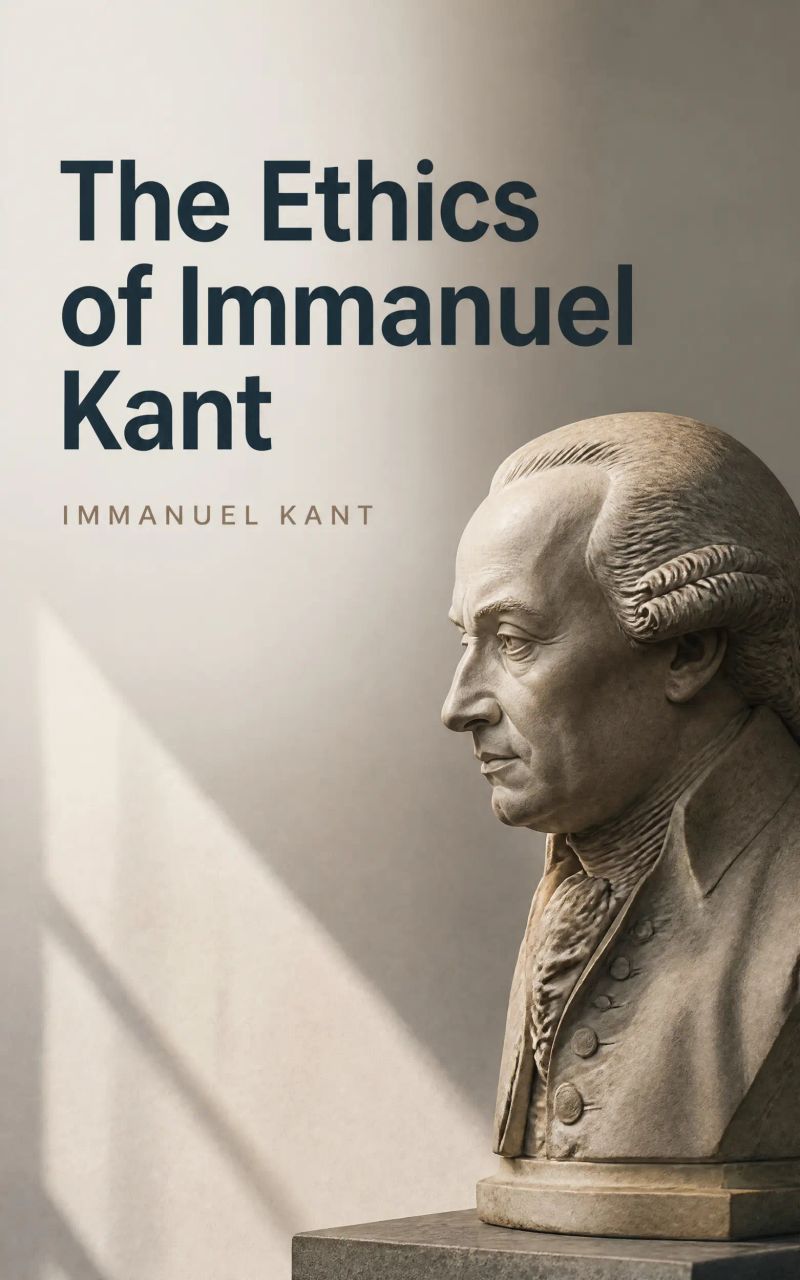
The Ethics of Immanuel Kant
Duty, Autonomy, and the Categorical Imperative in Enlightenment Moral PhilosophyBy Immanuel Kant


Length22h 12m
About this audiobook
The Ethics of Immanuel Kant presents the central architecture of Kantian moral philosophy: the autonomy of rational agents, the categorical imperative, the good will, duty, and the principle that humanity must always be treated as an end in itself. Its argument moves from ordinary moral consciousness toward a rigorous account of universal obligation, distinguishing morality from inclination, prudence, and the pursuit of happiness. Written in the analytical yet architectonic style characteristic of the Enlightenment, the work belongs to the decisive transition between early modern rationalism and modern deontological ethics, while also engaging the moral psychology and religious assumptions of its age. Kant (1724–1804), the Königsberg philosopher whose critical project transformed European thought, developed this ethics in response to both empiricist skepticism and the limitations of traditional metaphysics. Seeking a foundation for moral law that would be neither dependent on circumstance nor reducible to desire, he grounded obligation in practical reason and freedom. His discussions reflect a lifelong concern with human dignity, responsibility, and the possibility of universal principles in a world of competing interests. This book is recommended to readers seeking a foundational text in moral philosophy and to students tracing the origins of contemporary debates about rights, autonomy, justice, and moral responsibility. Although demanding in its conceptual precision, it rewards patient reading with an enduring vision of ethical life as self-legislation under principles any rational person could acknowledge. It remains indispensable for understanding both Kant and the modern philosophical idea of human dignity.
Audiobook details
Rating★★★★ 4.2 (274)
Includes Goodreads, Amazon, LibraryThing
GenrePhilosophy
Length22 hrs 12 mins
Narrated byListen with 1,000+ voices
FormateBook with Audio
Publish dateOct 1, 2015
LanguageEnglish
Table of contents
1The Vocation of the Scholar (Annotated)
2Fundamental Principles of the Metaphysic of Morals
3Preface
4First Section: Transition from the Common Rational Knowledge of Morality to the Philosophical
5Second Section: Transition from Popular Moral Philosophy to the Metaphysic of Morals
Show all chaptersShow less
6Third Section: Transition from the Metaphysic of Morals to the Critique of Pure Practical Reason
7The Metaphysics of Morals
8Translator's preface
9Bibliographical note
10General Introduction to the Metaphysics of Morals
11I. The Relation of the Faculties of the Human Mind to the Moral Laws
12II. The Idea and Necessity of a Metaphysic of Morals
13III. The Division of a Metaphysic of Morals
14General Divisions of the Metaphysics of Morals
15I. Division of the Metaphysic of Morals as a System of Duties generally
16II. Division of the Metaphysic of Morals according to Relations of Obligation
17III. Division of the Metaphysic of Morals
18IV. General preliminary Conceptions defined and explained
19Philosophy of Law (The Science of Right)
20Introduction to the Science of Right
21General Definitions and Divisions
22A. What the Science of Right is
23B. What is Right?
24C. Universal Principle of Right
25D. Right is conjoined with the Title or Authority to compel
26E. Strict Right may be also represented as the possibility of a universal reciprocal Compulsion in harmony with the Freedom of all according to universal Laws
27F. Supplementary Remarks on Equivocal Right
28Division of the Science of Right
29A. General Division of the Duties of Right
30B. Universal Division of Rights
31C. Methodical Division of the Science of Right
32Part First: Private Right
33Chapter First. Of the Mode of Having Anything External as One’s Own
34Chapter Second. The Mode of acquiring anything External
35First Section. Principles of Real Right
36Second Section. Principles of Personal Right
37Third Section. Principles of Personal Right that is Real in Kind
38The Rights of the Family as a Domestic Society
39TITLE FIRST. Conjugal Right. (Husband and Wife.)
40TITLE SECOND. Parental Right. (Parent and Child.)
41TITLE THIRD. Household Right. (Master and Servant.)
42SYSTEMATIC DIVISION Of all the Rights capable of being acquired by Contract
43EPISODICAL SECTION. The Ideal Acquisition of external Objects of the Will
44Chapter Third. Acquisition conditioned by the Sentence of a Public Judicatory
45Part Second: Public Right
46I. Right of the State and Constitutional Law
47II. The Right of Nations and International Law
48III. The Universal Right of Mankind
49Conclusion
50Supplementary Explanations of the Principles of Right

Zum ewigen FriedenImmanuel Kant, Sam Rokbuhm1h 18m$12 · $0.00

The Greatest Works of Immanuel KantImmanuel Kant83h 28m4.4 (142)$1.99 · $0.00

Untersuchung über die Deutlichkeit der Grundsätze der natürlichen Theologie und der MoralImmanuel Kant2h 49m4.0 (41)$1 · $0.00

Kant: Kritik der praktischen Vernunft, Kritik der reinen Vernunft & Kritik der UrteilskraftImmanuel Kant46h 31m4.5 (1.4K)$1 · $0.00
The Critique of Pure ReasonImmanuel Kant25h 41m4.1 (49.5K)$1.99 · $0.00

The Three Critiques: The Critique of Pure Reason, Practical Reason and JudgmentImmanuel Kant46h 6m4.3 (15.5K)$1.99 · $0.00

Physische GeographieImmanuel Kant13h 54m3.9 (47)$1 · $0.00

THE CRITIQUE OF JUDGMENTImmanuel Kant15h 35m4.1 (11.8K)$1.99 · $0.00

THE CRITIQUE OF PRACTICAL REASONImmanuel Kant8h 29m4.1 (14.1K)$1.99 · $0.00

Die Metaphysik der SittenImmanuel Kant14h 4m4.1 (4.2K)$1 · $0.00

Schriften zur physischen GeographieImmanuel Kant26h 23m4.4 (11)$1 · $0.00

Kritik der Urteilskraft: Die dritte KritikImmanuel Kant16h 25m4.1 (16.7K)$1 · $0.00

The Kantian Ethics: Metaphysics of Morals, The Critique of Practical Reason & Perpetual PeaceImmanuel Kant23h 29m$1.99 · $0.00

THE CRITIQUE OF PURE REASONImmanuel Kant25h 39m4.1 (51.3K)$1.99 · $0.00

IMMANUEL KANT: Philosophical Books, Critiques & EssaysImmanuel Kant83h 15m4.4 (143)$1.99 · $0.00

The Kantian Ethics: Metaphysics of MoralsImmanuel Kant23h 30m4.1 (5.1K)$1.99 · $0.00

Crítica de la Razón PuraImmanuel Kant26h 12m4.1 (51.4K)$11 · $0.00

Träume eines Geistersehers, erläutert durch Träume der Metaphysik (Kommentiert)Immanuel Kant4h 2m3.8 (189)$1 · $0.00

Metaphysische Anfangsgründe der Naturwissenschaft (Kommentiert)Immanuel Kant6h 33m4.1 (145)$1 · $0.00

Teoría y praxisImmanuel Kant4h 2m3.9 (243)$11 · $0.00

The Art of LivingThich Nhat Hanh5h 1m4.5 (14.2K)$24 · $0.00

Moral Letters to LuciliusLucius Annaeus Seneca24h 26m4.5 (71.7K)$0.99 · $0.00

Lessons in TruthH. Emilie Cady3h 50m4.5 (2.4K)$20 · $0.00

Letters from a StoicSeneca6h 5m4.4 (80.4K)$6 · $0.00
The Discourses of EpictetusP. E. MATHESOM12h 47m4.4 (17.7K)$1.20 · $0.00

IlluminationsWalter Benjamin10h 12m4.4 (16.2K)$20 · $0.00

That Bird Has My WingsJarvis Jay Masters9h 49m4.4 (13.7K)$29 · $0.00

Tâo Teh KingLaozi2h 34m4.4 (230.9K)$2 · $0.00

SymposiumPlato3h 26m4.4 (97.9K)$1.20 · $0.00

Buddhist Boot CampTimber Hawkeye2h 39m4.4 (8.4K)$18 · $0.00

Enchiridion & The Discourses of Epictetus (Annotated)Arrian Epictetus18h 9m4.4 (3.5K)$2 · $0.00

The Meditations of the Emperor Marcus Aurelius AntoninusEmperor of Rome Marcus Aurelius5h 41m4.4 (1.8M)$1 · $0.00

Crime and PunishmentFyodor Dostoevsky23h 11m4.4 (1.3M)$12 · $0.00

MeditationsMarcus Aurelius5h 52m4.4 (433.7K)$1 · $0.00

Everyday DharmaSuneel Gupta5h 2m4.5 (761)$20 · $0.00

The Joyful Wisdom ("La Gaya Scienza")Friedrich Wilhelm Nietzsche11h 37m4.4 (26.6K)$1 · $0.00
The Art of LivingEpictetus, Sharon Lebell3h 16m4.4 (50.1K)$18 · $0.00
MeditationsEmperor Of Rome Marcus Aurelius7h 23m4.3 (477.5K)$1.20 · $0.00

The Imitation of ChristThomas à Kempis6h 27m4.3 (84.6K)$21 · $0.00

Sadhana: the realisation of lifeRabindranath Tagore3h 49m4.4 (8.6K)$6 · $0.00
You may also like
The Art of ImpossibleSteven Kotler9h 17m4.2 (10K)$29 · $0.00

#AskGaryVeeGary Vaynerchuk11h 38m4.2 (5K)$29 · $0.00

The Attitude AdvantageJasper Livingstone9h 38m4.0 (1.5K)$7

The Personal Correspondence of George Sand & Gustave FlaubertGustave Flaubert, George Sand14h 46m4.1 (300)$1.99 · $0.00

The Master Key SystemCharles F. Haanel8h 48m4.3 (26.7K)$0.99 · $0.00

You Learn by LivingEleanor Roosevelt5h 29m4.2 (6.5K)$24 · $0.00

Think and Grow RichNapoleon Hill13h 1m4.2 (513.9K)$20

Status AnxietyAlain de Botton6h 25m4.1 (64.4K)$14

AwkwardTy Tashiro6h 57m3.9 (2.9K)$24 · $0.00

The Power of Sympathy: Politics and Moral Sentimentalism - A Conversation with Michael FrazerHoward Burton2h 5m$3 · $0.00

The Secret of ProsperityWallace D. Wattles, William Walker Atkinson, P. T. Barnum, Benjamin Franklin, Orison Swett Marden, James Allen, Russell Conwell, Henry Harrison Brown, Thorstein Veblen, Émile Coué, Kahlil Gibran, Marcus Aurelius, Niccolò Machiavelli, Lao Tzu104h 39m4.4 (50)$1.99 · $0.00

High Performance and the Human TouchFrank Breckwoldt4h 39m$21 · $0.00

In Search For HappinessAlder D'pass4h 2m$9 · $0.00
The Greatest Works of Immanuel KantImmanuel Kant83h 28m4.4 (142)$1.99 · $0.00

AN EXTRA-ORDINARY DISTINCTIVENESSElisa Estévez López7h 36m$14 · $0.00

JOHN DEWEY Premium Collection – 40+ Books in One Single Volume: Works on Psychology, Education, Philosophy & Politics (Annotated)John Dewey168h 33m4.4 (44)$0.99 · $0.00

Vacation with Friends Sounded Better in the Group Chat - How to Agree on the Budget, Pace, Accommodation, and Expectations Before a Trip So You Come Home Still FriendsMax Paradox5h 18m$7.70 · $0.00

How to Be BoldRanjay Gulati9h 6m4.0 (120)$29 · $0.00

Creativity RulesTina Seelig5h 12m3.9 (535)$24 · $0.00

I Bought a Planner. Now I Just Need the Life That Goes with It - How to plan your week so your system helps you get things done instead of becoming another hobby that requires stickers, colors, and a Sunday auditMax Paradox4h 26m$7.80 · $0.00