
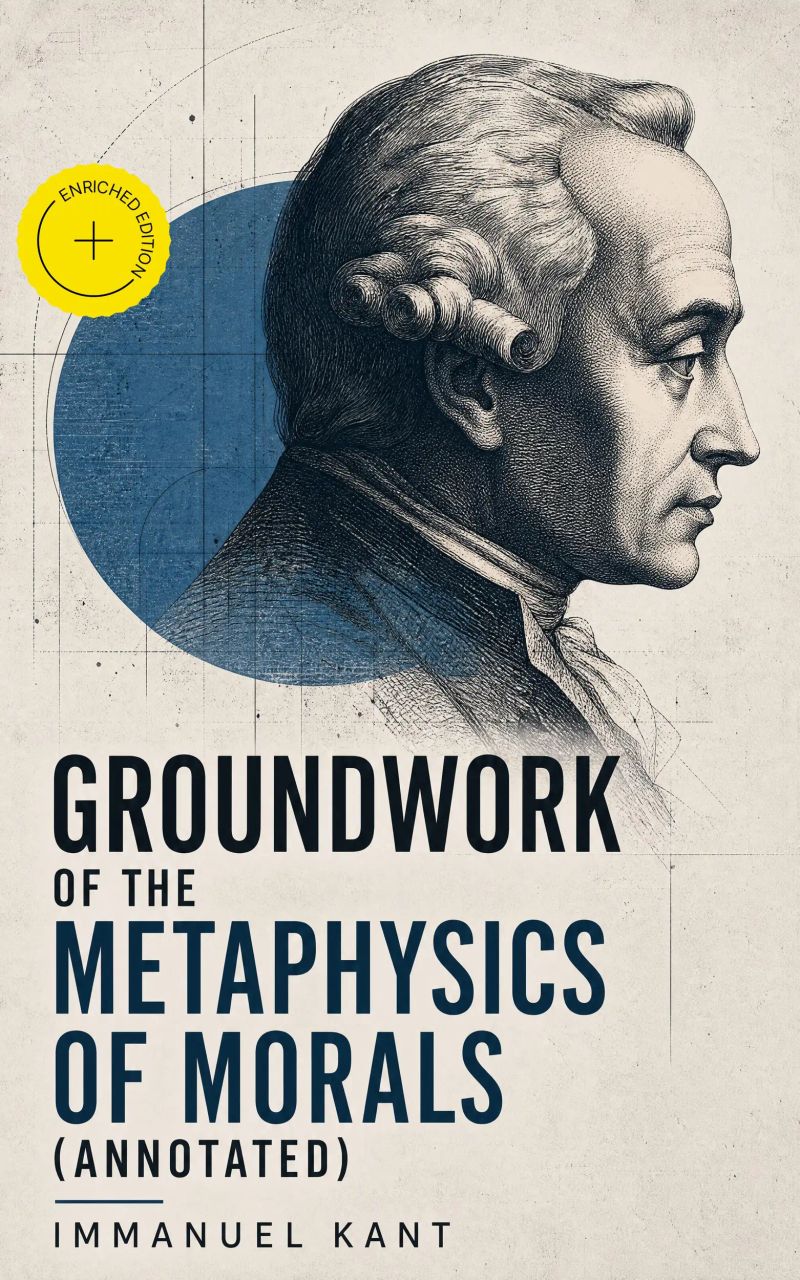
Groundwork of the Metaphysics of Morals (Annotated)
Enriched Edition. A Concise Inquiry into Duty, Autonomy, Practical Reason, and the Categorical ImperativeBy Immanuel Kant


Length5h 5m
About this audiobook
Immanuel Kant's Groundwork of the Metaphysics of Morals is a concise yet momentous inquiry into the supreme principle of morality. Written with the rigorous architecture characteristic of Enlightenment philosophy, the work moves from ordinary moral consciousness to the formulation of the categorical imperative, seeking a foundation for ethics independent of inclination, theology, or consequence. Its style is austere, analytic, and cumulative, situating it among the defining texts of modern moral philosophy. Kant, the Prussian philosopher of Königsberg, wrote this book after transforming metaphysics and epistemology in the Critique of Pure Reason. His lifelong concern with reason's authority, human freedom, and the dignity of persons shaped the Groundwork's central claim: that rational beings are autonomous legislators of moral law. The intellectual climate of the eighteenth century—marked by Newtonian science, Pietist seriousness, and debates over empiricism—deeply informs his project. This book is indispensable for readers seeking to understand duty, autonomy, and moral obligation at their most demanding level. Though difficult, it rewards careful reading with extraordinary clarity about why persons must never be treated merely as means. It is essential for students of philosophy, law, theology, and political thought.
This enriched edition has been carefully crafted to add value to your reading experience.
- A succinct Introduction situates the work's timeless appeal and themes.
- The Synopsis outlines the central plot, highlighting key developments without spoiling critical twists.
- A detailed Historical Context immerses you in the era's events and influences that shaped the writing.
- An Author Biography reveals milestones in the author's life, illuminating the personal insights behind the text.
- A thorough Analysis dissects symbols, motifs, and character arcs to unearth underlying meanings.
- Reflection questions prompt you to engage personally with the work's messages, connecting them to modern life.
- Hand‐picked Memorable Quotes shine a spotlight on moments of literary brilliance.
- Interactive footnotes clarify unusual references, historical allusions, and archaic phrases for an effortless, more informed read.
Audiobook details
GenrePhilosophy
Length5 hrs 5 mins
Narrated byListen with 1,000+ voices
FormateBook with Audio
Publish dateDec 12, 2023
LanguageEnglish
Table of contents
1Introduction
2Introduction
3Synopsis
4Historical Context
5Author Biography
Show all chaptersShow less
6Preface
7First Section: Transition from the common rational knowledge of morality to the philosophical
8Second Section: Transition from popular moral philosophy to the metaphysic of morals
9The Autonomy of the Will as the Supreme Principle of Morality
10Heteronomy of the Will as the Source of all spurious Principles of Morality
11Classification of all Principles of Morality which can be founded on the Conception of Heteronomy
12Third Section: Transition from the metaphysic of morals to the critique of pure practical reason
13The Concept of Freedom is the Key that explains the Autonomy of the Will.
14Freedom must be presupposed as a Property of the Will of all Rational Beings
15Of the Interest attaching to the Ideas of Morality.
16How is a Categorical Imperative Possible?
17Of the Extreme Limits of all Practical Philosophy.
18Concluding Remark
19Analysis
20Reflection
21Memorable Quotes

Kritik der Urteilskraft: Die dritte KritikImmanuel Kant16h 25m4.1 (16.7K)$1 · $0.00

Crítica de la Razón PuraImmanuel Kant26h 12m4.1 (51.4K)$11 · $0.00

Schriften zur Geschichtsphilosophie, Ethik und Politik (Kommentiert)Immanuel Kant9h 3m4.5 (11)$1 · $0.00

Kritik der reinen Vernunft (Kommentiert)Immanuel Kant25h 32m4.4 (1.2K)$1 · $0.00

Untersuchung über die Deutlichkeit der Grundsätze der natürlichen Theologie und der Moral (Kommentiert)Immanuel Kant2h 46m4.1 (113)$1 · $0.00

IMMANUEL KANT: Philosophical Books, Critiques & Essays (Annotated)Immanuel Kant83h 49m4.4 (143)$2 · $0.00

Immanuel Kant: Schriften Zur physischen Geographie (Kommentiert)Immanuel Kant26h 32m4.4 (11)$1 · $0.00

Über Pädagogik (Kommentiert)Immanuel Kant4h 34m4.0 (1.7K)$2 · $0.00
Kant's Prolegomena to Any Future Metaphysics (Annotated)Immanuel Kant6h 3m4.1 (12.9K)$2 · $0.00
Meisterwerke der Weltphilosophie (Kommentiert)Immanuel Kant, Søren Kierkegaard, Edmund Husserl, Ludwig Wittgenstein, Friedrich Nietzsche, Konfuzius, Platon, Xenophon, Aristoteles, Laotse, Marcus Tullius Cicero, Marcus Aurelius, Plotin, Thomas von Aquin, Niccolò Machiavelli, Thomas Morus, Giordano Bruno, Michel de Montaigne, René Descartes, Francis Bacon, Blaise Pascal, Baruch Spinoza, Gottfried Wilhelm Leibniz, David Hume, Jean Jacques Rousseau, Friedrich Schelling, John Locke, Georg Wilhelm Friedrich Hegel, John Stuart Mill, Karl Marx452h 31m4.4 (18)$2 · $0.00
Die größten Klassiker der Philosophie (Kommentiert)Immanuel Kant, Søren Kierkegaard, Edmund Husserl, Ludwig Wittgenstein, Friedrich Nietzsche, Konfuzius, Platon, Xenophon, Aristoteles, Laotse, Marcus Tullius Cicero, Marcus Aurelius, Plotin, Thomas von Aquin, Niccolò Machiavelli, Thomas Morus, Giordano Bruno, Michel de Montaigne, René Descartes, Francis Bacon, Blaise Pascal, Baruch Spinoza, Gottfried Wilhelm Leibniz, David Hume, Jean Jacques Rousseau, Friedrich Schelling, John Locke, Georg Wilhelm Friedrich Hegel, John Stuart Mill, Karl Marx452h 28m4.5 (114)$2 · $0.00

Anthropologie in pragmatischer Hinsicht (Kommentiert)Immanuel Kant11h 19m4.1 (1.5K)$2.50 · $0.00

The Greatest Works of Immanuel Kant (Annotated)Immanuel Kant83h 52m$2 · $0.00

Kritik der praktischen Vernunft (Kommentiert)Immanuel Kant9h 24m4.1 (12.8K)$1 · $0.00
Die größten Philosophen des Deutschen Idealismus (Kommentiert)Immanuel Kant, Johann Gottlieb Fichte, Georg Wilhelm Friedrich Hegel, Friedrich Schelling, Friedrich Schleiermacher138h 36m$1.50 · $0.00

Beobachtungen über das Gefühl des Schönen und Erhabenen (Kommentiert)Immanuel Kant4h 4m4.2 (155)$2 · $0.00
Logik - Ein Handbuch zu Vorlesungen (Kommentiert)Immanuel Kant7h 11m4.0 (1.4K)$2 · $0.00

Träume eines Geistersehers, erläutert durch Träume der Metaphysik (Kommentiert)Immanuel Kant4h 1m$2 · $0.00

Collected Works of Immanuel Kant: Complete Critiques, Philosophical Works and Essays (Including Kant's Inaugural Dissertation) (Annotated)Immanuel Kant83h 45m4.3 (18)$2 · $0.00

Sceptical Essays (Annotated)Bertrand Russell9h 16m4.6 (1K)$2 · $0.00

WitnessAriel Burger8h 1m4.6 (1.3K)$20 · $0.00

The Magic PresenceGodfré Ray King10h 21m4.6 (307)$1.20 · $0.00

The Art of LivingThich Nhat Hanh5h 1m4.5 (14.2K)$24 · $0.00
Moral Letters to LuciliusLucius Annaeus Seneca24h 26m4.5 (71.7K)$1.99 · $0.00

Lessons in TruthH. Emilie Cady3h 50m4.5 (2.4K)$20 · $0.00
The Discourses of EpictetusP. E. MATHESOM12h 47m4.4 (17.7K)$1.20 · $0.00

IlluminationsWalter Benjamin10h 12m4.4 (16.2K)$20 · $0.00

That Bird Has My WingsJarvis Jay Masters9h 49m4.4 (13.7K)$29 · $0.00

Tâo Teh KingLaozi2h 34m4.4 (230.9K)$2 · $0.00
SymposiumPlato3h 26m4.4 (97.9K)$1.20 · $0.00

Buddhist Boot CampTimber Hawkeye2h 39m4.4 (8.4K)$18 · $0.00
Enchiridion & The Discourses of Epictetus (Annotated)Arrian Epictetus18h 9m4.4 (3.5K)$2 · $0.00

The Meditations of the Emperor Marcus Aurelius AntoninusEmperor of Rome Marcus Aurelius5h 41m4.4 (1.8M)$1 · $0.00

Crime and PunishmentFyodor Dostoevsky23h 11m4.4 (1.3M)$12 · $0.00

MeditationsMarcus Aurelius5h 52m4.4 (433.7K)$1 · $0.00

Everyday DharmaSuneel Gupta5h 2m4.5 (761)$20 · $0.00

The Joyful Wisdom ("La Gaya Scienza")Friedrich Wilhelm Nietzsche11h 37m4.4 (26.6K)$1 · $0.00
The Art of LivingEpictetus, Sharon Lebell3h 16m4.4 (50.1K)$18 · $0.00
MeditationsEmperor Of Rome Marcus Aurelius7h 23m4.3 (477.5K)$1.20 · $0.00
You may also like

Hegel: The Science of LogicGeorg Wilhelm Friedrich Hegel17h 53m4.3 (4.5K)$1.99 · $0.00

Experiments on the Absence of Mechanical Connexion between Ether and MatterOliver Joseph Lodge1h 34m$1 · $0.00

The Declaration of the Rights of Man and of Citizens (Annotated)Georg Jellinek2h 43m4.0 (25)$2 · $0.00

Vermeer and His TimePhilip L. Hale3h 11m$18 · $0.00
Shafting, Pulleys, Belting and Rope TransmissionHubert E. Collins3h 15m$1 · $0.00

The Source and Mode of Solar Energy Throughout the UniverseIsaac W. Heysinger10h 11m$1 · $0.00

How to Make Money Flipping Fishing Gear - How to Evaluate Rods, Reels, and Accessories, Build Complete Kits, and Resell for ProfitJACK FLIPWELL6h 41m$7.80 · $0.00
Ancient Egyptian and Greek LoomsH. Ling Roth1h 38m$1 · $0.00

The Changing Conceptions of the Universe - From Newton to Einstein -Benjamin Harrow, Albert Einstein, Arthur Stanley Eddington, Joseph Sweetman Ames, Joseph John Thomson, Frank Watson Dyson2h 57m3.6 (16)$1.99 · $0.00
Value A CoinRichard W. Avery1h 31m3.1 (18)$2.30

FusangCharles G. Leland5h 6m3.8 (35)$21 · $0.00

How to Make Money Flipping Used Restaurant Equipment - How to Assess Equipment, Transport and Repair Costs, and Resell to Local BusinessesJACK FLIPWELL1h 57m$7.70 · $0.00

How to Make Money Flipping Used Books - How to Identify Valuable Editions, Assess Condition, Build Profitable Lots, and Sell to the Right ReadersJACK FLIPWELL8h 19m$8.10 · $0.00

Early Printed BooksE. Gordon Duff5h 55m3.7 (18)$2.30

Experiments and Observations Tending to Illustrate the Nature and Properties of ElectricityWilliam Sir Watson1h 1m$1 · $0.00

Photographic Reproduction ProcessesPeter C. Duchochois3h 56m$2 · $0.00

The Every-Machine Bread Maker CookbookCerys J. Chamberlain11h 10m$11.50

Power BI for Business IntelligenceLena Farrell7h 24m$5 · $0.00

Popular Astronomy: A Series of Lectures Delivered at IpswichGeorge Biddell Airy8h 53m$2 · $0.00

Mobile Hydraulic Fluid PowerRoy Vandermeer10h 53m$45