
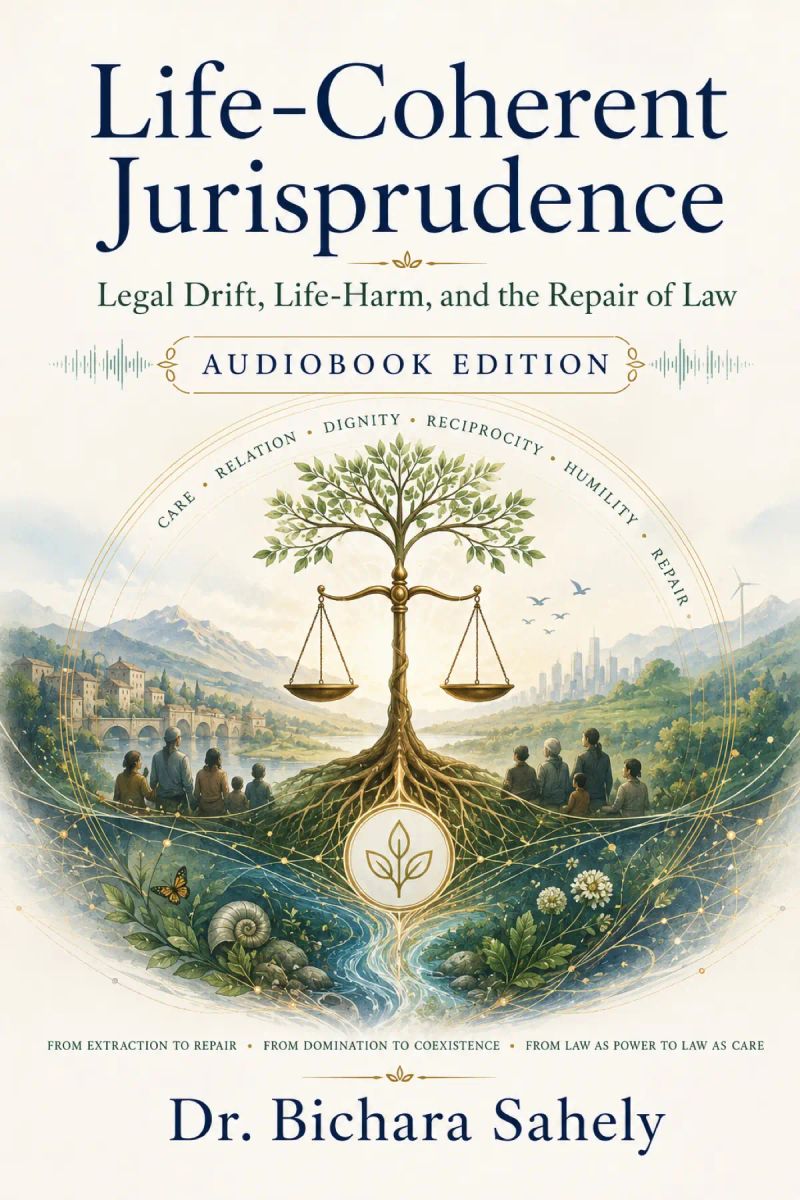
Life-Coherent Jurisprudence
Legal Drift, Life-Harm, and the Repair of LawBy Dr. Bichara Sahely


Length9h 22m
About this audiobook
Life-Coherent Jurisprudence asks a foundational question: what makes law worthy of life?
Dr. Bichara Sahely explores how legal systems can drift from serving living beings, communities, ecosystems, and future generations into protecting money, property, contract, debt, sovereignty, corporations, procedure, and growth as if they were ultimate. Drawing on Humberto Maturana, Johan Galtung, and John McMurtry, this audiobook reframes law as a living field of conserved coordination: capable of blindness, but also capable of learning.
Rather than beginning with blame, it offers a reparative path: seeing legal drift, naming life-harm, recognizing every affected other as legitimate, and restoring law to the service of life.
A philosophical, ecological, and practical invitation to reimagine legality as shared repair.
Audiobook details
GenrePhilosophy, Politics and Government
Length9 hrs 22 mins
Narrated byListen with 1,000+ voices
FormateBook with Audio
Publish dateJun 1, 2026
LanguageEnglish
Table of contents
1Chapter 1
2A Note to the Listener
3Part I — Life Before Law: The Prior Order of Living
41. Life Before Law: The Civilizational Drift from Life-Sequencing to Money-Value Sequencing
51.1 Life-Sequencing
Show all chaptersShow less
61.2 Money-Value Sequencing
71.3 Law as Conserved Coordination
81.4 The When and Where of the Drift
91.5 Why the Drift Occurred
101.6 How the Drift Occurred: Mechanisms of Legal Abstraction
111.7 The Great Inversion in Legal Form
121.8 Life-Harm Across Levels of Organization
131.9 Responsibility Without Blame-First Condemnation
141.10 Life-Coherent Re-Nesting
151.11 The Guiding Claim
162. Law as Conserved Coordination
172.1 Law as a Lineage of Distinctions
182.2 The Conservation of Legal Worlds
192.3 Legal Distinctions Reveal and Conceal
202.4 Law and Emotion
212.5 The Legal Production of Otherness
222.6 Legal Drift Without Innocence
232.7 Law as a Learning System
242.8 The Proper Role of Law
252.9 The Transition to Legal Lineages and Natural Drift
263. Legal Lineages and Natural Drift
273.1 Common Law as Drift Through Precedent
283.2 Civil Law as Drift Through System and Code
293.3 Customary Law as Drift Through Practice and Memory
303.4 Indigenous Legal Orders and Relational Lineages
313.5 Colonial Law as Drift Through Conquest and Administration
323.6 Commercial and Corporate Law as Drift Through Abstraction
333.7 Administrative Law as Drift Through Bureaucracy
343.8 Constitutional Law as Drift Through Foundational Distinctions
353.9 International Law as Drift Through Sovereignty and Power
363.10 Law’s Evolutionary Blindness
373.11 Disturbance as Signal
383.12 From Lineage to Reorientation
39Part II — The Great Inversion in Law
404. From Life-Sequencing to Money-Value Sequencing
414.1 The Meaning of Life-Sequencing
424.2 Law Under Life-Sequencing
434.3 The Meaning of Money-Value Sequencing
444.4 Law Under Money-Value Sequencing
454.5 Translation of Life into Legal-Monetary Form
464.6 The Power of Abstraction
474.7 Money as Coordination and Money as Master
484.8 The Role of Law in Stabilizing the Money-Sequence
494.9 When Life-Sequencing Becomes Subordinate
504.10 The False Neutrality of the Money-Sequence

Preserving Life, Transforming Power in GazaDr Bichara Sahely1h 42mFree

Preserving Life, Transforming PowerDr. Bichara Sahely1h 4mFree

Putting the Missing Bridge to WorkDr. Bichara Sahely2h 12mFree

The Missing BridgeDr. Bichara Sahely1h 5mFree

Transformational Laboratories ProtocolDr. Bichara Sahely2h 33mFree
Artificial Intelligence and the Epistemic CommonsDr Bichara Sahely3h 12mFree

Conflict, Repair, and Non-DominationDr Bichara Sahely2h 21mFree
Institutions of Reflexive TransformationDr Bichara Sahely1h 51mFree

The Politics of Civilizational HealingDr. Bichara Sahely2h 13mFree

The Missing Grammar of Modern CivilizationDr. Bichara Sahely2h 8mFree

Civilizational Healing Research ArchitectureDr. Bichara Sahely1h 24mFree
How Does a Civilization Learn to Heal?Dr. Bichara Sahely1h 16mFree

From Competent Physicians to Healing SocietiesDr. Bichara Sahely2h 20mFree

Competence Is Necessary, but Not SufficientDr. Bichara Sahely1h 15mFree

Life-Grounding CanMEDSDr. Bichara Sahely1h 13mFree

The Dynamic Architecture of ViabilityDr Bichara Sahely2h 1mFree

Completing the Life-Value Onto-Axiology ProgramDr. Bichara Sahely1h 9m5.0 (1)Free

BEYOND GLOBAL JUSTICEDr. Bichara Sahely1h 25mFree

The Sweetness That Consumed the WorldBichara Sahely16h 14mFree
THE SOVEREIGNTY OF CREDITDr. Bichara Sahely3h 56mFree

Moral Letters to LuciliusLucius Annaeus Seneca24h 26m4.5 (71.7K)$0.99 · $0.00

Lessons in TruthH. Emilie Cady3h 50m4.5 (2.4K)$20 · $0.00
The Discourses of EpictetusP. E. MATHESOM12h 47m4.4 (17.7K)$1.20 · $0.00

IlluminationsWalter Benjamin10h 12m4.4 (16.2K)$20 · $0.00
That Bird Has My WingsJarvis Jay Masters9h 49m4.4 (13.7K)$29 · $0.00

Tâo Teh KingLaozi2h 34m4.4 (230.9K)$2 · $0.00

SymposiumPlato3h 26m4.4 (97.9K)$1.20 · $0.00

Buddhist Boot CampTimber Hawkeye2h 39m4.4 (8.4K)$18 · $0.00

Enchiridion & The Discourses of Epictetus (Annotated)Arrian Epictetus18h 9m4.4 (3.5K)$2 · $0.00

The Meditations of the Emperor Marcus Aurelius AntoninusEmperor of Rome Marcus Aurelius5h 41m4.4 (1.8M)$1 · $0.00
Crime and PunishmentFyodor Dostoevsky23h 11m4.4 (1.3M)$12 · $0.00

MeditationsMarcus Aurelius5h 52m4.4 (433.7K)$1 · $0.00
Everyday DharmaSuneel Gupta5h 2m4.5 (761)$20 · $0.00

The Joyful Wisdom ("La Gaya Scienza")Friedrich Wilhelm Nietzsche11h 37m4.4 (26.6K)$1 · $0.00
The Art of LivingEpictetus, Sharon Lebell3h 16m4.4 (50.1K)$18 · $0.00

MeditationsEmperor Of Rome Marcus Aurelius7h 23m4.3 (477.5K)$1.20 · $0.00

The Imitation of ChristThomas à Kempis6h 27m4.3 (84.6K)$21 · $0.00

Sadhana: the realisation of lifeRabindranath Tagore3h 49m4.4 (8.6K)$6 · $0.00
SapiensYuval Noah Harari15h 18m4.3 (1.4M) · 1253$33 · $0.00
You BelongSebene Selassie8h 35m4.4 (2.7K)$26 · $0.00

KrantikariSanjeev Sanyal11h 44m4.6 (1.3K)$16 · $0.00

Unbroken Bonds of BattleJohnny Joey Jones8h 31m4.6 (2.6K)$8 · $0.00

On Democracies and Death CultsDouglas Murray10h 38m4.6 (6.5K)$29 · $0.00

Balcony Over Jerusalem: A Middle East Memoir - Israel, Palestine and BeyondJohn Lyons12h 37m4.6 (1.4K)$33 · $0.00

RiggedMollie Hemingway12h 48m4.6 (4.2K)$23 · $0.00

SledgehammerDavid Friedman8h 21m4.7 (589)$26 · $0.00

Citizenship in a Republic (Annotated)Theodore Roosevelt2h 44m4.6 (1.4K)$2 · $0.00

No EscapeNury Turkel9h 30m4.6 (809)$28 · $0.00

Always FaithfulThomas Schueman, Zainullah Zaki12h 12m4.6 (977)$29 · $0.00

UnthinkableJamie Raskin15h 8m4.5 (9.3K)$8 · $0.00

My Fourth Time, We DrownedSally Hayden13h 59m4.6 (2.9K)$23 · $0.00

A Revolution of Common SenseScott Jennings9h 29m4.6 (528)$29 · $0.00

Statement From the Dock at the Rivonia TrialNelson Mandela2h 18m4.6 (1.3K)$1 · $0.00

Lessons from the EdgeMarie Yovanovitch17h 11m4.5 (5.9K)$40 · $0.00

To Rescue the American SpiritBret Baier10h 12m4.5 (2.7K)$8 · $0.00

StonewalledSharyl Attkisson15h 19m4.5 (4.3K)$33 · $0.00
The World According to Orwell: 1984 & Animal FarmGeorge Orwell15h 42m4.6 (1.1K)$1 · $0.00
Basic EconomicsThomas Sowell18h 32m4.5 (29.3K)$28 · $0.00

To Rescue the RepublicBret Baier, Catherine Whitney11h 42m4.5 (8.6K)$29 · $0.00

Modern WarriorsPete Hegseth7h 10m4.5 (4.7K)$24 · $0.00
You may also like

How To EatMark Bittman, David Katz7h 13m3.8 (4.1K)$24 · $0.00

Old-Fashioned on PurposeJill Winger8h 57m4.5 (1.5K)$29 · $0.00
Velvet ElvisRob Bell4h3.9 (27.3K)$20 · $0.00

What Shall We Do?Leo graf Tolstoy11h 50m4.2 (2.3K)$2 · $0.00
Limitless MindJo Boaler6h 22m4.1 (3.7K)$24 · $0.00

The Antiracist Business BookTrudi Lebrón6h 10m4.6 (275)$17 · $0.00

In Emergency, Break GlassNate Anderson5h 33m4.2 (329)$17 · $0.00

TerraformPropaganda5h 39m4.7 (594)$24 · $0.00
Radical WholenessPhilip Shepherd11h 45m4.4 (789)$20

WildingIsabella Tree12h 22m4.5 (13.4K)$23

Me and White SupremacyLayla F. Saad5h 20m4.4 (41.6K)$17 · $0.00

This One Wild and Precious LifeSarah Wilson13h 46m3.9 (6.3K)$33 · $0.00

Never Play It SafeChase Jarvis7h 17m4.3 (514)$7 · $0.00

A LETTER TO A HINDU (A Fascinating View on Love and Non-Violence) (Annotated)Leo Tolstoy, M. K. Gandhi3h 46m4.0 (1.5K)$2 · $0.00

The Arts & Crafts MovementOscar Lovell Triggs3h 38m4.1 (27)$15 · $0.00

Returning to the BodyFarah Zidan1h 35m$5.70 · $0.00
The UpshiftErvin Laszlo3h 46m4.7 (26)$15

Embrace Your PowerDavid De Angelis2h 21m$4.50 · $0.00

Non sei (ancora) libero (tradotto)MARK FISHER1h 53m$4.60 · $0.00

The UnknownDan Desmarques1h 51m5.0 (4) Only with Ultra