
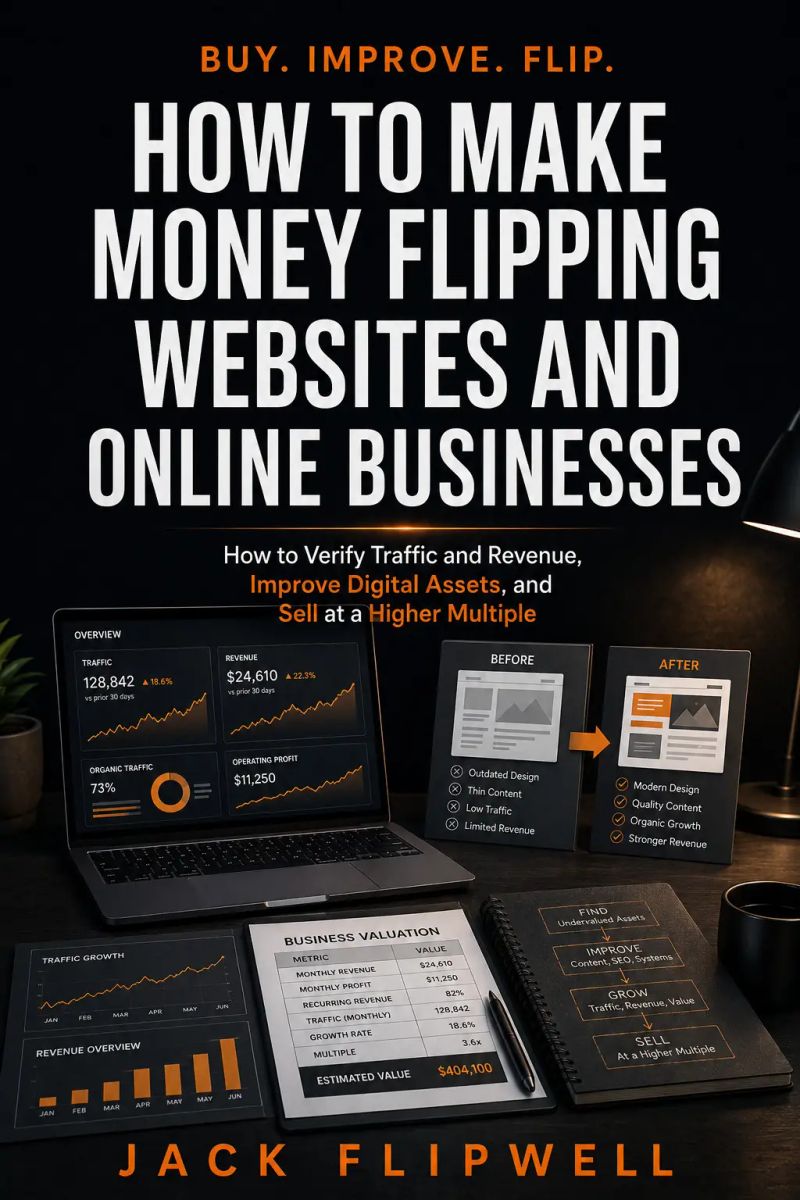
How to Make Money Flipping Websites and Online Businesses - How to Verify Traffic and Revenue, Improve Digital Assets, and Sell at a Higher Multiple
By JACK FLIPWELL

Length11h 6m
About this audiobook
A website, online store, newsletter, micro-SaaS product, or small digital business can be more than a source of monthly income. It can be an asset you buy, improve, operate, and later sell at a higher value.
The challenge is that some of the biggest risks in online businesses are invisible at first glance.
Is the traffic real?
Can the revenue be verified?
How much of the reported profit depends on unpaid owner labor?
Does the business rely on one customer, one supplier, one affiliate program, one advertising account, or one search channel?
Can the critical assets actually be transferred?
And how much should you pay today without giving the seller the value of improvements that you still need to create yourself?
How to Make Money Flipping Websites and Online Businesses is a practical guide to the complete BUY. IMPROVE. FLIP. process, from finding opportunities and conducting due diligence to taking control of digital assets, improving their economics, and preparing them for resale.
Inside, you will learn how to:
• identify the types of websites and online businesses that can be acquired and improved,
• find opportunities through marketplaces, brokers, direct outreach, and private deal flow,
• screen listings quickly before wasting time on weak deals,
• verify organic, paid, social, referral, and email traffic,
• verify revenue, expenses, margins, refunds, and cash flow,
• normalize earnings and account for the real cost of owner labor,
• identify customer, platform, supplier, technical, legal, and operational risk,
• assess domains, SEO, backlinks, content quality, and organic traffic concentration,
• perform model-specific due diligence for e-commerce, affiliate, advertising, SaaS, lead generation, and service businesses,
• calculate a maximum purchase price,
• negotiate price and deal structure,
• transfer domains, code, data, accounts, contracts, and operating systems safely,
• manage the first 30 days after acquisition,
• increase revenue through conversion, pricing, retention, email, upselling, and better monetization,
• improve margin without damaging the business,
• automate repetitive work and reduce founder dependence,
• build SOPs, operating documentation, reporting history, and a buyer-ready data room,
• decide when holding is better than selling,
• find buyers, manage seller-side due diligence, negotiate the exit, and complete the handover,
• build a repeatable acquisition and resale system.
This is not a book about buying random domains and hoping someone pays more later.
It does not promise guaranteed returns.
It does not rely on one magical valuation multiple.
Digital business markets change. Platform rules change. Search behavior changes. Advertising costs change. Buyer demand changes.
The method in this book is built around principles that remain useful even when individual tactics change.
First, understand exactly what you are buying.
Then verify the traffic, revenue, costs, ownership, transferability, and risk.
Normalize the true profit.
Set a maximum price.
Acquire with enough margin of safety.
After closing, stabilize the business before changing it.
Then focus on the improvements that create the strongest economic value.
That may mean:
• increasing conversion,
• improving pricing,
• raising average customer value,
• reducing churn,
• renegotiating supplier terms,
• cutting unnecessary costs,
• automating manual work,
• reducing owner dependence,
• documenting processes.
The strongest flip is not always the one that produces the largest increase in revenue.
Sometimes the biggest value creation comes from turning a profitable but chaotic founder-dependent project into a clean, measurable, documented, transferable business.
That can improve both:
• earnings,
• earnings quality.
When the time comes to sell, the next buyer should not need to trust your story.
They should be able to verify it.
They can review:
• financial history,
• traffic,
• customers,
• costs,
• owner workload,
• documented systems,
• operating performance.
That is how an online project becomes an investable asset.
The book also emphasizes one of the most overlooked parts of flipping:
You do not always have to sell.
If the business continues producing strong cash flow, requires limited owner involvement, and still has attractive upside, holding may be more rational than forcing an exit simply because the original plan assumed a short holding period.
BUY. IMPROVE. FLIP. is therefore not a rigid timetable.
It is a capital allocation process.
You buy when price, quality, and risk create an attractive entry.
You improve where your time and capital can create measurable value.
This publication was prepared with the assistance of tools that support the creative process, including artificial intelligence-based solutions. The final concept, structure, and editing belong to the author.
Audiobook details
GenreBusiness and Economics
Length11 hrs 6 mins
Narrated byListen with 1,000+ voices
FormateBook with Audio
Publish dateSep 30, 2026
LanguageEnglish
Table of contents
1INTRO
2Chapter 1 - What You Can Actually Flip Online
3Chapter 2 - Where to Find Websites and Online Businesses for Sale
4Chapter 3 - Fast Deal Screening
5Chapter 4 - How to Verify Website Traffic
Show all chaptersShow less
6Chapter 5 - How to Verify Revenue and Costs
7Chapter 6 - Normalizing Profit and Owner Time
8Chapter 7 - How to Assess Online Business Risk
9Chapter 8 - SEO, Domains, and Content Quality
10Chapter 9 - E-Commerce, Affiliate, Advertising, SaaS, and Other Models
11Chapter 10 - Valuation and Maximum Purchase Price
12Chapter 11 - Negotiation and Deal Structure
13Chapter 12 - Contracts, Payment, and Secure Asset Transfer
14Chapter 13 - The First 30 Days After Acquisition
15Chapter 14 - How to Increase Revenue Quickly
16Chapter 15 - How to Improve Margin and Reduce Costs
17Chapter 16 - Automation and Reducing Owner Dependence
18Chapter 17 - Building a Performance History and Documentation
19Chapter 18 - When to Sell and How to Set the Exit Price
20Chapter 19 - How to Sell an Online Business
21Chapter 20 - How to Build a Repeatable BUY. IMPROVE. FLIP. System

How to Make Money Flipping Sneakers - A Guide to Sourcing, Authentication, Pricing, and Profitable ResellingJACK FLIPWELL4h 29m$7.70 · $0.00
How to Make Money Reselling Clothes - How to Source, Photograph, Price, and Sell Secondhand Fashion OnlineJACK FLIPWELL5h 4m$7.70 · $0.00

How to Make Money Flipping Houses - How to Find Undervalued Properties, Control Renovation Costs, and Sell at the Right PriceJACK FLIPWELL4h 31m$7.70 · $0.00

Jak zarabiać na samochodach używanych - Jak znajdować okazje, szacować koszty i bezpiecznie sprzedawać auta z zyskiemJACK FLIPWELL4h 45m$7.80 · $0.00

Jak zarabiać na odsprzedaży iPhone’ów - Jak kupować poniżej ceny rynkowej, wykrywać wady i sprzedawać z zyskiemJACK FLIPWELL5h 30m$7.70 · $0.00

Jak zarabiać na flipach mieszkaniowych - Jak znajdować niedoszacowane nieruchomości, kontrolować koszty remontu i sprzedawać we właściwej cenieJACK FLIPWELL4h 54m$7.70 · $0.00

Jak zarabiać na używanej elektronice - Jak kupować, testować, wyceniać i sprzedawać smartfony, laptopy, tablety oraz konsoleJACK FLIPWELL5h4.7 (12)$7.70 · $0.00

How to Make Money Flipping Furniture - Turn Cheap and Forgotten Pieces into Products Buyers WantJACK FLIPWELL4h 26m$7.70 · $0.00

How to Make Money Flipping Almost Anything - A Complete System for Finding Deals, Calculating Margins, and Building Repeatable IncomeJACK FLIPWELL5h 57m$7.70 · $0.00

Jak zarabiać na odsprzedaży sneakersów - Przewodnik po wyszukiwaniu okazji, sprawdzaniu autentyczności i dochodowej sprzedażyJACK FLIPWELL4h 32m$7.70 · $0.00

How to Make Money Flipping Used Electronics - How to Buy, Test, Price, and Resell Phones, Laptops, Tablets, and Game ConsolesJACK FLIPWELL4h 22m$7.70 · $0.00

Jak zarabiać na odsprzedaży niemal wszystkiego - Kompletny system wyszukiwania okazji, obliczania marży i budowania powtarzalnego dochoduJACK FLIPWELL5h 29m$7.70 · $0.00

Jak zarabiać na odnawianiu i sprzedaży mebli - Jak zamieniać tanie i zapomniane przedmioty w produkty, które ludzie chcą kupowaćJACK FLIPWELL4h 49m$7.70 · $0.00

How to Make Money Flipping Watches - How to Spot Valuable Models, Avoid Fakes, and Resell with ConfidenceJACK FLIPWELL5h 45m$7.80 · $0.00
How to Make Money Flipping Used Cars - A Beginner's Guide to Finding Deals, Estimating Costs, and Selling Safely for ProfitJACK FLIPWELL4h 24m$7.80 · $0.00

Jak zarabiać na ubraniach z drugiej ręki - Jak wyszukiwać, fotografować, wyceniać i sprzedawać używaną modę w internecieJACK FLIPWELL4h 49m$7.70 · $0.00
How to Make Money Flipping Collectibles - How to Find Undervalued Toys, Sets, Cards, and Limited-Edition ItemsJACK FLIPWELL6h 30m$7.80 · $0.00

Jak zarabiać na przedmiotach kolekcjonerskich - Jak znajdować niedoszacowane zabawki, zestawy, karty i limitowane przedmiotyJACK FLIPWELL5h 5m$7.80 · $0.00

Jak zarabiać na kupowaniu i sprzedaży zegarków - Jak rozpoznawać wartościowe modele, unikać podróbek i sprzedawać z odpowiednią marżąJACK FLIPWELL4h 56m$7.80 · $0.00
How to Make Money Flipping iPhones - A Practical Guide to Buying Below Market Value, Spotting Defects, and Reselling for ProfitJACK FLIPWELL5h 17m$7.70 · $0.00
Never Split the DifferenceChris Voss, Tahl Raz8h 7m4.4 (277.7K)$26 · $0.00
The Intelligent Investor Rev Ed.Benjamin Graham17h 48m4.3 (191.5K)$40 · $0.00
The Hard Thing About Hard ThingsBen Horowitz7h 57m4.2 (134.3K)$26 · $0.00
Boundaries for LeadersHenry Cloud7h 36m4.3 (3.6K)$26 · $0.00
BuildTony Fadell11h 5m4.5 (14.3K)$8 · $0.00

The Joys Of CompoundingGautam Baid17h 34m4.5 (2.5K)$18 · $0.00
Basic EconomicsThomas Sowell18h 32m4.5 (29.3K)$28 · $0.00

Poor Charlie’s AlmanackGrover Gardener, Charles T. Munger13h 9m4.5 (24.7K)$18 · $0.00

The Ambuja StoryNarotam Sekhsaria13h 59m4.5 (830)$33 · $0.00

The Secret Door to SuccessFlorence Scovel Shinn2h 25m4.5 (2.1K)$1.20 · $0.00

This Is Going to HurtAdam Kay5h 47m4.4 (444.7K)$24 · $0.00

Big TrustShadé Zahrai, Fayçal Sekkouah8h 36m4.6 (406)$26 · $0.00
The Intelligent Investor Third EditionBenjamin Graham, Jason Zweig20h4.4 (156.6K)$46 · $0.00

Bottle of LiesKatherine Eban14h 25m4.4 (12K)$33 · $0.00
The Antiracist Business BookTrudi Lebrón6h 10m4.6 (275)$17 · $0.00
The FormulaJoshua Robinson, Jonathan Clegg10h 41m4.4 (6.9K)$29 · $0.00

Let Them LeadJohn U. Bacon7h 10m4.5 (1.4K)$24 · $0.00

Secrets of the Millionaire MindT. Harv Eker5h 11m4.4 (301.4K)$24 · $0.00

The Person You Mean to BeDolly Chugh9h 6m4.4 (7.2K)$29 · $0.00
BoundlessNick Kostov, Sean McLain9h 17m4.5 (1.1K)$29 · $0.00
You may also like

Psychopathology of Everyday Life (Annotated)Sigmund Freud9h 34m4.0 (24.8K)$0.99 · $0.00

The Principle of RelativityAlbert Einstein, H. Minkowski7h 43m4.4 (1.4K)$1 · $0.00
Basic EconomicsThomas Sowell18h 32m4.5 (29.3K)$28 · $0.00

THE THEORY OF THE LEISURE CLASS: An Economic Study of American Institutions and a Social Critique of Conspicuous Consumption (Annotated)Thorstein Veblen12h 58m4.4 (1K)$0.99 · $0.00

Holiday BuzzCleo Coyle10h 11m4.2 (7.8K)$23

The RepublicPlato12h 22m3.9 (255.5K)$15 · $0.00

Mystery of the Yellow Room (The first detective Joseph Rouletabille novel and one of the first locked room mystery crime fiction novels)Gaston Leroux8h 18m3.7 (17.9K)$1 · $0.00

The Figure in the CarpetHenry James1h 36m3.7 (3.3K)$2 · $0.00

Thirteen GuestsJ. Jefferson Farjeon9h 4m3.7 (2.7K)$2 · $0.00

The Food Label Has More Information Than My Résumé - How to Read Food Labels, Separate What Matters from Marketing Noise, and Shop Normally Without Taking a Biochemistry Exam in the Grocery AisleMax Paradox6h 22m$7.70 · $0.00

I Bought It Digitally. Which Apparently Means I Didn't Really Buy It - How to Tell a Purchase from a License or Subscription, Protect Important Files, and Know What You Actually Own Before a Platform Changes Its Terms or DisappearsMax Paradox6h 22m$7.70 · $0.00

No One Knows What “Good Work” Looks Like Right Now - How to Clarify Goals, Success Criteria, and Responsibilities When the Company Changes Strategy Faster Than the Slides in a PresentationMax Paradox6h 41m$7.70 · $0.00

I'm Back in the Office and Still Doing Everything on Teams - How to Make Sense of Hybrid Work, Decide When Being in the Office Really Helps, and Cut Down on Days When You Commute an Hour for a Video CallMax Paradox6h 49m$7.70 · $0.00

I'm Selling My Car and Every Buyer Asks, "How Much Can You Knock Off?" - How to Prepare Your Car, Write the Listing, Handle Negotiations, and Close the Sale Safely Without Fifteen Meetings With People Who Are Just LookingMax Paradox6h 28m$7.70 · $0.00

I Have to Get Five Departments to Agree, and None of Them Reports to Me - How to Influence Without Formal Authority, Align Interests, and Get Departments Working Together When They Have Five Priorities and One Shared DeadlineMax Paradox6h 47m$7.70 · $0.00

My Job Measures Everything Except What I Actually Do - How to Work with KPIs That Don't Capture the Full Picture, Talk About Quality and Impact, and Stop Turning Every Day into a Hunt for Green NumbersMax Paradox6h 40m$7.70 · $0.00

My Boss Asks for Status Updates More Often Than I Check the Time - How to Rebuild Trust, Set a Reporting Rhythm, and Talk About Autonomy Without Hiding From Your Messenger or Sending a Status Update Every 47 MinutesMax Paradox6h 36m$7.70 · $0.00

Constitution of the Commonwealth of Massachusetts (1780) (Annotated)Samuel Adams, John Adams, James Bowdoin4h 5m$0.99 · $0.00

The Famous Cases of Dr. Thorndyke: 40 of His Criminal Investigations (Illustrated) (Annotated)R. Austin Freeman44h 38m4.2 (236)$1.99 · $0.00

Ultimate PhysicsScientific American7h 5m4.3 (49)$17