
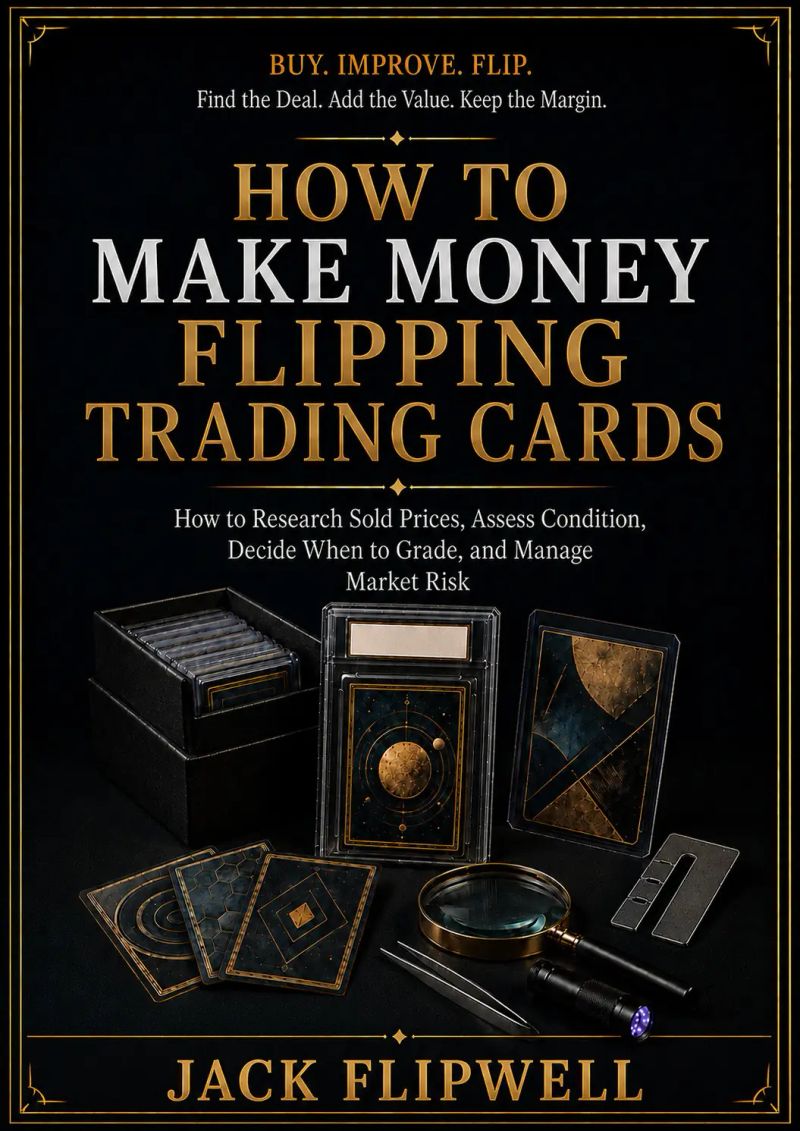
How to Make Money Flipping Trading Cards - How to Research Sold Prices, Assess Condition, Decide When to Grade, and Manage Market Risk
By JACK FLIPWELL


Length8h 32m
About this audiobook
The trading card market can look deceptively simple. Buy a card, wait for demand, sell at a higher price. Maybe send a strong raw copy for grading, receive a high grade, and capture an even larger premium. In reality, successful card flipping depends on dozens of decisions involving product identification, real sold prices, condition, liquidity, grading economics, marketplace fees, inventory risk, and execution.
How to Make Money Flipping Trading Cards is a practical guide by JACK FLIPWELL for collectors and resellers who want to approach the market with data instead of hype. It does not promise easy profits or attempt to predict which card will become the next record-breaking sale. Instead, it shows how to build a repeatable system for finding underpriced cards, protecting margin, and reducing the cost of mistakes.
You will learn how to research completed sales rather than relying on unrealistic asking prices. The book explains how to build reliable comps, identify outliers, compare sale formats, interpret recent trends, and determine whether the market for a specific card is genuinely liquid. You will also learn why a card with a lower headline value can be a better business opportunity than a rare product that trades only a few times per year.
Accurate identification receives detailed attention because small product differences can create large pricing differences. Variations, parallels, serial numbering, language, foil treatment, promotional editions, autographs, memorabilia, reprints, grading companies, and grades can all change what the card actually is and what buyers are willing to pay.
Condition assessment is covered through a practical raw-card inspection process. You will learn how to evaluate surfaces, corners, edges, centering, dents, bends, moisture damage, production issues, and other defects that can affect resale value and grading decisions. The book clearly separates home inspection from professional grading and avoids pretending that any seller can guarantee a future grade.
Authentication is approached as a layered risk-management process. You will learn how to compare cards with reliable references, inspect product-specific characteristics, verify grading certificates, evaluate sellers, recognize misleading reprints, and reduce exposure to counterfeit cards, fake autographs, altered cards, and counterfeit slabs.
The sourcing chapters explain where profitable opportunities can appear, including large marketplaces, local classifieds, specialist communities, card shows, hobby shops, dealers, and direct collection purchases. You will see how poorly written listings, incorrect categories, bad photography, bulk sales, and motivated sellers can create opportunities for someone with stronger research and faster execution.
A full section is dedicated to buying collections and lots. You will learn why the sum of retail card prices is not the same as wholesale value, how to separate high-value cards from mid-tier inventory and bulk, how to calculate labor and liquidation risk, and how to determine the maximum price you can pay for an entire collection.
Grading receives detailed financial treatment. Instead of assuming every clean-looking raw card should be submitted, you will learn how to compare the raw sale alternative with multiple graded outcomes, calculate the full grading cost, identify the break-even grade, interpret population data, and decide whether the expected upside actually justifies the extra cost, delay, and uncertainty.
The selling section covers product photography, accurate condition descriptions, pricing strategy, negotiation, auction versus fixed-price listings, multichannel selling, packaging, shipping, insurance, transaction documentation, and ways to reduce return and dispute risk. The goal is not to hide defects or create artificial hype. It is to present the exact product clearly enough that the buyer can make an informed decision.
The book then moves beyond individual flips into inventory and capital management. You will learn how to separate cash from nominal collection value, monitor stale inventory, maintain liquidity, limit exposure to a single player or category, track cards in grading, and stress-test the business against slower sales or declining prices.
The data section explains how to measure net profit, return on cost, holding period, grading performance, sourcing quality, discount rates, return reasons, forecast error, and the difference between repeatable edge and simple luck. Over time, your own transaction history can become a competitive advantage that public sold-price databases cannot provide.
This publication was prepared with the assistance of tools that support the creative process, including artificial intelligence-based solutions. The final concept, structure, and editing belong to the author.
Audiobook details
Rating★★★★ 4.0 (34)
Includes Goodreads, Amazon
GenreBusiness and Economics
Length8 hrs 32 mins
Narrated byListen with 1,000+ voices
FormateBook with Audio
Publish dateSep 30, 2026
LanguageEnglish
Table of contents
1How to Make Money Flipping Trading Cards
2INTRO
3Chapter 1 - How the Trading Card Market Really Works
4Chapter 2 - How to Research Sold Prices and Build a Reliable Valuation
5Chapter 3 - How to Evaluate Liquidity, Demand, and the Risk of Frozen Capital
Show all chaptersShow less
6Chapter 4 - How to Identify the Exact Card, Variation, and Edition
7Chapter 5 - How to Assess Card Condition Without Professional Grading
8Chapter 6 - How to Evaluate Authenticity and Avoid Counterfeits
9Chapter 7 - Where to Buy Cards and How to Find Underpriced Listings
10Chapter 8 - How to Buy Collections, Lots, and Bulk Card Deals
11Chapter 9 - How to Calculate a Purchase Before Paying and Set Your Maximum Buy Price
12Chapter 10 - When Grading Makes Sense and How to Calculate It Before Submission
13Chapter 11 - How to Prepare a Card for Sale and Take Photos That Build Trust
14Chapter 12 - How to Write Listings, Set Prices, and Sell Without Giving Away the Margin
15Chapter 13 - How to Pack and Ship Cards While Reducing Damage and Disputes
16Chapter 14 - How to Manage Inventory, Cash, and Market Risk
17Chapter 15 - How to Measure Results and Build Your Own Data System
18Chapter 16 - How to Scale Card Flipping Without Losing Control
19Chapter 17 - How to Reduce Fraud, Errors, Returns, and Counterparty Risk
20Chapter 18 - Advanced Flipping Strategies and How to Build a Durable Edge
21Chapter 19 - How to Build a Complete Buying, Grading, and Selling System from First Research to Final Sale
22Chapter 20 - From the First Flip to a Repeatable Business - A Practical Action Plan

How to Make Money Flipping Sneakers - A Guide to Sourcing, Authentication, Pricing, and Profitable ResellingJACK FLIPWELL4h 29m$7.70 · $0.00
How to Make Money Reselling Clothes - How to Source, Photograph, Price, and Sell Secondhand Fashion OnlineJACK FLIPWELL5h 4m$7.70 · $0.00

How to Make Money Flipping Houses - How to Find Undervalued Properties, Control Renovation Costs, and Sell at the Right PriceJACK FLIPWELL4h 31m$7.70 · $0.00

Jak zarabiać na samochodach używanych - Jak znajdować okazje, szacować koszty i bezpiecznie sprzedawać auta z zyskiemJACK FLIPWELL4h 45m$7.80 · $0.00

Jak zarabiać na odsprzedaży iPhone’ów - Jak kupować poniżej ceny rynkowej, wykrywać wady i sprzedawać z zyskiemJACK FLIPWELL5h 30m$7.70 · $0.00

Jak zarabiać na flipach mieszkaniowych - Jak znajdować niedoszacowane nieruchomości, kontrolować koszty remontu i sprzedawać we właściwej cenieJACK FLIPWELL4h 54m$7.70 · $0.00

Jak zarabiać na używanej elektronice - Jak kupować, testować, wyceniać i sprzedawać smartfony, laptopy, tablety oraz konsoleJACK FLIPWELL5h4.7 (12)$7.70 · $0.00
How to Make Money Flipping Furniture - Turn Cheap and Forgotten Pieces into Products Buyers WantJACK FLIPWELL4h 26m$7.70 · $0.00
How to Make Money Flipping Almost Anything - A Complete System for Finding Deals, Calculating Margins, and Building Repeatable IncomeJACK FLIPWELL5h 57m$7.70 · $0.00

Jak zarabiać na odsprzedaży sneakersów - Przewodnik po wyszukiwaniu okazji, sprawdzaniu autentyczności i dochodowej sprzedażyJACK FLIPWELL4h 32m$7.70 · $0.00
How to Make Money Flipping Used Electronics - How to Buy, Test, Price, and Resell Phones, Laptops, Tablets, and Game ConsolesJACK FLIPWELL4h 22m$7.70 · $0.00

Jak zarabiać na odsprzedaży niemal wszystkiego - Kompletny system wyszukiwania okazji, obliczania marży i budowania powtarzalnego dochoduJACK FLIPWELL5h 29m$7.70 · $0.00

Jak zarabiać na odnawianiu i sprzedaży mebli - Jak zamieniać tanie i zapomniane przedmioty w produkty, które ludzie chcą kupowaćJACK FLIPWELL4h 49m$7.70 · $0.00
How to Make Money Flipping Watches - How to Spot Valuable Models, Avoid Fakes, and Resell with ConfidenceJACK FLIPWELL5h 45m$7.80 · $0.00
How to Make Money Flipping Used Cars - A Beginner's Guide to Finding Deals, Estimating Costs, and Selling Safely for ProfitJACK FLIPWELL4h 24m$7.80 · $0.00

Jak zarabiać na ubraniach z drugiej ręki - Jak wyszukiwać, fotografować, wyceniać i sprzedawać używaną modę w internecieJACK FLIPWELL4h 49m$7.70 · $0.00
How to Make Money Flipping Collectibles - How to Find Undervalued Toys, Sets, Cards, and Limited-Edition ItemsJACK FLIPWELL6h 30m$7.80 · $0.00

Jak zarabiać na przedmiotach kolekcjonerskich - Jak znajdować niedoszacowane zabawki, zestawy, karty i limitowane przedmiotyJACK FLIPWELL5h 5m$7.80 · $0.00

Jak zarabiać na kupowaniu i sprzedaży zegarków - Jak rozpoznawać wartościowe modele, unikać podróbek i sprzedawać z odpowiednią marżąJACK FLIPWELL4h 56m$7.80 · $0.00
How to Make Money Flipping iPhones - A Practical Guide to Buying Below Market Value, Spotting Defects, and Reselling for ProfitJACK FLIPWELL5h 17m$7.70 · $0.00
Never Split the DifferenceChris Voss, Tahl Raz8h 7m4.4 (277.7K)$26 · $0.00
The Intelligent Investor Rev Ed.Benjamin Graham17h 48m4.3 (191.5K)$40 · $0.00
The Hard Thing About Hard ThingsBen Horowitz7h 57m4.2 (134.3K)$26 · $0.00
Boundaries for LeadersHenry Cloud7h 36m4.3 (3.6K)$26 · $0.00
Level UpRob Dial7h 42m4.6 (3.3K)$26 · $0.00

Eat It!Jordan Syatt, Michael Vacanti4h 40m4.6 (1.5K)$20 · $0.00

Progress and Poverty, Volumes I and II (Annotated)Henry George19h 21m4.6 (574)$0.99 · $0.00

Not Everything Counts but Everything Matters: The powerful and inspirational new book about leadership and achieving success from the visionary multi-premiership winning Panthers coachIvan Cleary6h 1m4.6 (680)$24 · $0.00
BuildTony Fadell11h 5m4.5 (14.3K)$8 · $0.00
The Joys Of CompoundingGautam Baid17h 34m4.5 (2.5K)$18 · $0.00
Basic EconomicsThomas Sowell18h 32m4.5 (29.3K)$28 · $0.00

Poor Charlie’s AlmanackGrover Gardener, Charles T. Munger13h 9m4.5 (24.7K)$18 · $0.00

The Ambuja StoryNarotam Sekhsaria13h 59m4.5 (830)$33 · $0.00

The Secret Door to SuccessFlorence Scovel Shinn2h 25m4.5 (2.1K)$1.20 · $0.00

This Is Going to HurtAdam Kay5h 47m4.4 (444.7K)$24 · $0.00

Big TrustShadé Zahrai, Fayçal Sekkouah8h 36m4.6 (406)$26 · $0.00
The Intelligent Investor Third EditionBenjamin Graham, Jason Zweig20h4.4 (156.6K)$46 · $0.00

Bottle of LiesKatherine Eban14h 25m4.4 (12K)$33 · $0.00

The Antiracist Business BookTrudi Lebrón6h 10m4.6 (275)$17 · $0.00
The FormulaJoshua Robinson, Jonathan Clegg10h 41m4.4 (6.9K)$29 · $0.00
You may also like
The Art of Cross-Examination (Annotated)Francis L. Wellman5h 56m4.1 (1.5K)$1.49 · $0.00

A Study in ScarletArthur Conan Doyle4h 51m4.2 (585.4K)$6.99 · $0.00

Last Woman HangedCaroline Overington9h 34m3.8 (1.3K)$29 · $0.00

The Complete Charlie Chan Series – All 6 Mystery Novels in One Edition (Annotated)Earl Derr Biggers56h 17m4.3 (391)$2 · $0.00

The Memoirs of Sherlock HolmesArthur Conan Doyle9h 37m4.4 (130K)Free
Freakonomics Rev EdSteven D. Levitt, Stephen J. Dubner7h 51m4.1 (961.9K)$7 · $0.00
SuperFreakonomicsSteven D. Levitt, Stephen J. Dubner7h 28m4.1 (227.7K)$24 · $0.00

Mystery of the Yellow Room (The first detective Joseph Rouletabille novel and one of the first locked room mystery crime fiction novels)Gaston Leroux8h 18m3.7 (17.9K)$1 · $0.00

Poirot InvestigatesAgatha Christie5h 56m4.0 (88.2K)$1 · $0.00
Absolute CertaintyRose Connors6h 32m3.8 (1.2K)$17 · $0.00
ThreadbareMonica Ferris7h 3m4.0 (2.4K)$22

Wisconsin Contractor License Exam Prep Book 2026/2027Everett Haldane16h 19m$30

Self-Publishing Guide for Independent AuthorsAnthony Ekanem54m$5

Professor Augustus Van Dusen: 49 Detective Mysteries in One EditionJacques Futrelle38h 37m4.3 (35)$1.99 · $0.00
The Humbugs of the World & The Art of Money GettingP. T. Barnum14h 47m4.4 (12)$1.99 · $0.00

The Collected Mysteries of Fergus Hume (Annotated)Fergus Hume204h 31m4.5 (12)$1.99 · $0.00

The Blood Says Otherwise: Stories of murder, forensics and hidden truthsRuben Miller8h 34m4.3 (70)$26 · $0.00

West Virginia Property and Casualty Insurance Exam Review 2026/2027Leopold Wrenfield17h 9m$30

The Greatest Mystery Cases of Detective Henry Marquis: Complete 16 Tales in One EditionMelville Davisson Post9h 44m$1.99 · $0.00

Thieves Fall InAnthony Gilbert11m4.5 (152)$1 · $0.00