
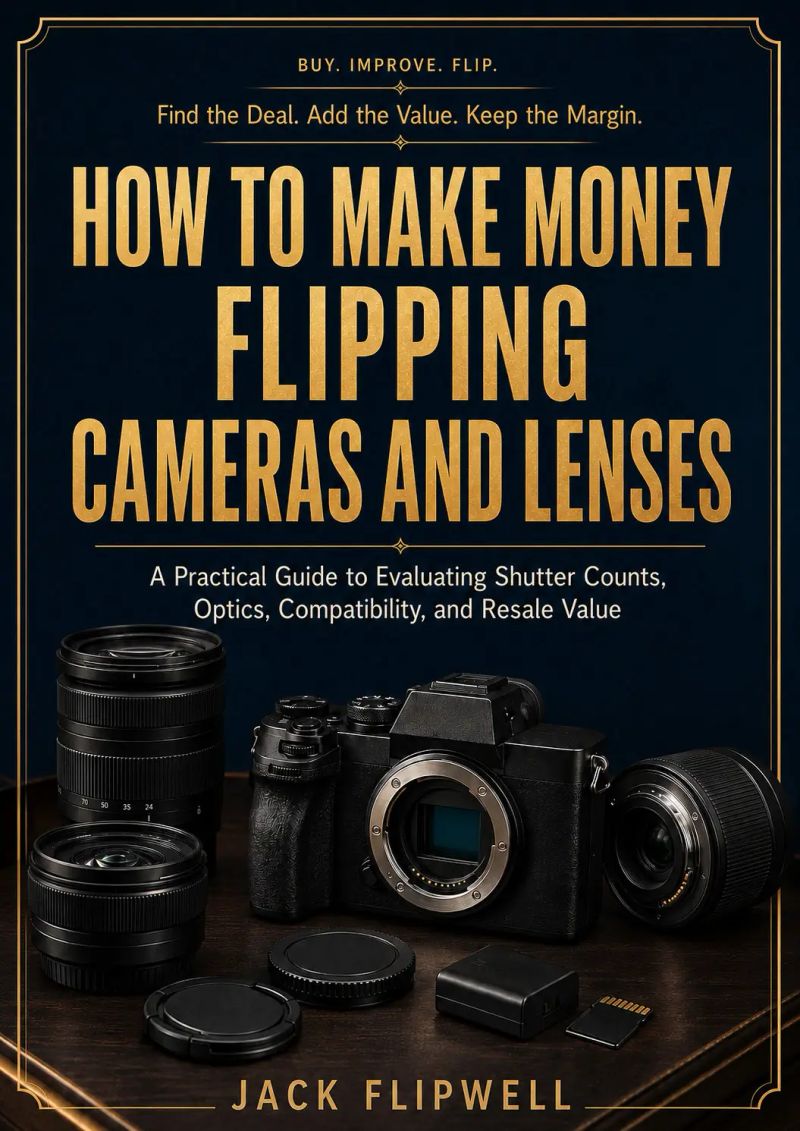
How to Make Money Flipping Cameras and Lenses - A Practical Guide to Evaluating Shutter Counts, Optics, Compatibility, and Resale Value
By JACK FLIPWELL


Length8h 37m
About this audiobook
Used cameras and lenses can retain substantial value for years, but two examples of the same model can have very different real resale values. Shutter count, sensor condition, autofocus performance, optical fungus, haze, aperture problems, stabilization, compatibility, missing accessories, and service history can turn an apparent bargain into either a strong flip or an expensive mistake.
How to Make Money Flipping Cameras and Lenses is a practical guide to evaluating, buying, improving, and reselling used photographic equipment. JACK FLIPWELL presents a complete system from finding an undervalued listing to testing the equipment, calculating a safe purchase price, preparing the product for resale, writing the listing, packing it correctly, and measuring the final profit after all costs.
This book does not rely on promises of easy money or guaranteed returns. Instead, it teaches a repeatable decision process designed to reduce uncertainty and protect capital.
You will learn how the used camera market works, why asking prices are not the same as realistic sale prices, and why liquidity can matter as much as headline margin. The book explains how to compare similar products properly, recognize weak or incomplete listings, use saved searches intelligently, identify potentially undervalued bundles, and avoid confusing low price with genuine opportunity.
A major part of the book focuses on inspection.
You will learn how to evaluate a camera body before purchase, including the mount, controls, card slots, ports, battery compartment, screen, viewfinder, autofocus, stabilization, shutter behavior, and image output. You will also learn how to interpret shutter counts carefully and why one number should never replace a complete assessment of the camera's condition.
Sensor testing receives its own practical process. You will learn how to distinguish ordinary dust from more serious image artifacts, how to create repeatable test frames, how to evaluate suspicious pixels and banding, and when a cleaning issue should be treated differently from a possible sensor defect. The book clearly separates safe reseller-level checks from work better left to qualified technicians.
Lenses are treated as a separate technical category. You will learn how to inspect front and rear elements, recognize possible fungus, haze, separation, coating damage, scratches, and internal dust, and verify whether those defects actually affect photographs. You will also learn how to test a lens for decentering, poor corner performance, backlit contrast problems, and inconsistent results across focal lengths.
The mechanical side of lenses is covered in equal detail. Zoom rings, manual focus, focus-by-wire systems, autofocus motors, aperture mechanisms, stabilization, switches, tripod collars, and position-dependent faults are all included. The goal is to make sure you are buying a specific verified lens, not simply a clean-looking piece of glass.
Compatibility is another major source of costly mistakes. This book explains mounts, sensor formats, adapters, teleconverters, electronic aperture control, autofocus limitations, stabilization behavior, third-party lens compatibility, and firmware-related differences. You will learn why physical fit is only one part of compatibility and how incorrect assumptions can reduce both resale value and the size of the buyer pool.
Bundles and accessories receive a full business analysis. A body, several lenses, batteries, chargers, a grip, flash, filters, bag, and adapters may be worth more when separated or may sell better as a logical complete kit. You will learn how to value each component independently, avoid overstating the worth of low-value extras, identify the slow-moving tail of a bundle, and calculate the real net advantage of splitting a kit.
The book then moves into local inspection, negotiation, and purchase economics. You will learn how to test equipment without rushing, how to recalculate after discovering a defect, how to negotiate using real costs rather than vague opinions, and how to define a maximum purchase price before emotions enter the deal.
A practical financial model shows how to work backward from realistic resale value. You will account for selling fees, shipping, packaging, cleaning, missing accessories, service work, risk reserve, and expected profit. You will also learn how to calculate a quick-exit price, break-even level, conservative scenario, and capital turnover rather than relying only on a headline percentage margin.
This publication was prepared with the assistance of tools that support the creative process, including artificial intelligence-based solutions. The final concept, structure, and editing belong to the author.
Audiobook details
GenreBusiness and Economics
Length8 hrs 37 mins
Narrated byListen with 1,000+ voices
FormateBook with Audio
Publish dateSep 26, 2026
LanguageEnglish
Table of contents
1INTRO
2Chapter 1 - How the Used Camera and Lens Market Really Works
3Chapter 2 - How to Find Undervalued Listings and Set a Realistic Purchase Price
4Chapter 3 - How to Inspect a Camera Body Before You Buy
5Chapter 4 - Shutter Count, Shutter Mechanisms, and the Real Meaning of Camera Wear
Show all chaptersShow less
6Chapter 5 - Sensor Condition, Dust, Dead Pixels, and Image Quality
7Chapter 6 - Autofocus, Stabilization, and Functions That Are Easy to Misjudge
8Chapter 7 - How to Evaluate a Lens: Glass, Fungus, Haze, Dust, and Optical Damage
9Chapter 8 - Lens Mechanics: Aperture, Zoom, Focus Rings, Autofocus, and Stabilization
10Chapter 9 - Mounts, Sensor Formats, and Compatibility: How to Avoid Buying a Lens You Cannot Resell Easily
11Chapter 10 - Bundles, Accessories, and Splitting Kits: How to Increase Margin Without Inventing Value
12Chapter 11 - Local Inspections: How to Test Equipment Without Pressure or Chaos
13Chapter 12 - Purchase Economics: Margin, Costs, Risk Reserve, and Capital Turnover
14Chapter 13 - Negotiation and the Purchase Decision: How to Buy Lower Without Buying Problems
15Chapter 14 - Cleaning and Preparing Equipment for Resale: How to Add Value Without Risky Repairs
16Chapter 15 - Sales Photography: How to Show Condition Clearly and Build Buyer Confidence
17Chapter 16 - How to Write the Listing, Set the Price, and Sell Without Giving Away the Margin
18Chapter 17 - Packing, Shipping, and Documentation: How to Protect the Margin After the Sale
19Chapter 18 - Returns, Complaints, Disputes, and Post-Sale Problems: How to Protect the Buyer, Your Reputation, and Your Capital
20Chapter 19 - Scaling the Business: Capital, Inventory Turnover, Specialization, and Sourcing
21Chapter 20 - The Complete System: From the First Listing to Repeatable Profit

How to Make Money Flipping Sneakers - A Guide to Sourcing, Authentication, Pricing, and Profitable ResellingJACK FLIPWELL4h 29m$7.70 · $0.00
How to Make Money Reselling Clothes - How to Source, Photograph, Price, and Sell Secondhand Fashion OnlineJACK FLIPWELL5h 4m$7.70 · $0.00

How to Make Money Flipping Houses - How to Find Undervalued Properties, Control Renovation Costs, and Sell at the Right PriceJACK FLIPWELL4h 31m$7.70 · $0.00

Jak zarabiać na samochodach używanych - Jak znajdować okazje, szacować koszty i bezpiecznie sprzedawać auta z zyskiemJACK FLIPWELL4h 45m$7.70 · $0.00

Jak zarabiać na odsprzedaży iPhone’ów - Jak kupować poniżej ceny rynkowej, wykrywać wady i sprzedawać z zyskiemJACK FLIPWELL5h 30m$7.70 · $0.00

Jak zarabiać na flipach mieszkaniowych - Jak znajdować niedoszacowane nieruchomości, kontrolować koszty remontu i sprzedawać we właściwej cenieJACK FLIPWELL4h 54m$7.70 · $0.00

Jak zarabiać na używanej elektronice - Jak kupować, testować, wyceniać i sprzedawać smartfony, laptopy, tablety oraz konsoleJACK FLIPWELL5h4.7 (12)$7.70 · $0.00

How to Make Money Flipping Furniture - Turn Cheap and Forgotten Pieces into Products Buyers WantJACK FLIPWELL4h 26m$7.70 · $0.00

How to Make Money Flipping Almost Anything - A Complete System for Finding Deals, Calculating Margins, and Building Repeatable IncomeJACK FLIPWELL5h 57m$7.70 · $0.00

Jak zarabiać na odsprzedaży sneakersów - Przewodnik po wyszukiwaniu okazji, sprawdzaniu autentyczności i dochodowej sprzedażyJACK FLIPWELL4h 32m$7.70 · $0.00
How to Make Money Flipping Used Electronics - How to Buy, Test, Price, and Resell Phones, Laptops, Tablets, and Game ConsolesJACK FLIPWELL4h 22m$7.70 · $0.00

Jak zarabiać na odsprzedaży niemal wszystkiego - Kompletny system wyszukiwania okazji, obliczania marży i budowania powtarzalnego dochoduJACK FLIPWELL5h 29m$7.70 · $0.00

Jak zarabiać na odnawianiu i sprzedaży mebli - Jak zamieniać tanie i zapomniane przedmioty w produkty, które ludzie chcą kupowaćJACK FLIPWELL4h 49m$7.70 · $0.00
How to Make Money Flipping Watches - How to Spot Valuable Models, Avoid Fakes, and Resell with ConfidenceJACK FLIPWELL5h 45m$7.70 · $0.00
How to Make Money Flipping Used Cars - A Beginner's Guide to Finding Deals, Estimating Costs, and Selling Safely for ProfitJACK FLIPWELL4h 24m$7.70 · $0.00

Jak zarabiać na ubraniach z drugiej ręki - Jak wyszukiwać, fotografować, wyceniać i sprzedawać używaną modę w internecieJACK FLIPWELL4h 49m$7.70 · $0.00
How to Make Money Flipping Collectibles - How to Find Undervalued Toys, Sets, Cards, and Limited-Edition ItemsJACK FLIPWELL6h 30m$7.70 · $0.00

Jak zarabiać na przedmiotach kolekcjonerskich - Jak znajdować niedoszacowane zabawki, zestawy, karty i limitowane przedmiotyJACK FLIPWELL5h 5m$7.70 · $0.00

Jak zarabiać na kupowaniu i sprzedaży zegarków - Jak rozpoznawać wartościowe modele, unikać podróbek i sprzedawać z odpowiednią marżąJACK FLIPWELL4h 56m$7.70 · $0.00
How to Make Money Flipping iPhones - A Practical Guide to Buying Below Market Value, Spotting Defects, and Reselling for ProfitJACK FLIPWELL5h 17m$7.70 · $0.00
Never Split the DifferenceChris Voss, Tahl Raz8h 7m4.4 (277.7K)$26 · $0.00
The Intelligent Investor Rev Ed.Benjamin Graham17h 48m4.3 (191.5K)$40 · $0.00
The Hard Thing About Hard ThingsBen Horowitz7h 57m4.2 (134.3K)$26 · $0.00
Boundaries for LeadersHenry Cloud7h 36m4.3 (3.6K)$26 · $0.00

Not Everything Counts but Everything Matters: The powerful and inspirational new book about leadership and achieving success from the visionary multi-premiership winning Panthers coachIvan Cleary6h 1m4.6 (680)$24 · $0.00
BuildTony Fadell11h 5m4.5 (14.3K)$8 · $0.00

The Joys Of CompoundingGautam Baid17h 34m4.5 (2.5K)$18 · $0.00
Basic EconomicsThomas Sowell18h 32m4.5 (29.3K)$28 · $0.00

Poor Charlie’s AlmanackGrover Gardener, Charles T. Munger13h 9m4.5 (24.7K)$18 · $0.00

The Ambuja StoryNarotam Sekhsaria13h 59m4.5 (830)$33 · $0.00

The Secret Door to SuccessFlorence Scovel Shinn2h 25m4.5 (2.1K)$1.20 · $0.00

This Is Going to HurtAdam Kay5h 47m4.4 (444.7K)$24 · $0.00

Big TrustShadé Zahrai, Fayçal Sekkouah8h 36m4.6 (406)$26 · $0.00
The Intelligent Investor Third EditionBenjamin Graham, Jason Zweig20h4.4 (156.6K)$46 · $0.00

Bottle of LiesKatherine Eban14h 25m4.4 (12K)$33 · $0.00

The Antiracist Business BookTrudi Lebrón6h 10m4.6 (275)$17 · $0.00
The FormulaJoshua Robinson, Jonathan Clegg10h 41m4.4 (6.9K)$29 · $0.00

Let Them LeadJohn U. Bacon7h 10m4.5 (1.4K)$24 · $0.00

Secrets of the Millionaire MindT. Harv Eker5h 11m4.4 (301.4K)$24 · $0.00

The Person You Mean to BeDolly Chugh9h 6m4.4 (7.2K)$29 · $0.00
You may also like
Smart BaseballKeith Law9h 52m4.1 (4.5K)$29 · $0.00

Risky BusinessLiran Einav, Amy Finkelstein, Ray Fisman7h 28m4.0 (426)$17 · $0.00
Stein on WritingSol Stein11h 19m4.4 (5.5K)$21

Bertrand Russell: Problems of PhilosophyBertrand Russell4h 51m4.1 (25.1K)$1.99 · $0.00

THE THREE CRITIQUES: The Critique of Pure Reason, The Critique of Practical Reason & The Critique of JudgmentImmanuel Kant46h 8m4.2 (1.6K)$2 · $0.00

Psychopathology of Everyday Life (Annotated)Sigmund Freud9h 34m4.0 (24.8K)$0.99 · $0.00

Skin in the GameJim Gilreath11h 5m$25

The Psychology of HashishAleister Crowley3h 12m3.8 (80)$2 · $0.00

Self-Publishing Guide for Independent AuthorsAnthony Ekanem54m$5

Chasing ShadowsSocialuser4m4.4 (13)$7 · $0.00

Bridge; its Principles and Rules of Play with Illustrative Hands and the Club Code of Bridge LawsJ. B. Elwell2h 58m$2 · $0.00

Preventable DiseasesWoods Hutchinson10h 49m3.7 (29)$2 · $0.00

I Bought Cheap Tickets. Everything Else Cost a Fortune - How to Plan the Real Cost of Travel, Keep Add-Ons Under Control, and Avoid Savings That Turn Into the Most Expensive Option Once Everything Is Added UpMax Paradox4h 53m$7.70 · $0.00
Ace Statics Through Problem SolvingBethany Okonkwo13h 20m$75

MAT Exam Prep 2026–2027Sani Sulaiman5h 47m$6.50 · $0.00

Nuts To Crack A Galaxy of Puzzles, Riddles, Conundrums etc.Anonymous27m$2.30

HumoristsPaul Johnson6h 59m3.3 (175)$17 · $0.00

Ellie Has a SecretAmelia Bothe6m4.2 (192)$4 · $0.00

The Science of GeniusScientific American6h 14m3.9 (13)$17
How Can I Increase the Value of My Business?Richard Mowrey3h 22m$15