
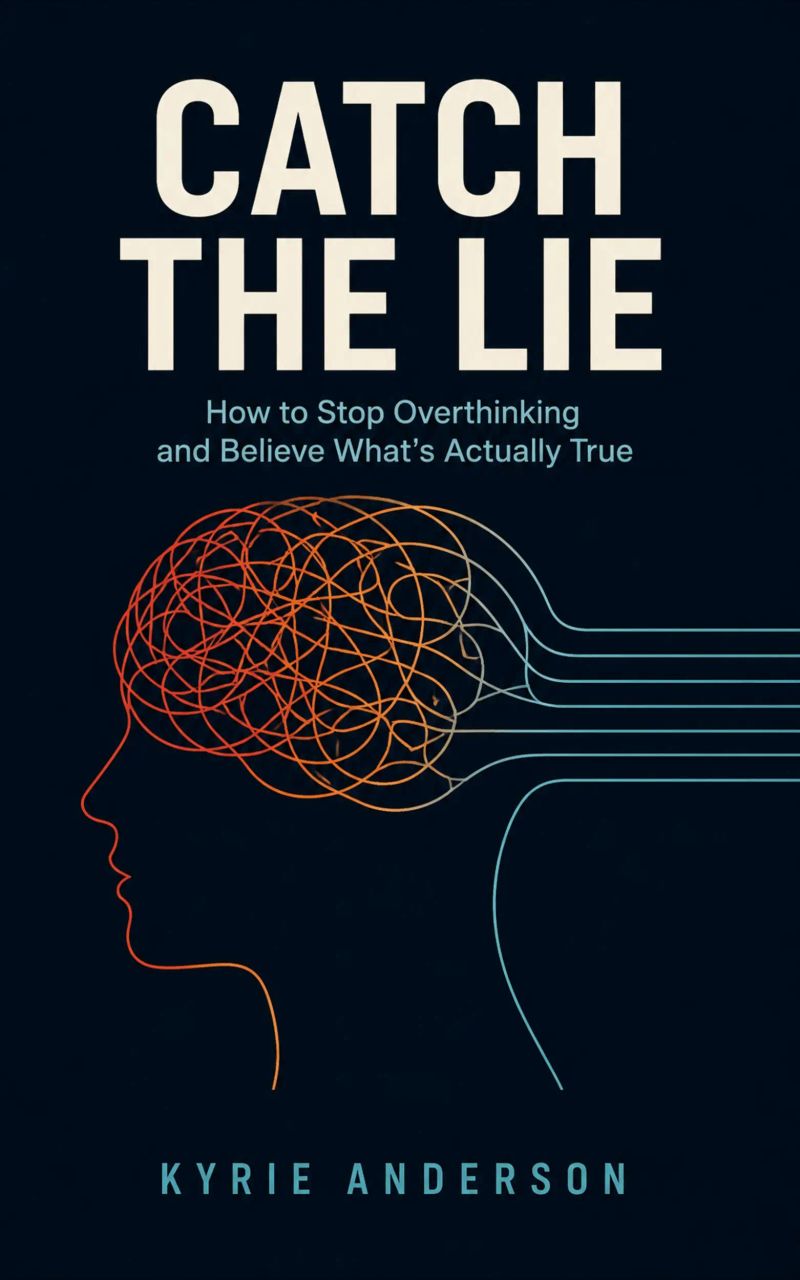
Catch the Lie
How to Stop Overthinking and Believe What's Actually TrueBy Kyrie Anderson

Length3h 44m
About this audiobook
Your brain is not your friend.
It is not designed to make you happy, or to tell you the truth, or to accurately report what's real. It is designed to keep you alive — and four hundred million years of evolution never got the memo that you're not being chased by a predator, you're just lying awake at 2:47 a.m. running a scenario about a text you sent three hours ago.
Catch the Lie is a clear-eyed, evidence-based guide to the four specific lies your brain tells you on a loop — Anxiety, Doubt, Catastrophe, and Comparison — and what fifty years of cognitive science actually says about disarming them. Drawing on the work of Aaron Beck, Daniel Kahneman, Lisa Feldman Barrett, and Judson Brewer, Kyrie Anderson translates decades of clinical research into the Thought Trial: five concrete questions you can run on any lying thought, starting tonight.
This is not a spiritual book. There's no mysticism here, no non-dual philosophy, no instruction to simply "stop thinking." This is a practical, sometimes uncomfortable look at why your mind malfunctions in a world it was never built for — and a specific, testable method for building the gap between what your brain says and what you choose to believe.
You won't become a different person. You'll become the same person, with a lot less suffering manufactured by your own thoughts.
Your brain is already lying to you. Time to start catching it.
Audiobook details
GenreSelf-Help, Psychology
Length3 hrs 44 mins
Narrated byListen with 1,000+ voices
FormateBook with Audio
Publish dateJul 5, 2026
LanguageEnglish
Table of contents
1Introduction
2The Brain as Unreliable Narrator
3Who this book is for
4Who this book is not for
5How the book is organized
Show all chaptersShow less
6A note on examples
7What I hope you get from this book
8Chapter 1
9Your Brain Is Not Your Friend
10What your brain actually is
11What the research says about this
12The three jobs of your brain that are working against you
13Why believing the brain makes everything worse
14What Rachel did, briefly
15Try this: Notice One Story Today
16The Takeaway
17Chapter 2
18The Four Lies
19Why naming them matters
20Lie 1: The Anxiety Lie
21Lie 2: The Doubt Lie
22Lie 3: The Catastrophe Lie
23Lie 4: The Comparison Lie
24How the Four Lies work together
25What the Thought Trial does
26Try this: Catch One Lie Today
27The Takeaway
28Chapter 3
29Why the Glitch Exists
30System 1 and System 2
31The negativity bias
32The brain's preference for false positives
33Why modern life makes the glitch worse
34Why this is actually good news
35Try this: Label the System
36The Takeaway
37Chapter 4
38The Anxiety Lie
39What the Anxiety Lie says, and how to recognize it
40What the research says about this
41Why you cannot reason your way out of the Anxiety Lie
42The three specific moves
43What Daniel did
44Try this: The Alarm Log
45The Takeaway
46Chapter 5
47The Doubt Lie
48The inner voice research
49What the Doubt Lie actually says
50The impostor pattern
Learning to PrayJames Martin13h 24m4.5 (3.4K)$33 · $0.00
Forever BoyKate Swenson9h 27m4.7 (5K)$29 · $0.00

You Are Worth ItKyle Carpenter, Don Yaeger8h 53m4.7 (4.8K)$29 · $0.00

The Happiest Man on EarthEddie Jaku3h 48m4.6 (178K)$7 · $0.00
Finding MeViola Davis9h 15m4.6 (256.4K)$29 · $0.00

Spiritual AnatomyDaaji Kamlesh D. Patel9h 47m4.7 (319)$29 · $0.00

The Dangerous Truth about Today’s MarijuanaLaura Stack CSP, MBA9h 57m4.7 (385)$20 · $0.00

The Gospel according to Spiritualism (Translated)Allan Kardec14h 39m4.6 (3.9K)$5.70 · $0.00

Birdie & HarlowTaylor Wolfe7h 50m4.6 (6.5K)$26 · $0.00
CrossroadsKaleb Dahlgren7h 56m4.6 (4.9K)$26 · $0.00

Life on the BridgeKaelynn Partlow5h 40m4.6 (1.1K)$24 · $0.00
Keep Your Love OnDanny Silk9h 4m4.6 (8.1K)$10 · $0.00

The Tao of Joy Every DayDerek Lin10h 24m4.6 (762)$20 · $0.00
UndividedVicky Beeching9h 2m4.6 (1.3K)$29 · $0.00

HE CAN WHO THINKS HE CAN & OTHER BOOKS ON SUCCESSOrison Swett Marden5h 54m4.6 (1.2K)$1.99 · $0.00
Level UpRob Dial7h 42m4.6 (3.3K)$26 · $0.00
Burn the HaystackJennie Young, PhD9h 30m4.6 (543)$29 · $0.00

ACRES OF DIAMONDS: Our Every-day Opportunities (Wisdom & Empowerment Series) (Annotated)Russell Conwell2h 26m4.6 (1K)$2 · $0.00
Good InsideBecky Kennedy9h 55m4.5 (59.3K)$29 · $0.00

The Lost VoiceGreta Morgan8h 30m4.7 (285)$26 · $0.00
What to Make of a LifeJim Collins13h 31m4.4 (794)$33 · $0.00

I Am The StormJanice Dean9h4.6 (1.5K)$8 · $0.00

On Democracies and Death CultsDouglas Murray10h 38m4.6 (6.5K)$29 · $0.00

TerraformPropaganda5h 39m4.7 (594)$24 · $0.00

Southern Horrors: Lynch Law in All Its Phases (Annotated)Ida B. Wells-Barnett2h 44m4.6 (1.3K)$2 · $0.00
Hour of the HeartIrvin D. Yalom, Benjamin Yalom8h 19m4.6 (2.3K)$26 · $0.00
Braving the TruthRachel Held Evans11h 31m4.7 (359)$29 · $0.00
Level UpRob Dial7h 42m4.6 (3.3K)$26 · $0.00

As a JewSarah Hurwitz8h 36m4.6 (1.2K)$26 · $0.00

Saint Joan (Annotated)George Bernard Shaw6h 20m4.6 (1.2K)$1.20 · $0.00
Burn the HaystackJennie Young, PhD9h 30m4.6 (543)$29 · $0.00

Woman and the New Race (Annotated)Margaret Sanger6h 30m4.6 (1K)$0.99 · $0.00
Good InsideBecky Kennedy9h 55m4.5 (59.3K)$29 · $0.00

The Mis-Education of the NegroCarter Godwin Woodson5h 4m4.5 (29.4K)$1.20 · $0.00

Du Bois: EssaysW.E.B. Du Bois6h 22m4.6 (1.5K)$1 · $0.00

The North American Indian (Illustrated Edition)Edward S. Curtis, Frederick Webb Hodge5h 59m4.6 (1.4K)$2 · $0.00

Valley of the BirdtailAndrew Stobo Sniderman, Douglas Sanderson10h 1m4.6 (2.4K)$29 · $0.00
Lies My Therapist Told MeGreg E. Gifford9h 3m4.6 (503)$29 · $0.00
Disturbed in Their NestsAlephonsion Deng, Judy A. Bernstein11h 22m4.6 (595)$23 · $0.00

No Name in the StreetJames Baldwin5h4.5 (8.5K)$20 · $0.00
You may also like
The Adrenal Thyroid RevolutionAviva Romm8h 40m4.1 (2.6K)$26 · $0.00
The Secret Language of the BodyJennifer Mann, Karden Rabin8h 39m4.3 (1K)$26 · $0.00
Breaking the Age CodeBecca Levy7h 36m4.1 (2.1K)$26 · $0.00

The 30-Day Alzheimer's SolutionDean Sherzai, Ayesha Sherzai3h 44m4.1 (1.3K)$18 · $0.00
How To Stop Worrying And Start Living (Annotated)Dale Carnegie13h 9m4.2 (149.4K)$1.99 · $0.00
This Is Your Brain on AnxietyFaith G. Harper PhD1h3.7 (4.1K)$8 · $0.00
Strong Mind, Light LifeDanniel Silva3h 40m$1.80 · $0.00
The Code of CalmDanniel Silva3h 47m$1.80 · $0.00
GROUNDEDJames Igbodato3h 36m$8
The Code of a Healthy MindDanniel Silva3h 24m$1.80 · $0.00

The Code of a Tranquil MindSara Melo3h 6m$1.80 · $0.00

When the Mind Goes to WarSara Melo3h 1m$1.80 · $0.00
Safe To FeelAmanda Fincham2h 35m$12 · $0.00
The Anchor ProtocolSarah Hopkins4h 48m$4
The Anxiety BookJonathan Davidson MD, Henry Dreher10h 14m3.9 (96)$20 · $0.00
The Second Before the ChoiceDanniel Silva3h 36m$1.80 · $0.00
The Busy Brain CureRomie Mushtaq8h 16m3.4 (283)$7 · $0.00
The Human Behavior ProjectDanniel Silva3h 10m$1.80 · $0.00
Anxiety Relief: How to Overcome Anxiety by Becoming a Warrior of Peace (A Counterintuitive Approach to Recover and Regain Control of Your Life)Kevin Cantrell2h 49m$3.50 · $0.00
The Science of Mental HealthDanniel Silva3h 42m$1.80 · $0.00