
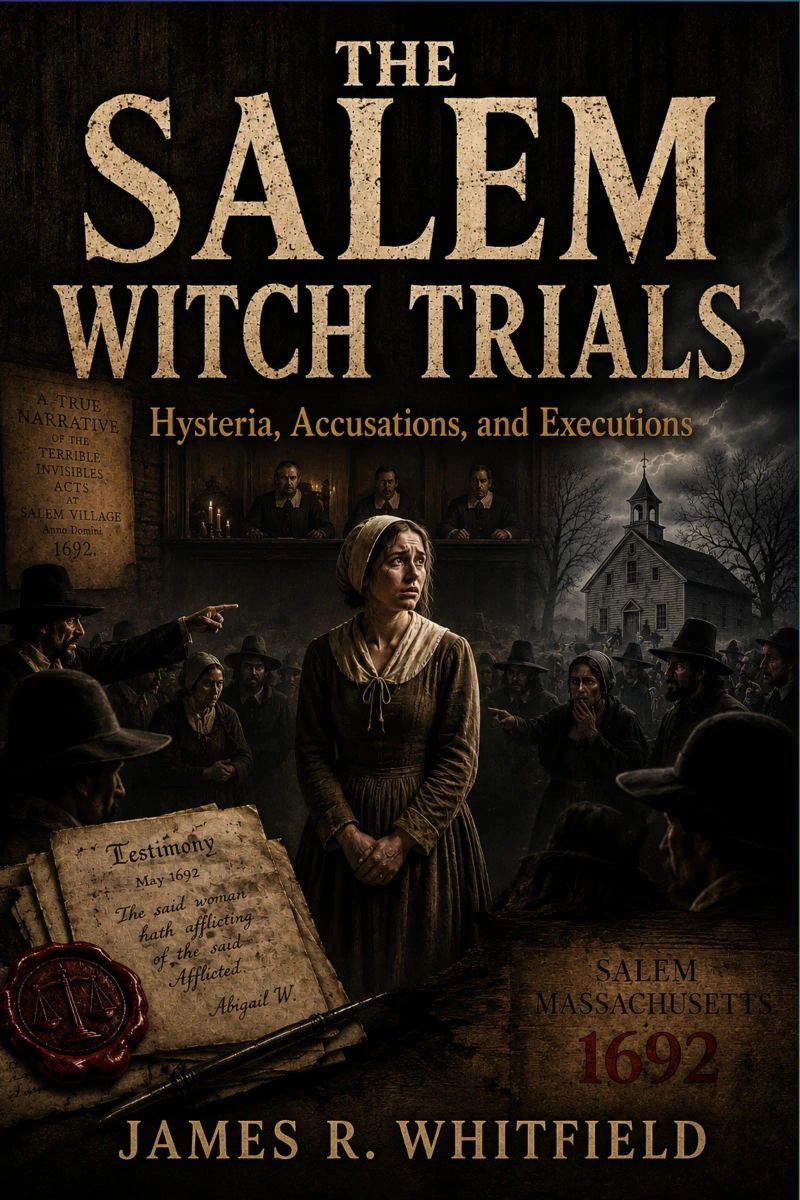
THE SALEM WITCH TRIALS
Hysteria, Accusations, and Executions The Dark Chapter of Colonial Massachusetts That Reveals How Fear and Superstition Can Tear a Community ApartBy James R. Whitfield


Length5h 50m
About this audiobook
The complete narrative history of the Salem witch trials — mass hysteria, spectral evidence, 19 hangings, and the colonial Massachusetts community that destroyed itself in 1692.
In late January 1692, two girls in the parsonage of the Reverend Samuel Parris began throwing themselves on the floor and crying out against invisible tormentors. Within weeks, village physician William Griggs declared them "under an evil hand." Within months, the Court of Oyer and Terminer had hanged nineteen people on Proctor's Ledge — a site confirmed by researchers only in 2016 — pressed Giles Corey to death under stones over two September days, and imprisoned more than two hundred accused. The Salem witch trials lasted fifteen months and executed more accused witches than the entire previous history of New England.
Historian James R. Whitfield traces the full arc: a colony without a charter since 1684, frontier refugees from King William's War (the destruction of York, Maine in January 1692 sent the orphaned Mercy Lewis directly into the Putnam household), and the factional geography Paul Boyer and Stephen Nissenbaum mapped — western farm families against Salem Town merchants — that gave the accusations their targets. At the center stood Samuel Parris, John Hathorne, William Stoughton, Cotton Mather, and Governor William Phips, each decision widening a crisis none would stop.
Inside this Salem witch trials history:
Tituba's confession — her elaborate March 1 testimony, delivered after Samuel Parris allegedly beat her, transformed a household incident into a colony-wide conspiracy (Chapter 4)
The machinery of accusation — spectral evidence, the touch test, and the perverse confession-for-survival logic that drove dozens of new arrests monthly through May (Chapter 7)
The faces behind the names — Bridget Bishop in her red paragon bodice; Rebecca Nurse, initially acquitted before Stoughton forced reconsideration; Mary Eastey, whose prison petition argued for evidence reform, not her own life (Chapter 17)
Giles Corey's gambit — refusing to enter a plea for two days under the stones, preserving his estate where conviction would forfeit it (Chapter 9)
The long shadow — Arthur Miller's Crucible, "witch hunt" in American political vocabulary, and the 2017 Proctor's Ledge memorial (Chapter 15)
The unfinished exoneration — five executed witches — Susannah Martin, Alice Parker, Margaret Scott, and others — waited until acting Governor Jane Swift signed legislation in 2001, 309 years after their deaths (Chapter 16)
The Salem witch trials remain America's paradigm for mass hysteria and judicial overreach. This narrative history recovers not a morality play but the tragedy the record actually shows: intelligent men operating within a framework that made the killings seem reasonable, young women genuinely suffering from something whose nature is still contested, and a community that took fifteen months to stop what it had started.
For readers of Stacy Schiff's THE WITCHES and Mary Beth Norton's IN THE DEVIL'S SNARE.
Audiobook details
GenreHistory
Length5 hrs 50 mins
Narrated byListen with 1,000+ voices
FormateBook with Audio
LanguageEnglish
Table of contents
1Introduction
2Author’s Note
3Prologue: The Gallows Still Stand
4PART ONE: THE WORLD THAT MADE SALEM POSSIBLE
5Chapter 1: God’s Experiment in the Wilderness
Show all chaptersShow less
6Chapter 2: A Colony Under Siege
7Chapter 3: Salem Village — A Community Already at War with Itself
8PART TWO: THE SPARK
9Chapter 4: The Girls in the Parsonage
10Chapter 5: The First Accusations
11PART THREE: THE MACHINERY OF ACCUSATION
12Chapter 6: The Court of Oyer and Terminer
13Chapter 7: The Anatomy of an Accusation
14Chapter 8: Who Was Accused and Why
15PART FOUR: THE EXECUTIONS
16Chapter 9: Hangings on Gallows Hill
17Chapter 10: The Voices of Resistance
18PART FIVE: THE COLLAPSE
19Chapter 11: When the Accusations Touched the Untouchable
20Chapter 12: The Aftermath — A Community Among the Wreckage
21PART SIX: UNDERSTANDING SALEM
22Chapter 13: The Psychological Architecture of Mass Hysteria
23Chapter 14: Salem as Political History
24Chapter 15: Salem’s Long Shadow — American History and Memory
25Chapter 16: Redemption, Exoneration, and Remembrance
26PART SEVEN: RECOVERING THE RECORD
27Chapter 17: The Faces Behind the Names
28Chapter 18: The Documents That Saved the Story
29Chapter 19: The Long Memory
30Chapter 20: The European Context
31Chapter 21: The Specific Communities
32Chapter 22: The Final Reckoning
33Chapter 23: The Surviving Places
34Epilogue: What Salem Tells Us About Ourselves
35Acknowledgments
36Selected Bibliography
37About the Author
THE CALIFORNIA GOLD RUSHJames R. Whitfield5h 35m$7

NATIVE AMERICAN HISTORYJames R. Whitfield5h 23m$10 · $0.00
The american revolutionJames R. Whitfield2h 20m$9 · $0.00
THE SPANISH CONQUEST OF THE AMERICASJames R. Whitfield5h 43m$7 · $0.00

NATIVE AMERICAN HISTORYJames R. Whitfield6h 25m$7 · $0.00

NATIVE AMERICAN HISTORYJames R. Whitfield6h 25m$7 · $0.00
THE CALIFORNIA GOLD RUSHJames R. Whitfield5h 30m$10 · $0.00
THE CALIFORNIA GOLDJames R. Whitfield5h 44m$6 · $0.00

GEORGE WASHINGTONJames R. Whitfield6h 22m$8 · $0.00
THE DECLARATION OF INDEPENDENCEJames R. Whitfield5h 4m$10 · $0.00

THE MEXICAN-AMERICAN WARJames R. Whitfield5h 21m$10 · $0.00

The american revolutionJames R. Whitfield6h 12m$9 · $0.00

CHRISTOPHER COLUMBUSJames R. Whitfield4h 51m$9 · $0.00
THE AMERICAN REVOLUTIONJames R. Whitfield6h 12m4.6 (25)$8 · $0.00

CHRISTOPHER COLUMBUSJames R. Whitfield5h 40m$7 · $0.00
THE DECLARATION OF INDEPENDENCEJames R. Whitfield6h 8m$8 · $0.00
THE DECLARATION OF INDEPENDENCEJames R. Whitfield6h 8m$7 · $0.00

GEORGE WASHINGTONJames R. Whitfield5h 26m$10 · $0.00
THE SPANISH CONQUEST OF THE AMERICASJames R. Whitfield4h 33m$9 · $0.00

A Brief History of IntelligenceMax S. Bennett12h 18m4.6 (6.6K)$29 · $0.00
The Gulag Archipelago Volume 3Aleksandr I. Solzhenitsyn21h 56m4.7 (8.9K)$46 · $0.00
Pearl of Great PriceJoseph Smith3h 8m4.7 (7.2K)$1.20 · $0.00

The Happiest Man on EarthEddie Jaku3h 48m4.6 (178K)$7 · $0.00

MotherlandJulia Ioffe17h 52m4.7 (2.5K)$40 · $0.00

Where Cowards Go to DieBenjamin Sledge8h 42m4.7 (351)$20 · $0.00

RevolutionariesSanjeev Sanyal11h 23m4.6 (2.6K)$29 · $0.00

We Crossed a Bridge and It TrembledWendy Pearlman6h4.6 (5.2K)$24 · $0.00

Unbroken Bonds of BattleJohnny Joey Jones8h 31m4.6 (2.6K)$8 · $0.00

The Daughter of AuschwitzTova Friedman, Malcolm Brabant7h 54m4.6 (16.7K)$26 · $0.00
Lily's PromiseLily Ebert, Dov Forman8h 54m4.6 (16.1K)$29 · $0.00
On Democracies and Death CultsDouglas Murray10h 38m4.6 (6.5K)$29 · $0.00

Across the RiverKent Babb11h 40m4.6 (927)$29 · $0.00

Balcony Over Jerusalem: A Middle East Memoir - Israel, Palestine and BeyondJohn Lyons12h 37m4.6 (1.4K)$33 · $0.00

BeyondStephen Walker15h 39m4.6 (3.2K)$33 · $0.00
Kings and PawnsHoward Bryant10h 9m4.6 (678)$29 · $0.00

No EscapeNury Turkel9h 30m4.6 (809)$28 · $0.00
Jubal Stone: U.S. Marshal: Blood Trail To Hell: A Western Adventure NovelCasey Nash3h 42m4.6 (3.2K)$18 · $0.00

Fall and RiseMitchell Zuckoff17h 23m4.6 (9.8K)$40 · $0.00
The SurvivorJosef Lewkowicz, Michael Calvin9h 22m4.6 (2.5K)$29 · $0.00
You may also like
The Discoverie Of WitchcraftReginald Scot32h 25m4.1 (423)$2.30
Extraordinary Popular Delusions and the Madness of Crowds (Complete Edition: Volume 1-3)Charles Mackay33h 13m4.1 (35.9K)$1.99 · $0.00

Memoirs Of Extraordinary Popular DelusionsCharles Mackay10h 22m4.0 (9.2K)Free

Memoirs of Extraordinary Popular Delusions and the Madness of CrowdsCharles Mackay27h 50m4.1 (29.3K)Free

The Witch's HammerHeinrich Kramer18h 46m3.5 (5.7K)$4.70 · $0.00
Extraordinary Popular Delusions and the Madness of Crowds (Complete Edition: Volume 1-3)Charles Mackay33h 5m4.0 (11.3K)$1 · $0.00
A History of the Inquisition of the Middle Ages (Summarized Edition)Henry Charles Lea18h 1m4.1 (301)$2
The Private Memoirs and Confessions of a Justified Sinner (Psychological Thriller)James Hogg8h 54m3.9 (15.8K)$1.99 · $0.00
White Witch, Black CurseKim Harrison18h 31m4.4 (59.5K)$40 · $0.00
Salem Witchcraft (Complete Edition)Charles Wentworth Upham31h 50m3.5 (102)$2 · $0.00
Discovery of Witches. The Wonderfull Discoverie of Witches in the Countie of LancasterThomas active 1612-1618 Potts8h 31m3.5 (53)$1 · $0.00
The Discovery of Witches (Annotated)Matthew Hopkins1h 13m3.6 (626)$2 · $0.00
The witchcraft delusion of 1692Thomas Hutchinson2h 49m$1 · $0.00
Discovery of Witches. The Wonderfull Discoverie of Witches in the Countie of Lancaster (Summarized Edition)Thomas active 1612-1618 Potts3h 39m$2
The Witchcraft of Salem VillageShirley Jackson3h 10m$14

The Witchcraft Delusion in Colonial Connecticut (Annotated)John M. Taylor5h 13m3.9 (107)$2 · $0.00
Giles Corey, YeomanMary Eleanor Wilkins Freeman1h 52m3.6 (19)$2 · $0.00

The Witchcraft Delusion in New England (Vol. 1-3)Cotton Mather, Robert Calef22h 30m$2 · $0.00
The Witchcraft Delusion in New England (Vol. 1-3) (Annotated)Cotton Mather, Robert Calef19h 30m4.0 (26)$1.49 · $0.00
Salem Witch Trials: The Dark History of the Witch Trials That Terrified a Community (How Rumors, Religion, and Suspicion Fueled the Witch Trials)Jim Jones1h 31m$3.50 · $0.00