
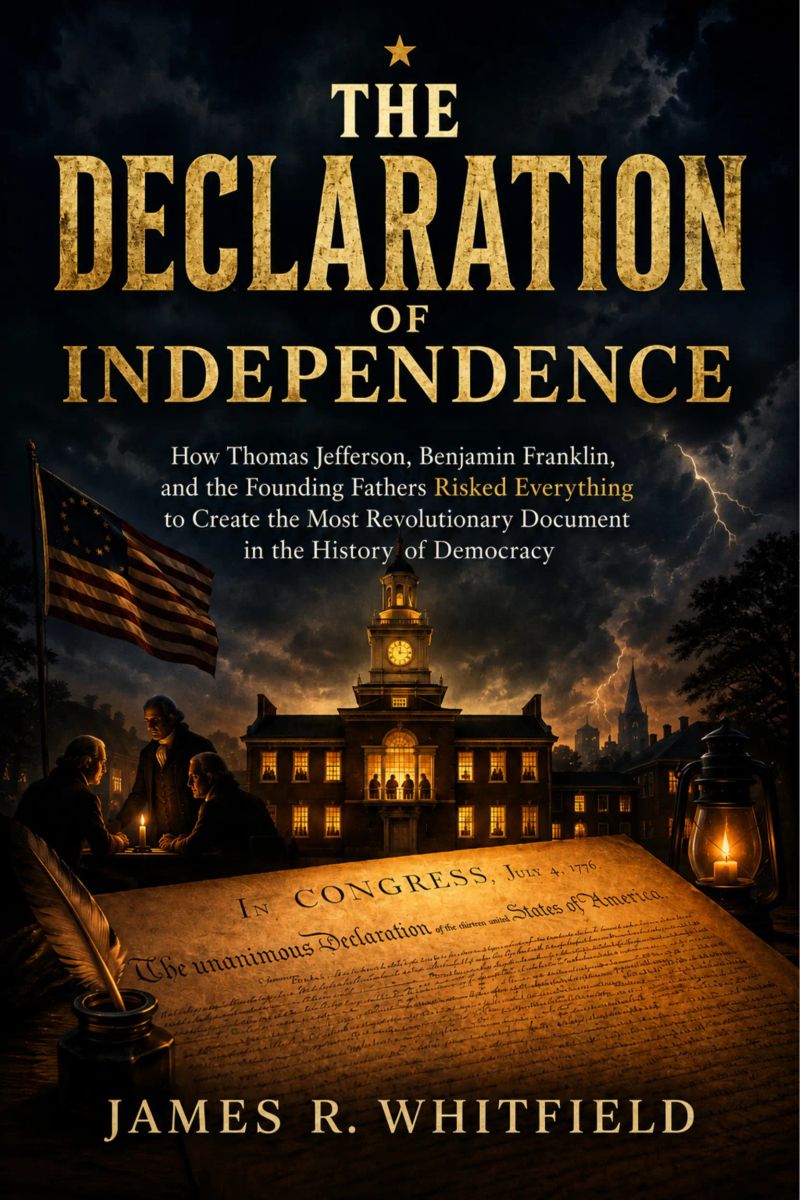
THE DECLARATION OF INDEPENDENCE
How Thomas Jefferson, Benjamin Franklin, and the Founding Fathers Risked Everything to Create the Most Revolutionary Document in the History of DemocracyBy James R. Whitfield


Length6h 8m
About this audiobook
In June 1776, Thomas Jefferson spent two weeks at a portable writing desk in a Philadelphia rented room, drawing on Locke, George Mason, and his own earlier writing to produce the draft that would become America's founding document. This history traces the full arc of that achievement — and the contradictions it carried from the start.
The book covers the imperial crisis that made independence inevitable, Jefferson's drafting sprint, and the editorial hands that shaped the final text — including Benjamin Franklin's quiet change of "sacred and undeniable" to "self-evident." Four sweltering days of Congressional debate produced 90 revisions, most painfully the removal of Jefferson's slave trade passage under Southern pressure. The 56 signers risked execution and property seizure; some, like Richard Stockton of New Jersey, paid with their lives.
The Declaration's most contested sentence — "all men are created equal" — is traced through its Lockean roots and its repeated redeployment by abolitionists, suffragists, and civil rights leaders across two centuries. Its global reach extended from the French Revolution to Latin American independence movements, the 1948 UN Universal Declaration, and Ho Chi Minh's 1945 Vietnamese proclamation.
The book treats Jefferson's slaveholding directly, not as a footnote — the man who wrote that all men are created equal owned enslaved people his entire life. That contradiction is not incidental to the document's history. It is central to it.
Audiobook details
GenreGeneral Fiction, Literary Classics, Other
Length6 hrs 8 mins
Narrated byListen with 1,000+ voices
FormateBook with Audio
LanguageEnglish
Table of contents
1Introduction
2Author’s Note
3Prologue: The Weight of the Quill
4PART ONE: THE WORLD THAT MADE REVOLUTION NECESSARY
5Chapter 1: The Empire and the Colony: A Marriage Gone Wrong
Show all chaptersShow less
6Chapter 2: The Men Who Would Become Founders
7Chapter 3: The Point of No Return: Lexington, Concord, and the Blood Already Spilled
8PART TWO: THE DOCUMENT IS BORN
9Chapter 4: Why Jefferson? The Making of the Primary Author
10Chapter 5: The First Draft: Genius, Passion, and Fatal Excess
11Chapter 6: Franklin’s Hand: The Master Editor at Work
12Chapter 7: The Congress Tears It Apart: Four Days of Agony
13PART THREE: THE PRICE OF THE SIGNATURE
14Chapter 8: Signing the Death Warrant
15Chapter 9: Traitors to the Crown: What They Stood to Lose
16Chapter 10: Benjamin Franklin’s Impossible Position
17PART FOUR: THE REVOLUTIONARY IDEA
18Chapter 11: All Men Are Created Equal: The Most Contested Sentence in History
19Chapter 12: The Global Shockwave
20Chapter 13: The Document’s Near-Disappearance
21PART FIVE: THE LIVING DOCUMENT
22Chapter 14: Every Generation’s Declaration
23Chapter 15: What It Still Demands of Us
24PART SIX: THE LONG ECHO
25Chapter 16: The Fifty-Six — Lives After the Signing
26Chapter 17: The Document Itself
27PART SEVEN: THE WIDER STORY
28Chapter 18: The Lee Resolution and the Path to Independence
29Chapter 19: The Excised Passages — What Jefferson Lost
30Chapter 20: The British Response
31Chapter 21: The Declaration’s International Influence
32Chapter 22: From Articles to Constitution
33Chapter 23: The Continental Congress as Institution
34Chapter 24: Independence Day — Two Centuries of Commemoration
35Chapter 25: The Drafting Committee — Five Men, One Document
36Chapter 26: The Continuing Conversation
37Epilogue: If They Could See Us Now
38Acknowledgments
39Selected Bibliography
40About the Author
THE CALIFORNIA GOLD RUSHJames R. Whitfield5h 35m$7

NATIVE AMERICAN HISTORYJames R. Whitfield5h 23m$10 · $0.00

THE SALEM WITCH TRIALSJames R. Whitfield5h 51m$6 · $0.00
The american revolutionJames R. Whitfield2h 20m$9 · $0.00
THE SPANISH CONQUEST OF THE AMERICASJames R. Whitfield5h 43m$7 · $0.00

NATIVE AMERICAN HISTORYJames R. Whitfield6h 25m$7 · $0.00

NATIVE AMERICAN HISTORYJames R. Whitfield6h 25m$7 · $0.00
THE CALIFORNIA GOLD RUSHJames R. Whitfield5h 30m$10 · $0.00
THE CALIFORNIA GOLDJames R. Whitfield5h 44m$6 · $0.00
GEORGE WASHINGTONJames R. Whitfield6h 22m$8 · $0.00
THE DECLARATION OF INDEPENDENCEJames R. Whitfield5h 4m$10 · $0.00

THE MEXICAN-AMERICAN WARJames R. Whitfield5h 21m$10 · $0.00
The american revolutionJames R. Whitfield6h 12m$9 · $0.00

CHRISTOPHER COLUMBUSJames R. Whitfield4h 51m$9 · $0.00
THE AMERICAN REVOLUTIONJames R. Whitfield6h 12m4.6 (25)$8 · $0.00

CHRISTOPHER COLUMBUSJames R. Whitfield5h 40m$7 · $0.00
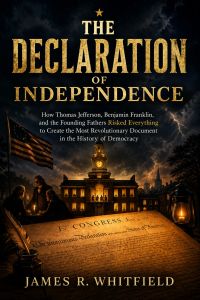
THE DECLARATION OF INDEPENDENCEJames R. Whitfield6h 8m$7 · $0.00
GEORGE WASHINGTONJames R. Whitfield5h 26m$10 · $0.00

THE SPANISH CONQUEST OF THE AMERICASJames R. Whitfield4h 33m$9 · $0.00

WhistlerAnn Patchett10h 45m4.6 (4.6K)$29 · $0.00
Demon CopperheadBarbara Kingsolver21h 3m4.5 (949.4K)$46 · $0.00

To Kill a MockingbirdHarper Lee12h 18m4.5 (7.4M)$29 · $0.00

Remarkably Bright CreaturesShelby Van Pelt11h 17m4.4 (1.7M)$29 · $0.00

This Side of Paradise - The Original 1920 Edition (Annotated)F. Scott Fitzgerald11h 30m4.6 (1.6K)$2 · $0.00

War LordBernard Cornwell13h 21m4.6 (33.1K)$33 · $0.00
The Great Gatsby: Original 1925 Edition (An F. Scott Fitzgerald Classic NovelFrancis Scott Fitzgerald4h 45m4.6 (9.3K)$18 · $0.00
Something Like LoveBeverly Jenkins10h 21m4.6 (2.7K)$29 · $0.00
Black History CollectionFrederick Douglass, Harriet Ann Jacobs, Booker T. Washington, W.E.B. Du Bois27h 9m4.6 (2.6K)$18 · $0.00

The Old Man and the Sea (Annotated)Ernest Hemingway4h 27m4.6 (1.4K)$2 · $0.00

White HotIlona Andrews13h 18m4.5 (136.9K)$5 · $0.00

The Ghost by the Billabong (The Matilda Saga, #5)Jackie French14h 58m4.6 (773)$33 · $0.00
Cast in BloodMichelle Sagara16h 35m4.6 (607)$33 · $0.00
The Captain Blood Trilogy (Annotated)Rafael Sabatini29h 20m4.6 (1K)$3 · $0.00
Ship of the Line (Annotated)Cecil Louis Troughton Smith11h 13m4.6 (1K)$2 · $0.00
The George Orwell CollectionGeorge Orwell24h 46m4.5 (14.4K)$12 · $0.00
ShivajiRanjit Desai25h 13m4.6 (3.1K)$24 · $0.00
Time RegainedMarcel Proust15h 38m4.5 (9.2K)$2 · $0.00

Driving ForceElle James4h 58m4.6 (407)$20 · $0.00

When God Calls the HeartBrian Bird, Michelle Cox3h 24m4.6 (439)$10 · $0.00
To Kill a MockingbirdHarper Lee12h 18m4.5 (7.4M)$29 · $0.00

These Precious DaysAnn Patchett11h 14m4.5 (45.2K)$29 · $0.00

The Jeeves and Wooster Stories: The Complete Collection (33 Books)P. G. Wodehouse21h 57m4.7 (2.8K)$15 · $0.00

The Gulag Archipelago Volume 3Aleksandr I. Solzhenitsyn21h 56m4.7 (8.9K)$46 · $0.00
This Side of Paradise - The Original 1920 Edition (Annotated)F. Scott Fitzgerald11h 30m4.6 (1.6K)$2 · $0.00
The Great Gatsby: Original 1925 Edition (An F. Scott Fitzgerald Classic NovelFrancis Scott Fitzgerald4h 45m4.6 (9.3K)$18 · $0.00
TWELFTH NIGHTWilliam Shakespeare, Sidney Lee16h 38m4.6 (2.8K)$1.99 · $0.00

The Complete Histories / History Plays of William Shakespeare (Annotated)William Shakespeare29h 42m4.6 (2.3K)$0.99 · $0.00
Braving the TruthRachel Held Evans11h 31m4.7 (359)$29 · $0.00
The Old Man and the Sea (Annotated)Ernest Hemingway4h 27m4.6 (1.4K)$2 · $0.00
Henry V (The Play, Historical Background and Analysis of the Character in the Play)William Shakespeare, William Hazlitt8h 50m4.6 (1.3K)$1.99 · $0.00
H. P. LOVECRAFT Ultimate Collection: Novellas, Short Stories, Poetry & Essays (Annotated)H. P. Lovecraft12h 28m4.6 (2.3K)$2 · $0.00
Time RegainedMarcel Proust16h 8m4.5 (10.6K)$1.99 · $0.00
The Mis-Education of the NegroCarter Goodwin Woodson4h 32m4.5 (28.4K)$10 · $0.00
Lessons in TruthH. Emilie3h 50m4.6 (1.4K)$4.70 · $0.00
TORAH - Bilingual Edition: English/Hebrew (Annotated)Max Margolis, JPS28h 26m4.6 (1K)$2 · $0.00

Betty Crocker picture cooky bookBetty Crocker, Inc. General Mills2h 13m4.5 (6.5K)$1 · $0.00

The Complete Tales of Beatrix PotterBeatrix Potter3h 36m4.5 (75K)$3 · $0.00

Anne of Green GablesL. M. Montgomery11h 1m4.5 (1.2M)$2.30 · $0.00

Crime and Punishment (The Unabridged Garnett Translation) (Annotated)Fyodor Dostoevsky24h 25m4.5 (15.4K)$0.99 · $0.00
Mere ChristianityC. S. Lewis7h 7m4.4 (519.7K)$24 · $0.00

Her Daily BreadKate Wood12h 57m4.6 (153)$33 · $0.00
The Holy Bible - 1 SamuelKing James2h 13m4.8 (1.6K)$3 · $0.00
The American Standard Bible — The Gospel of MatthewMatthew3h 56m4.7 (3K)$2 · $0.00
Bad Fat Black GirlSesali Bowen6h 32m4.7 (2.8K)$24 · $0.00
The King James Audio Bible New Testament CompleteChristopher Glyn20h 2m4.7 (2.6K)$12 · $0.00
Faiths CheckbookCharles Spurgeon12h 44m4.7 (3.2K)$11 · $0.00

Ten Things I Wish You Knew About Your Child's Mental HealthDr. Billy Garvey4h 53m4.7 (2.4K)$20 · $0.00

Designing Terry Pratchett’s DiscworldPaul Kidby3h 52m4.7 (343)$20 · $0.00
The Chosen Book OneAmanda Jenkins, Kristen Hendricks, Dallas Jenkins3h 8m4.6 (4.9K)$10 · $0.00
The Lives of BrianBrian Johnson9h 45m4.6 (3.5K)$29 · $0.00
Expository Thoughts on the Gospel of LukeJ.C. Ryle27h 13m4.7 (536)$18 · $0.00
CrossroadsKaleb Dahlgren7h 56m4.6 (4.9K)$26 · $0.00

Across the RiverKent Babb11h 40m4.6 (927)$29 · $0.00

Brain Training for RidersAndrea Monsarrat Waldo5h 56m4.7 (550)$19 · $0.00

My Effin' LifeGeddy Lee17h 11m4.6 (13.1K)$40 · $0.00
Kings and PawnsHoward Bryant10h 9m4.6 (678)$29 · $0.00

The Elementia Chronicles #2: The New OrderSean Fay Wolfe11h 17m4.6 (841)$29 · $0.00
The ActsLuke2h 55m4.6 (19.7K)$12 · $0.00
New Testament - Easy NavigationWorld English Bible19h 35m4.6 (1.3K)$1.30 · $0.00
You may also like
Common SenseThomas Paine31h 40m4.1 (67.7K)$1.99 · $0.00
William the ConquerorEdward A. Freeman6h 42m3.7 (1.3K)$2 · $0.00
The American RevolutionChristopher Collier, James Lincoln Collier2h 9m4.1 (686)$10
The Story of LibertyCharles Carleton Coffin10h 56m4.4 (522)$1.99 · $0.00
The History of the Holy Roman Empire: 1st Century A.D. - 19th CenturyViscount James Bryce15h 3m4.0 (2.1K)$1.99 · $0.00

THE CIVIL WAR (Complete Edition)Julius Caesar7h 27m4.1 (8.1K)$1.99 · $0.00

The Politically Incorrect Guide to the Presidents, Part 1Larry Schweikart10h 45m4.1 (230)$20

A history of Canada, 1763-1812Charles Prestwood Sir Lucas13h 25m$2 · $0.00
The Life and Legacy of Napoleon Bonaparte: All 4 Volumes (Annotated)William Milligan Sloane58h 30m4.2 (35)$2 · $0.00
Ancient Greece: The History of Classical Greece from Its Earliest Beginnings to the Hellenistic Age (Summarized Edition)John Bagnell Bury8h 58m$2

Portraits of British Americans (Vol. 1-3)Fennings Taylor41h 14m$0.99 · $0.00

A Short History of FranceMary Platt Parmele5h 54m3.5 (90)$1 · $0.00
The Signers of the Declaration of Independence - Complete Biographies in One VolumeL. Carroll Judson20h 24m$2 · $0.00
DelacroixPaul G. Konody1h 19m$1 · $0.00
Founding Fathers: Complete Biographies, Their Articles, Historical & Political DocumentsL. Carroll Judson, Emory Speer, Helen M. Campbell, John Jay (Lawyer)27h 38m$2 · $0.00

The Little Book of the FlagEva March Tappan2h 4m$2 · $0.00

Biographical OutlinesAnonymous1h 39m$1 · $0.00
St. John's College, CambridgeRobert Forsyth Scott52m$2 · $0.00
Founding Fathers: Complete Biographies, Their Articles, Historical & Political DocumentsL. Carroll Judson, John Jay (Lawyer), Helen M. Campbell, Emory Speer27h 42m4.4 (12)$1.99 · $0.00
John Locke: The Philosopher of LibertySaraban K. K. 54m4.7 (11) Only with Ultra