
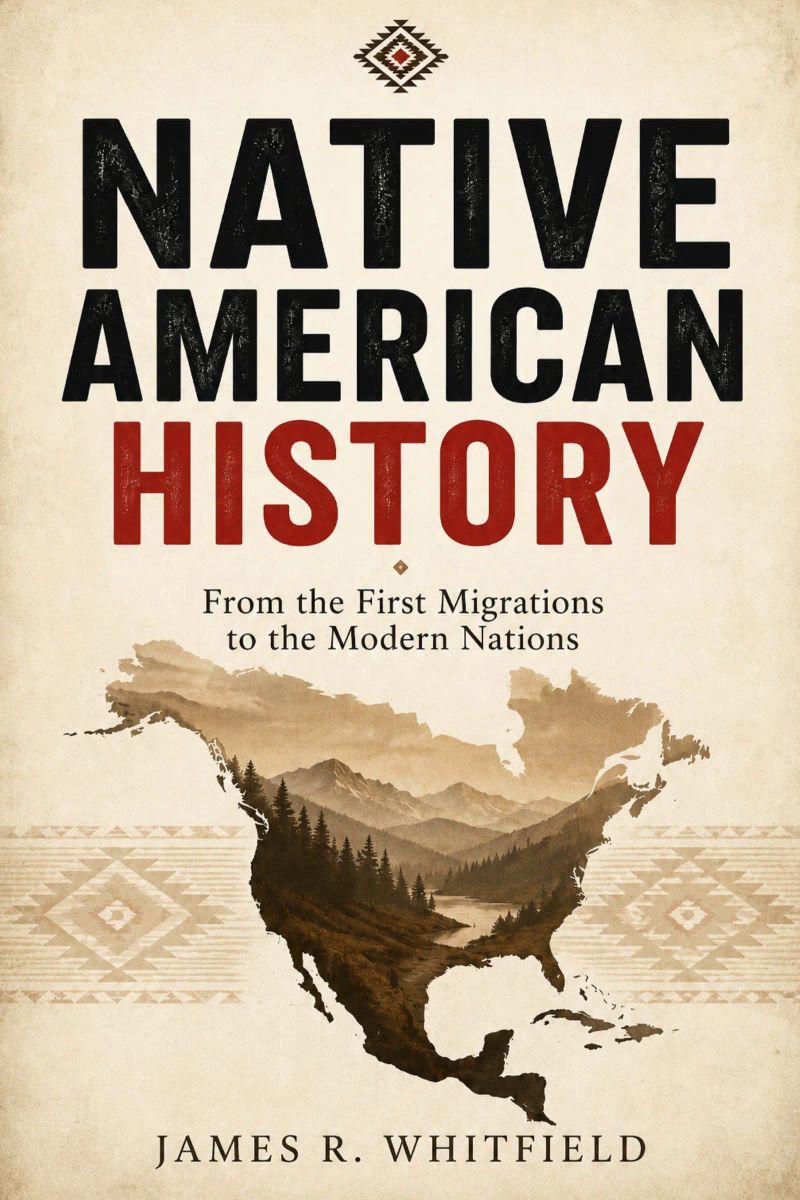
NATIVE AMERICAN HISTORY
From the First Migrations to the Modern Nations A Comprehensive History of the Original Inhabitants of North AmericaBy James R. Whitfield


Length6h 24m
About this audiobook
Native American history from first migrations to today's 574 federally recognized nations — a complete narrative of Indigenous peoples of North America: mound builders, Haudenosaunee democracy, Trail of Tears, boarding schools, Red Power, and tribal sovereignty.
In the summer of 1908, a Black cowboy named George McJunkin noticed bones in a washed-out arroyo in New Mexico. Lodged among them was a fluted spear point between the ribs of an extinct bison. He died in 1922 before anyone took him seriously. Five years later, archaeologists confirmed what he understood: humans had hunted here for at least ten thousand years — and sites from Monte Verde to White Sands suggest twenty thousand or more.
That deep past is where this narrative history begins. James R. Whitfield traces the full arc from Cahokia — the pre-Columbian city that at its height rivaled London — through the Haudenosaunee Confederacy's federal constitution (some historians date it to 1142), the Pueblo Revolt of 1680, Sitting Bull's four years in Canadian exile, the 250-person massacre at Wounded Knee in December 1890, Richard Pratt's Carlisle boarding school with its motto "Kill the Indian, Save the Man," and the American Indian Movement's 71-day occupation of Wounded Knee in 1973.
Inside this Native American history book:
The deep precolonial past — Cahokia's Monks Mound, larger in footprint than any Egyptian pyramid; Chaco Canyon's lunar-standstill calendar; Hopewell trade networks from Lake Superior to the Gulf (Chapters 2-3)
Haudenosaunee democracy — the Peacemaker's Great Law, five nations bound in a federal confederacy centuries before the U.S. Constitution (Chapter 4)
Contact and catastrophe — a 90-percent population collapse within 150 years; disease traveling trade routes before Europeans arrived (Chapters 6-8)
Trail of Tears and the wars of the West — Jackson's Removal Act, Sitting Bull's surrender and death at the hands of Lakota police, the Ghost Dance (Chapters 10-13)
The boarding-school era — 408 federal schools, 53 burial sites, and intergenerational trauma documented in the 2022 Interior Department report (Chapter 14)
Red Power — Alcatraz 1969, the Trail of Broken Treaties, the armed 71-day Wounded Knee siege of 1973 (Chapter 16)
The living nations — tribal sovereignty, language immersion schools, and nine million Americans who identify as Native today (Chapters 17-18)
No other single-volume narrative covers fifteen thousand years of Indigenous North America — from Ice Age migrants to the self-determination era. The story did not end at Wounded Knee. It is still being written.
For readers of Roxanne Dunbar-Ortiz's AN INDIGENOUS PEOPLES' HISTORY OF THE UNITED STATES and Dee Brown's BURY MY HEART AT WOUNDED KNEE.
Audiobook details
GenreHistory, Psychology
Length6 hrs 24 mins
Narrated byListen with 1,000+ voices
FormateBook with Audio
LanguageEnglish
Table of contents
1Introduction
2Author’s Note
3Prologue: Before the Word “America” Existed
4PART ONE: THE WORLD BEFORE COLUMBUS
5Chapter 1: The First Americans — Origins, Migration, and the Deep Past
Show all chaptersShow less
6Chapter 2: The Mound Builders — America’s Forgotten Architects
7Chapter 3: The Southwest Civilizations
8Chapter 4: The Eastern Woodlands — The Haudenosaunee and the World’s Oldest Democracy
9Chapter 5: The Plains, the Plateau, and the Pacific — A Continent of Diversity
10PART TWO: CONTACT AND CONQUEST
11Chapter 6: Columbus, Conquest, and the First Wave of Destruction
12Chapter 7: The English Arrive — Alliance, Betrayal, and the Wars of the East
13Chapter 8: The Colonial Period — Trade, Disease, and Shifting Alliances
14PART THREE: REMOVAL, RESISTANCE, AND WAR
15Chapter 9: The New Nation’s Indian Policy
16Chapter 10: Andrew Jackson and the Trail of Tears
17Chapter 11: Manifest Destiny and the War on the West
18Chapter 12: Sitting Bull — The Last Defender of the Plains
19Chapter 13: The Ghost Dance and Wounded Knee
20PART FOUR: ERASURE AND SURVIVAL
21Chapter 14: Kill the Indian, Save the Man — The Boarding School Era
22Chapter 15: The 20th Century — From Allotment to Termination
23PART FIVE: RESURGENCE
24Chapter 16: Red Power — The American Indian Movement
25Chapter 17: Sovereignty, Casinos, and the Ongoing Legal Battles
26Chapter 18: The Living Nations — Indigenous Culture, Identity, and Renaissance
27Epilogue: The Story Is Not Over
28Acknowledgments
29Selected Bibliography
30About the Author
THE CALIFORNIA GOLD RUSHJames R. Whitfield5h 35m$7

NATIVE AMERICAN HISTORYJames R. Whitfield5h 23m$10 · $0.00

THE SALEM WITCH TRIALSJames R. Whitfield5h 51m$6 · $0.00

The american revolutionJames R. Whitfield2h 20m$9 · $0.00

THE SPANISH CONQUEST OF THE AMERICASJames R. Whitfield5h 43m$7 · $0.00

NATIVE AMERICAN HISTORYJames R. Whitfield6h 25m$7 · $0.00
THE CALIFORNIA GOLD RUSHJames R. Whitfield5h 30m$10 · $0.00
THE CALIFORNIA GOLDJames R. Whitfield5h 44m$6 · $0.00

GEORGE WASHINGTONJames R. Whitfield6h 22m$8 · $0.00

THE DECLARATION OF INDEPENDENCEJames R. Whitfield5h 4m$10 · $0.00

THE MEXICAN-AMERICAN WARJames R. Whitfield5h 21m$10 · $0.00

The american revolutionJames R. Whitfield6h 12m$9 · $0.00

CHRISTOPHER COLUMBUSJames R. Whitfield4h 51m$9 · $0.00

THE AMERICAN REVOLUTIONJames R. Whitfield6h 12m4.6 (25)$8 · $0.00

CHRISTOPHER COLUMBUSJames R. Whitfield5h 40m$7 · $0.00

THE DECLARATION OF INDEPENDENCEJames R. Whitfield6h 8m$8 · $0.00

THE DECLARATION OF INDEPENDENCEJames R. Whitfield6h 8m$7 · $0.00

GEORGE WASHINGTONJames R. Whitfield5h 26m$10 · $0.00

THE SPANISH CONQUEST OF THE AMERICASJames R. Whitfield4h 33m$9 · $0.00

A Brief History of IntelligenceMax S. Bennett12h 18m4.6 (6.6K)$29 · $0.00

The Gulag Archipelago Volume 3Aleksandr I. Solzhenitsyn21h 56m4.7 (8.9K)$46 · $0.00

Pearl of Great PriceJoseph Smith3h 8m4.7 (7.2K)$1.20 · $0.00

The Happiest Man on EarthEddie Jaku3h 48m4.6 (178K)$7 · $0.00

MotherlandJulia Ioffe17h 52m4.7 (2.5K)$40 · $0.00

Where Cowards Go to DieBenjamin Sledge8h 42m4.7 (351)$20 · $0.00

RevolutionariesSanjeev Sanyal11h 23m4.6 (2.6K)$29 · $0.00

We Crossed a Bridge and It TrembledWendy Pearlman6h4.6 (5.2K)$24 · $0.00

Unbroken Bonds of BattleJohnny Joey Jones8h 31m4.6 (2.6K)$8 · $0.00

The Daughter of AuschwitzTova Friedman, Malcolm Brabant7h 54m4.6 (16.7K)$26 · $0.00

Lily's PromiseLily Ebert, Dov Forman8h 54m4.6 (16.1K)$29 · $0.00

On Democracies and Death CultsDouglas Murray10h 38m4.6 (6.5K)$29 · $0.00

Across the RiverKent Babb11h 40m4.6 (927)$29 · $0.00

Balcony Over Jerusalem: A Middle East Memoir - Israel, Palestine and BeyondJohn Lyons12h 37m4.6 (1.4K)$33 · $0.00

BeyondStephen Walker15h 39m4.6 (3.2K)$33 · $0.00
Kings and PawnsHoward Bryant10h 9m4.6 (678)$29 · $0.00

No EscapeNury Turkel9h 30m4.6 (809)$28 · $0.00

Jubal Stone: U.S. Marshal: Blood Trail To Hell: A Western Adventure NovelCasey Nash3h 42m4.6 (3.2K)$18 · $0.00

Fall and RiseMitchell Zuckoff17h 23m4.6 (9.8K)$40 · $0.00
The SurvivorJosef Lewkowicz, Michael Calvin9h 22m4.6 (2.5K)$29 · $0.00
What to Make of a LifeJim Collins13h 31m4.4 (794)$33 · $0.00

Black AF HistoryMichael Harriot15h 43m4.7 (14.6K)$33 · $0.00

Bad Fat Black GirlSesali Bowen6h 32m4.7 (2.8K)$24 · $0.00

Invisible StormJason Kander6h 48m4.7 (3.2K)$24 · $0.00

I Am The StormJanice Dean9h4.6 (1.5K)$8 · $0.00
On Democracies and Death CultsDouglas Murray10h 38m4.6 (6.5K)$29 · $0.00

TerraformPropaganda5h 39m4.7 (594)$24 · $0.00

Southern Horrors: Lynch Law in All Its Phases (Annotated)Ida B. Wells-Barnett2h 44m4.6 (1.3K)$2 · $0.00

Hour of the HeartIrvin D. Yalom, Benjamin Yalom8h 19m4.6 (2.3K)$26 · $0.00

Braving the TruthRachel Held Evans11h 31m4.7 (359)$29 · $0.00
Level UpRob Dial7h 42m4.6 (3.3K)$26 · $0.00

As a JewSarah Hurwitz8h 36m4.6 (1.2K)$26 · $0.00
Saint Joan (Annotated)George Bernard Shaw6h 20m4.6 (1.2K)$1.20 · $0.00

Burn the HaystackJennie Young, PhD9h 30m4.6 (543)$29 · $0.00

Woman and the New Race (Annotated)Margaret Sanger6h 30m4.6 (1K)$0.99 · $0.00

Good InsideBecky Kennedy9h 55m4.5 (59.3K)$29 · $0.00

The Mis-Education of the NegroCarter Godwin Woodson5h 4m4.5 (29.4K)$1.20 · $0.00

Du Bois: EssaysW.E.B. Du Bois6h 22m4.6 (1.5K)$1 · $0.00

The North American Indian (Illustrated Edition)Edward S. Curtis, Frederick Webb Hodge5h 59m4.6 (1.4K)$2 · $0.00

Valley of the BirdtailAndrew Stobo Sniderman, Douglas Sanderson10h 1m4.6 (2.4K)$29 · $0.00
You may also like
The BeadworkersBeth Piatote5h 15m4.1 (1.2K)$17 · $0.00
The Day the World Ended at Little BighornJoseph M. Marshall III8h 18m4.1 (1.4K)$20

The North American Indian (Annotated)Edward S. Curtis, Frederick Webb Hodge7h 2m4.4 (555)$2 · $0.00

ANCIENT GREECE: The History of Classical Greece from Its Earliest Beginnings to the Hellenistic Age (Annotated)John Bagnell Bury41h 58m4.2 (1.3K)$2 · $0.00

Indian Boyhood & From the Deep Woods to CivilizationCharles Eastman9h 55m4.3 (355)$0.99 · $0.00

The Native Races of East AfricaWilfrid D. Hambly1h 3m$2 · $0.00

The Towns That Never Died: The Hopi and the Fight for the MesasMarisol Keevama3h 57m$6
The Australian aboriginalHerbert Basedow14h 34m$2 · $0.00

An Account of the Manners and Customs of the Aborigines and the State of their Relations with EuropeansEdward John Eyre10h 35m$1.20 · $0.00

The Caddo Indians of LouisianaClarence H. Webb, Hiram F. Gregory1h 9m$1 · $0.00

History of the Iroquois & Tuscarora IndiansElias Johnson8h 27m4.3 (17)$1 · $0.00

The Complete Works of Sara Agnes Rice Pryor (Illustrated Edition) (Annotated)Sara Agnes Rice Pryor39h 45m$1.99 · $0.00

Mother Earth Is Our ElderKatlia (Catherine) Lafferty10h 16m$29 · $0.00

Legends, Traditions and Laws of the Iroquois & History of the Tuscarora IndiansElias Johnson8h 34m3.8 (69)$0.99 · $0.00

The White Clay People: A History of the Gros Ventre NationDaniel Redfield Hollis3h 49m$6

The Chickamauga Dam and its environsRobert Sparks Walker55m$1 · $0.00

Native American Studies (22 Book Collection)Lewis Spence, John Wesley Powell, James Owen Dorsey, Charles C. Royce, Frank Hamilton Cushing, Washington Matthews, Garrick Mallery, Cyrus Thomas, Clay MacCauley, Edward S. Curtis, James Mooney, Alexander Scott Withers, Franz Boas, Elias Johnson, Erminnie A. Smith, John Stevens Cabot Abbott, Joseph Kossuth Dixon, John Heckewelder, William C. Reichel, Black Hawk, Charles M. Scanlan, William John McGee, John G. Bourke228h 23m$2 · $0.00

Native Americans: 22 Books on History, Mythology, Culture & Linguistic StudiesVarious225h 8m$1 · $0.00

A Popular History of Ireland (Vol. 1&2) (Annotated)Thomas D'Arcy McGee34h 45m3.4 (70)$1.99 · $0.00

The Catawba Nation: River People of the Carolina PiedmontMargaret Ellsworth Boyd4h 40m$6