
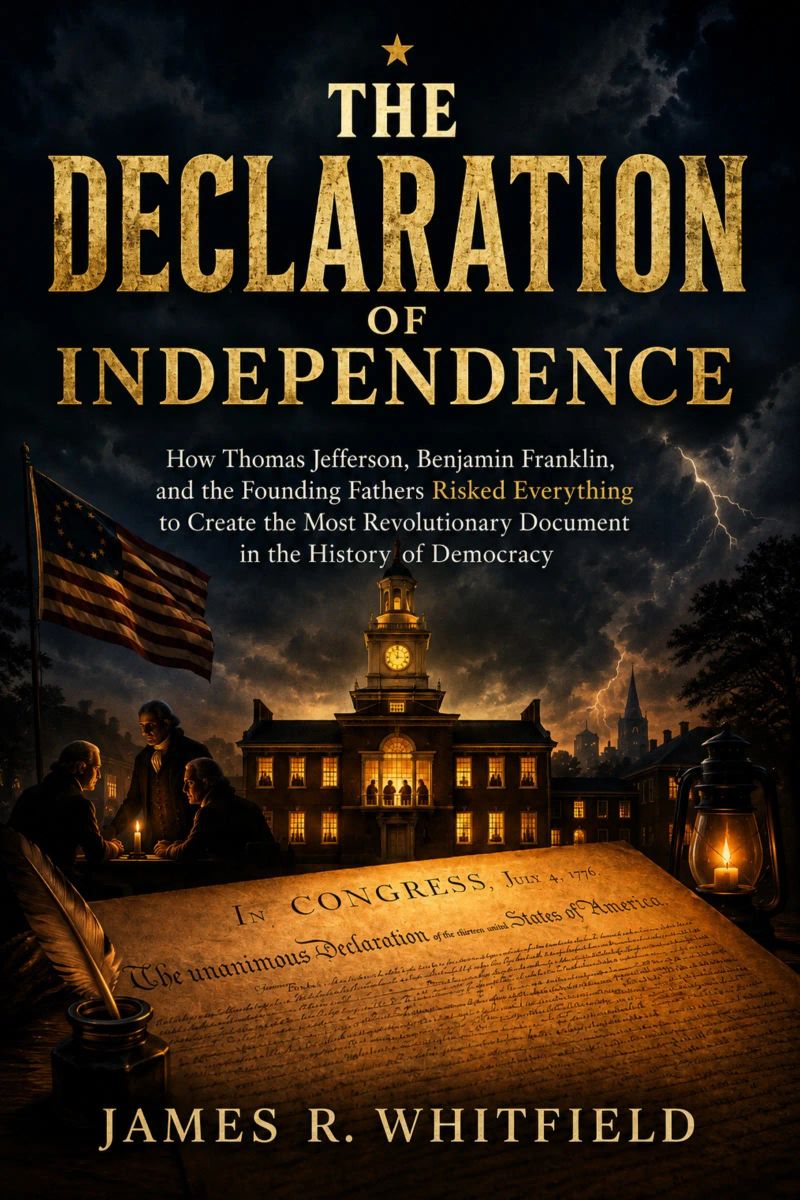
THE DECLARATION OF INDEPENDENCE
How Thomas Jefferson, Benjamin Franklin, and the Founding Fathers Risked Everything to Create the Most Revolutionary Document in the History of DemocracyBy James R. Whitfield


Length6h 8m
About this audiobook
The complete narrative history of the Declaration of Independence — Thomas Jefferson, Benjamin Franklin, John Adams, and how 56 signers risked their lives to produce the most revolutionary document in American history.
On June 11, 1776, Thomas Jefferson sat at a portable writing desk — a fourteen-inch folding box he had designed himself — in a rented room at the corner of Market and Seventh Streets in Philadelphia. Over the next two weeks, drawing on John Locke, George Mason's Virginia Constitution draft, and his own 1774 pamphlet A Summary View, Jefferson produced a first draft that John Adams called the work of a man "ten times" the writer Adams himself was.
This Declaration of Independence history traces the full arc of the founding document: the imperial crisis from the Proclamation of 1763 through Lexington and Concord, Jefferson's drafting sprint, Franklin's editorial hand that changed "sacred and undeniable" to "self-evident," the Congressional debate that removed the slave trade passage, and 56 signers' personal stakes — including Richard Stockton of New Jersey, captured and chained by British forces, dead at 50 — through the document's international legacy from the 1789 French Declaration of Rights to Ho Chi Minh's 1945 Vietnamese independence proclamation.
Inside this American Revolution founding document history:
Why Jefferson? — Adams's deliberate choice of the younger Virginian, his borrowed writing desk, and the two weeks that produced America's founding statement (Chapter 4)
Franklin's editorial hand — how the 70-year-old philosopher's changes tightened Jefferson's draft, and why Franklin's international reputation was essential to the document's diplomatic power (Chapter 6)
Four days of Congressional agony — the 90 specific changes debated in a closed, fly-infested room, the removal of the slave trade passage under Southern pressure, and Jefferson's silent anguish as his draft was revised (Chapter 7)
The price of the signature — what the 56 signers actually risked: treason, execution, property seizure, and the war that followed (Chapters 8–9)
"All men are created equal" — the most contested sentence in American history, its Lockean roots, and how abolitionism, women's suffrage, and the civil rights movement each redeployed it (Chapter 11)
The global shockwave — from the French Revolution's Declaration of Rights to Latin American independence declarations, the 1948 UN Universal Declaration of Human Rights, and Jefferson's deathbed letter of June 24, 1826 (Chapters 12, 21)
Slavery and the contradiction — the document's principal author owned enslaved people his entire life; the book treats this directly, not as a footnote (Chapters 11, 19)
The parchment Jefferson wrote on is preserved at the National Archives. The writing desk is at the Smithsonian. The principles — that all men are created equal, that governments derive their just powers from the consent of the governed — are still being argued over, still being extended to populations the signers never considered. That unfinished argument is what this narrative history of the American founding is about.
For readers of David McCullough's JOHN ADAMS and Joseph Ellis's AMERICAN SPHINX.
Audiobook details
GenreHistory, Biography and Memoir
Length6 hrs 8 mins
Narrated byListen with 1,000+ voices
FormateBook with Audio
LanguageEnglish
Table of contents
1Introduction
2Author’s Note
3Prologue: The Weight of the Quill
4PART ONE: THE WORLD THAT MADE REVOLUTION NECESSARY
5Chapter 1: The Empire and the Colony: A Marriage Gone Wrong
Show all chaptersShow less
6Chapter 2: The Men Who Would Become Founders
7Chapter 3: The Point of No Return: Lexington, Concord, and the Blood Already Spilled
8PART TWO: THE DOCUMENT IS BORN
9Chapter 4: Why Jefferson? The Making of the Primary Author
10Chapter 5: The First Draft: Genius, Passion, and Fatal Excess
11Chapter 6: Franklin’s Hand: The Master Editor at Work
12Chapter 7: The Congress Tears It Apart: Four Days of Agony
13PART THREE: THE PRICE OF THE SIGNATURE
14Chapter 8: Signing the Death Warrant
15Chapter 9: Traitors to the Crown: What They Stood to Lose
16Chapter 10: Benjamin Franklin’s Impossible Position
17PART FOUR: THE REVOLUTIONARY IDEA
18Chapter 11: All Men Are Created Equal: The Most Contested Sentence in History
19Chapter 12: The Global Shockwave
20Chapter 13: The Document’s Near-Disappearance
21PART FIVE: THE LIVING DOCUMENT
22Chapter 14: Every Generation’s Declaration
23Chapter 15: What It Still Demands of Us
24PART SIX: THE LONG ECHO
25Chapter 16: The Fifty-Six — Lives After the Signing
26Chapter 17: The Document Itself
27PART SEVEN: THE WIDER STORY
28Chapter 18: The Lee Resolution and the Path to Independence
29Chapter 19: The Excised Passages — What Jefferson Lost
30Chapter 20: The British Response
31Chapter 21: The Declaration’s International Influence
32Chapter 22: From Articles to Constitution
33Chapter 23: The Continental Congress as Institution
34Chapter 24: Independence Day — Two Centuries of Commemoration
35Chapter 25: The Drafting Committee — Five Men, One Document
36Chapter 26: The Continuing Conversation
37Epilogue: If They Could See Us Now
38Acknowledgments
39Selected Bibliography
40About the Author
THE CALIFORNIA GOLD RUSHJames R. Whitfield5h 35m$7

NATIVE AMERICAN HISTORYJames R. Whitfield5h 23m$10 · $0.00

THE SALEM WITCH TRIALSJames R. Whitfield5h 51m$6 · $0.00

The american revolutionJames R. Whitfield2h 20m$9 · $0.00

THE SPANISH CONQUEST OF THE AMERICASJames R. Whitfield5h 43m$7 · $0.00

NATIVE AMERICAN HISTORYJames R. Whitfield6h 25m$7 · $0.00

NATIVE AMERICAN HISTORYJames R. Whitfield6h 25m$7 · $0.00
THE CALIFORNIA GOLD RUSHJames R. Whitfield5h 30m$10 · $0.00
THE CALIFORNIA GOLDJames R. Whitfield5h 44m$6 · $0.00

GEORGE WASHINGTONJames R. Whitfield6h 22m$8 · $0.00

THE DECLARATION OF INDEPENDENCEJames R. Whitfield5h 4m$10 · $0.00

THE MEXICAN-AMERICAN WARJames R. Whitfield5h 21m$10 · $0.00
The american revolutionJames R. Whitfield6h 12m$9 · $0.00

CHRISTOPHER COLUMBUSJames R. Whitfield4h 51m$9 · $0.00

THE AMERICAN REVOLUTIONJames R. Whitfield6h 12m4.6 (25)$8 · $0.00

CHRISTOPHER COLUMBUSJames R. Whitfield5h 40m$7 · $0.00
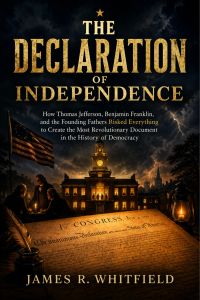
THE DECLARATION OF INDEPENDENCEJames R. Whitfield6h 8m$8 · $0.00
GEORGE WASHINGTONJames R. Whitfield5h 26m$10 · $0.00

THE SPANISH CONQUEST OF THE AMERICASJames R. Whitfield4h 33m$9 · $0.00

A Brief History of IntelligenceMax S. Bennett12h 18m4.6 (6.6K)$29 · $0.00

The Gulag Archipelago Volume 3Aleksandr I. Solzhenitsyn21h 56m4.7 (8.9K)$46 · $0.00

Pearl of Great PriceJoseph Smith3h 8m4.7 (7.2K)$1.20 · $0.00

The Happiest Man on EarthEddie Jaku3h 48m4.6 (178K)$7 · $0.00

MotherlandJulia Ioffe17h 52m4.7 (2.5K)$40 · $0.00

Where Cowards Go to DieBenjamin Sledge8h 42m4.7 (351)$20 · $0.00

RevolutionariesSanjeev Sanyal11h 23m4.6 (2.6K)$29 · $0.00

We Crossed a Bridge and It TrembledWendy Pearlman6h4.6 (5.2K)$24 · $0.00

Unbroken Bonds of BattleJohnny Joey Jones8h 31m4.6 (2.6K)$8 · $0.00

The Daughter of AuschwitzTova Friedman, Malcolm Brabant7h 54m4.6 (16.7K)$26 · $0.00

Lily's PromiseLily Ebert, Dov Forman8h 54m4.6 (16.1K)$29 · $0.00

On Democracies and Death CultsDouglas Murray10h 38m4.6 (6.5K)$29 · $0.00

Across the RiverKent Babb11h 40m4.6 (927)$29 · $0.00

Balcony Over Jerusalem: A Middle East Memoir - Israel, Palestine and BeyondJohn Lyons12h 37m4.6 (1.4K)$33 · $0.00

BeyondStephen Walker15h 39m4.6 (3.2K)$33 · $0.00
Kings and PawnsHoward Bryant10h 9m4.6 (678)$29 · $0.00

No EscapeNury Turkel9h 30m4.6 (809)$28 · $0.00

Jubal Stone: U.S. Marshal: Blood Trail To Hell: A Western Adventure NovelCasey Nash3h 42m4.6 (3.2K)$18 · $0.00

Fall and RiseMitchell Zuckoff17h 23m4.6 (9.8K)$40 · $0.00

The SurvivorJosef Lewkowicz, Michael Calvin9h 22m4.6 (2.5K)$29 · $0.00

Matters of the HeartJacinta Nampijinpa Price9h 35m4.8 (359)$29 · $0.00
The StepsSylvester Stallone9h 4m4.8 (635)$29 · $0.00

How to Test Negative for StupidJohn Kennedy8h 13m4.7 (9.7K)$28 · $0.00

Bad Fat Black GirlSesali Bowen6h 32m4.7 (2.8K)$24 · $0.00

Send MeMarty Skovlund, Joe Kent8h 10m4.7 (1.6K)$26 · $0.00

John Muir: The Story of My Boyhood and Youth & Letters to a Friend (Annotated)John Muir10h 13m4.7 (1.1K)$0.99 · $0.00

Invisible StormJason Kander6h 48m4.7 (3.2K)$24 · $0.00

Forever BoyKate Swenson9h 27m4.7 (5K)$29 · $0.00

You Are Worth ItKyle Carpenter, Don Yaeger8h 53m4.7 (4.8K)$29 · $0.00
The Happiest Man on EarthEddie Jaku3h 48m4.6 (178K)$7 · $0.00
MotherlandJulia Ioffe17h 52m4.7 (2.5K)$40 · $0.00
Evidence Not SeenDarlene Deibler Rose11h 11m4.6 (11.9K)$29 · $0.00
Where Cowards Go to DieBenjamin Sledge8h 42m4.7 (351)$20 · $0.00

Will You Love Me?Cathy Glass9h 5m4.6 (9.3K)$29 · $0.00

Designing Terry Pratchett’s DiscworldPaul Kidby3h 52m4.7 (343)$20 · $0.00

HostageEli Sharabi5h 25m4.6 (10.8K)$24 · $0.00

Finding MeViola Davis9h 15m4.6 (256.4K)$29 · $0.00

The Dangerous Truth about Today’s MarijuanaLaura Stack CSP, MBA9h 57m4.7 (385)$20 · $0.00

Birdie & HarlowTaylor Wolfe7h 50m4.6 (6.5K)$26 · $0.00
The Lives of BrianBrian Johnson9h 45m4.6 (3.5K)$29 · $0.00
You may also like

MY OWN STORY (Illustrated) (Annotated)Emmeline Pankhurst11h 58m4.2 (4.6K)$0.99 · $0.00

American TempestHarlow Giles Unger8h 12m3.7 (1K)$16.70
The Suppression of the African Slave Trade to America (1638–1870)W.E.B. Du Bois15h 41m4.2 (1.5K)$1.99 · $0.00
The Lincoln-Douglas DebatesAbraham Lincoln, Stephen Douglas16h 5m4.2 (472)$30

The Art of Political War and Other Radical PursuitsDavid Horowitz6h 15m4.1 (271)$14
Second Treatise of GovernmentJohn Locke5h 39m4.1 (29.2K)Free
My Own StoryEmmeline Pankhurst11h 57m4.4 (2.9K)$2 · $0.00

The Politically Incorrect Guide to the Founding FathersBrion McClanahan PhD9h 26m4.0 (602)$20
Hellenica (The History of the Peloponnesian War and Its Aftermath)Xenophon15h 14m4.1 (4.3K)$1.99 · $0.00

Republicans Buy Sneakers TooClay Travis9h4.1 (1.7K)$29 · $0.00

The Federalist PapersAlexander Hamilton, John Jay, James Madison21h 20m4.3 (126.6K)Free

Unfit for CommandJohn E. O’Neill, Jerome R. Corsi PhD6h 15m4.0 (1K)$14 · $0.00
History of American AbolitionismF. G. De Fontaine3h 58m$1 · $0.00

The Last Boer WarH. Rider Haggard8h 12m3.7 (43)$2.30

Napoleon the LittleVictor Hugo7h 12m3.4 (109)$2.30 · $0.00
The American Nation: A History, Vol. 16Albert Bushnell Hart7h 50m$23
THE DECLARATION OF INDEPENDENCEJames R. Whitfield5h 4m$10 · $0.00
The Tale of the Great MutinyW. H. Fitchett9h 49m4.0 (167)$2.30

The Crisis of Eighteen Hundred and Sixty-One in the Government of the United StatesAbel D. Streight2h 32m4.0 (19)$2 · $0.00

The Complete History of the Civil War (Including Memoirs & Biographies of the Lead Commanders)John Esten Cooke, Abraham Lincoln, James Ford Rhodes, Ulysses S. Grant, William T. Sherman, Frank H. Alfriend154h 44m$2 · $0.00