
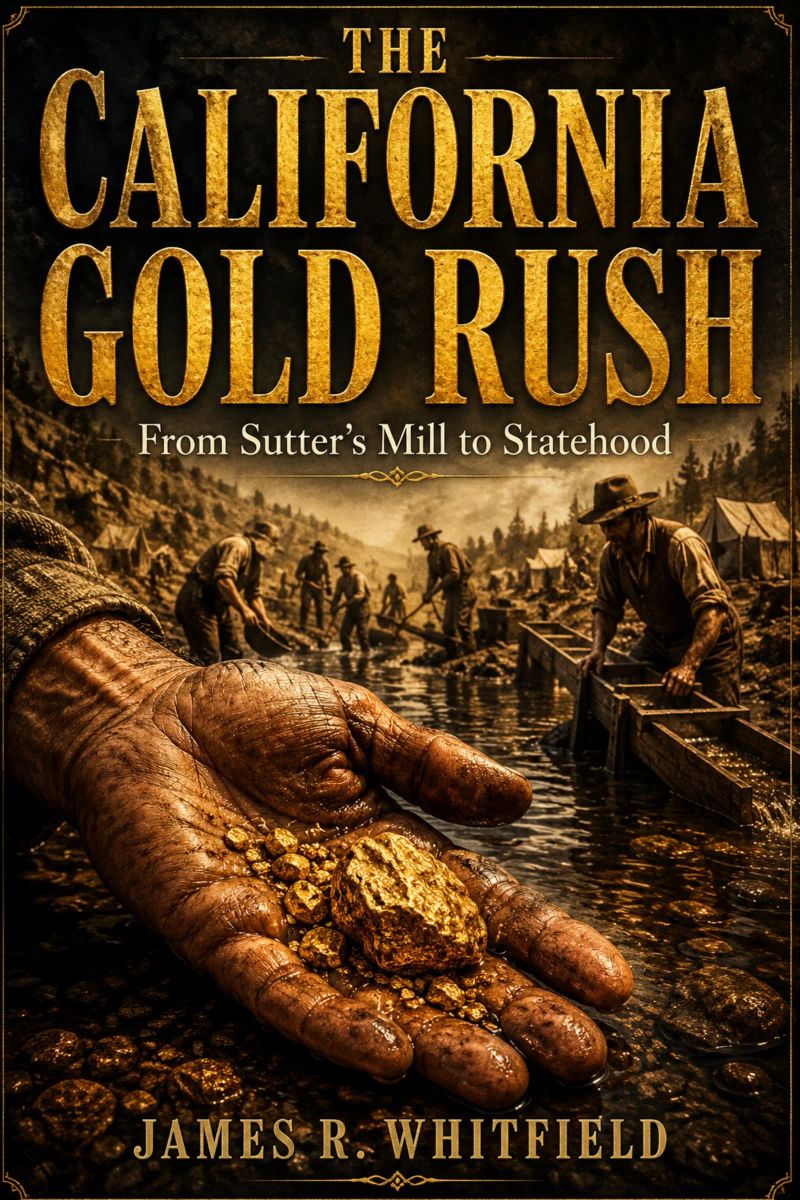
THE CALIFORNIA GOLD RUSH
From Sutter's Mill to StatehoodBy James R. Whitfield


Length5h 35m
About this audiobook
California Gold Rush history — from Sutter's Mill to statehood, the forty-niners, and the American West transformation of 1848-1860. How gold discovery triggered the largest voluntary migration in human history and destroyed a civilization.
On January 24, 1848, carpenter James Marshall picked a half-pea-sized piece of metal from the tailrace of John Sutter's sawmill on the American River. Mormon diarist Henry Bigler recorded it that night: "this day some kind of mettle was found in the tail race that looks like goald." Sutter tested the flake with nitric acid and apothecary scales — twenty-three carats fine — and wrote in his diary: "What a great misfortune was this sudden discovery for me!" He was right. Within a year his workers had left for the diggings, his wheat rotted unharvested, and his land titles were in litigation. He died in Washington in 1880, broke, still petitioning Congress for restitution.
James R. Whitfield's California Gold Rush narrative covers twenty-six chapters — from Mexican California's 150,000 Indigenous people through Polk's 1848 Congressional message that sent 90,000 forty-niners west, the $81 million peak production of 1852, and the 1.5 billion cubic yards of debris that choked the Sacramento River and produced America's first major environmental court case in 1884. California's non-Native population grew from 14,000 to 380,000 in twelve years. Its Indigenous population fell from 150,000 to under 30,000.
Inside this American West history:
The discovery and the news going out — Brannan's quinine bottle, Polk's message, and migration from Hunan to Cornwall to New South Wales (Chapters 4-6)
The boomtowns — Coloma, Hangtown, Mokelumne Hill's French and German newspapers, and 200 named camps whose canvas traces are nearly invisible today (Chapter 11)
Chinese miners and the Foreign Miners' Tax — called to the "Gold Mountain," taxed and expelled, written out of the official story (Chapter 13)
California Indians and genocide — state-legislature-approved killing-campaign budgets, population collapse from 150,000 to under 30,000 (Chapter 17)
Hydraulic mining and environmental catastrophe — Matteson's 1853 invention, the North Bloomfield monitors dismantling entire hillsides, and the 1884 Woodruff v. North Bloomfield decision (Chapter 23)
What the rush built — San Francisco's rise, the Transcontinental Railroad's financing, and $2 billion in nineteenth-century gold (Chapters 22, 25)
The flake Marshall found is in the Smithsonian today. The Gold Rush it started built an economy and destroyed a civilization. Whitfield's narrative holds both without looking away.
For readers of H. W. Brands's THE AGE OF GOLD and J. S. Holliday's THE WORLD RUSHED IN.
Audiobook details
GenreHistory
Length5 hrs 35 mins
Narrated byListen with 1,000+ voices
FormateBook with Audio
Publish dateJun 2, 2026
LanguageEnglish
Table of contents
1Introduction
2Author’s Note
3Prologue: The Glint in the Tailrace
4PART ONE: BEFORE THE STRIKE
5Chapter 1: Mexican California — The World That Was
Show all chaptersShow less
6Chapter 2: John Sutter and the Empire on the American River
7Chapter 3: James Marshall and the Carpentry of Fate
8PART TWO: THE NEWS GOES OUT
9Chapter 4: January 24, 1848 — The Discovery
10Chapter 5: Sam Brannan's Bottle and the San Francisco Run
11Chapter 6: Polk's Message and the World Hears
12PART THREE: THE FORTY-NINERS
13Chapter 7: By Sea Around the Horn
14Chapter 8: By Land Across the Plains
15Chapter 9: Through the Isthmus of Panama
16PART FOUR: THE DIGGINGS
17Chapter 10: Placer Mining and the Pan
18Chapter 11: Boomtowns — Coloma, Hangtown, Mokelumne Hill
19Chapter 12: The Mother Lode and Hard Rock Mining
20PART FIVE: THE PEOPLE OF THE RUSH
21Chapter 13: Chinese Miners and the Gold Mountain
22Chapter 14: Chileans, Mexicans, and the Foreign Miners' Tax
23Chapter 15: African American Argonauts
24Chapter 16: The Women of the Diggings
25PART SIX: VIOLENCE AND DISPOSSESSION
26Chapter 17: California Indians and Genocide
27Chapter 18: Lynching, Vigilance Committees, and Frontier Justice
28Chapter 19: The Land Grant Wars
29PART SEVEN: STATEHOOD AND CONSEQUENCE
30Chapter 20: The 1849 Constitutional Convention
31Chapter 21: The Compromise of 1850 and Free-State California
32Chapter 22: San Francisco — From Village to Metropolis
33PART EIGHT: THE LONG TAIL
34Chapter 23: Hydraulic Mining and Environmental Catastrophe
35Chapter 24: The Comstock Lode and the Silver Successor
36Chapter 25: What the Rush Built — Banking, Agriculture, Industry
37Chapter 26: The Rush in American Memory
38Epilogue: What the Rush Left Behind
39Acknowledgments
40Selected Bibliography
41About the Author
NATIVE AMERICAN HISTORYJames R. Whitfield5h 23m$10 · $0.00

THE SALEM WITCH TRIALSJames R. Whitfield5h 51m$6 · $0.00
The american revolutionJames R. Whitfield2h 20m$9 · $0.00
THE SPANISH CONQUEST OF THE AMERICASJames R. Whitfield5h 43m$7 · $0.00
NATIVE AMERICAN HISTORYJames R. Whitfield6h 25m$7 · $0.00
NATIVE AMERICAN HISTORYJames R. Whitfield6h 25m$7 · $0.00
THE CALIFORNIA GOLD RUSHJames R. Whitfield5h 30m$10 · $0.00
THE CALIFORNIA GOLDJames R. Whitfield5h 44m$6 · $0.00

GEORGE WASHINGTONJames R. Whitfield6h 22m$8 · $0.00

THE DECLARATION OF INDEPENDENCEJames R. Whitfield5h 4m$10 · $0.00

THE MEXICAN-AMERICAN WARJames R. Whitfield5h 21m$10 · $0.00

The american revolutionJames R. Whitfield6h 12m$9 · $0.00
CHRISTOPHER COLUMBUSJames R. Whitfield4h 51m$9 · $0.00

THE AMERICAN REVOLUTIONJames R. Whitfield6h 12m4.6 (25)$8 · $0.00

CHRISTOPHER COLUMBUSJames R. Whitfield5h 40m$7 · $0.00

THE DECLARATION OF INDEPENDENCEJames R. Whitfield6h 8m$8 · $0.00
THE DECLARATION OF INDEPENDENCEJames R. Whitfield6h 8m$7 · $0.00
GEORGE WASHINGTONJames R. Whitfield5h 26m$10 · $0.00
THE SPANISH CONQUEST OF THE AMERICASJames R. Whitfield4h 33m$9 · $0.00

A Brief History of IntelligenceMax S. Bennett12h 18m4.6 (6.6K)$29 · $0.00
The Gulag Archipelago Volume 3Aleksandr I. Solzhenitsyn21h 56m4.7 (8.9K)$46 · $0.00
Pearl of Great PriceJoseph Smith3h 8m4.7 (7.2K)$1.20 · $0.00

The Happiest Man on EarthEddie Jaku3h 48m4.6 (178K)$7 · $0.00

MotherlandJulia Ioffe17h 52m4.7 (2.5K)$40 · $0.00

Where Cowards Go to DieBenjamin Sledge8h 42m4.7 (351)$20 · $0.00

RevolutionariesSanjeev Sanyal11h 23m4.6 (2.6K)$29 · $0.00

We Crossed a Bridge and It TrembledWendy Pearlman6h4.6 (5.2K)$24 · $0.00

Unbroken Bonds of BattleJohnny Joey Jones8h 31m4.6 (2.6K)$8 · $0.00

The Daughter of AuschwitzTova Friedman, Malcolm Brabant7h 54m4.6 (16.7K)$26 · $0.00
Lily's PromiseLily Ebert, Dov Forman8h 54m4.6 (16.1K)$29 · $0.00
On Democracies and Death CultsDouglas Murray10h 38m4.6 (6.5K)$29 · $0.00

Across the RiverKent Babb11h 40m4.6 (927)$29 · $0.00

Balcony Over Jerusalem: A Middle East Memoir - Israel, Palestine and BeyondJohn Lyons12h 37m4.6 (1.4K)$33 · $0.00

BeyondStephen Walker15h 39m4.6 (3.2K)$33 · $0.00
Kings and PawnsHoward Bryant10h 9m4.6 (678)$29 · $0.00

No EscapeNury Turkel9h 30m4.6 (809)$28 · $0.00
Jubal Stone: U.S. Marshal: Blood Trail To Hell: A Western Adventure NovelCasey Nash3h 42m4.6 (3.2K)$18 · $0.00
Fall and RiseMitchell Zuckoff17h 23m4.6 (9.8K)$40 · $0.00
The SurvivorJosef Lewkowicz, Michael Calvin9h 22m4.6 (2.5K)$29 · $0.00
You may also like
A Crack in the Edge of the WorldSimon Winchester12h 31m4.0 (10.6K)$33 · $0.00
The Amur RiverColin Thubron10h 13m4.1 (1.8K)$29 · $0.00
PacificSimon Winchester14h 3m4.1 (6.2K)$33 · $0.00
The Little Ice AgeBrian Fagan8h 32m3.9 (4.1K)$20

Palestinian WalksRaja Shehadeh6h 15m4.3 (3.1K)$17

The History of Medieval EuropeLynn Thorndike24h 28m4.1 (476)$2 · $0.00
A Complete Account of the Settlement at Port JacksonWatkin Tench5h 46m4.4 (58)$1 · $0.00
The Eames-Erskine caseA. Fielding45m3.9 (125)$2 · $0.00
THE CALIFORNIA GOLDJames R. Whitfield5h 44m$6 · $0.00

The Assiniboine: Riders of the Northern Plains and the Fur TradeMarguerite Delacroix-Vance4h 39m$6
The English Colony in New South Wales (Vol. 1&2) (Annotated)David Collins39h 37m3.9 (44)$0.99 · $0.00
Seven Cargoes: How Corn, Horses, and Disease Remade Native AmericaDaniel R. Whitcomb5h 20m$6

Englisch lernen Audio - Englische GärtenSpotlight Verlag1h 1m4.6 (15)$17
WALT WHITMAN Ultimate Collection: 500+ Works in Poetry & Prose (Annotated)Walt Whitman79h 39m$2 · $0.00
In An Unknown Prison LandGeorge Chetwynd Griffith6h 52m$2.30
Life in the Clearings versus the BushSusanna Moodie12h 46m3.5 (164)$2 · $0.00

The Congo and Coasts of AfricaRichard Harding Davis2h 59m4.1 (14)$2 · $0.00
An Account of the English Colony in New South Wales Vol 1David Collins25h 57m$1 · $0.00
The Middlemen of the Columbia: Chinook Power and the River TradeMarcus Hale Whitfield4h 24m$6
Journeys and Explorations in the Cotton Kingdom (Annotated)Frederick Law Olmsted14h 52m4.0 (273)$0.99 · $0.00