
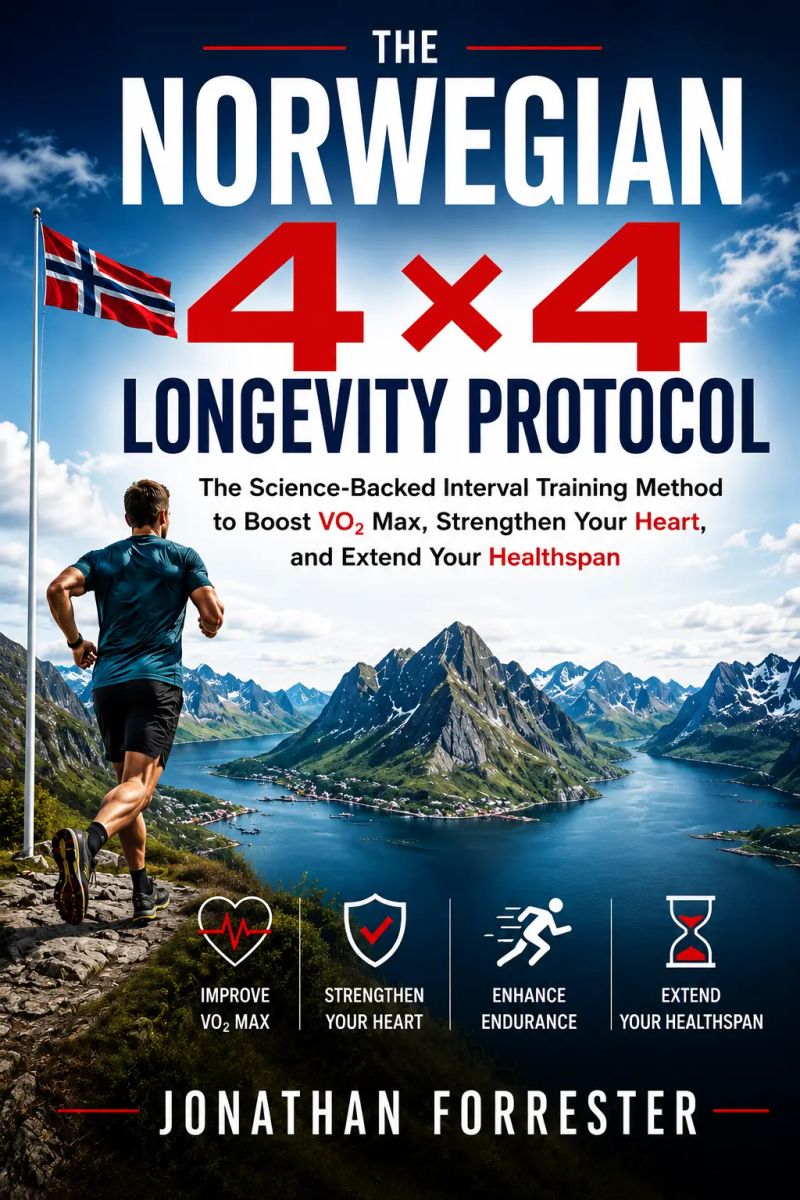
THE NORWEGIAN 4×4 LONGEVITY PROTOCOL
The Science-Backed Interval Training Method to Boost VO₂ Max, Strengthen Your Heart, and Extend Your HealthspanBy Jonathan Forrester


Length1h 5m
About this audiobook
The Norwegian 4×4 Longevity Protocol is a clear, science-backed guide to the interval training method developed in Trondheim, Norway. In about 40 minutes—four 4-minute high-intensity efforts with recovery between—you can boost your VO₂ max, strengthen your heart, and extend your healthspan. This concise edition explains why cardiorespiratory fitness predicts longevity, how the protocol works, and how to find your zones, choose your modality, and fit training into a real week. It includes a 12-week starter plan, guidance for all ages and abilities, safety advice, and an FAQ. Practical, motivating, and easy to follow.
Audiobook details
GenreHealth and Wellness
Length1 hr 5 mins
Narrated byListen with 1,000+ voices
FormateBook with Audio
Publish dateAug 8, 2026
LanguageEnglish
Table of contents
1Introduction
2Introduction: Fitness Is the Currency of a Longer Life
3Part I — The Science of Cardiorespiratory Fitness
4Chapter 1: VO₂ Max, the Most Powerful Predictor of How Long You Will Live
5What the large studies show
Show all chaptersShow less
6Why this matters more with age
7Chapter 2: Inside the Engine — What VO₂ Max Actually Measures
8The central factor: your heart as a pump
9The peripheral factors: delivery and extraction
10How VO₂ max is measured and estimated
11Chapter 3: The Trondheim Revolution — Where the 4×4 Was Born
12Comparing intervals with steady effort
13From athletes to patients
14The large longevity experiment
15Part II — The 4×4 Protocol
16Chapter 4: Anatomy of the 4×4 Protocol
17The structure, step by step
18How hard is hard enough?
19Why four minutes and four intervals?
20Chapter 5: Finding Your Zones — Heart Rate, Effort, and Precision
21Estimating your maximum heart rate
22Translating the targets into numbers
23When you have no monitor: the talk test and RPE
24A note on precision versus consistency
25Chapter 6: The Weekly Blueprint — Programming for a Real Life
26How often to run the protocol
27What to do on the other days
28Fitting it around your life
29Part III — Beyond the Heart: What the Protocol Changes
30Chapter 7: Mitochondria and the Cellular Case for Intervals
31How intensity signals the cell
32Metabolic ripple effects
33Chapter 8: The Heart Remodeled
34A bigger, stronger stroke
35Healthier blood vessels
36From weakened hearts to stronger ones
37Chapter 9: The Brain on Intervals
38Blood flow, growth factors, and gray matter
39Mood, stress, and cognitive aging
40Part IV — Putting the Protocol Into Practice
41Chapter 10: Getting Started Safely
42Screening before you begin
43Build a base before you build a ceiling
44Progress the intensity gradually
45Warning signs to heed
46Chapter 11: Choosing Your Modality
47The main options
48Matching the modality to you
49Varying it to stay fresh
50Chapter 12: Recovery, Sleep, and Fuel
More from Jonathan Forrester



Hour of the HeartIrvin D. Yalom, Benjamin Yalom8h 19m4.6 (2.3K)$26 · $0.00

The Yoga Sutras of PatanjaliPatanjali4h 8m4.5 (18.5K)$6 · $0.00

The Lost VoiceGreta Morgan8h 30m4.7 (285)$26 · $0.00

Healthy Kids, Happy KidsElisa Song14h 18m4.6 (760)$33 · $0.00
Eat It!Jordan Syatt, Michael Vacanti4h 40m4.6 (1.5K)$20 · $0.00

Consent Laid BareChanel Contos7h 11m4.5 (1.7K)$24 · $0.00
How to Make Disease DisappearRangan Chatterjee5h 26m4.5 (3.5K)$24 · $0.00

The Complete Herbal (Annotated)Nicholas Culpeper29h 8m4.5 (1.4K)$2 · $0.00

A Plague Upon Our HouseScott W. Atlas MD10h 37m4.5 (3.4K)$20 · $0.00

The Cancer CodeDr. Jason Fung10h 48m4.5 (5.3K)$29 · $0.00

The Gift of TherapyIrvin Yalom7h 39m4.5 (38.8K)$26 · $0.00

EarlySarah DiGregorio9h 47m4.5 (1.3K)$29 · $0.00

Bottle of LiesKatherine Eban14h 25m4.4 (12K)$33 · $0.00
The 36-Hour DayNancy L. Mace, Peter V. Rabins17h 13m4.4 (9.2K)$28 · $0.00

FlooredSara Reardon10h 36m4.5 (1K)$29 · $0.00
Radical RemissionKelly A. Turner9h 26m4.4 (8.1K)$29 · $0.00
The Sinatra SolutionStephen T. Sinatra MD9h4.5 (899)$20 · $0.00

The Songaminute ManSimon McDermott6h 12m4.5 (280)$24 · $0.00
Sometimes BrilliantLarry Brilliant12h 27m4.5 (954)$29 · $0.00

Live Your LifeAmanda Kloots, Anna Kloots10h 54m4.4 (13.7K)$29 · $0.00
You may also like
The Ultimate Diabetes BookDr. Ahmet Ergin11h 33m4.4 (515)$20
Dr. Susan Love’s Breast Book, 5th EditionSusan M. Love MD19h 37m4.6 (981)$32

Goodbye to InflammationSandra Monino5h 46m4.1 (3.3K)$24 · $0.00

The E-Myth AccountantMichael E. Gerber, M. Darren Root CPA, CITP5h 49m4.0 (348)$14

Unf*ck Your AngerFaith G. Harper PhD2h 15m3.9 (2.4K)$15

Practical Points in AnesthesiaFrederick-Emil Neef44m$2 · $0.00

An Essay on the Effects of Opium. Considered as a PoisonJohn Awsiter1h 23m$2 · $0.00

A System of MidwiferyEdward Rigby16h 56m3.6 (10)$2 · $0.00
PARAMEDIC EXAM STUDY GUIDE 2026/2027Adrian Hartwell14h 3m$10
Polyvagal Theory: A Trauma-informed Polyvagal Approach to PTSD Recovery (Practical Exercises to Rewire Your Brain for Safety, Connection and Emotional Stability)Kevin Colbert2h 52m$3.50 · $0.00

The Omega Rx ZoneBarry Sears2h 30m3.9 (261)$18 · $0.00
Polyvagal Theory: The Ultimate Guide on How to Understand the Autonomic Nervous System (A Practical Guide to Nervous System Regulation, Trauma Recovery and Vagus Nerve Healing for Therapists and Individuals)Carlos Galvin2h 56m$3.50 · $0.00
Recession-Proof Your LifeLuna Z. Rainstorm11h 29m$6.40 · $0.00

Obstetrics for NursesCharles B. Reed9h 6m$2 · $0.00

The Silence of the MindDanniel Silva3h 57m$1.80 · $0.00

CRITICAL CARE NURSING CERTIFICATE STUDY GUIDE 2026/2027Adrian Hartwell14h 41m$10

Security Gates in GitHub ActionsSloane Garrett8h 4m$21.50 · $0.00

Mastering Your Emergency FundAdira D. York6h 52m$6.40 · $0.00

CCTN Exam Study GuideMarie Peterson9h 10m$10
Vagus Nerve Stimulation - Guided Meditation & SubliminalMiss Smilla43m$3 · $0.00