
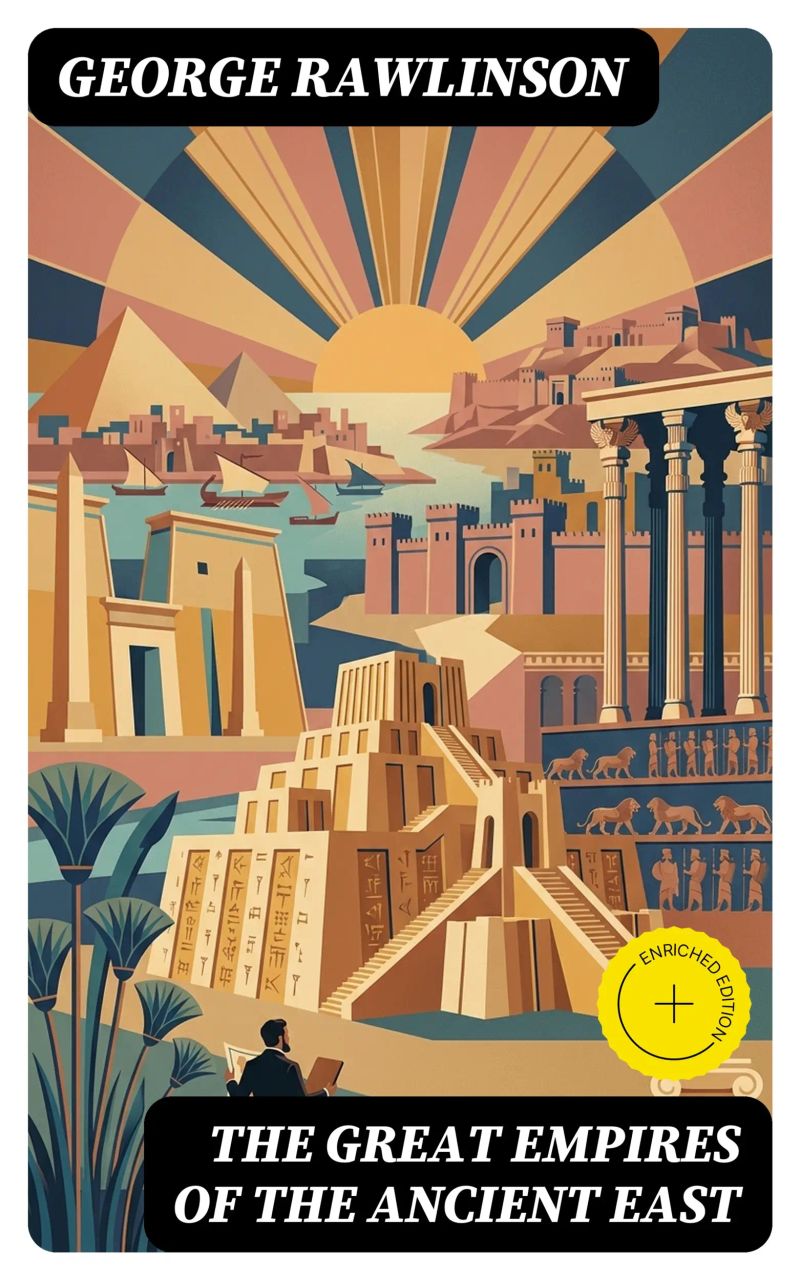
The Great Empires of the Ancient East
Egypt, Phoenicia, The Kings of Israel and Judah, Babylon, Parthia, Chaldea, Assyria, Media, Persia, Sasanian Empire & The History of HerodotusBy George Rawlinson

Length145h 1m
About this audiobook
In "The Great Empires of the Ancient East," George Rawlinson meticulously explores the rise and fall of powerful civilizations such as Babylon, Assyria, and Persia, weaving a rich tapestry of historical narrative with astute archaeological insights. Written in the 19th century, Rawlinson's work reflects the era's burgeoning interest in Oriental studies and the ancient world, characterized by a scholarly yet accessible prose that invites readers to both educate and inspire wonder. His detailed analysis of historical texts, inscriptions, and artifacts enables a deeper understanding of the socio-political, religious, and cultural dynamics that shaped these empires, manifesting in a compelling chronicle that illuminates their legacies. George Rawlinson, a notable British historian, was deeply influenced by his own explorations in the East and his groundbreaking translations of cuneiform inscriptions. His expertise in ancient languages and dedication to the preservation of history rendered him a prominent figure in contemporary scholarship. This background, coupled with his personal curiosity about the cultures he studied, fueled his desire to provide a comprehensive narrative that would bridge the past and present for modern readers. Rawlinson's work is recommended for anyone seeking to understand the foundational empires that contributed significantly to the course of human history. Through his scholarship, readers will gain not only knowledge but also an appreciation for the complexity of the ancient East, making it an essential addition to the library of history enthusiasts and scholars alike.
Audiobook details
GenreHistory
Length145 hrs 1 min
Narrated byListen with 1,000+ voices
FormateBook with Audio
Publish dateDec 15, 2023
LanguageEnglish
Table of contents
1Introduction
2Introduction
3Synopsis
4Historical Context
5I. The Land of Egypt.
Show all chaptersShow less
6II. The People of Egypt.
7III. The Dawn of History.
8IV. The Pyramid Builders.
9V. The Rise of Thebes to Power, and the Early Theban Kings.
10VI. The Good Amenemhat and His Works.
11VII. Abraham in Egypt.
12VIII. The Great Invasion—The Hyksôs or Shepherd Kings—Joseph and Apepi.
13IX. How the Hyksôs were Expelled from Egypt.
14X. Thothmes I., The First Great Egyptian Conqueror.
15XI. Queen Hatasu and Her Merchant Fleet.
16XII. Thothmes the Third and Amenhotep the Second.
17XIII. Amenhotep III. And His Great Works—The Vocal Memnon.
18XIV. Khuenaten and the Disk-Worshippers.
19XV. Beginning of the Decline of Egypt.
20XVI. Menephthah I., The Pharaoh of the Exodus.
21XVII. The Decline of Egypt Under the Later Ramessides.
22XVIII. The Priest-Kings—Pinetem and Solomon.
23XIX. Shishak and His Dynasty.
24XX. The Land Shadowing With Wings—Egypt Under the Ethiopians
25XXI. The Fight Over the Carcase—Ethiopia v. Assyria.
26XXII. The Corpse Comes to Life Again—Psamatik I. and His Son Neco.
27XXIII. The Later Saïte Kings.—Psamatik II., Apries, and Amasis.
28XXIV. The Persian Conquest.
29XXV. Three Desperate Revolts.
30XXVI. A Last Gleam of Sunshine—Nectanebo I.
31XXVII. The Light Goes Out in Darkness.
32Preface
33Chapter II—Climate and Productions
34Chapter IV—The Cities
35Chapter V—The Colonies
36Chapter VI—Architecture
37Chapter VII—Æsthetic Art
38Chapter VIII—Industrial Art and Manufactures
39Chapter IX—Ships, Navigation, and Commerce
40Chapter X—Mining
41Chapter XII—Dress, Ornaments, and Social Habits
42Chapter XIII—Phoenician Writing, Language, and Literature
43Chapter XIV—Political History
443. Phoenicia during the period of its subjection to Assyria (B.C. 877-635)
455. Phoenicia under the Persians (B.C. 528-333)
466. Phoenicia in the time of Alexander the Great (B.C. 333-323)
477. Phoenicia under the Greeks (B.C. 323-65) (pt. 1)
487. Phoenicia under the Greeks (B.C. 323-65) (pt. 2)
49Chapter I. General View of the Country
50Chapter II. Climate and Productions
Ancient Egypt: History, Mythology & LiteratureGeorge Rawlinson, Arthur Gilman, Gaston Maspero, Agnes Sophia Griffith Johns, E. A. Wallis Budge, Lewis Spence47h 15m$0.99 · $0.00
Ancient Empires: A 15-Volume AnthologyGeorge Rawlinson, L. W. King, John Bagnell Bury, Arrian, Theodor Mommsen, Edward Gibbon, Charles Oman455h 15m$0.99
History of the Sasanian Empire (Annotated)George Rawlinson17h 20m3.9 (25)$2 · $0.00
The Kings of Israel and Judah (Annotated)George Rawlinson10h 6m4.1 (729)$2 · $0.00
The Great Empires of the Ancient East (Annotated)George Rawlinson144h 35m$2 · $0.00
History of the Ancient Chaldea (Annotated)George Rawlinson6h 11m$2 · $0.00

The Essential Works of George Rawlinson (Annotated)George Rawlinson145h 34m$2 · $0.00

Ancient Media (Annotated)George Rawlinson6h 32m$2 · $0.00
The Great Civilizations of the Ancient East (Annotated)George Rawlinson145h 31m$2 · $0.00

The Greatest Empires & Civilizations of the Ancient EastGeorge Rawlinson145h 7m$2 · $0.00

The History of BabylonGeorge Rawlinson7h 24m3.2 (37)$1 · $0.00

The Seven Great Monarchies Of The Ancient Eastern World: BabylonGeorge Rawlinson7h 3m3.4 (16)$1 · $0.00

History of the Ancient ChaldeaGeorge Rawlinson6h 10m$2 · $0.00
History of the Phoenician CivilizationGeorge Rawlinson16h 50m3.8 (134)$1 · $0.00

The Great Empires of the Ancient EastGeorge Rawlinson145h 1m$1 · $0.00
History of the Phoenician CivilizationGeorge Rawlinson17h 33m3.6 (89)$1 · $0.00

PARTHIA (Illustrated)George Rawlinson11h 50m4.3 (11)$2 · $0.00
History of the Phoenician CivilizationGeorge Rawlinson16h 20m3.9 (114)$2 · $0.00
Persian EmpireGeorge Rawlinson13h 7m3.7 (21)$2 · $0.00

THE KINGS OF ISRAEL AND JUDAHGeorge Rawlinson10h4.3 (723)$2 · $0.00

Frederick Douglass: All 3 Memoirs in One VolumeFrederick Douglass44h 9m4.7 (1.2K)$2 · $0.00

The Bark Canoes and Skin Boats of North America (Annotated)Howard Irving Chapelle, Tappan Adney13h 9m4.8 (150)$0.99 · $0.00

I've Been to the MountaintopMartin Luther King48m4.7 (1.4K)$11 · $0.00

RevolutionariesSanjeev Sanyal11h 23m4.6 (2.6K)$29 · $0.00

We Crossed a Bridge and It TrembledWendy Pearlman6h4.6 (5.2K)$24 · $0.00

Unbroken Bonds of BattleJohnny Joey Jones8h 31m4.6 (2.6K)$8 · $0.00

The Daughter of AuschwitzTova Friedman, Malcolm Brabant7h 54m4.6 (16.7K)$26 · $0.00

Lily's PromiseLily Ebert, Dov Forman8h 54m4.6 (16.1K)$29 · $0.00

Saving My EnemyBob Welch9h 11m4.6 (2.3K)$20

On Democracies and Death CultsDouglas Murray10h 38m4.6 (6.5K)$29 · $0.00

Across the RiverKent Babb11h 40m4.6 (927)$29 · $0.00

The Red Record (Annotated)Ida B. Wells-Barnett5h 19m4.8 (102)$0.99 · $0.00

Balcony Over Jerusalem: A Middle East Memoir - Israel, Palestine and BeyondJohn Lyons12h 37m4.6 (1.4K)$33 · $0.00

The Fire Next TimeJames Baldwin2h 25m4.6 (159.1K)$15

EnduranceAlfred Lansing6h 1m4.6 (40.8K)$20

LES MISERABLES (Illustrated Edition)Victor Hugo66h 17m4.6 (791.2K)$1 · $0.00

BeyondStephen Walker15h 39m4.6 (3.2K)$33 · $0.00

The Antiquities of the Jews (Annotated)Flavius Josephus59h 14m4.6 (2K)$3 · $0.00

Kings and PawnsHoward Bryant10h 9m4.6 (678)$29 · $0.00

No EscapeNury Turkel9h 30m4.6 (809)$28 · $0.00
You may also like

History of the World (Updated)J. M. Roberts54h 42m4.2 (4.8K)$30
The Story of MankindHendrik Van Loon13h 39m3.6 (4.5K)Free
The Life of GreeceWill Durant32h 34m4.4 (5.6K)$30
Ancient Greece, Second EditionThomas R. Martin12h 59m4.1 (3.3K)$23

The History of Rome (Volumes 1-5)Theodor Mommsen72h 53m4.4 (745)$1 · $0.00
Empires of the SteppesKenneth W. Harl17h 13m4.0 (1.5K)$40 · $0.00

The History of EnglandDavid Hume125h 2m4.3 (2.1K)$0.60 · $0.00

FoundationPeter Ackroyd18h 20m4.2 (7.8K)$25

The Outline of History: Being a Plain History of Life and MankindH. G. Wells48h 36m4.0 (6.6K)$2.30

ANCIENT GREECE: The History of Classical Greece from Its Earliest Beginnings to the Hellenistic Age (Annotated)John Bagnell Bury41h 58m4.2 (1.3K)$2 · $0.00

History of the Conquest of PeruWilliam Hickling Prescott28h 35m4.1 (1.1K)$1 · $0.00
The Histories (Annotated)Herodotus33h 18m4.2 (68.1K)$2 · $0.00
The Great Civilizations of the Ancient East (Annotated)George Rawlinson145h 31m$2 · $0.00

World History: Cultures, States, and Societies to 1500Eugene Berger, George Israel, Charlotte Miller, Brian Parkinson, Andrew Reeves, Nadejda Williams21h 24m3.8 (146)$1.50 · $0.00

World History: Cultures, States, and Societies to 1500Eugene Berger, George Israel, Charlotte Miller, Brian Parkinson, Andrew Reeves, Nadejda Williams21h 22m3.4 (42)$1 · $0.00
The Book of Ancient GreeksDorothy Mills11h 13m4.1 (248)$2.30

The Invasion of India by Alexander the GreatJohn Watson McCrindle18h 44m$1 · $0.00
25 Pivotal Moments in Ancient Civilizations Explained in 7 Minutes EachNietsnie Trebla3h 45m4.2 (5) Only with Ultra
Ancient Man – The Beginning of Civilizations (Illustrated Edition) (Annotated)Hendrik Willem van Loon3h 54m3.3 (36)$2 · $0.00
The Greatest Empires & Civilizations of the Ancient EastGeorge Rawlinson145h 7m$2 · $0.00