
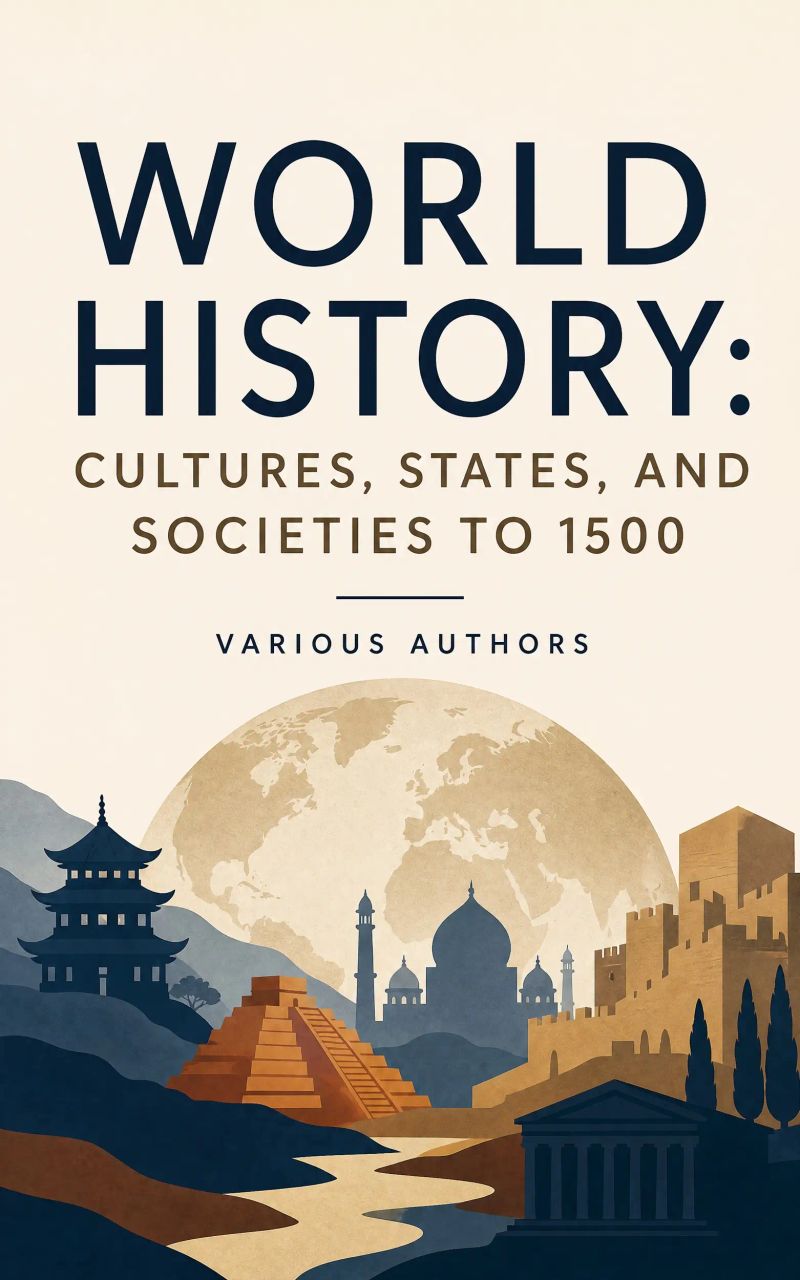
World History: Cultures, States, and Societies to 1500
A Global Survey of Cultures, States, Trade, Religions, and Exchange Before 1500By Eugene Berger, George Israel, Charlotte Miller, Brian Parkinson, Andrew Reeves, Nadejda Williams


Length21h 18m
About this audiobook
World History: Cultures, States, and Societies to 1500 offers a capacious account of the human past from early societies through the major political, religious, and cultural formations of the premodern world. Its chapters move across regions and scales, pairing broad historical synthesis with attention to exchange, migration, belief, governance, technology, and social hierarchy. Rather than treating civilizations as isolated units, the volume foregrounds the connections—and tensions—that shaped Afro-Eurasian, American, and other world histories before 1500. Prepared by Eugene Berger, George Israel, Charlotte Miller, Brian Parkinson, Andrew Reeves, and Nadejda Williams, the book brings a collaborative scholarly perspective to the challenges of global historical narration. Their collective approach aligns with world-history scholarship that questions Eurocentric periodization and emphasizes comparative study, transregional networks, and the agency of diverse communities. The contributors' varied emphases allow states, cultures, and societies to appear not as static categories but as historically contingent and mutually influential formations. This volume is especially valuable for students and general readers seeking a rigorous introduction to premodern global history. It invites readers to compare distinct social worlds while recognizing the processes that linked them. Rich in interpretive breadth, it fosters productive dialogue between regional histories and offers an educational foundation for understanding later global developments.
Audiobook details
Rating★★★★ 3.8 (53)
Includes Goodreads, Amazon
GenreHistory, Literary Classics
Length21 hrs 18 mins
Narrated byListen with 1,000+ voices
FormateBook with Audio
Publish dateDec 18, 2023
LanguageEnglish
Table of contents
1History of Egypt, Chaldea, Syria, Babylonia, and Assyria in the Light of Recent Discovery (Annotated)
2Chapter One: Prehistory
3Chronology
4Introduction
5Questions to Guide your Reading
Show all chaptersShow less
6Key Terms
7Human Beginnings in Africa
8Agriculture and the "Neolithic Revolution"
9Summary
10Works Consulted and Further Reading
11Links to Primary Sources
12Chapter Two: Early Middle Eastern and Northeast African Civilizations Charlotte Miller
13Chronology
14Introduction
15Questions to Guide your Reading
16Key Terms
17Ancient Mesopotamia
18Sumerian City-States
19Mesopotamian Empires
20The Significance of Mesopotamia for World History
21The Israelites and Ancient Israel
22Early Israelites
23The United Kingdom of Israel
24The Importance of the Israelites and Ancient Israel
25Ancient Egypt
26Dynastic Egypt
27Nubia: the Kingdoms of Kerma and Kush
28Summary
29Works Consulted and Further Reading
30Links to Primary Sources
31Chapter Three: Ancient and Early Medieval India George L. Israel
32Chronology
33Introduction
34Questions to Guide your Reading
35Key Terms
36What is India? The Geography of South Asia
37India's First Major Civilization: The Indus Valley Civilization
38The Long Vedic Age
39Transition to Empire: States, Cities, and New Religions
40The Mauryan Empire
41Regional States, Trade, and Devotional Religion
42The Gupta Empire and India's Classical Age
43India's Early Medieval Age and the Development of Islamic States in India
44Conclusion
45Works Consulted and Further Reading
46Links to Primary Sources
47Chapter Four: China and East Asia to the Ming Dynasty George L. Israel
48Chronology
49Introduction
50Questions to Guide your Reading
More from Eugene Berger, George Israel, Charlotte Miller, Brian Parkinson, Andrew Reeves, Nadejda Williams

World History: Cultures, States, and Societies to 1500Eugene Berger, George Israel, Charlotte Miller, Brian Parkinson, Andrew Reeves, Nadejda Williams21h 22m3.4 (42)$1 · $0.00

World History: Cultures, States, and Societies to 1500Eugene Berger, George Israel, Charlotte Miller, Brian Parkinson, Andrew Reeves, Nadejda Williams21h 24m3.8 (146)$1.50 · $0.00

A Brief History of IntelligenceMax S. Bennett12h 18m4.6 (6.6K)$29 · $0.00

We Crossed a Bridge and It TrembledWendy Pearlman6h4.6 (5.2K)$24 · $0.00

Unbroken Bonds of BattleJohnny Joey Jones8h 31m4.6 (2.6K)$8 · $0.00

The Daughter of AuschwitzTova Friedman, Malcolm Brabant7h 54m4.6 (16.7K)$26 · $0.00

Lily's PromiseLily Ebert, Dov Forman8h 54m4.6 (16.1K)$29 · $0.00

On Democracies and Death CultsDouglas Murray10h 38m4.6 (6.5K)$29 · $0.00

Across the RiverKent Babb11h 40m4.6 (927)$29 · $0.00

Balcony Over Jerusalem: A Middle East Memoir - Israel, Palestine and BeyondJohn Lyons12h 37m4.6 (1.4K)$33 · $0.00

BeyondStephen Walker15h 39m4.6 (3.2K)$33 · $0.00

Kings and PawnsHoward Bryant10h 9m4.6 (678)$29 · $0.00

No EscapeNury Turkel9h 30m4.6 (809)$28 · $0.00

Jubal Stone: U.S. Marshal: Blood Trail To Hell: A Western Adventure NovelCasey Nash3h 42m4.6 (3.2K)$18 · $0.00

Fall and RiseMitchell Zuckoff17h 23m4.6 (9.8K)$40 · $0.00

The SurvivorJosef Lewkowicz, Michael Calvin9h 22m4.6 (2.5K)$29 · $0.00

Always FaithfulThomas Schueman, Zainullah Zaki12h 12m4.6 (977)$29 · $0.00

The State of Society in France Before the Revolution of 1789 (Annotated)Alexis de Tocqueville17h 25m4.6 (1.2K)$2 · $0.00

All the Gallant MenDonald Stratton, Ken Gire5h 55m4.6 (11.8K)$24 · $0.00

Saint Joan (Annotated)George Bernard Shaw6h 20m4.6 (1.2K)$1.20 · $0.00

Medgar and MyrlieJoy-Ann Reid10h 52m4.5 (27.8K)$29 · $0.00

The History of the Peloponnesian War (Annotated)Thucydides24h 3m4.6 (1.1K)$2 · $0.00

To Kill a MockingbirdHarper Lee12h 18m4.5 (7.4M)$29 · $0.00

These Precious DaysAnn Patchett11h 14m4.5 (45.2K)$29 · $0.00

Braving the TruthRachel Held Evans11h 31m4.7 (359)$29 · $0.00

The Old Man and the Sea (Annotated)Ernest Hemingway4h 27m4.6 (1.4K)$2 · $0.00

Henry V (The Play, Historical Background and Analysis of the Character in the Play)William Shakespeare, William Hazlitt8h 50m4.6 (1.3K)$1.99 · $0.00

H. P. LOVECRAFT Ultimate Collection: Novellas, Short Stories, Poetry & Essays (Annotated)H. P. Lovecraft12h 28m4.6 (2.3K)$2 · $0.00

Time RegainedMarcel Proust16h 8m4.5 (10.6K)$1.99 · $0.00
The Mis-Education of the NegroCarter Goodwin Woodson4h 32m4.5 (28.4K)$10 · $0.00

Lessons in TruthH. Emilie3h 50m4.6 (1.4K)$4.70 · $0.00

TORAH - Bilingual Edition: English/Hebrew (Annotated)Max Margolis, JPS28h 26m4.6 (1K)$2 · $0.00

Betty Crocker picture cooky bookBetty Crocker, Inc. General Mills2h 13m4.5 (6.5K)$1 · $0.00

The Complete Tales of Beatrix PotterBeatrix Potter3h 36m4.5 (75K)$3 · $0.00

Anne of Green GablesL. M. Montgomery11h 1m4.5 (1.2M)$2.30 · $0.00

Crime and Punishment (The Unabridged Garnett Translation) (Annotated)Fyodor Dostoevsky24h 25m4.5 (15.4K)$1.99 · $0.00

The North American IndianEdward S. Curtis, Frederick Webb Hodge6h4.5 (1.2K)$2 · $0.00

The Picture of Dorian Gray: The Uncensored 13 Chapter Version + The Revised 20 Chapter Version (Annotated)Oscar Wilde16h 12m4.5 (2.8K)$1.99 · $0.00

Grimoire Of The Everyday WitchIsadora Lys / Virginia Santos5h 35m4.5 (3.9K)$9 · $0.00

Winnie-the-PoohAlan Alexander Milne2h 52m4.5 (401.1K)$3 · $0.00

Sitting PrettyRebekah Taussig7h 33m4.5 (18.9K)$26 · $0.00

The Poetic Edda & The Prose EddaSnorri Sturluson, Saemund Sigfusson9h 34m4.5 (4K)$1 · $0.00
You may also like

The Art of War in the Middle Ages: Military History of Europe (378-1515) (Annotated)Charles Oman6h 11m4.0 (694)$1.99 · $0.00

History of the WarsProcopius9h 13m4.3 (599)$1.99 · $0.00

The Art of War in the Middle Ages (378-1515)Charles Oman6h 10m4.0 (674)$1.99 · $0.00

The Influence of Sea Power upon HistoryAlfred Thayer Mahan23h 51m4.1 (2.8K)$1 · $0.00

Battle Of Jankau, 1645, In The Thirty Years' WarAndré Geraque Kiffer2h 19m$5 · $0.00

The Medieval MindHenry Osborn Taylor46h 54m4.2 (12)$1.99 · $0.00

The Cathedrals of Great BritainP. H. Ditchfield9h 22m$2 · $0.00

Battle Of Issus, November 333 BcAndré Geraque Kiffer1h 52m$5 · $0.00

Afghanistan and the Anglo-Russian DisputeTheophilus F. Rodenbough3h 23m3.6 (70)$2 · $0.00

Battle Of Kadesh, 1300 BcAndré Geraque Kiffer1h 19m$5 · $0.00

Battle Of Fontenoy, 1745, In The War Of The Austrian SuccessionAndré Geraque Kiffer2h 15m$5 · $0.00

The Art of War in the Middle AgesCharles Oman6h 9m4.0 (755)$1.99 · $0.00

Between Crown and Enlightenment: Great Figures of the 17th Century5 Minutes, 5 Minute Biographies, George Fritsche1h 28m$6 · $0.00

History of Byzantine Empire: 5 Essential History BooksJ. B. Bury, William Gordon Holmes, Charles Oman, Joseph François Michaud, Edwin Pears133h 56m4.4 (12)$1.99

The Abbeys of Great BritainH. Claiborne Dixon5h 37m$2 · $0.00

The Franco-German War of 1870-71 (Annotated)Graf von Helmuth Moltke15h 28m4.1 (143)$1.99 · $0.00

The Story of Madras (Annotated)Glyn Barlow3h 5m3.6 (58)$1.99 · $0.00

Hittite Battle Of Kadesh, 1300 BcAndré Geraque Kiffer1h 24m$5 · $0.00

The Hundred Years’ War and the Black DeathSantiago Machain5h 44m$21 · $0.00

The History of the Byzantine Empire: From Its Glory to Its DownfallCharles Oman9h 46m4.0 (662)$2 · $0.00