
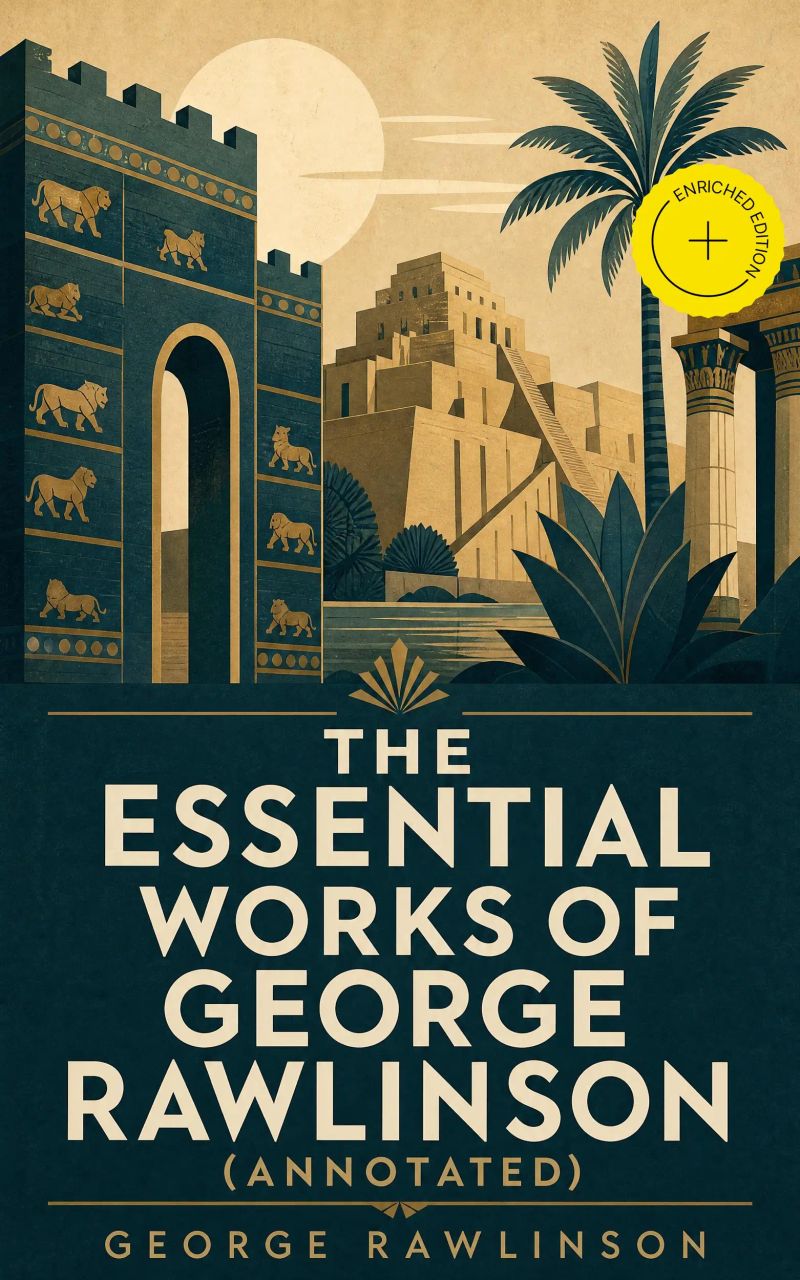
The Essential Works of George Rawlinson (Annotated)
Enriched Edition. Egypt, The Kings of Israel and Judah, Phoenicia, Parthia, Chaldea, Assyria, Media, Babylon, Persia…By George Rawlinson


Length145h 33m
About this audiobook
The Essential Works of George Rawlinson gathers the writings of a major Victorian interpreter of the ancient Near East, presenting histories of Assyria, Babylonia, Persia, Phoenicia, Egypt, and related civilizations with an ambitious comparative scope. Rawlinson's prose is lucid, methodical, and documentary, shaped by classical historiography yet animated by nineteenth-century archaeological discovery. His work stands at the intersection of biblical scholarship, imperial historical imagination, and the emerging decipherment of ancient inscriptions. George Rawlinson (1812–1902), an English historian, Anglican clergyman, and Oxford scholar, was deeply influenced by the intellectual currents of his age. As the brother of Sir Henry Rawlinson, a pioneer in cuneiform studies, he had unusual access to the breakthroughs transforming knowledge of Mesopotamia. His scholarship reflects both clerical learning and academic rigor, seeking to reconcile ancient texts, material evidence, and the grand narratives of civilization. This collection is recommended for readers interested in the history of historical writing as much as in antiquity itself. Though modern scholarship has revised many of Rawlinson's conclusions, his works remain valuable for their breadth, elegance, and formative role in popularizing ancient Eastern history for English-speaking audiences.
This enriched edition has been carefully crafted to add value to your reading experience.
- A comprehensive Introduction outlines these selected works' unifying features, themes, or stylistic evolutions.
- A Historical Context section situates the works in their broader era—social currents, cultural trends, and key events that underpin their creation.
- A concise Synopsis (Selection) offers an accessible overview of the included texts, helping readers navigate plotlines and main ideas without revealing critical twists.
- A unified Analysis examines recurring motifs and stylistic hallmarks across the collection, tying the stories together while spotlighting the different work's strengths.
- Reflection questions inspire deeper contemplation of the author's overarching message, inviting readers to draw connections among different texts and relate them to modern contexts.
- Lastly, our hand‐picked Memorable Quotes distill pivotal lines and turning points, serving as touchstones for the collection's central themes.
Audiobook details
GenreHistory
Length145 hrs 33 mins
Narrated byListen with 1,000+ voices
FormateBook with Audio
Publish dateDec 20, 2023
LanguageEnglish
Table of contents
1The Essential Works of George Rawlinson (Annotated)
2Introduction
3Historical Context
4Synopsis (Selection)
5Egypt
Show all chaptersShow less
6I. The Land of Egypt.
7II. The People of Egypt.
8III. The Dawn of History.
9IV. The Pyramid Builders.
10V. The Rise of Thebes to Power, and the Early Theban Kings.
11VI. The Good Amenemhat and His Works.
12VII. Abraham in Egypt.
13VIII. The Great Invasion—The Hyksôs or Shepherd Kings—Joseph and Apepi.
14IX. How the Hyksôs were Expelled from Egypt.
15X. Thothmes I., The First Great Egyptian Conqueror.
16XI. Queen Hatasu and Her Merchant Fleet.
17XII. Thothmes the Third and Amenhotep the Second.
18XIII. Amenhotep III. And His Great Works—The Vocal Memnon.
19XIV. Khuenaten and the Disk-Worshippers.
20XV. Beginning of the Decline of Egypt.
21XVI. Menephthah I., The Pharaoh of the Exodus.
22XVII. The Decline of Egypt Under the Later Ramessides.
23XVIII. The Priest-Kings—Pinetem and Solomon.
24XIX. Shishak and His Dynasty.
25XX. The Land Shadowing With Wings—Egypt Under the Ethiopians
26XXI. The Fight Over the Carcase—Ethiopia v. Assyria.
27XXII. The Corpse Comes to Life Again—Psamatik I. and His Son Neco.
28XXIII. The Later Saïte Kings.—Psamatik II., Apries, and Amasis.
29XXIV. The Persian Conquest.
30XXV. Three Desperate Revolts.
31XXVI. A Last Gleam of Sunshine—Nectanebo I.
32XXVII. The Light Goes Out in Darkness.
33Phoenicia
34Preface
35Chapter II—Climate and Productions
36Chapter IV—The Cities
37Chapter V—The Colonies
38Chapter VI—Architecture
39Chapter VII—Æsthetic Art
40Chapter VIII—Industrial Art and Manufactures
41Chapter IX—Ships, Navigation, and Commerce
42Chapter X—Mining
43Chapter XII—Dress, Ornaments, and Social Habits
44Chapter XIII—Phoenician Writing, Language, and Literature
45Chapter XIV—Political History (pt. 1)
46Chapter XIV—Political History (pt. 2)
47Chapter XIV—Political History (pt. 3)
48Chaldea
49Chapter I. General View of the Country
50Chapter II. Climate and Productions

CHALDEA (Illustrated Edition)George Rawlinson6h 18m4.4 (12)$1.99 · $0.00
Ancient Egypt: History, Mythology & LiteratureGeorge Rawlinson, Arthur Gilman, Gaston Maspero, Agnes Sophia Griffith Johns, E. A. Wallis Budge, Lewis Spence47h 15m$1.99 · $0.00
Ancient Empires: A 15-Volume AnthologyGeorge Rawlinson, L. W. King, John Bagnell Bury, Arrian, Theodor Mommsen, Edward Gibbon, Charles Oman455h 5m4.6 (12)$1.99
History of the Sasanian Empire (Annotated)George Rawlinson17h 20m3.9 (25)$2 · $0.00
The Kings of Israel and Judah (Annotated)George Rawlinson10h 6m4.1 (729)$2 · $0.00
The Great Empires of the Ancient East (Annotated)George Rawlinson144h 35m$2 · $0.00
History of the Ancient Chaldea (Annotated)George Rawlinson6h 11m$2 · $0.00

Ancient Media (Annotated)George Rawlinson6h 32m$2 · $0.00
The Great Civilizations of the Ancient East (Annotated)George Rawlinson145h 31m$2 · $0.00

The Greatest Empires & Civilizations of the Ancient EastGeorge Rawlinson145h 7m$2 · $0.00
The History of BabylonGeorge Rawlinson7h 24m3.2 (37)$1 · $0.00

The Seven Great Monarchies Of The Ancient Eastern World: BabylonGeorge Rawlinson7h 3m3.4 (16)$1 · $0.00
History of the Ancient ChaldeaGeorge Rawlinson6h 10m$2 · $0.00
History of the Phoenician CivilizationGeorge Rawlinson16h 50m3.8 (134)$1 · $0.00
The Great Empires of the Ancient EastGeorge Rawlinson145h 1m$1 · $0.00
History of the Phoenician CivilizationGeorge Rawlinson17h 33m3.6 (89)$1 · $0.00
PARTHIA (Illustrated)George Rawlinson11h 59m4.3 (11)$1.99 · $0.00
History of the Phoenician CivilizationGeorge Rawlinson16h 20m3.9 (114)$2 · $0.00
Persian EmpireGeorge Rawlinson13h 7m3.7 (21)$2 · $0.00

A Brief History of IntelligenceMax S. Bennett12h 18m4.6 (6.6K)$29 · $0.00

The Daughter of AuschwitzTova Friedman, Malcolm Brabant7h 54m4.6 (16.7K)$26 · $0.00

Lily's PromiseLily Ebert, Dov Forman8h 54m4.6 (16.1K)$29 · $0.00

On Democracies and Death CultsDouglas Murray10h 38m4.6 (6.5K)$29 · $0.00

Across the RiverKent Babb11h 40m4.6 (927)$29 · $0.00
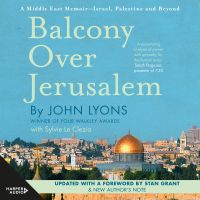
Balcony Over Jerusalem: A Middle East Memoir - Israel, Palestine and BeyondJohn Lyons12h 37m4.6 (1.4K)$33 · $0.00

BeyondStephen Walker15h 39m4.6 (3.2K)$33 · $0.00

Kings and PawnsHoward Bryant10h 9m4.6 (678)$29 · $0.00

No EscapeNury Turkel9h 30m4.6 (809)$28 · $0.00

Jubal Stone: U.S. Marshal: Blood Trail To Hell: A Western Adventure NovelCasey Nash3h 42m4.6 (3.2K)$18 · $0.00

Fall and RiseMitchell Zuckoff17h 23m4.6 (9.8K)$40 · $0.00

The SurvivorJosef Lewkowicz, Michael Calvin9h 22m4.6 (2.5K)$29 · $0.00

Always FaithfulThomas Schueman, Zainullah Zaki12h 12m4.6 (977)$29 · $0.00

The State of Society in France Before the Revolution of 1789 (Annotated)Alexis de Tocqueville17h 25m4.6 (1.2K)$2 · $0.00

All the Gallant MenDonald Stratton, Ken Gire5h 55m4.6 (11.8K)$24 · $0.00

Saint Joan (Annotated)George Bernard Shaw6h 20m4.6 (1.2K)$1.20 · $0.00

Medgar and MyrlieJoy-Ann Reid10h 52m4.5 (27.8K)$29 · $0.00

The History of the Peloponnesian War (Annotated)Thucydides24h 3m4.6 (1.1K)$2 · $0.00

Where the Birds Never SingJack Sacco10h 31m4.6 (3.8K)$29 · $0.00

Serviceman J: The Untold Story of an NZSAS SoldierJamie Pennell5h 51m4.6 (452)$24 · $0.00
You may also like

The Story of the Volsungs (Volsunga Saga); with Excerpts from the Poetic EddaAnonymous5h 55m4.1 (2.4K)$2 · $0.00
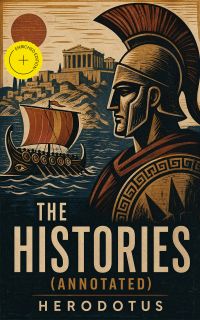
The Histories (Annotated)Herodotus33h 18m4.2 (68.1K)$2 · $0.00
The Story of MankindHendrik Van Loon13h 39m3.6 (4.5K)Free

The Story of EgyptJoann Fletcher17h 26m4.0 (2K)$25

History of the Conquest of Mexico (Vol. 1-4)William Hickling Prescott47h 48m4.2 (5.8K)$1 · $0.00
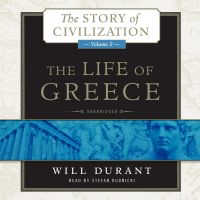
The Life of GreeceWill Durant32h 34m4.4 (5.6K)$30
Ancient Greece, Second EditionThomas R. Martin12h 59m4.1 (3.3K)$23
An Account of EgyptHerodotus3h 44m4.0 (1.1K)Free
Ancient Egypt: History, Mythology & LiteratureLewis Spence, Arthur Gilman, George Rawlinson, E. A. Wallis Budge, Gaston Maspero, Agnes Sophia Griffith Johns47h 11m4.2 (18)$1 · $0.00

The History of Denmark, Sweden and NorwayS. A. Dunham25h 4m$1.99 · $0.00
The History of Antiquity (Vol. 1-6) (Annotated)Max Duncker92h 42m4.1 (33)$2 · $0.00
The Greatest Empires & Civilizations of the Ancient EastGeorge Rawlinson145h 7m$2 · $0.00

Viking LegacySantiago Machain6h 56m$25 · $0.00
An Account of EgyptHerodotus3h 41m$2.30
ANCIENT EGYPT: History, Archaeology, Literature, Mythology & Ancient Egyptian TextsGeorge Rawlinson, Arthur Gilman, Gaston Maspero, Agnes Sophia Griffith Johns, E. A. Wallis Budge47h 14m4.2 (25)$1.99 · $0.00
The History of the Ancient CivilizationsMax Duncker82h 26m$1.99 · $0.00

Romanesque ArtVictoria Charles, Klaus H. Carl3h 58m4.0 (19)$15 · $0.00
ASSYRIA (Illustrated)George Rawlinson19h 8m4.0 (26)$1.99 · $0.00

Chinese ArtStephen W. Bushell5h 34m4.2 (31)$18 · $0.00
ANCIENT EGYPT: History, Archaeology, Literature, Mythology & Ancient Egyptian TextsArthur Gilman, George Rawlinson, E. A. Wallis Budge, Gaston Maspero, Agnes Sophia Griffith Johns47h 11m4.4 (16)$1 · $0.00