
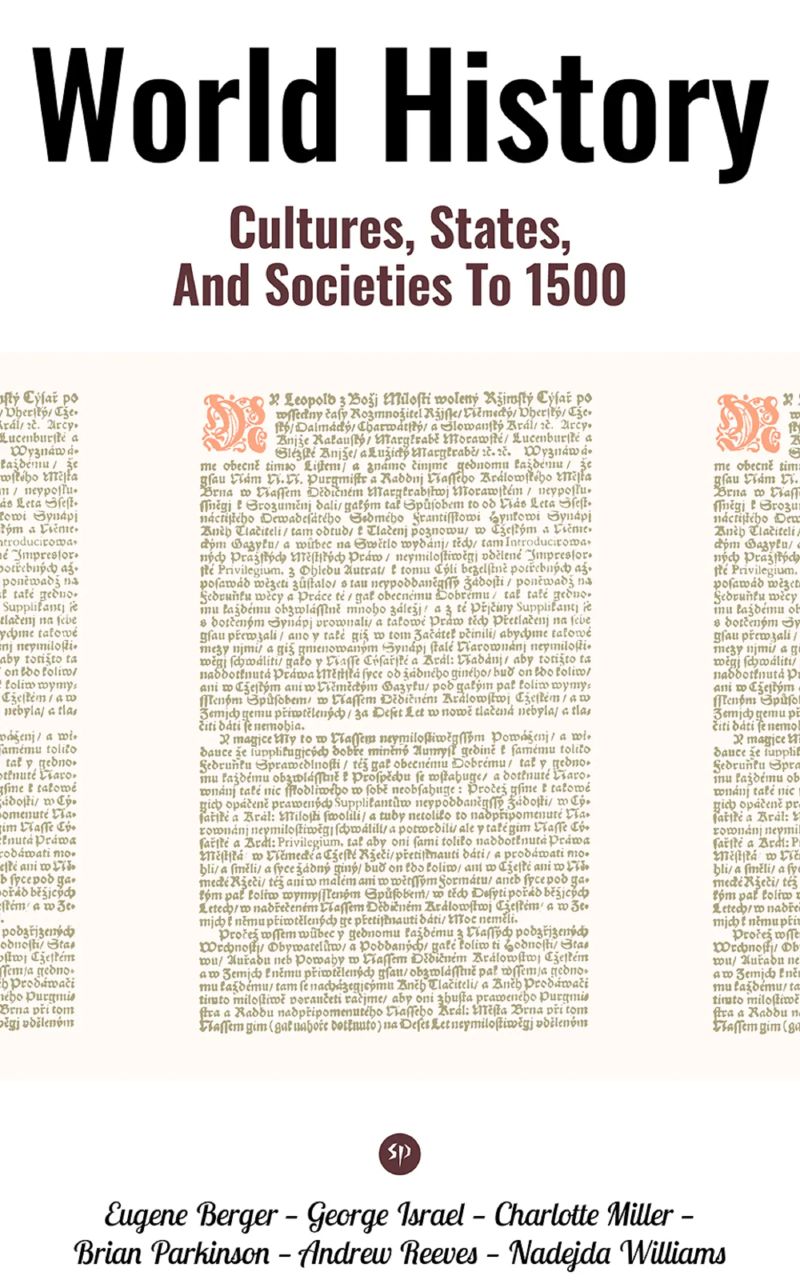
World History: Cultures, States, and Societies to 1500
By Eugene Berger, George Israel, Charlotte Miller, Brian Parkinson, Andrew Reeves, Nadejda Williams


Length21h 23m
About this audiobook
Contents:
Prehistory
Early Middle Eastern and Northeast African Civilizations
Ancient and Early Medieval India
China and East Asia to the Ming Dynasty
The Greek World from the Bronze Age to the Roman Conquest
The Roman World from 753 BCE to 500 CE
Western Europe and Byzantium circa 500 - 1000 CE
Islam to the Mamluks
African History to 1500
The Americas
Central Asia
Western Europe and Byzantium circa 1000 - 1500 CE
Audiobook details
Rating★★★★ 3.8 (146)
Includes Amazon, Goodreads
GenreHistory
Length21 hrs 23 mins
Narrated byListen with 1,000+ voices
FormateBook with Audio
Publish dateMay 24, 2018
LanguageEnglish
Table of contents
1World History: Cultures, States, and Societies to 1500
2Chapter One: Prehistory
3Chronology
4Introduction
5Questions to Guide your Reading
Show all chaptersShow less
6Key Terms
7Human Beginnings in Africa
8Agriculture and the "Neolithic Revolution"
9Summary
10Works Consulted and Further Reading
11Links to Primary Sources
12Chapter Two: Early Middle Eastern and Northeast African Civilizations
13Chronology
14Introduction
15Questions to Guide your Reading
16Key Terms
17Ancient Mesopotamia
18Sumerian City-States
19Mesopotamian Empires
20The Significance of Mesopotamia for World History
21The Israelites and Ancient Israel
22Early Israelites
23The United Kingdom of Israel
24The Importance of the Israelites and Ancient Israel
25Ancient Egypt
26Dynastic Egypt
27Nubia: the Kingdoms of Kerma and Kush
28Summary
29Works Consulted and Further Reading
30Links to Primary Sources
31Chapter Three: Ancient and Early Medieval India
32Chronology
33Introduction
34Questions to Guide your Reading
35Key Terms
36What is India? The Geography of South Asia
37India's First Major Civilization: The Indus Valley Civilization
38The Long Vedic Age
39Transition to Empire: States, Cities, and New Religions
40The Mauryan Empire
41Regional States, Trade, and Devotional Religion
42The Gupta Empire and India's Classical Age
43India's Early Medieval Age and the Development of Islamic States in India
44Conclusion
45Works Consulted and Further Reading
46Links to Primary Sources
47Chapter Four: China and East Asia to the Ming Dynasty
48Chronology
49Introduction
50Questions to Guide your Reading
More from Eugene Berger, George Israel, Charlotte Miller, Brian Parkinson, Andrew Reeves, Nadejda Williams

World History: Cultures, States, and Societies to 1500Eugene Berger, George Israel, Charlotte Miller, Brian Parkinson, Andrew Reeves, Nadejda Williams21h 22m3.4 (42)$1 · $0.00

World History: Cultures, States, and Societies to 1500Eugene Berger, George Israel, Charlotte Miller, Brian Parkinson, Andrew Reeves, Nadejda Williams21h 19m3.8 (53)$1.49 · $0.00

A Brief History of IntelligenceMax S. Bennett12h 18m4.6 (6.6K)$29 · $0.00

Where Cowards Go to DieBenjamin Sledge8h 42m4.7 (351)$20 · $0.00

RevolutionariesSanjeev Sanyal11h 23m4.6 (2.6K)$29 · $0.00

We Crossed a Bridge and It TrembledWendy Pearlman6h4.6 (5.2K)$24 · $0.00

Unbroken Bonds of BattleJohnny Joey Jones8h 31m4.6 (2.6K)$8 · $0.00

The Daughter of AuschwitzTova Friedman, Malcolm Brabant7h 54m4.6 (16.7K)$26 · $0.00

Lily's PromiseLily Ebert, Dov Forman8h 54m4.6 (16.1K)$29 · $0.00

On Democracies and Death CultsDouglas Murray10h 38m4.6 (6.5K)$29 · $0.00

Across the RiverKent Babb11h 40m4.6 (927)$29 · $0.00

Balcony Over Jerusalem: A Middle East Memoir - Israel, Palestine and BeyondJohn Lyons12h 37m4.6 (1.4K)$33 · $0.00

BeyondStephen Walker15h 39m4.6 (3.2K)$33 · $0.00

Kings and PawnsHoward Bryant10h 9m4.6 (678)$29 · $0.00

No EscapeNury Turkel9h 30m4.6 (809)$28 · $0.00

Jubal Stone: U.S. Marshal: Blood Trail To Hell: A Western Adventure NovelCasey Nash3h 42m4.6 (3.2K)$18 · $0.00

Fall and RiseMitchell Zuckoff17h 23m4.6 (9.8K)$40 · $0.00

The SurvivorJosef Lewkowicz, Michael Calvin9h 22m4.6 (2.5K)$29 · $0.00

Always FaithfulThomas Schueman, Zainullah Zaki12h 12m4.6 (977)$29 · $0.00

The State of Society in France Before the Revolution of 1789 (Annotated)Alexis de Tocqueville17h 25m4.6 (1.2K)$2 · $0.00

All the Gallant MenDonald Stratton, Ken Gire5h 55m4.6 (11.8K)$24 · $0.00

Saint Joan (Annotated)George Bernard Shaw6h 20m4.6 (1.2K)$1.20 · $0.00
You may also like

The Outline of History: Being a Plain History of Life and MankindH. G. Wells48h 36m4.0 (6.6K)$2.30

FoundationPeter Ackroyd18h 20m4.2 (7.8K)$25
Empires of the SteppesKenneth W. Harl17h 13m4.0 (1.5K)$40 · $0.00

History of the World (Updated)J. M. Roberts54h 42m4.2 (4.8K)$30

ANCIENT GREECE: The History of Classical Greece from Its Earliest Beginnings to the Hellenistic Age (Annotated)John Bagnell Bury41h 58m4.2 (1.3K)$2 · $0.00

History of the Conquest of PeruWilliam Hickling Prescott28h 35m4.1 (1.1K)$1 · $0.00
The Histories (Annotated)Herodotus33h 18m4.2 (68.1K)$2 · $0.00

The History of the Decline and Fall of the Roman Empire (Complete 6 Volume Edition)Edward Gibbon179h 32m4.6 (64.2K)$1.99 · $0.00
Ancient Greece, Second EditionThomas R. Martin12h 59m4.1 (3.3K)$23

The Story of Mankind - Illustrated History of the Human Civilization Retold for ChildrenHendrik Willem van Loon14h 42m3.6 (5.3K)$1.99 · $0.00

The History of Rome - All 5 Volumes in One EditionTheodor Mommsen100h 46m4.5 (3.1K)$1.99 · $0.00
Ancient Man – The Beginning of Civilizations (Illustrated Edition) (Annotated)Hendrik Willem van Loon3h 54m3.3 (36)$2 · $0.00

The Invasion of India by Alexander the GreatJohn Watson McCrindle18h 44m$1 · $0.00
World History: Cultures, States, and Societies to 1500Eugene Berger, George Israel, Charlotte Miller, Brian Parkinson, Andrew Reeves, Nadejda Williams21h 22m3.4 (42)$1 · $0.00

A Short History of RussiaMary Platt Parmele7h 19m3.6 (639)$2 · $0.00

Mexico, Aztec, Spanish and Republican (Annotated)Brantz Mayer36h 19m$2 · $0.00
History of the Phoenician CivilizationGeorge Rawlinson16h 20m3.9 (114)$2 · $0.00

Biblical Geography and HistoryCharles Foster Kent11h 18m4.0 (95)$2 · $0.00
The Great Civilizations of the Ancient East (Annotated)George Rawlinson145h 31m$2 · $0.00

The History of the Ancient CivilizationsMax Duncker82h 26m$1.99 · $0.00