
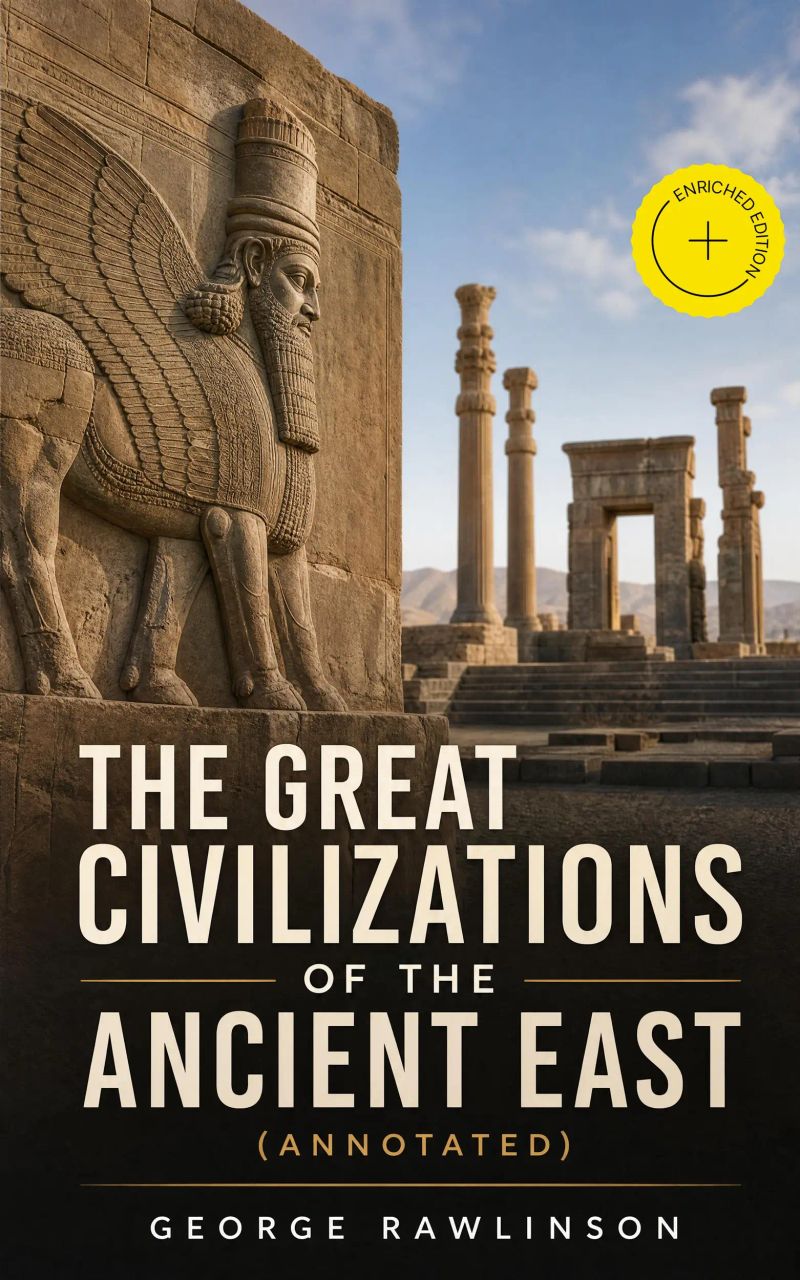
The Great Civilizations of the Ancient East (Annotated)
Enriched Edition. Egypt, Phoenicia, The Kings of Israel and Judah, Babylon, Parthia, Chaldea, Assyria, Media, Persia…By George Rawlinson


Length145h 31m
About this audiobook
The Great Civilizations of the Ancient East presents a sweeping account of the formative empires and cultures of Western Asia and the Near East, tracing their political institutions, religious habits, artistic achievements, and historical interrelations. Written in the lucid, documentary manner characteristic of nineteenth-century historical scholarship, the work joins classical testimony with archaeological and biblical evidence, situating Assyria, Babylonia, Persia, and neighboring powers within the broader story of ancient imperial development. George Rawlinson, an English historian, clergyman, and Camden Professor of Ancient History at Oxford, was deeply shaped by the Victorian age's expanding knowledge of the ancient Near East. Brother of the celebrated Assyriologist Sir Henry Rawlinson, he had unusual access to the discoveries and decipherments that transformed European understanding of Mesopotamia and Persia. His clerical education and classical training also encouraged his effort to reconcile ancient history, scriptural tradition, and emerging archaeological research. This volume is recommended to readers seeking a learned, accessible entry into the civilizations that preceded and influenced the classical world. Though marked by the assumptions of its era, it remains valuable for its breadth, clarity, and historical imagination, offering insight not only into antiquity but also into the scholarly ambitions of Victorian historiography.
This enriched edition has been carefully crafted to add value to your reading experience.
- A succinct Introduction situates the work's timeless appeal and themes.
- The Synopsis outlines the central plot, highlighting key developments without spoiling critical twists.
- A detailed Historical Context immerses you in the era's events and influences that shaped the writing.
- A thorough Analysis dissects symbols, motifs, and character arcs to unearth underlying meanings.
- Reflection questions prompt you to engage personally with the work's messages, connecting them to modern life.
- Hand‐picked Memorable Quotes shine a spotlight on moments of literary brilliance.
- Interactive footnotes clarify unusual references, historical allusions, and archaic phrases for an effortless, more informed read.
Audiobook details
GenreHistory
Length145 hrs 31 mins
Narrated byListen with 1,000+ voices
FormateBook with Audio
Publish dateDec 13, 2023
LanguageEnglish
Table of contents
1Introduction
2Introduction
3Synopsis
4Historical Context
5Egypt
Show all chaptersShow less
6I. The Land of Egypt.
7II. The People of Egypt.
8III. The Dawn of History.
9IV. The Pyramid Builders.
10V. The Rise of Thebes to Power, and the Early Theban Kings.
11VI. The Good Amenemhat and His Works.
12VII. Abraham in Egypt.
13VIII. The Great Invasion—The Hyksôs or Shepherd Kings—Joseph and Apepi.
14IX. How the Hyksôs were Expelled from Egypt.
15X. Thothmes I., The First Great Egyptian Conqueror.
16XI. Queen Hatasu and Her Merchant Fleet.
17XII. Thothmes the Third and Amenhotep the Second.
18XIII. Amenhotep III. And His Great Works—The Vocal Memnon.
19XIV. Khuenaten and the Disk-Worshippers.
20XV. Beginning of the Decline of Egypt.
21XVI. Menephthah I., The Pharaoh of the Exodus.
22XVII. The Decline of Egypt Under the Later Ramessides.
23XVIII. The Priest-Kings—Pinetem and Solomon.
24XIX. Shishak and His Dynasty.
25XX. The Land Shadowing With Wings—Egypt Under the Ethiopians
26XXI. The Fight Over the Carcase—Ethiopia v. Assyria.
27XXII. The Corpse Comes to Life Again—Psamatik I. and His Son Neco.
28XXIII. The Later Saïte Kings.—Psamatik II., Apries, and Amasis.
29XXIV. The Persian Conquest.
30XXV. Three Desperate Revolts.
31XXVI. A Last Gleam of Sunshine—Nectanebo I.
32XXVII. The Light Goes Out in Darkness.
33Phoenicia
34Preface
35Chapter II—Climate and Productions
36Chapter IV—The Cities
37Chapter V—The Colonies
38Chapter VI—Architecture
39Chapter VII—Æsthetic Art
40Chapter VIII—Industrial Art and Manufactures
41Chapter IX—Ships, Navigation, and Commerce
42Chapter X—Mining
43Chapter XII—Dress, Ornaments, and Social Habits
44Chapter XIII—Phoenician Writing, Language, and Literature
45Chapter XIV—Political History (pt. 1)
46Chapter XIV—Political History (pt. 2)
47Chapter XIV—Political History (pt. 3)
48Chaldea
49Chapter I. General View of the Country
50Chapter II. Climate and Productions

CHALDEA (Illustrated Edition)George Rawlinson6h 18m4.4 (12)$1.99 · $0.00
Ancient Egypt: History, Mythology & LiteratureGeorge Rawlinson, Arthur Gilman, Gaston Maspero, Agnes Sophia Griffith Johns, E. A. Wallis Budge, Lewis Spence47h 15m$1.99 · $0.00
Ancient Empires: A 15-Volume AnthologyGeorge Rawlinson, L. W. King, John Bagnell Bury, Arrian, Theodor Mommsen, Edward Gibbon, Charles Oman455h 5m4.6 (12)$1.99
History of the Sasanian Empire (Annotated)George Rawlinson17h 20m3.9 (25)$2 · $0.00
The Kings of Israel and Judah (Annotated)George Rawlinson10h 6m4.1 (729)$2 · $0.00
The Great Empires of the Ancient East (Annotated)George Rawlinson144h 35m$2 · $0.00
History of the Ancient Chaldea (Annotated)George Rawlinson6h 11m$2 · $0.00

The Essential Works of George Rawlinson (Annotated)George Rawlinson145h 34m$2 · $0.00

Ancient Media (Annotated)George Rawlinson6h 32m$2 · $0.00

The Greatest Empires & Civilizations of the Ancient EastGeorge Rawlinson145h 7m$2 · $0.00

The History of BabylonGeorge Rawlinson7h 24m3.2 (37)$1 · $0.00

The Seven Great Monarchies Of The Ancient Eastern World: BabylonGeorge Rawlinson7h 3m3.4 (16)$1 · $0.00
History of the Ancient ChaldeaGeorge Rawlinson6h 10m$2 · $0.00
History of the Phoenician CivilizationGeorge Rawlinson16h 50m3.8 (134)$1 · $0.00
The Great Empires of the Ancient EastGeorge Rawlinson145h 1m$1 · $0.00
History of the Phoenician CivilizationGeorge Rawlinson17h 33m3.6 (89)$1 · $0.00

PARTHIA (Illustrated)George Rawlinson11h 59m4.3 (11)$1.99 · $0.00
History of the Phoenician CivilizationGeorge Rawlinson16h 20m3.9 (114)$2 · $0.00
Persian EmpireGeorge Rawlinson13h 7m3.7 (21)$2 · $0.00

A Brief History of IntelligenceMax S. Bennett12h 18m4.6 (6.6K)$29 · $0.00

The Daughter of AuschwitzTova Friedman, Malcolm Brabant7h 54m4.6 (16.7K)$26 · $0.00

Lily's PromiseLily Ebert, Dov Forman8h 54m4.6 (16.1K)$29 · $0.00

On Democracies and Death CultsDouglas Murray10h 38m4.6 (6.5K)$29 · $0.00

Across the RiverKent Babb11h 40m4.6 (927)$29 · $0.00

Balcony Over Jerusalem: A Middle East Memoir - Israel, Palestine and BeyondJohn Lyons12h 37m4.6 (1.4K)$33 · $0.00

BeyondStephen Walker15h 39m4.6 (3.2K)$33 · $0.00

Kings and PawnsHoward Bryant10h 9m4.6 (678)$29 · $0.00

No EscapeNury Turkel9h 30m4.6 (809)$28 · $0.00

Jubal Stone: U.S. Marshal: Blood Trail To Hell: A Western Adventure NovelCasey Nash3h 42m4.6 (3.2K)$18 · $0.00

Fall and RiseMitchell Zuckoff17h 23m4.6 (9.8K)$40 · $0.00

The SurvivorJosef Lewkowicz, Michael Calvin9h 22m4.6 (2.5K)$29 · $0.00

Always FaithfulThomas Schueman, Zainullah Zaki12h 12m4.6 (977)$29 · $0.00

The State of Society in France Before the Revolution of 1789 (Annotated)Alexis de Tocqueville17h 25m4.6 (1.2K)$2 · $0.00

All the Gallant MenDonald Stratton, Ken Gire5h 55m4.6 (11.8K)$24 · $0.00

Saint Joan (Annotated)George Bernard Shaw6h 20m4.6 (1.2K)$1.20 · $0.00

Medgar and MyrlieJoy-Ann Reid10h 52m4.5 (27.8K)$29 · $0.00

The History of the Peloponnesian War (Annotated)Thucydides24h 3m4.6 (1.1K)$2 · $0.00

Where the Birds Never SingJack Sacco10h 31m4.6 (3.8K)$29 · $0.00

Serviceman J: The Untold Story of an NZSAS SoldierJamie Pennell5h 51m4.6 (452)$24 · $0.00
You may also like
The Story of MankindHendrik Van Loon13h 39m3.6 (4.5K)Free

History of the Conquest of Mexico (Vol. 1-4)William Hickling Prescott47h 48m4.2 (5.8K)$1 · $0.00
The Histories (Annotated)Herodotus33h 18m4.2 (68.1K)$2 · $0.00
The GreeksDiane Harris Cline6h 23m4.1 (547)$17

History of the World (Updated)J. M. Roberts54h 42m4.2 (4.8K)$30
The Life of GreeceWill Durant32h 34m4.4 (5.6K)$30
Empires of the SteppesKenneth W. Harl17h 13m4.0 (1.5K)$40 · $0.00

A Child's History of the WorldV. M. Hillyer10h 9m4.1 (3.2K)$2.30
Ancient Greece, Second EditionThomas R. Martin12h 59m4.1 (3.3K)$23

The Story of the Volsungs (Volsunga Saga); with Excerpts from the Poetic EddaAnonymous5h 55m4.1 (2.4K)$2 · $0.00

The Story of Mankind - Illustrated History of the Human Civilization Retold for ChildrenHendrik Willem van Loon14h 42m3.6 (5.3K)$1.99 · $0.00
The Greatest Empires & Civilizations of the Ancient EastGeorge Rawlinson145h 7m$2 · $0.00

The Invasion of India by Alexander the GreatJohn Watson McCrindle18h 44m$1 · $0.00
The History of Antiquity (Vol. 1-6) (Annotated)Max Duncker92h 42m4.1 (33)$2 · $0.00

Kings, Kingdoms, and the Christianization of ScandinaviaSantiago Machain6h 40m$25 · $0.00

NorwaySigvart Sörensen10h 37m$1 · $0.00

Chinese ArtStephen W. Bushell5h 34m4.2 (31)$18 · $0.00

The History of Denmark, Sweden and NorwayS. A. Dunham25h 4m$1.99 · $0.00
The Invasion of India by Alexander the GreatJohn Watson McCrindle17h 15m3.7 (34)$1.99 · $0.00
Romanesque ArtVictoria Charles, Klaus H. Carl3h 58m4.0 (19)$15 · $0.00