
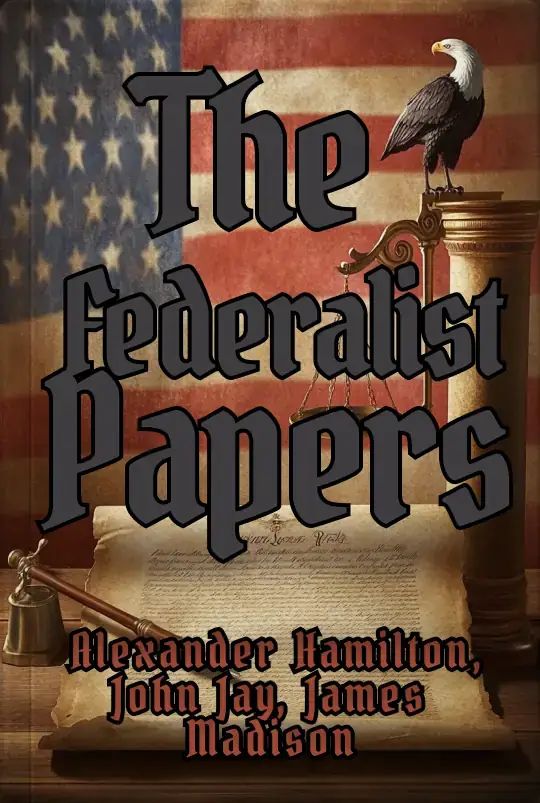
The Federalist Papers
By Alexander Hamilton, John Jay, James Madison


Length21h 20m
About this audiobook
The Federalist Papers is a collection of 85 essays written by James Madison, Alexander Hamilton, and John Jay to promote the ratification of the United States Constitution. These essays explain the principles of the Constitution and argue for a strong federal government to ensure the nation's stability and unity.
Audiobook details
Rating★★★★ 4.3 (126.6K)
Includes Goodreads, Amazon, LibraryThing, StoryGraph
GenrePolitics and Government
Length21 hrs 20 mins
Narrated byListen with 1,000+ voices
FormateBook with Audio
Publish dateJan 7, 1788
LanguageEnglish
Table of contents
1By Alexander Hamilton, John Jay,James Madison
2Federalist No. 2. Concerning Dangers From Foreign Force And Influence
3Federalist No. 3. The Same Subject Continued (concerning Dangers From Foreign Force And Influence)
4Federalist No. 4. The Same Subject Continued (concerning Dangers From Foreign Force And Influence)
5Federalist No. 5. The Same Subject Continued (concerning Dangers From Foreign Force And Influence)
Show all chaptersShow less
6Federalist No. 6. Concerning Dangers From Dissensions Between The States
7Federalist No. 7. The Same Subject Continued (concerning Dangers From Dissensions Between The States)
8Federalist No. 8. The Consequences Of Hostilities Between The States
9Federalist No. 9. The Union As A Safeguard Against Domestic Faction And Insurrection
10Federalist No. 10. The Same Subject Continued (the Union As A Safeguard Against Domestic Faction And Insurrection)
11Federalist No. 11. The Utility Of The Union In Respect To Commercial Relations And A Navy
12Federalist No. 12. The Utility Of The Union In Respect To Revenue
13Federalist No. 13. Advantage Of The Union In Respect To Economy In Government
14Federalist No. 14. Objections To The Proposed Constitution From Extent Of Territory Answered
15Federalist No. 15. The Insufficiency Of The Present Confederation To Preserve The Union
16Federalist No. 16. The Same Subject Continued (the Insufficiency Of The Present Confederation To Preserve The Union)
17Federalist No. 17. The Same Subject Continued (the Insufficiency Of The Present Confederation To Preserve The Union)
18Federalist No. 18. The Same Subject Continued (the Insufficiency Of The Present Confederation To Preserve The Union)
19Federalist No. 19. The Same Subject Continued (the Insufficiency Of The Present Confederation To Preserve The Union)
20Federalist No. 20. The Same Subject Continued (the Insufficiency Of The Present Confederation To Preserve The Union)
21Federalist No. 21. Other Defects Of The Present Confederation
22Federalist No. 22. The Same Subject Continued (other Defects Of The Present Confederation)
23Federalist No. 23. The Necessity Of A Government As Energetic As The One Proposed To The Preservation Of The Union
24Federalist No. 24. The Powers Necessary To The Common Defense Further Considered
25Federalist No. 25. The Same Subject Continued (the Powers Necessary To The Common Defense Further Considered)
26Federalist No. 26. The Idea Of Restraining The Legislative Authority In Regard To The Common Defense Considered
27Federalist No. 27. The Same Subject Continued (the Idea Of Restraining The Legislative Authority In Regard To The Common Defense Considered)
28Federalist No. 28. The Same Subject Continued (the Idea Of Restraining The Legislative Authority In Regard To The Common Defense Considered)
29Federalist No. 29. Concerning The Militia
30Federalist No. 30. Concerning The General Power Of Taxation
31Federalist No. 31. The Same Subject Continued (concerning The General Power Of Taxation)
32Federalist No. 32. The Same Subject Continued (concerning The General Power Of Taxation)
33Federalist No. 33. The Same Subject Continued (concerning The General Power Of Taxation)
34Federalist No. 34. The Same Subject Continued (concerning The General Power Of Taxation)
35Federalist No. 35. The Same Subject Continued (concerning The General Power Of Taxation)
36Federalist No. 36. The Same Subject Continued (concerning The General Power Of Taxation)
37Federalist No. 37. Concerning The Difficulties Of The Convention In Devising A Proper Form Of Government
38Federalist No. 38. The Same Subject Continued, And The Incoherence Of The Objections To The New Plan Exposed
39Federalist No. 39. The Conformity Of The Plan To Republican Principles
40Federalist No. 40. On The Powers Of The Convention To Form A Mixed Government Examined And Sustained
41Federalist No. 41. General View Of The Powers Conferred By The Constitution
42Federalist No. 42. The Powers Conferred By The Constitution Further Considered
43Federalist No. 43. The Same Subject Continued (the Powers Conferred By The Constitution Further Considered)
44Federalist No. 44. Restrictions On The Authority Of The Several States
45Federalist No. 45. The Alleged Danger From The Powers Of The Union To The State Governments
46Federalist No. 46. The Influence Of The State And Federal Governments Compared
47Federalist No. 47. The Particular Structure Of The New Government And The Distribution Of Power Among Its Different Parts
48Federalist No. 48. These Departments Should Not Be So Far Separated As To Have No Constitutional Control Over Each Other
49Federalist No. 49. Method Of Guarding Against The Encroachments Of Any One Department Of Government By Appealing To The People Through A Convention
50Federalist No. 50. Periodical Appeals To The People Considered

How to Test Negative for StupidJohn Kennedy8h 13m4.7 (9.7K)$28 · $0.00

Black AF HistoryMichael Harriot15h 43m4.7 (14.6K)$33 · $0.00

The Gulag Archipelago Volume 3Aleksandr I. Solzhenitsyn21h 56m4.7 (8.9K)$46 · $0.00

MotherlandJulia Ioffe17h 52m4.7 (2.5K)$40 · $0.00

HostageEli Sharabi5h 25m4.6 (10.8K)$24 · $0.00

KrantikariSanjeev Sanyal11h 44m4.6 (1.3K)$16 · $0.00

Unbroken Bonds of BattleJohnny Joey Jones8h 31m4.6 (2.6K)$8 · $0.00

On Democracies and Death CultsDouglas Murray10h 38m4.6 (6.5K)$29 · $0.00

Balcony Over Jerusalem: A Middle East Memoir - Israel, Palestine and BeyondJohn Lyons12h 37m4.6 (1.4K)$33 · $0.00

RiggedMollie Hemingway12h 48m4.6 (4.2K)$23 · $0.00

SledgehammerDavid Friedman8h 21m4.7 (589)$26 · $0.00

Citizenship in a Republic (Annotated)Theodore Roosevelt2h 44m4.6 (1.4K)$2 · $0.00

No EscapeNury Turkel9h 30m4.6 (809)$28 · $0.00

Always FaithfulThomas Schueman, Zainullah Zaki12h 12m4.6 (977)$29 · $0.00

UnthinkableJamie Raskin15h 8m4.5 (9.3K)$8 · $0.00

My Fourth Time, We DrownedSally Hayden13h 59m4.6 (2.9K)$23 · $0.00

A Revolution of Common SenseScott Jennings9h 29m4.6 (528)$29 · $0.00

Statement From the Dock at the Rivonia TrialNelson Mandela2h 18m4.6 (1.3K)$1 · $0.00

Lessons from the EdgeMarie Yovanovitch17h 11m4.5 (5.9K)$40 · $0.00

To Rescue the American SpiritBret Baier10h 12m4.5 (2.7K)$8 · $0.00
You may also like

A Slobbering Love AffairGoldberg, Bernard3h 48m3.9 (1.2K)Free

Deliver Us From EvilSean Hannity4h 40m3.7 (1.7K)$20 · $0.00

Plague of CorruptionMikovits, Judy9h 57m4.4 (15K)Free

“Mr. President”Harlow Giles Unger6h 58m4.1 (701)$20 · $0.00

Hot Talk, Cold Science, Third EditionS. Fred Singer6h 22m4.5 (779)$23
The Politically Incorrect Guide to the ConstitutionKevin R. C. Gutzman6h 35m4.4 (1.5K)$17

Ten Days That Shook the WorldKarl Marx16h 16m4.1 (12.6K)$2 · $0.00

UncheckedRachael Bade, Karoun Demirjian17h 36m4.2 (448)$40 · $0.00

An Enemy of the PeopleHenrik Ibsen3h 44m4.0 (20.4K)$21 · $0.00
Second Treatise of GovernmentJohn Locke5h 39m4.1 (29.2K)Free

Louis D. BrandeisJeffrey Rosen7h 45m4.1 (431)$20

Henry ClayHarlow Giles Unger8h 40m4.1 (1.1K)$20 · $0.00

What is to be done?Vladimir Lenin7h 23m4.2 (8.2K)$4 · $0.00

Hellenica (The History of the Peloponnesian War and Its Aftermath)Xenophon15h 14m4.1 (4.3K)$1.99 · $0.00

War Is a RacketButler, Smedley D3h 18m4.4 (10.8K)Free

Nine Black RobesJoan Biskupic13h 11m4.1 (2K)$33 · $0.00

The Civil WarJulius Caesar7h 40m4.2 (7.6K)$17

This America Of OursNate Schweber11h 32m4.4 (355)$29 · $0.00

William Jay and the Constitutional Movement for the Abolition of SlaveryBayard Tuckerman5h 17m$2 · $0.00

William Jay and the Constitutional Movement for the Abolition of SlaveryBayard Tuckerman5h 27m$1.99 · $0.00