
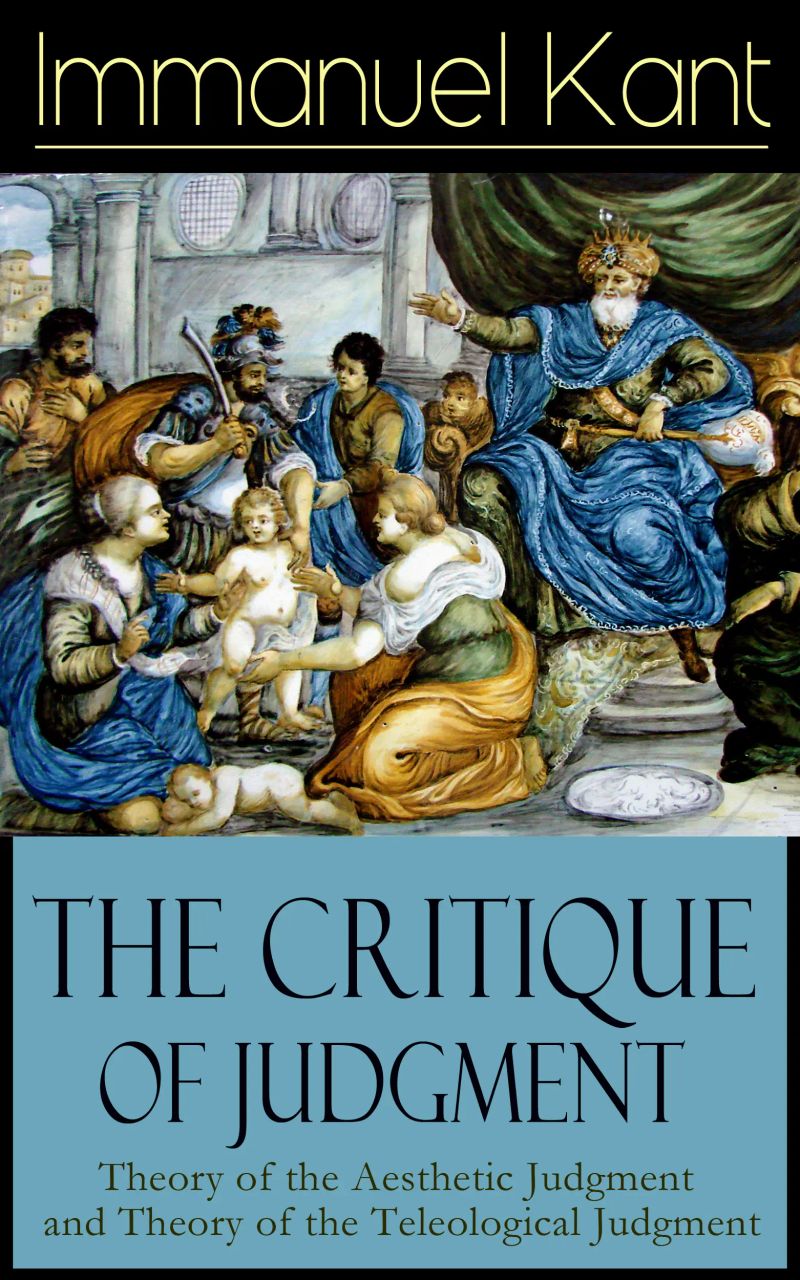
The Critique of Judgment: Theory of the Aesthetic Judgment and Theory of the Teleological Judgment
Aesthetics, Teleology, and the Antinomies of Human ReasonBy Immanuel Kant


Length14h 53m
About this audiobook
This carefully crafted ebook: "The Critique of Judgment: Theory of the Aesthetic Judgment and Theory of the Teleological Judgment" is formatted for your eReader with a functional and detailed table of contents.
The Critique of Judgment, also translated as the Critique of the Power of Judgment and more commonly referred to as the third Critique, is a philosophical work by Immanuel Kant. Critique of Judgment completes the Critical project begun in the Critique of Pure Reason and the Critique of Practical Reason (the first and second Critiques, respectively). The book is divided into two main sections: the Critique of Aesthetic Judgment and the Critique of Teleological Judgment, and also includes a large overview of the entirety of Kant's Critical system, arranged in its final form. The end result of Kant's Critical Project is that there are certain fundamental antinomies in human Reason, most particularly that there is a complete inability to favor on the one hand the argument that all behavior and thought is determined by external causes, and on the other that there is an actual "spontaneous" causal principle at work in human behavior.
Immanuel Kant (1724-1804) was a German philosopher, who, according to the Stanford Encyclopedia of Philosophy is "the central figure of modern philosophy." Kant argued that fundamental concepts of the human mind structure human experience, that reason is the source of morality, that aesthetics arises from a faculty of disinterested judgment, that space and time are forms of our understanding, and that the world as it is "in-itself" is unknowable. Kant took himself to have effected a Copernican revolution in philosophy, akin to Copernicus' reversal of the age-old belief that the sun revolved around the earth.
Audiobook details
GenrePhilosophy
Length14 hrs 53 mins
Narrated byListen with 1,000+ voices
FormateBook with Audio
Publish dateOct 1, 2015
LanguageEnglish
Table of contents
1The Critique of Judgment: Theory of the Aesthetic Judgment and Theory of the Teleological Judgment
17First Moment of the judgement of taste according to quality
2Editor’s Introduction
18Second Moment of the judgement of taste, viz. according to quantity
3Preface
19Third Moment of judgements of taste, according to the relation of the purposes which are brought into consideration therein
4Introduction
20Fourth Moment of the judgement of taste, according to the modality of the satisfaction in the object
5I. Of the division of Philosophy
21General remark on the first section of the Analytic
Show all chaptersShow less
6II. Of the realm of Philosophy in general
22Second Book Analytic of the Sublime
7III. Of the Critique of Judgement as a means of combining the two parts of Philosophy into a whole
23A.—Of the Mathematically Sublime
8IV. Of judgement as a faculty legislating a priori
24B.—Of the Dynamically Sublime in Nature
9V. The principle of the formal purposiveness of nature is a transcendental principle of judgement
25General remark upon the exposition of the aesthetical reflective Judgement
10VI. Of the combination of the feeling of pleasure with the concept of the purposiveness of nature
26Deduction of [pure] aesthetical judgements
11VII. Of the aesthetical representation of the purposiveness of nature
27Second Division: Dialectic of the Aesthetical Judgement
12VIII. Of the logical representation of the purposiveness of nature
28Part II: Critique of the Teleological Judgement
13IX. Of the connexion of the legislation of Understanding with that of Reason by means of the Judgement
29First Division: Analytic of the Teleological Judgement
14Part I: Critique of the Aesthetical Judgement
30Second Division: Dialectic of the Teleological Judgement
15First Division: Analytic of the Aesthetical Judgement
31Methodology of the Teleological Judgement
16First Book: Analytic of the Beautiful
32General remark on Teleology

Ausgewählte Schriften zur Geschichtsphilosophie, Ethik und PolitikImmanuel Kant7h 23m$2 · $0.00
THE THREE CRITIQUES: The Critique of Pure Reason, The Critique of Practical Reason & The Critique of JudgmentImmanuel Kant46h 10m$1 · $0.00

Anthropologie in pragmatischer HinsichtImmanuel Kant9h 19m$1 · $0.00
Critique of Practical Reason (Kritik der praktischen Vernunft)Immanuel Kant6h 50m$2 · $0.00
Kant's Prolegomena to Any Future MetaphysicsImmanuel Kant4h 21m$1 · $0.00

Groundwork of the Metaphysics of MoralsImmanuel Kant4h 28m$1 · $0.00

The Metaphysical Elements of EthicsImmanuel Kant2h 50m$2 · $0.00

Über die Vulkane im MondeImmanuel Kant22m$2 · $0.00

Über PädagogikImmanuel Kant2h 45m$2 · $0.00

Allgemeine Naturgeschichte und Theorie des HimmelsImmanuel Kant6h 10m$1 · $0.00

Die Metaphysik der SittenImmanuel Kant12h 16m$2 · $0.00

The Kantian Ethics: Metaphysics of Morals, The Critique of Practical Reason & Perpetual PeaceImmanuel Kant23h 26m$1 · $0.00

The Greatest Works of Immanuel KantImmanuel Kant84h 30m$1 · $0.00

Ikuiseen rauhaan: Valtio-oikeudellinen tutkielmaImmanuel Kant3h 1m$2 · $0.00

Kritik der praktischen VernunftImmanuel Kant7h 34m$2 · $0.00

Immanuel Kant: Beobachtungen über das Gefühl des Schönen und ErhabenenImmanuel Kant3h 49m$2 · $0.00

Die Metaphysik der SittenImmanuel Kant13h 47m$2 · $0.00

Groundwork of the Metaphysics of MoralsImmanuel Kant4h 47m$2 · $0.00

Metaphysische Anfangsgründe der NaturwissenschaftImmanuel Kant6h 14m$2 · $0.00

The Ethics of Immanuel KantImmanuel Kant22h 5m$2 · $0.00
Plato: Complete WorksPlato141h 44m$2 · $0.00

WitnessAriel Burger8h 1m$20 · $0.00
Philosophy and Opinions of Marcus GarveyMarcus Mosiah Garvey3h 1m$2 · $0.00

Feeling Is The SecretNeville Goddard44m5 (1)$2 · $0.00

The Way to a Beautiful WorldJames Norbury44m$9 · $0.00
The Collected Works of Friedrich NietzscheFriedrich Nietzsche92h$2 · $0.00
The Practicing StoicWard Farnsworth9h 56m$20

Moral Letters to LuciliusLucius Annaeus Seneca25h 38m$2 · $0.00
THE THREE CRITIQUES: The Critique of Pure Reason, The Critique of Practical Reason & The Critique of JudgmentImmanuel Kant46h 10m$1 · $0.00

The Complete Essays of MontaigneMichel de Montaigne45h 30m$2 · $0.00

The Origin of OthersToni Morrison2h 25m$20
The LawFrédéric Bastiat2h 7m$10

IlluminationsWalter Benjamin10h 12m$20 · $0.00

Tâo Teh KingLaozi2h 38m$2 · $0.00

Buddhist Boot CampTimber Hawkeye2h 39m$18 · $0.00

The DhammapadaFriedrich Max Müller1h 30m$15

Change Your MindRJ Spina7h 5m$17

SUMMA THEOLOGICAThomas Aquinas282h 57m$1 · $0.00

The Meditations of the Emperor Marcus Aurelius AntoninusEmperor of Rome Marcus Aurelius6h 24m$1 · $0.00

Crime and PunishmentFyodor Dostoevsky23h 11m$12 · $0.00
You may also like

EvolutionF. B. Jevons7h 19m$2 · $0.00

Law & Ultimate ConcernsJohn Warwick Montgomery25h 14m$99 · $0.00

The Critique of JudgmentImmanuel Kant16h 24m$2 · $0.00

The Critique of Judgment (Theory of the Aesthetic Judgment & Theory of the Teleological Judgment)Immanuel Kant14h 54m$2 · $0.00

Physico-theologyW. Derham18h 43m$2 · $0.00

Essays on the use and limit of the imagination in scienceJohn Tyndall2h 26m$2 · $0.00

Beauty and the BeastStewart Andrew McDowall2h 16m$2 · $0.00
The Philosophy of Natural TheologyWilliam Jackson14h 4m$1 · $0.00

An Enquiry Concerning Human UnderstandingDavid Hume6h 43m$2 · $0.00

The Tao Teh KingLaozi1h 11m$2.30

An Examination of President Edwards' Inquiry into the Freedom of the WillAlbert Taylor Bledsoe7h 5m$2 · $0.00

A Discourse Upon the Origin and the Foundation of the Inequality Among MankindJean-Jacques Rousseau2h 50m$2 · $0.00
A Practical Enquiry into the Philosophy of EducationJames Gall12h 51m$1 · $0.00
The True and False Theory of EvolutionChauncey Giles3h 55m$2 · $0.00

Darwin DevolvesMichael J. Behe10h 34m$29 · $0.00

Domesticated AnimalsNathaniel Southgate Shaler4h 47m$1 · $0.00
Total Per Cent Lambing RulesThomas Boylan8m$2 · $0.00
Keeping, Raising and Training Horses Naturally: The Horse Book for More Pleasure in Riding and a Close Bond With Your Horse - Incl. Health Guide, Ground Work, Lunging and Horse GamesPaula Meyerhoff1h 3m$10 · $0.00

Geology and RevelationGerald Molloy10h 11m$2 · $0.00
NatureRalph Waldo Emerson1h 38m$2.30