
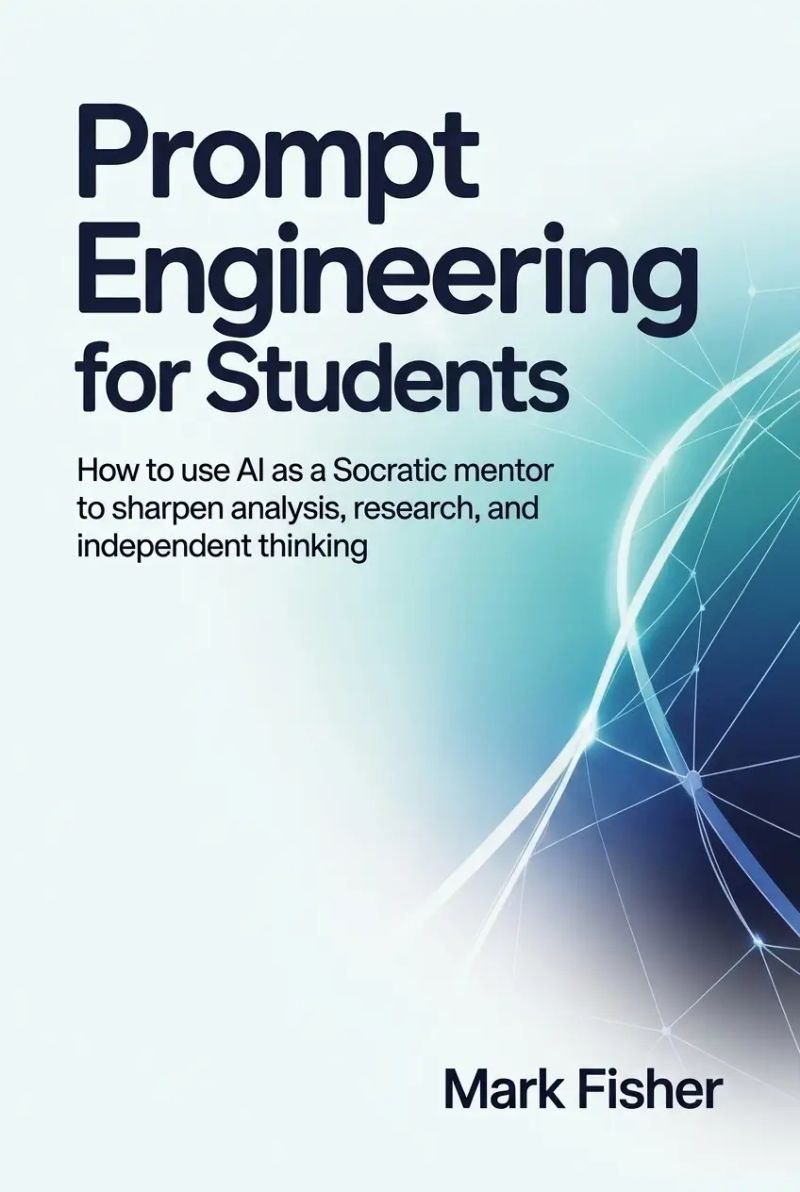
Prompt Engineering for Students
How to Use AI as a Socratic Mentor to Sharpen Analysis, Research, and Independent ThinkingBy Mark FisherRecorded TrackLength0m
About this audiobook
Prompt Engineering for Students reframes AI not as an answer machine but as a Socratic mentor — a tireless sparring partner that pushes students to think harder, not less. Through five core techniques and a toolkit of 31 ready-to-use prompts, students learn to interrogate themselves, stress-test arguments, find weaknesses in their own drafts, and study smarter using cognitive science. The book confronts the real danger of cognitive outsourcing and offers concrete habits for using AI deliberately. The result: sharper analysis, better research, and an authorial voice that survives the age of artificial intelligence.
Audiobook details
GenreTechnology, Education and Learning
Length0 mins
Narrated byRecorded Track
FormatAudiobook
Publish dateJun 10, 2026
LanguageEnglish
Table of contents
1Introduction
2Introduction: A Mentor in Your Pocket
3Chapter 1: From Search Box to Thinking Partner
4Chapter 2: The Socratic Mindset
5Take ideas seriously enough to test them.
Show all chaptersShow less
6Welcome the experience of being wrong.
7Ask the next question.
8Distinguish between knowing and recognizing.
9Be patient with confusion.
10Chapter 3: Anatomy of a Powerful Prompt
11Role
12Context
13Task
14Format
15Specificity beats elegance.
16Constraints sharpen output.
17Examples are gold.
18Iterate, don't restart.
19Push back.
20Chapter 4: AI as Socratic Mentor — Core Techniques
21Technique 1: The Interrogate-Me Prompt
22Technique 2: The Devil's Advocate Prompt
23Technique 3: The Three-Levels Prompt
24Technique 4: The Find-the-Flaw Prompt
25Technique 5: The Stretch-My-Thinking Prompt
26Chapter 5: Sharpening Analysis
27Stage 1: Map the structure.
28Stage 2: Identify the load-bearing claims.
29Stage 3: Stress-test the load-bearing claims.
30Chapter 6: Better Research
31Step 1: Build a research map.
32Step 2: Triangulate.
33Step 3: Find the gap.
34Step 4: Verify, verify, verify.
35Chapter 7: Writing With AI Without Losing Your Voice
36Mode 1: Generation.
37Mode 2: Polishing.
38Mode 3: Sparring.
39Write the bad version first, on your own.
40Identify your tics, your tells, your patterns.
41Resist the smoothing instinct.
42Use AI as a second reader, not a co-author.
43Keep an honest record of what you wrote and what AI wrote.
44Chapter 8: Studying Smarter
45For active retrieval
46For spaced practice
47For interleaving
48The Feynman technique, automated
49Concept mapping
50Mistake logs
More from Mark Fisher
THE CODE OF THE RICH MINDMark Fisher2h 25m$2.99 · $0.00
MICRO HABITS TO BREAK NEGATIVE HABITSMark Fisher1h 18m$2.99 · $0.00
NO MORE PROCRASTINATIONMark Fisher1h 9m4.3 (11)$2.99 · $0.00
MICRO HABITS FOR WEALTH - Small actions Big changesMark Fisher1h 19m$2.99 · $0.00

MICRO HABITS FOR HEALTH - Small Actions, Big ChangesMark Fisher1h 19m$2.99 · $0.00

LiftoffEric Berger9h 4m4.6 (9.5K)$29 · $0.00

The Honey BusMeredith May9h 31m4.4 (16.6K)$25 · $0.00
Collected Writings of Nikola TeslaThomas Commerford Martin, Nikola Tesla19h 42m4.4 (2.8K)$1.99 · $0.00

Operation PedestalMax Hastings12h 29m4.4 (5.2K)$29 · $0.00

When the Heavens Went on SaleAshlee Vance18h 20m4.4 (3K)$40 · $0.00
Everybody Has a Podcast (Except You)Justin McElroy, Travis McElroy, Griffin McElroy5h 9m4.3 (2.3K)$24 · $0.00
Hands of TimeRebecca Struthers8h 8m4.4 (1.3K)$26 · $0.00
Never Lost AgainBill Kilday10h 1m4.4 (805)$29 · $0.00
How the Internet HappenedBrian McCullough13h 28m4.3 (2.7K)$23 · $0.00
Collected Writings of Nikola TeslaNikola Tesla, Thomas Commerford Martin21h 50m4.3 (1.7K)$1 · $0.00
Just AspireAjai Chowdhry9h 13m4.4 (260)$29 · $0.00
The Little Book of AliensAdam Frank8h 20m4.3 (1.3K)$26 · $0.00
The inventions, researches and writings of Nikola Tesla (Annotated)Thomas Commerford Martin16h 59m4.3 (1.3K)$2 · $0.00

KargilV.P. Malik15h 18m4.3 (2K)$24 · $0.00
Experiments with Alternating CurrentsNikola Tesla9h 16m4.3 (874)$1.99 · $0.00

Fire on the HorizonTom Shroder, John Konrad8h 23m4.3 (858)$26 · $0.00
The Smell of Kerosene (Annotated)National Aeronautics and Space Administration, Donald L. Mallick, Peter W. Merlin11h 32m4.3 (523)$2 · $0.00

The Boy Who Harnessed the WindWilliam Kamkwamba, Bryan Mealer10h 5m4.2 (78.9K)$29 · $0.00

Across the Airless WildsEarl Swift10h 8m4.3 (1.3K)$29 · $0.00

Console WarsBlake J. Harris20h 41m4.2 (13.7K)$46 · $0.00

A Brief History of IntelligenceMax S. Bennett12h 18m4.6 (6.6K)$29 · $0.00

HomeschooledStefan Merrill Block7h 10m3.6 (18.5K)$28 · $0.00

Children Under FireJohn Woodrow Cox10h 17m4.5 (1.6K)$29 · $0.00

The State Must ProvideAdam Harris7h 15m4.5 (775)$24 · $0.00

The Call of the Wild and FreeAinsley Arment9h 7m4.4 (21.2K)$29 · $0.00
The Freelance WayRobert Vlach19h 48m4.5 (528)$40 · $0.00

Race to the BottomLuke Rosiak9h 20m4.5 (600)$29 · $0.00

They Came for the SchoolsMike Hixenbaugh9h 5m4.5 (2.6K)$8 · $0.00

Find Me UnafraidKennedy Odede, Jessica Posner11h 11m4.5 (2.7K)$29 · $0.00

Asking for ItKate Harding8h 55m4.4 (5.3K)$20 · $0.00
Defining Moments in Black HistoryDick Gregory7h 37m4.4 (6K)$26 · $0.00
The Emerald Tablets of Thoth the AtlanteanMaurice Doreal3h 4m4.4 (8.8K)$6 · $0.00

Learning AmericaLuma Mufleh6h 37m4.4 (564)$24 · $0.00
Math-ishJo Boaler7h 21m4.4 (588)$24 · $0.00
It Worked For MeColin Powell7h 42m4.3 (9.8K)$26 · $0.00

Little SoldiersLenora Chu11h 30m4.3 (3.1K)$29 · $0.00

Financial FeministTori Dunlap8h 3m4.2 (22.2K)$8 · $0.00

Grammar-land; Or, Grammar in Fun for the Children of Schoolroom-shireM. L. Nesbitt2h 36m4.4 (487)$1 · $0.00
DarkwaterWilliam Edward Burghardt Du Bois6h 40m4.3 (1.4K)$11 · $0.00

The Highway Code UKDepartment for Transport3h 33m4.2 (36.6K)$11 · $0.00
You may also like
The Creativity CodeMarcus du Sautoy9h 54m4.0 (2.2K)$20 · $0.00
The NumeratiStephen Baker7h 55m3.6 (2K)$17 · $0.00
Making SenseSam Harris22h 27m4.1 (3K)$46 · $0.00

Email Marketing: A Step-by-step Storybrand Guide for Any Business (The Step-by-step System for Building an Email List of Raving Fans Who Buy From You and Share Your Message)Roland Castillo1h 11m$3.50 · $0.00

Adapting To AIJasper Livingstone6h 29m$10

AI Without The AnxietyJasper Livingstone4h 54m$10

The Awakened IntelligenceJasper Livingstone4h 14m$13

Clear Thinking With AIJasper Livingstone4h 59m$10

Unlock Your Intelligent EdgeJasper Livingstone4h 20m$10
Tik Tok: A Step by Step Guide to Creating Your First Video (A Beginner Friendly Guide on Utilizing Tik-tok to Gain More Followers Gain More Clients)Kenneth Bachman2h 17m$3.50 · $0.00

Leading in the Age of Artificial IntelligenceJasper Livingstone9h 37m$14.50 · $0.00
AI For Managers Who Don’t CodeJasper Livingstone7h 18m$10

Ai cash machineJOHN J CARPENTER1h 49m$5.80 · $0.00
Business-Englisch lernen Audio - Motivieren Sie Ihr Team!Spotlight Verlag1h 14m$23

Filosofía de la mente y psicologíaPablo López-Silva, Francisco Osorio9h 24m$8 · $0.00
AI Tools for TeachersProf. Angelina Joel Adams2h 25m$6.50 · $0.00

The AI Culture BlueprintSagar Pandya1h 30m$2 · $0.00

AI Without The AnxietyJasper Livingstone4h 55m$12.50 · $0.00

Hundreds of Applications, Zero InterviewsImad Muratspahic4h 9m$12 · $0.00

Short Selling and Dark Pool VolumeXspurts6h 3m$6.40 · $0.00