
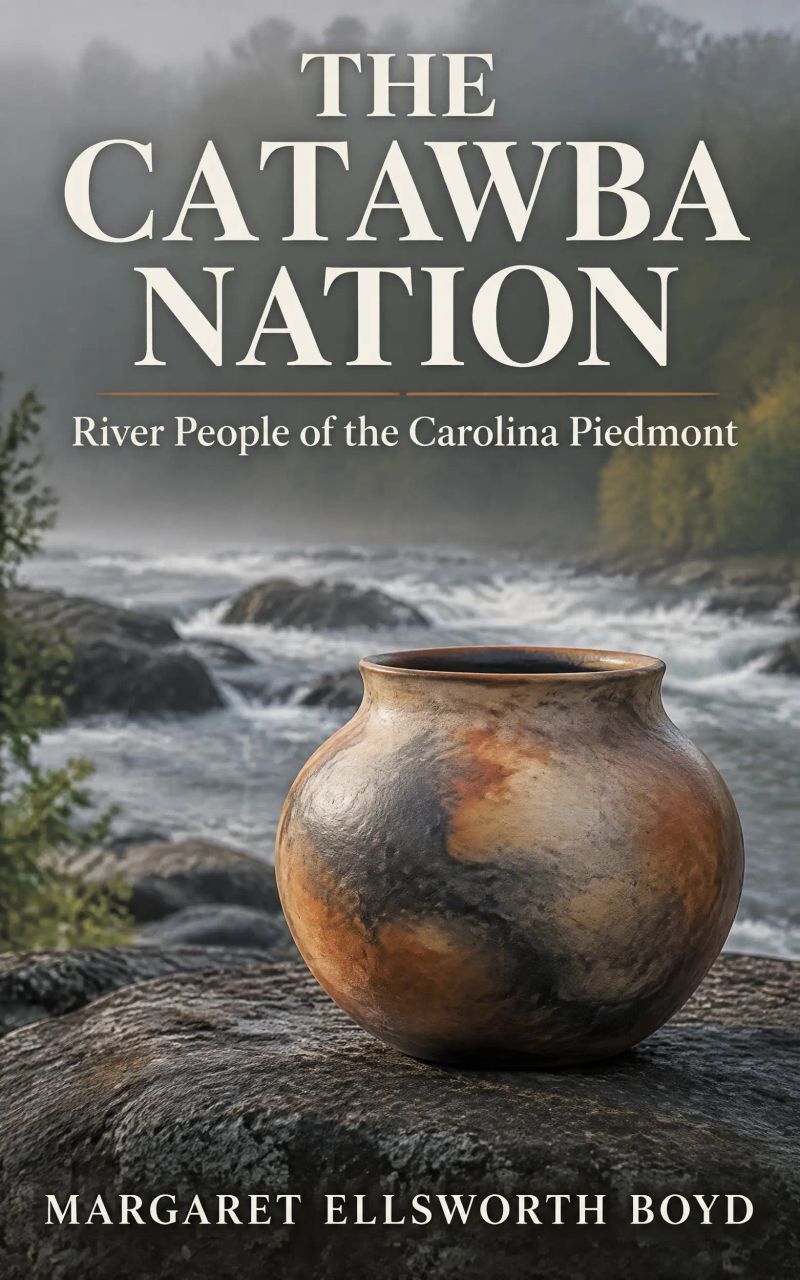
The Catawba Nation: River People of the Carolina Piedmont
By Margaret Ellsworth Boyd


Length4h 39m
About this audiobook
Fifteen miles on a side. That was the square of land along their river that the Catawba kept under the treaty signed at Augusta in 1763, after two centuries of trade, war and epidemic, as colonists poured into the Carolina Piedmont.
Before the square there was the river. The people who called themselves Iswa, the river people, built palisaded towns at the fords and shoals of the Catawba and its sister streams. They raised corn, beans and squash on floodplains renewed by every spring flood, burned the understory each fall to keep the woods open for deer, fished the spring runs of shad, and settled quarrels with a ball game rough enough to stand in for war.
Carolina traders came inland for deerskins, and after them came the Yamasee War of 1715, a long balancing act between rival empires, and an alliance with the Patriot side in the Revolution. The nineteenth century was harder: in 1840 the reservation itself was signed away to South Carolina. The twentieth brought federal recognition, lost and then won back, and carried the nation into the present.
The colonists named the river for the people. The people had long since named themselves for the river.
Audiobook details
GenreHistory
Length4 hrs 39 mins
Narrated byListen with 1,000+ voices
FormateBook with Audio
Publish dateSep 19, 2026
LanguageEnglish
Table of contents
1Chapter 1: The River and the Towns
2Chapter 2: The Coming of the Trade
3Chapter 3: The Yamasee War, 1715
4Chapter 4: Between Empires
5Chapter 5: The Deerskin Road
Show all chaptersShow less
6Chapter 6: The 1763 Treaty and the Fifteen-Mile Square
7Chapter 7: The Revolution and the Long Alliance
8Chapter 8: The Long Nineteenth Century
9Chapter 9: Allotment, Removal, and the Twentieth Century
10Chapter 10: Recognition and the Modern Nation
11Chapter 11: The River People in the Twenty-First Century
12Chapter 12: What the River Remembers
13About the Author

A Brief History of IntelligenceMax S. Bennett12h 18m4.6 (6.6K)$29 · $0.00

The Happiest Man on EarthEddie Jaku3h 48m4.6 (178K)$7 · $0.00

MotherlandJulia Ioffe17h 52m4.7 (2.5K)$40 · $0.00

Where Cowards Go to DieBenjamin Sledge8h 42m4.7 (351)$20 · $0.00

RevolutionariesSanjeev Sanyal11h 23m4.6 (2.6K)$29 · $0.00

We Crossed a Bridge and It TrembledWendy Pearlman6h4.6 (5.2K)$24 · $0.00

Unbroken Bonds of BattleJohnny Joey Jones8h 31m4.6 (2.6K)$8 · $0.00

The Daughter of AuschwitzTova Friedman, Malcolm Brabant7h 54m4.6 (16.7K)$26 · $0.00

Lily's PromiseLily Ebert, Dov Forman8h 54m4.6 (16.1K)$29 · $0.00

On Democracies and Death CultsDouglas Murray10h 38m4.6 (6.5K)$29 · $0.00

Across the RiverKent Babb11h 40m4.6 (927)$29 · $0.00

Balcony Over Jerusalem: A Middle East Memoir - Israel, Palestine and BeyondJohn Lyons12h 37m4.6 (1.4K)$33 · $0.00

BeyondStephen Walker15h 39m4.6 (3.2K)$33 · $0.00
Kings and PawnsHoward Bryant10h 9m4.6 (678)$29 · $0.00

No EscapeNury Turkel9h 30m4.6 (809)$28 · $0.00
Jubal Stone: U.S. Marshal: Blood Trail To Hell: A Western Adventure NovelCasey Nash3h 42m4.6 (3.2K)$18 · $0.00

Fall and RiseMitchell Zuckoff17h 23m4.6 (9.8K)$40 · $0.00

The SurvivorJosef Lewkowicz, Michael Calvin9h 22m4.6 (2.5K)$29 · $0.00

Always FaithfulThomas Schueman, Zainullah Zaki12h 12m4.6 (977)$29 · $0.00

The State of Society in France Before the Revolution of 1789 (Annotated)Alexis de Tocqueville17h 25m4.6 (1.2K)$2 · $0.00
You may also like
The BeadworkersBeth Piatote5h 15m4.1 (1.2K)$17 · $0.00
The Great HungerCecil Woodham-Smith18h 23m4.3 (2.3K)$28

Life Among the Piutes: The First Autobiography of a Native American WomanSarah Winnemucca Hopkins9h 10m4.2 (1.4K)$0.99 · $0.00

Waiting for the Long Night MoonAmanda Peters5h 23m4.1 (3.8K)$28 · $0.00
The Osage Empire Before OilDaniel R. Whitfield4h 38m$6
Mayflower ChroniclesKathryn Brewster Haueisen11h 26m4.3 (88)$23 · $0.00

The Whale Hunters of Montauk: Long Island's First ReservationsMargaret Ellsworth Hathaway4h 10m$6
Gold and Ashes: California's Indians and the Rush That Remade the WestDaniel R. Hollister4h 12m$6

Cedar and Trade: The Haida and Tlingit Empires of the Northwest CoastMargaret Ellsworth4h 34m$6

The Snake War and the Bannock War: Northern Paiute and Bannock ResistanceDuncan H. Ridgeway3h 56m$6
The Land Was Never Sold: Alaska Native Claims and the Fight for 44 Million AcresMargaret Elwell Nunn4h 32m$6

Grandma Says: Wake Up, World!Agnes Baker Pilgrim6h 11m4.5 (35)$17

Reading the English: Uncas and the Making of Native ConnecticutEleanor M. Crandall4h 29m$6

The Agrarian Problem in the Sixteenth CenturyR. H. Tawney17h 49m$1 · $0.00
Mescalero Apache: Sierra Blanca and the Reservation WarsDaniel R. Whitlock4h 1m$6

The Pomo and the Precious Blood: California's Clear Lake RemovalsMargaret Ellsworth Cavanaugh4h 17m$6

Last Stand of the Louisiana ShrimpersEmma Christopher Lirette8h 55m$25 · $0.00

Trail of Death: The Potawatomi Removal of 1838Marcus Whitfield3h 57m$6
The Whale House of the ChilkatGeorge Thornton Emmons1h 8m$2 · $0.00

Tales by Polish AuthorsAnonymous5h 11m$2 · $0.00