
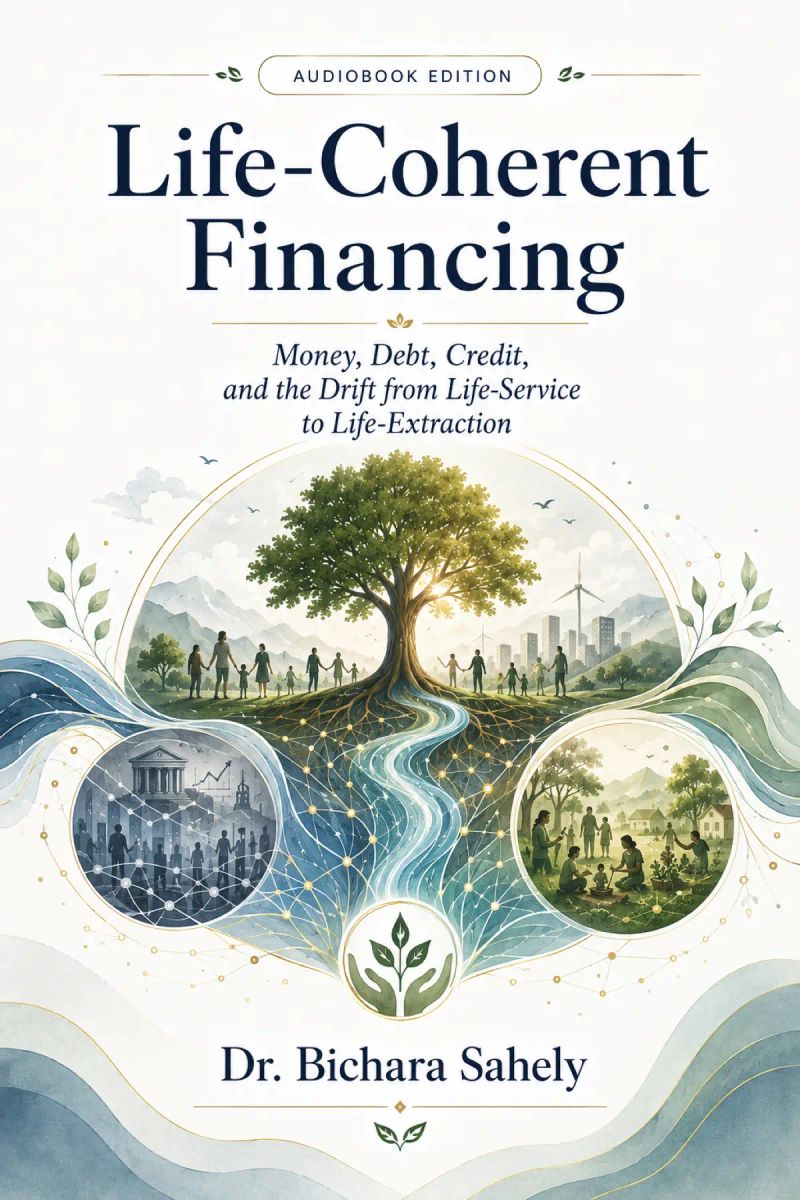
Life-Coherent Financing
Money, Debt, Credit, and the Drift from Life-Service to Life-ExtractionBy Dr. Bichara Sahely


Length7h 37m
About this audiobook
**Life-Coherent Financing** reimagines money, debt, credit, banking, public finance, taxation, digital currency, and investment through a life-centered lens. Drawing on Maturana, McMurtry, Galtung, Graeber, Hudson, Lietaer, Keen, Werner, MMT, ecological economics, care economics, and commons thinking, Dr. Bichara Sahely traces the drift from money as social memory and life-serving credit toward compounding claim-power, financialization, offshore escape, ecological harm, and programmable control.
This audiobook asks a simple but profound question: what should finance serve? Its answer is clear: no financial claim is legitimate beyond the life-capacity of the persons, communities, ecosystems, and future generations required to honor it. A call to restore finance as life-credit, reciprocity, repair, and positive financial peace.
Audiobook details
GenreBusiness and Economics, Politics and Government
Length7 hrs 37 mins
Narrated byListen with 1,000+ voices
FormateBook with Audio
Publish dateJun 2, 2026
LanguageEnglish
Table of contents
1Chapter 1
2Opening Overview
3Preface: Why Finance Must Be Re-grounded in Life
41. Introduction: The Financial Question Beneath Civilization
52. Money Before Money: Obligation, Reciprocity, and Social Memory
Show all chaptersShow less
62.1 The barter myth and the loss of relational memory
72.2 Credit before coin: the social life of accounting
82.3 Money as memory, trust, and enforceable recognition
92.4 Debt as moral relation and political technology
102.5 Commodity money, state money, and the danger of false oppositions
112.6 From social memory to abstraction
122.7 Life-coherent implications
133. Debt, Interest, and the Capture of the Future
143.1 The temporal asymmetry of compound interest
153.2 Hudson and the ancient recognition of debt overload
163.3 Debt as discipline, debt as domination
173.4 Usury, risk-sharing, and civilizational memory
183.5 The creditor’s illusion: claims as if they were life
193.6 Sovereign debt and the politics of necessity
203.7 Public debt, private debt, and the asymmetry of judgment
213.8 Bankruptcy, Jubilee, and the ethics of reset
223.9 The life-coherent legitimacy test for debt
233.10 From future capture to life-credit
244. Banking as the Power to Create Claims
254.1 The balance-sheet nature of bank money
264.2 Credit as authorized world-bringing
274.3 The myth of neutral credit allocation
284.4 Public license and private gain
294.5 Productive, speculative, and extractive credit
304.6 Banking, housing, and land
314.7 Banking, production, and ecological direction
324.8 Central banks and the hierarchy of money
334.9 Public banking and democratic credit
344.10 Credit guidance and the recovery of purpose
354.11 Bank profitability and life-value
364.12 Financial inclusion and the danger of inclusion into harm
374.13 From banking to the wider credit system
384.14 Life-coherent implications
395. Public Money, Sovereign Currency, and the Myth of Fiscal Scarcity
405.1 The household analogy and its errors
415.2 Taxation as reciprocity, demand creation, and life-ground return
425.3 Public spending as democratic provisioning
435.4 Deficits, surpluses, and sectoral relations
445.5 Inflation as real-resource and distributional signal
455.6 Monetary sovereignty and its degrees
465.7 Central banking and the politics of stability
475.8 The myth of taxpayer money and the politics of resentment
485.9 Public debt as claim, infrastructure, and power
495.10 The false economy of austerity
505.11 Public investment and the creation of future capacity

Preserving Life, Transforming Power in GazaDr Bichara Sahely1h 42mFree

Preserving Life, Transforming PowerDr. Bichara Sahely1h 4mFree

Putting the Missing Bridge to WorkDr. Bichara Sahely2h 12mFree

The Missing BridgeDr. Bichara Sahely1h 5mFree

Transformational Laboratories ProtocolDr. Bichara Sahely2h 33mFree

Artificial Intelligence and the Epistemic CommonsDr Bichara Sahely3h 12mFree

Conflict, Repair, and Non-DominationDr Bichara Sahely2h 21mFree

Institutions of Reflexive TransformationDr Bichara Sahely1h 51mFree

The Politics of Civilizational HealingDr. Bichara Sahely2h 13mFree

The Missing Grammar of Modern CivilizationDr. Bichara Sahely2h 8mFree

Civilizational Healing Research ArchitectureDr. Bichara Sahely1h 24mFree

How Does a Civilization Learn to Heal?Dr. Bichara Sahely1h 16mFree

From Competent Physicians to Healing SocietiesDr. Bichara Sahely2h 20mFree

Competence Is Necessary, but Not SufficientDr. Bichara Sahely1h 15mFree

Life-Grounding CanMEDSDr. Bichara Sahely1h 13mFree

The Dynamic Architecture of ViabilityDr Bichara Sahely2h 1mFree

Completing the Life-Value Onto-Axiology ProgramDr. Bichara Sahely1h 9m5.0 (1)Free

BEYOND GLOBAL JUSTICEDr. Bichara Sahely1h 25mFree

The Sweetness That Consumed the WorldBichara Sahely16h 14mFree
THE SOVEREIGNTY OF CREDITDr. Bichara Sahely3h 56mFree

Never Split the DifferenceChris Voss, Tahl Raz8h 7m4.4 (277.7K)$26 · $0.00
The Intelligent Investor Rev Ed.Benjamin Graham17h 48m4.3 (191.5K)$40 · $0.00

The Hard Thing About Hard ThingsBen Horowitz7h 57m4.2 (134.3K)$26 · $0.00

Boundaries for LeadersHenry Cloud7h 36m4.3 (3.6K)$26 · $0.00
Basic EconomicsThomas Sowell18h 32m4.5 (29.3K)$28 · $0.00

Poor Charlie’s AlmanackGrover Gardener, Charles T. Munger13h 9m4.5 (24.7K)$18 · $0.00

The Ambuja StoryNarotam Sekhsaria13h 59m4.5 (830)$33 · $0.00

The Secret Door to SuccessFlorence Scovel Shinn2h 25m4.5 (2.1K)$1.20 · $0.00

This Is Going to HurtAdam Kay5h 47m4.4 (444.7K)$24 · $0.00

Big TrustShadé Zahrai, Fayçal Sekkouah8h 36m4.6 (406)$26 · $0.00
The Intelligent Investor Third EditionBenjamin Graham, Jason Zweig20h4.4 (156.6K)$46 · $0.00

Bottle of LiesKatherine Eban14h 25m4.4 (12K)$33 · $0.00

The Antiracist Business BookTrudi Lebrón6h 10m4.6 (275)$17 · $0.00
The FormulaJoshua Robinson, Jonathan Clegg10h 41m4.4 (6.9K)$29 · $0.00

Let Them LeadJohn U. Bacon7h 10m4.5 (1.4K)$24 · $0.00

Secrets of the Millionaire MindT. Harv Eker5h 11m4.4 (301.4K)$24 · $0.00

The Person You Mean to BeDolly Chugh9h 6m4.4 (7.2K)$29 · $0.00
BoundlessNick Kostov, Sean McLain9h 17m4.5 (1.1K)$29 · $0.00

Everyday DharmaSuneel Gupta5h 2m4.5 (761)$20 · $0.00

Let's Talk Mutual FundsMonika Halan7h 5m4.4 (2.4K)$16 · $0.00

KrantikariSanjeev Sanyal11h 44m4.6 (1.3K)$16 · $0.00

Unbroken Bonds of BattleJohnny Joey Jones8h 31m4.6 (2.6K)$8 · $0.00

On Democracies and Death CultsDouglas Murray10h 38m4.6 (6.5K)$29 · $0.00

Balcony Over Jerusalem: A Middle East Memoir - Israel, Palestine and BeyondJohn Lyons12h 37m4.6 (1.4K)$33 · $0.00
RiggedMollie Hemingway12h 48m4.6 (4.2K)$23 · $0.00

SledgehammerDavid Friedman8h 21m4.7 (589)$26 · $0.00

Citizenship in a Republic (Annotated)Theodore Roosevelt2h 44m4.6 (1.4K)$2 · $0.00

No EscapeNury Turkel9h 30m4.6 (809)$28 · $0.00

Always FaithfulThomas Schueman, Zainullah Zaki12h 12m4.6 (977)$29 · $0.00

UnthinkableJamie Raskin15h 8m4.5 (9.3K)$8 · $0.00

My Fourth Time, We DrownedSally Hayden13h 59m4.6 (2.9K)$23 · $0.00

A Revolution of Common SenseScott Jennings9h 29m4.6 (528)$29 · $0.00

Statement From the Dock at the Rivonia TrialNelson Mandela2h 18m4.6 (1.3K)$1 · $0.00

Lessons from the EdgeMarie Yovanovitch17h 11m4.5 (5.9K)$40 · $0.00

To Rescue the American SpiritBret Baier10h 12m4.5 (2.7K)$8 · $0.00

StonewalledSharyl Attkisson15h 19m4.5 (4.3K)$33 · $0.00
The World According to Orwell: 1984 & Animal FarmGeorge Orwell15h 42m4.6 (1.1K)$1 · $0.00
Basic EconomicsThomas Sowell18h 32m4.5 (29.3K)$28 · $0.00

To Rescue the RepublicBret Baier, Catherine Whitney11h 42m4.5 (8.6K)$29 · $0.00

Modern WarriorsPete Hegseth7h 10m4.5 (4.7K)$24 · $0.00
You may also like

The Zero Marginal Cost SocietyJeremy Rifkin14h 14m3.9 (3.2K)$23 · $0.00

Advantage India : From Challenge to OppourtunityA.P.J Abdul Kalam, Srijan Pal Singh6h 9m4.5 (252)$8
Mission EconomyMariana Mazzucato6h 45m4.0 (4.1K)$24 · $0.00

A Call for RevolutionDalai Lama, Sofia Stril-Rever1h 30m4.2 (1.4K)$16 · $0.00

Let There Be WaterSeth M. Siegel8h 36m4.2 (2.3K)$20 · $0.00

The Good AncestorRoman Krznaric7h 52m4.1 (2.3K)$20 · $0.00

The Best American Science and Nature Writing 2022Ayana Elizabeth Johnson, Jaime Green12h 27m4.0 (623)$29 · $0.00

Man and Nature; Or, Physical Geography as Modified by Human ActionGeorge P. Marsh23h 35m4.1 (323)$1 · $0.00

BauhausMichael Siebenbrodt, Lutz Schöbe8h 28m4.3 (282)$18 · $0.00

The Shark’s PaintbrushJay Harman11h 50m4.1 (459)$20

ProgressJohan Norberg6h 57m4.2 (3.4K)$20 · $0.00

The Best American Science and Nature Writing 2024Bill McKibben, Jaime Green14h 14m4.2 (301)$33 · $0.00

The Century of Global CitiesAndrea Tobia Zevi5h 31m$7

Future History Of The AmazonCarlos Araujo Carujo1h 14m$7 · $0.00

Path to ZeroTucker Perkins4h 33m3.5 (13)$20

The Fifth SeasonRuby M. Harris11h 12m$4.10 · $0.00

Conversations About The EnvironmentHoward Burton9h 54m$10 · $0.00

Amazon BrazilianCarlos Araujo Carujo2h 56m$7 · $0.00

Embracing the Anthropocene: Managing Human Impact - A Conversation with Mark MaslinHoward Burton2h 3m$3 · $0.00

The Future of FoodScientific American5h 50m$17