
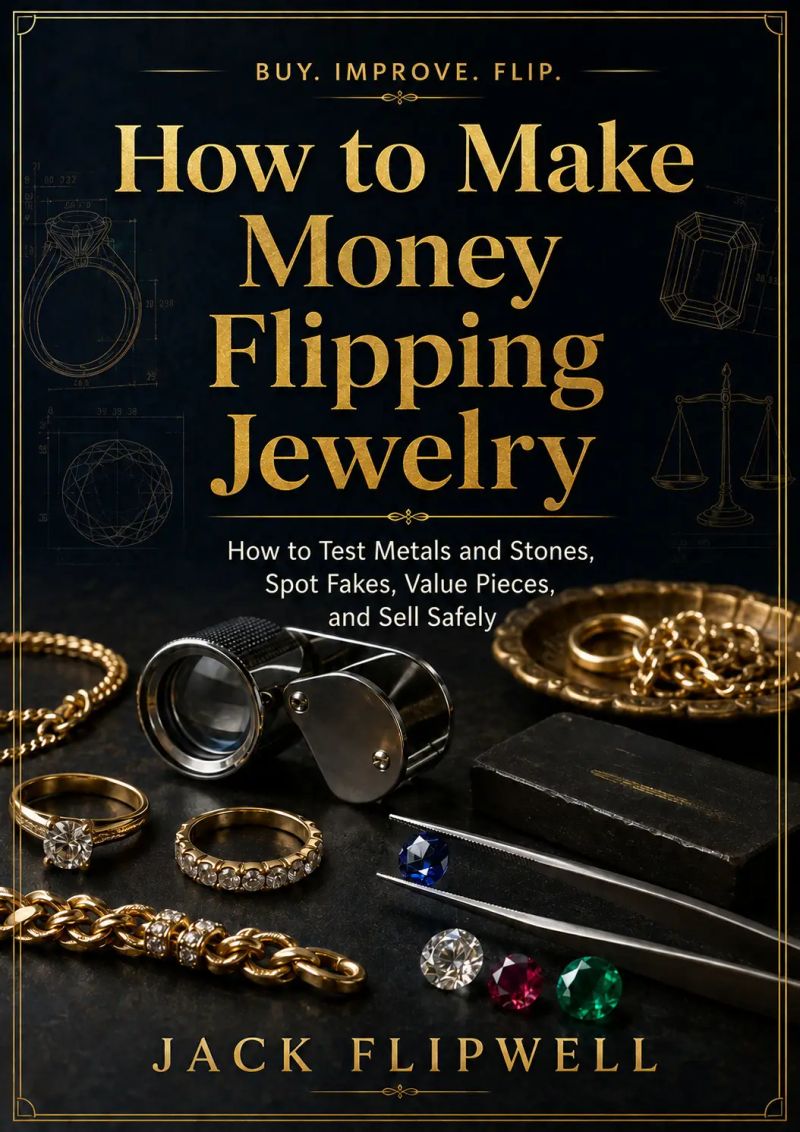
How to Make Money Flipping Jewelry - How to Test Metals and Stones, Spot Fakes, Value Pieces, and Sell Safely
By JACK FLIPWELL


Length8h 7m
About this audiobook
Jewelry can look extremely valuable while hiding more traps than almost any other secondhand category. Gold color does not prove gold. A stamped purity mark can be misread, altered, or counterfeit. A clear stone does not automatically mean a natural diamond, and a luxury logo is not proof of authenticity. In this market, money is made primarily by reducing expensive mistakes before they happen.
How to Make Money Flipping Jewelry is a practical guide to the complete jewelry flipping process, from finding opportunities and checking metals, stones, brands, and condition to valuation, listing creation, safe selling, inventory management, and scaling.
JACK FLIPWELL shows how to evaluate jewelry as inventory intended for resale rather than as an attractive object purchased emotionally. You will learn to separate material value from retail value, brand premium, and collector value. You will understand why the price of a new item in a jewelry store may have little connection to the amount a used piece can realistically achieve, and why active asking prices are not as useful as actual completed sales.
The book explains the foundations of precious-metal identification in practical language. You will learn how purity, weight, marks, hallmarks, and construction affect value. You will see how a jeweler's loupe, precision scale, calipers, magnet screening, and other basic tools fit into a larger verification process, and why no single test should replace disciplined analysis. The book also explains when more advanced methods or professional services are appropriate.
A major section is dedicated to stones. You will learn the difference between natural, synthetic, treated, composite, and imitation materials, and why one simple gemstone tester cannot answer every question. The book covers the practical risks surrounding diamond, moissanite, cubic zirconia, ruby, sapphire, emerald, pearls, opal, amber, and other common materials without encouraging unsupported identification claims. It also explains how to read gemological documentation carefully and why a report is valuable only when it can be reliably linked to the actual stone.
Branded jewelry and counterfeits receive equally detailed treatment. The book shows why authentication requires more than checking a logo. You will learn to examine construction, dimensions, weight, engraving, clasps, model variations, documentation, and provenance. You will also understand why a piece made from genuine gold can still be counterfeit and why an original box or receipt should never replace examination of the jewelry itself.
Condition and preparation are covered from a business perspective. You will learn to distinguish cosmetic wear from structural problems, inspect clasps, links, ring shanks, stone settings, solder repairs, dents, and previous modifications. The book explains when safe cleaning can add value and when polishing, ultrasonic cleaning, chemicals, or amateur repair can permanently reduce it.
One of the most important parts of the book is the valuation system:
Maximum Purchase Price = Conservative Resale Price - All Costs - Risk Reserve - Required Profit
This approach teaches you to stop negotiating against the seller's asking price and instead buy according to your own economics. You will learn to include selling fees, shipping, authentication, repairs, negotiation, inventory time, and identification uncertainty in the purchase decision.
You will also learn where to source jewelry, from local listings and large marketplaces to pawnshops, auction houses, vintage dealers, private collections, lots, and repeat suppliers. The book shows how to ask precise questions, request useful photographs, recognize red flags, distinguish a real opportunity from a trap, and negotiate without inventing defects.
The sales section covers photography, listing structure, sales channels, pricing, buyer negotiation, local transactions, international selling, secure payment, packaging, shipping, returns, chargebacks, and product substitution risk. The emphasis throughout is on reducing uncertainty for the buyer while protecting the seller from avoidable loss.
The book also addresses the formal side of jewelry flipping. It identifies areas that may require current legal, tax, customs, hallmarking, consumer-protection, trademark, shipping, or wildlife-trade guidance. It clearly separates tasks a reseller can perform from those that should be handled by a jeweler, gemologist, authenticator, accountant, lawyer, or other qualified specialist.
This publication was prepared with the assistance of tools that support the creative process, including artificial intelligence-based solutions. The final concept, structure, and editing belong to the author.
Audiobook details
GenreBusiness and Economics
Length8 hrs 7 mins
Narrated byListen with 1,000+ voices
FormateBook with Audio
Publish dateSep 28, 2026
LanguageEnglish
Table of contents
1INTRO
2Chapter 1 - How the Jewelry Market Works and Where the Margin Really Comes From
3Chapter 2 - Precious Metals, Purity Marks, and Hallmarks - How to Determine What Jewelry Is Made From
4Chapter 3 - Tools, Tests, and Inspection Procedure - How to Examine Jewelry Without Expensive Mistakes
5Chapter 4 - Natural, Synthetic, and Imitation Stones - How Not to Overpay for Sparkle
Show all chaptersShow less
6Chapter 5 - Authenticity, Brands, and Counterfeits - How to Check Jewelry Before Paying for the Logo
7Chapter 6 - Condition, Damage, Cleaning, and Repairs - What to Improve and What to Leave Alone
8Chapter 7 - How to Value Jewelry - From Metal Content to a Realistic Selling Price
9Chapter 8 - Where to Buy and How to Negotiate - Sourcing, Offer Selection, and Maximum Entry Price
10Chapter 9 - Documentation, Inventory Records, and Stock Control - How Not to Lose Money in Small Valuable Items
11Chapter 10 - Photography and the Sales Listing - How to Turn a Verified Piece Into a Product Buyers Trust
12Chapter 11 - Where to Sell Jewelry - Marketplaces, Auctions, Local Sales, and Choosing the Right Exit Channel
13Chapter 12 - Safe Payment, Packing, and Shipping - How to Protect the Jewelry and the Money After the Sale
14Chapter 13 - How to Recognize the Best Opportunities - Listing Selection, Red Flags, and Deal Scoring
15Chapter 14 - Managing Price and Selling Time - When to Wait, When to Reduce, and When to Exit
16Chapter 15 - The Buyer, Post-Listing Negotiation, and Problem Handling - How to Sell Professionally Without Giving Away the Margin
17Chapter 16 - Law, Taxes, Provenance, and Seller Responsibility - How to Flip Jewelry Without Unnecessary Legal Risk
18Chapter 17 - Scaling a Jewelry Flipping Business - How to Grow Revenue Without Growing the Error Rate
19Chapter 18 - Risk Management - How to Protect Capital, Inventory, and the Business as a Whole
20Chapter 19 - From Individual Deals to a Repeatable System - How to Build Your Own Jewelry Flipping Model
21Chapter 20 - The Complete Action Plan - From Your First Small Budget to a Repeatable Jewelry Flipping System

How to Make Money Flipping Sneakers - A Guide to Sourcing, Authentication, Pricing, and Profitable ResellingJACK FLIPWELL4h 29m$7.70 · $0.00
How to Make Money Reselling Clothes - How to Source, Photograph, Price, and Sell Secondhand Fashion OnlineJACK FLIPWELL5h 4m$7.70 · $0.00

How to Make Money Flipping Houses - How to Find Undervalued Properties, Control Renovation Costs, and Sell at the Right PriceJACK FLIPWELL4h 31m$7.70 · $0.00

Jak zarabiać na samochodach używanych - Jak znajdować okazje, szacować koszty i bezpiecznie sprzedawać auta z zyskiemJACK FLIPWELL4h 45m$7.80 · $0.00

Jak zarabiać na odsprzedaży iPhone’ów - Jak kupować poniżej ceny rynkowej, wykrywać wady i sprzedawać z zyskiemJACK FLIPWELL5h 30m$7.70 · $0.00

Jak zarabiać na flipach mieszkaniowych - Jak znajdować niedoszacowane nieruchomości, kontrolować koszty remontu i sprzedawać we właściwej cenieJACK FLIPWELL4h 54m$7.70 · $0.00

Jak zarabiać na używanej elektronice - Jak kupować, testować, wyceniać i sprzedawać smartfony, laptopy, tablety oraz konsoleJACK FLIPWELL5h4.7 (12)$7.70 · $0.00
How to Make Money Flipping Furniture - Turn Cheap and Forgotten Pieces into Products Buyers WantJACK FLIPWELL4h 26m$7.70 · $0.00
How to Make Money Flipping Almost Anything - A Complete System for Finding Deals, Calculating Margins, and Building Repeatable IncomeJACK FLIPWELL5h 57m$7.70 · $0.00

Jak zarabiać na odsprzedaży sneakersów - Przewodnik po wyszukiwaniu okazji, sprawdzaniu autentyczności i dochodowej sprzedażyJACK FLIPWELL4h 32m$7.70 · $0.00
How to Make Money Flipping Used Electronics - How to Buy, Test, Price, and Resell Phones, Laptops, Tablets, and Game ConsolesJACK FLIPWELL4h 22m$7.70 · $0.00

Jak zarabiać na odsprzedaży niemal wszystkiego - Kompletny system wyszukiwania okazji, obliczania marży i budowania powtarzalnego dochoduJACK FLIPWELL5h 29m$7.70 · $0.00

Jak zarabiać na odnawianiu i sprzedaży mebli - Jak zamieniać tanie i zapomniane przedmioty w produkty, które ludzie chcą kupowaćJACK FLIPWELL4h 49m$7.70 · $0.00
How to Make Money Flipping Watches - How to Spot Valuable Models, Avoid Fakes, and Resell with ConfidenceJACK FLIPWELL5h 45m$7.80 · $0.00

How to Make Money Flipping Used Cars - A Beginner's Guide to Finding Deals, Estimating Costs, and Selling Safely for ProfitJACK FLIPWELL4h 24m$7.80 · $0.00

Jak zarabiać na ubraniach z drugiej ręki - Jak wyszukiwać, fotografować, wyceniać i sprzedawać używaną modę w internecieJACK FLIPWELL4h 49m$7.70 · $0.00
How to Make Money Flipping Collectibles - How to Find Undervalued Toys, Sets, Cards, and Limited-Edition ItemsJACK FLIPWELL6h 30m$7.80 · $0.00

Jak zarabiać na przedmiotach kolekcjonerskich - Jak znajdować niedoszacowane zabawki, zestawy, karty i limitowane przedmiotyJACK FLIPWELL5h 5m$7.80 · $0.00

Jak zarabiać na kupowaniu i sprzedaży zegarków - Jak rozpoznawać wartościowe modele, unikać podróbek i sprzedawać z odpowiednią marżąJACK FLIPWELL4h 56m$7.80 · $0.00
How to Make Money Flipping iPhones - A Practical Guide to Buying Below Market Value, Spotting Defects, and Reselling for ProfitJACK FLIPWELL5h 17m$7.70 · $0.00
Never Split the DifferenceChris Voss, Tahl Raz8h 7m4.4 (277.7K)$26 · $0.00
The Intelligent Investor Rev Ed.Benjamin Graham17h 48m4.3 (191.5K)$40 · $0.00
The Hard Thing About Hard ThingsBen Horowitz7h 57m4.2 (134.3K)$26 · $0.00
Boundaries for LeadersHenry Cloud7h 36m4.3 (3.6K)$26 · $0.00
The Joys Of CompoundingGautam Baid17h 34m4.5 (2.5K)$18 · $0.00
Basic EconomicsThomas Sowell18h 32m4.5 (29.3K)$28 · $0.00

Poor Charlie’s AlmanackGrover Gardener, Charles T. Munger13h 9m4.5 (24.7K)$18 · $0.00

The Ambuja StoryNarotam Sekhsaria13h 59m4.5 (830)$33 · $0.00

The Secret Door to SuccessFlorence Scovel Shinn2h 25m4.5 (2.1K)$1.20 · $0.00

This Is Going to HurtAdam Kay5h 47m4.4 (444.7K)$24 · $0.00

Big TrustShadé Zahrai, Fayçal Sekkouah8h 36m4.6 (406)$26 · $0.00
The Intelligent Investor Third EditionBenjamin Graham, Jason Zweig20h4.4 (156.6K)$46 · $0.00

Bottle of LiesKatherine Eban14h 25m4.4 (12K)$33 · $0.00

The Antiracist Business BookTrudi Lebrón6h 10m4.6 (275)$17 · $0.00
The FormulaJoshua Robinson, Jonathan Clegg10h 41m4.4 (6.9K)$29 · $0.00

Let Them LeadJohn U. Bacon7h 10m4.5 (1.4K)$24 · $0.00

Secrets of the Millionaire MindT. Harv Eker5h 11m4.4 (301.4K)$24 · $0.00
The Person You Mean to BeDolly Chugh9h 6m4.4 (7.2K)$29 · $0.00
BoundlessNick Kostov, Sean McLain9h 17m4.5 (1.1K)$29 · $0.00
Everyday DharmaSuneel Gupta5h 2m4.5 (761)$20 · $0.00
You may also like

How to Sing [Meine Gesangskunst]Lilli Lehmann4h 19m4.1 (351)$2 · $0.00

The Logic of HegelGeorg Wilhelm Friedrich Hegel13h 29m4.2 (1.8K)$1 · $0.00
The Myth of the Rational Market Revised EditionJustin Fox13h 26m4.0 (5.4K)$29 · $0.00
Pictorial Composition and the Critical Judgment of PicturesHenry Rankin Poore7h 12m4.1 (267)$2 · $0.00
Sell It Today, Sell It NowTom Hopkins, Pat Leiby4h 38m4.1 (385)$75

Appearance and Reality from the Problems of PhilosophyBertrand Russell19m4.1 (25.9K)$1 · $0.00

Pragmatism: A New Name for Some Old Ways of ThinkingWilliam James6h 56m4.0 (5.6K)$1 · $0.00

The CategoriesAristotle2h 41m4.0 (2.2K)$1 · $0.00

Take More VacationsScott Keyes8h 12m4.0 (1.9K)$26 · $0.00

The Hot HandBenjamin Cohen8h 39m3.9 (1.6K)$26 · $0.00

It's ElementalKate Biberdorf9h 12m3.8 (1.1K)$29 · $0.00
How to Make Money Flipping Used Cars - A Beginner's Guide to Finding Deals, Estimating Costs, and Selling Safely for ProfitJACK FLIPWELL4h 24m$7.80 · $0.00

Ohio RBT Certification Exam Prep 2026/2027Mireille Oyelaran16h 5m$22

The Greatest Works of Immanuel KantImmanuel Kant84h 15m4.4 (120)$1 · $0.00
WILLIAM WALKER ATKINSON Ultimate Collection – 58 Books in One VolumeWilliam Walker Atkinson319h 5m4.6 (15)$3 · $0.00

Selected Mathematical Works: Symbolic Logic + The Game of Logic + Feeding the Mind: by Charles Lutwidge Dodgson, alias Lewis Carroll (Annotated)Lewis Carroll8h 35m$2 · $0.00

Tennessee DMV Permit Test Study Guide 2026/2027Lydia Pembrook10h 56m$19
LSAT LOGIC GAMES MASTERY GUIDE 2026/2027Adrian Hartwell12h 18m$10
Advertising OnlineNola D. Fenwright2h 39m$2.30 · $0.00
The Investor's HandbookXavier I. Kingsley4h 50m$4.10 · $0.00