
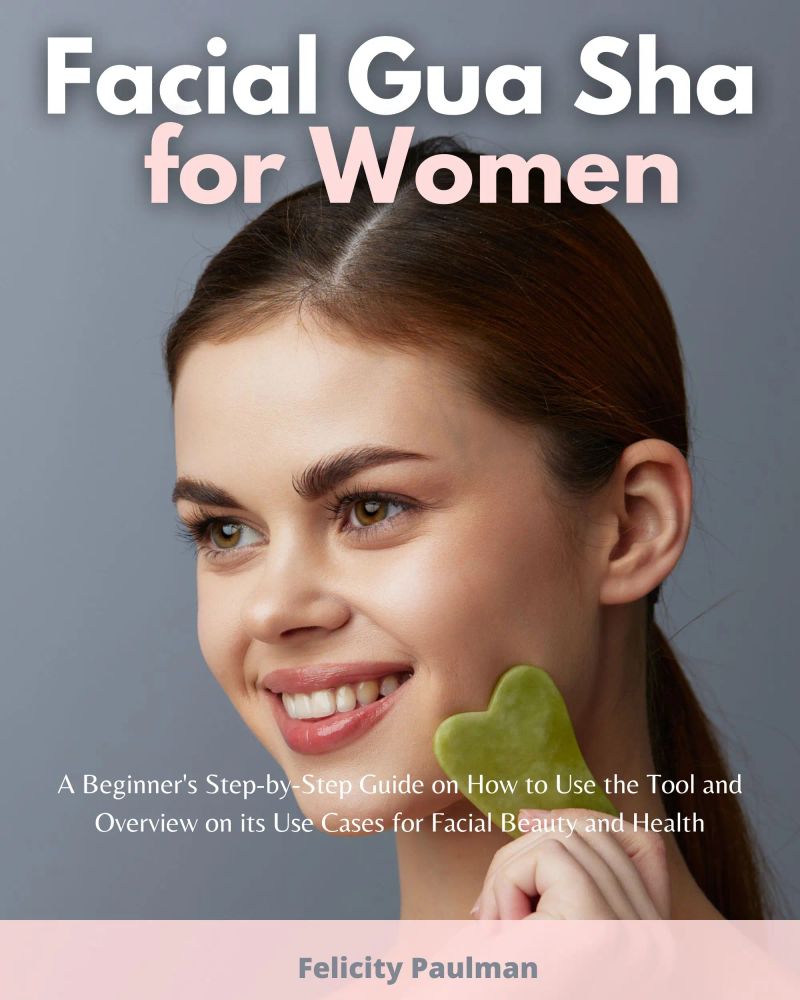
Facial Gua Sha for Women
A Beginner's Step-by-Step Guide on How to Use the Tool and Overview on its Use Cases for Facial Beauty and HealthBy Felicity Paulman


Length1h 40m
About this audiobook
The term "qi" refers to the energy that circulates throughout the body, as described by traditional Chinese medicine. It is said to be responsible for both a person's bodily and mental wellness. It is believed that the kidneys are the source of qi and that it travels through the body in a network of channels known as the meridians.
It is believed that there are twelve primary meridians, each of which is associated with a distinct organ. According to traditional Chinese medicine, illness results from an imbalance in the flow of qi. Acupuncture, herbal medicine, and gua sha are some of the practices that are utilized in traditional Chinese medicine to bring about a state of balance.
In Gua Sha, a kind of traditional Chinese medicine, the patient's skin is scraped using a tool that is both smooth and curved to stimulate circulation and has a therapeutic effect. It is believed that the technique dates back to the 7th century, and it is being used today for a range of diseases, including the reduction of pain, the prevention of colds and flu, and the treatment of digestive issues.
When doing Gua Sha, a tool made of jade or another type of stone that is polished and curved is often used. After applying oil to the surface of the skin, the practitioner will scrape the instrument in a manner that is both hard and soft over the surface of the skin. The scrape should not be uncomfortable; nevertheless, some patients may feel bruising following the treatment due to the nature of the procedure.
Gua Sha may have a variety of beneficial effects, some of which include the alleviation of pain, enhancement of circulation, reduction of inflammation, and improvement of immunological function. In addition, Gua Sha may be used to treat respiratory illnesses like colds and flu, as well as digestive issues like constipation and diarrhea.
Gua Sha is an effective technique for reducing wrinkles and promoting a youthful appearance. It can also help with menstrual cramps, menopausal symptoms, and PMS.
The frequency of Gua Sha treatments depends on the condition being treated. For general well-being, one or two sessions per week may suffice, while acute issues might require three or more sessions weekly.
When performed by a skilled practitioner, Gua Sha is generally safe, though minor bruising or skin irritation can occur. If you're unsure whether it's right for you, consult a healthcare professional before booking a session.
In this beginner's guide, we'll take a deeper look at the following subtopics:
Background and history of gua sha
The Gua Sha Tools Materials and Shapes
How do practitioners perform the gua sha technique?
The uses of the gua sha technique
The gua sha technique in conjunction with the other traditional Chinese medicines
The risks of the gua sha technique
Women and facial beauty
Benefits of using gua sha on your face
Step-by-step guide on how to perform gua sha on your face
When to know if gua sha is right for you?
The gua sha and Graston technique's similarities and differences
Keep reading to learn more about this ancient Chinese healing practice and how it can benefit your overall health and well-being. We'll explore its origins, the tools used in Gua Sha, how practitioners perform the technique, and the various uses of this therapy. By the end of this guide, you'll have a better understanding of Gua Sha and whether it is the right treatment for your specific needs.
Audiobook details
GenreHealth and Wellness, Self-Help
Length1 hr 40 mins
Narrated byListen with 1,000+ voices
FormateBook with Audio
Publish dateMar 7, 2025
LanguageEnglish
Table of contents
1Disclaimer
2Background and History of Gua Sha
3Gua Sha Around the World
4Other Names and Modern Popularity
5Anatomy of Gua Sha Benefits
Show all chaptersShow less
6The Gua Sha Tools
7Gua Sha Tools Based on Materials
8Gua Sha Tool Shapes and Their Applications
9How to Spot Authentic, High-Quality Gua Sha Tools
10How do Practitioners Perform the Gua Sha Technique?: How Often Should Gua Sha be Performed?
11Uses of Gua Sha
12Treating Pain and Inflammation
13Boosting Immunity
14Relieving Stress
15Relieving Fatigue
16Relieving Headaches
17Improving Digestion
18Treating Flu
19Detoxifying the Body
20Relieving Menstrual Cramps
21For Skincare
22For the Body
23Gua Sha for Specific Health Conditions
24Alleviating Tension Headaches and Migraines
25Managing Arthritis and Fibromyalgia Symptoms
26Easing Menstrual Cramps
27Promoting Digestion
28How Gua Sha Treatment Complements Other Traditional Chinese Medicine (TCM) Practices
29How Gua Sha Complements TCM Techniques
30The Role of Meridians and Energy Flow in Gua Sha Therapy
31Case studies from TCM practitioners using Gua Sha in treatments.
32The Risks of the Gua Sha Technique
33Common Mistakes and How to Avoid Them
34Gua Sha Safety Tips: Practicing Safely and Effectively
35Is Gua Sha Right for Me?
36Women and Facial Beauty
37Benefits of Using Gua Sha on your Face
38Facial Gua Sha for Targeted Concerns
39Reducing Under-Eye Puffiness and Dark Circles
40Sculpting the Jawline and Cheekbones
41Minimizing Fine Lines and Wrinkles
42Performing Gua Sha for Sinus Relief
43Stress Reduction with Gua Sha
445 Step-by-Step Guide on How to Perform Gua Sha
45Step 1: Choose the Right Gua Sha Tool for Your Needs
46Step 2: Prepare Your Skin
47Step 3: Begin Scraping with Proper Technique
48Step 4: Final Touch - Cleaning and Cooling
49Step 5: Moisturize and Relax
50Creating a Gua Sha Routine

A Parent of Teens Happiness Reset GuideFelicity Paulman1h 54m$5.50

The Newborn Night-Shift Playbook for Two ParentsFelicity Paulman1h 53m$5.50
Tinnitus Retraining Therapy WorkbookFelicity Paulman1h 53m$5.50
Castor Oil for HairFelicity Paulman1h 58m$5.50

High-Conflict Co-Parenting PlaybookFelicity Paulman2h 1m$5.50

Talking to Aging Parents Who Refuse HelpFelicity Paulman2h 2m$5.50

Gaslighting Recovery for Divorced WomenFelicity Paulman1h 42m$5.50
Sobriety for High-Achieving WomenFelicity Paulman1h 35m$5.50

Boundaries for Adult Children of AlcoholicsFelicity Paulman1h 36m$5.50

Inner Child Healing for Highly Sensitive PeopleFelicity Paulman1h 38m$5.50
Pranic Healing for BeginnersFelicity Paulman1h 27m$5.50

Neuro-Linguistic Programming for WomenFelicity Paulman1h 35m$5.50

Happiness for Busy ParentsFelicity Paulman1h 33m$5.50

Swedish Death Cleaning for Adult ChildrenFelicity Paulman1h 29m$5.50

Manifestation for Women Over 40Felicity Paulman1h 32m$5.50

Child Anxiety & Screen TimeFelicity Paulman1h 35m$5.50

Daughters of Narcissistic MothersFelicity Paulman1h 32m$5.50

Vagus Nerve Healing for Women with AnxietyFelicity Paulman1h 26m$5.50

Memory Improvement for Seniors Over 50Felicity Paulman1h 31m$5.50

Highly Sensitive Woman Over 40Felicity Paulman1h 29m$5.50
Eat It!Jordan Syatt, Michael Vacanti4h 40m4.6 (1.5K)$20 · $0.00

Consent Laid BareChanel Contos7h 11m4.5 (1.7K)$24 · $0.00

How to Make Disease DisappearRangan Chatterjee5h 26m4.5 (3.5K)$24 · $0.00
The Complete Herbal (Annotated)Nicholas Culpeper29h 8m4.5 (1.4K)$2 · $0.00

A Plague Upon Our HouseScott W. Atlas MD10h 37m4.5 (3.4K)$20 · $0.00

The Cancer CodeDr. Jason Fung10h 48m4.5 (5.3K)$29 · $0.00

The Gift of TherapyIrvin Yalom7h 39m4.5 (38.8K)$26 · $0.00

EarlySarah DiGregorio9h 47m4.5 (1.3K)$29 · $0.00

Bottle of LiesKatherine Eban14h 25m4.4 (12K)$33 · $0.00
The 36-Hour DayNancy L. Mace, Peter V. Rabins17h 13m4.4 (9.2K)$28 · $0.00
FlooredSara Reardon10h 36m4.5 (1K)$29 · $0.00

Radical RemissionKelly A. Turner9h 26m4.4 (8.1K)$29 · $0.00
The Sinatra SolutionStephen T. Sinatra MD9h4.5 (899)$20 · $0.00

The Songaminute ManSimon McDermott6h 12m4.5 (280)$24 · $0.00

Sometimes BrilliantLarry Brilliant12h 27m4.5 (954)$29 · $0.00

Live Your LifeAmanda Kloots, Anna Kloots10h 54m4.4 (13.7K)$29 · $0.00

All in Her HeadElizabeth Comen13h 25m4.4 (18.2K)$33 · $0.00
The Wisdom of Your BodyHillary McBride9h 14m4.4 (6.7K)$29 · $0.00

The Alzheimer's SolutionDean Sherzai, Ayesha Sherzai9h 47m4.4 (1.9K)$29 · $0.00
Rewire Your MindsetBrian Keane6h 49m4.5 (896)$23 · $0.00
Learning to PrayJames Martin13h 24m4.5 (3.4K)$33 · $0.00

Finding MeViola Davis9h 15m4.6 (256.4K)$29 · $0.00
Spiritual AnatomyDaaji Kamlesh D. Patel9h 47m4.7 (319)$29 · $0.00

The Dangerous Truth about Today’s MarijuanaLaura Stack CSP, MBA9h 57m4.7 (384)$20 · $0.00

Birdie & HarlowTaylor Wolfe7h 50m4.6 (6.5K)$26 · $0.00

CrossroadsKaleb Dahlgren7h 56m4.6 (4.9K)$26 · $0.00

Life on the BridgeKaelynn Partlow5h 40m4.6 (1.1K)$24 · $0.00

Keep Your Love OnDanny Silk9h 4m4.6 (8.1K)$10 · $0.00
The Tao of Joy Every DayDerek Lin10h 24m4.6 (762)$20 · $0.00
UndividedVicky Beeching9h 2m4.6 (1.3K)$29 · $0.00
Level UpRob Dial7h 42m4.6 (3.3K)$26 · $0.00
Burn the HaystackJennie Young, PhD9h 30m4.6 (543)$29 · $0.00
ACRES OF DIAMONDS: Our Every-day Opportunities (Wisdom & Empowerment Series) (Annotated)Russell Conwell2h 26m4.6 (1K)$2 · $0.00

Good InsideBecky Kennedy9h 55m4.5 (59.3K)$29 · $0.00

The Lost VoiceGreta Morgan8h 30m4.7 (285)$26 · $0.00

Stripped DownBunnie Xo8h 25m4.5 (32.9K)$26 · $0.00

UnthinkableJamie Raskin15h 8m4.5 (9.3K)$8 · $0.00

Wallace D. Wattles Ultimate Collection Wallace D. Wattles16h 53m4.6 (1.3K)$1 · $0.00

Inquire WithinIn-Q2h 18m4.6 (993)$16 · $0.00

Under His WingsEmily Compagno7h 16m4.6 (848)$22 · $0.00
You may also like
The Complete HerbalNicholas Culpeper27h 59m4.4 (1.9K)$2.30
The Wisdom of the ShireNoble Smith4h 48m4.1 (1.7K)$14

Healthy at HomeTieraona Low Dog MD9h 59m4.4 (454)$20 · $0.00

Madame Young's Guide to HealthAmelia Young6h 53m$2 · $0.00

Housekeeping in Old VirginiaVarious11h 48m4.3 (158)$1.99 · $0.00

Food Remedies: Facts About Foods And Their Medicinal UsesFlorence Daniel1h 57m3.4 (93)$1 · $0.00

Ginseng and Other Medicinal PlantsA. R. Harding8h 54m4.0 (288)$2 · $0.00

Food Remedies: Facts About Foods And Their Medicinal UsesFlorence Daniel1h 55m4.5 (11)$1 · $0.00

The British WoodliceWilfred Mark Webb, Charles Sillem2h 21m$2 · $0.00

The Bee-Master of WarrilowTickner Edwardes5h 37m4.1 (72)$2.30

La Cura por el AguaYogui Ramacharaka3h 8m4.2 (23)$6 · $0.00

Companion Planting: The Beginner's Guide to Companion Gardening (The Ultimate Science-based Guide to Successful Gardening Through Companion Planting for Healthier)William Norwood4h 37m4.4 (29)$3.50 · $0.00

On the Preparations of the Indian Hemp, or Gunjah (Cannabis Indica)W. B. O'Shaughnessy1h 26m$1 · $0.00

Forbidden AsiaHans-Jürgen Döpp54m3.1 (19)$15 · $0.00
The Life TreeCarlos Araujo Carujo2h 10m$11 · $0.00

Mary Whitcher's Shaker house-keeperMary Whitcher2h 54m4.6 (12)$1 · $0.00

Tin Foil and Its Combinations for Filling TeethHenry Lovejoy Ambler2h 19m$1 · $0.00

Nooks and Corners of English Life, Past and PresentJohn Timbs10h 1m$1 · $0.00

A Tale of Two Monkeys, and other storiesAnonymous42m$2 · $0.00

Leaves from our Tuscan kitchen; or, How to cook vegetablesJanet Ross4h 11m4.0 (171)$1 · $0.00