
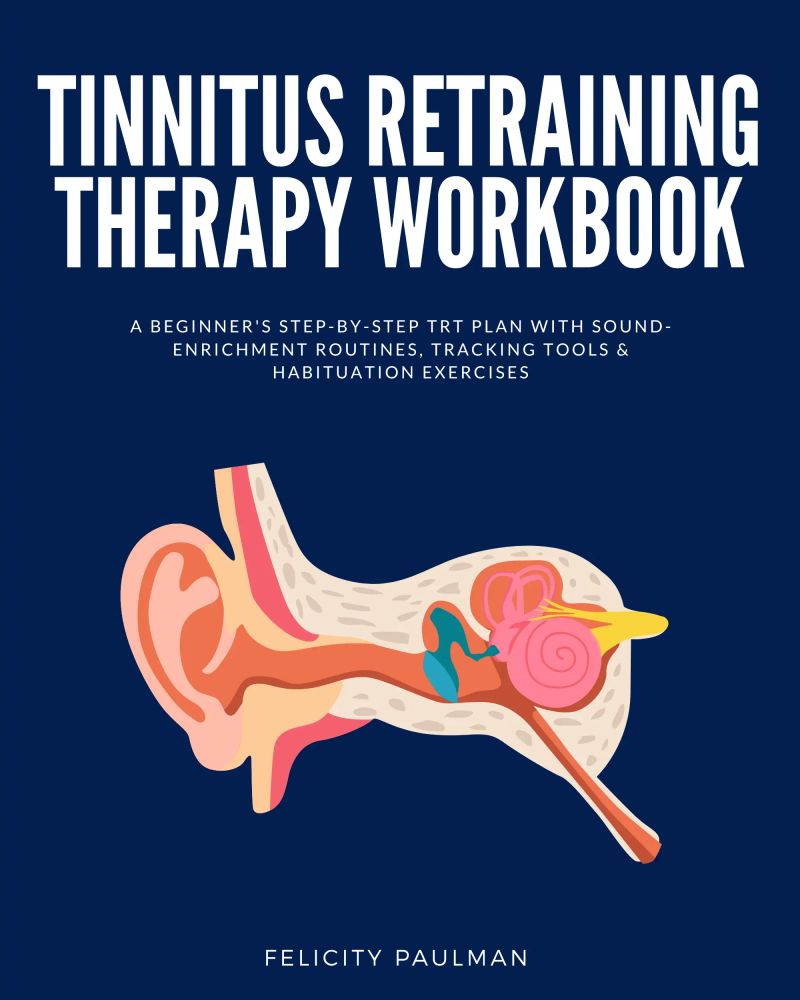
Tinnitus Retraining Therapy Workbook
A Beginner's Step-by-Step TRT Plan with Sound-Enrichment Routines, Tracking Tools & Habituation ExercisesBy Felicity Paulman


Length1h 52m
About this audiobook
Tinnitus is a condition characterized by the perception of sound in the absence of any external source. Most commonly, people describe it as a ringing in the ears, but it can also manifest as buzzing, hissing, clicking, or other noises. Tinnitus is a symptom rather than a disease itself, and it can vary greatly in intensity and duration from person to person. These phantom sounds may be constant or fluctuate, sometimes becoming more noticeable in quiet environments or during periods of stress.
People experiencing tinnitus often report symptoms that extend beyond the auditory sensations themselves. The most common symptom is the persistent perception of noise, but many also experience associated difficulties such as trouble sleeping, concentration problems, irritability, and increased stress or anxiety. Tinnitus may impact emotional well-being and overall quality of life, particularly when it becomes intrusive during work or relaxation. For some, these symptoms are mild and temporary; for others, they can become chronic and require intervention to manage effectively.
Tinnitus has a variety of potential causes and risk factors. The most common causes include age-related hearing loss, exposure to loud noises, and certain ear injuries or infections. In some cases, medications with ototoxic properties meaning they can damage the inner ear may trigger or worsen tinnitus. Medical conditions such as high blood pressure, diabetes, or temporomandibular joint (TMJ) disorders can also play a role in its development. Additionally, stress, genetics, and lifestyle factors may influence susceptibility. Understanding these risk factors is an important step in identifying suitable management strategies.
Tinnitus Retraining Therapy (TRT) was developed to help individuals adapt to tinnitus by reducing the emotional and psychological impact it can have. The primary purpose of TRT is not to eliminate the tinnitus sound itself, but to help people reach a point where the tinnitus is no longer bothersome or distressing. TRT combines sound therapy with specialized counseling to facilitate the process of habituation, a natural adjustment where the brain gradually learns to tune out the tinnitus noise, making it less intrusive over time.
This workbook is designed to guide you step-by-step through the core components and exercises of TRT. Each chapter builds on the previous one, beginning with fundamental information about the auditory system and types of tinnitus, then progressing through symptom recognition, identification of causes, and a thorough explanation of TRT’s principles. You will find practical tools, including assessment questionnaires, tracking templates, and sound enrichment routines. Throughout the guide, you will also learn about counseling techniques, daily exercises, troubleshooting advice, and ways to enhance your ongoing progress.
In this guide, you will discover:The basics of tinnitus, including its symptoms, causes, and risk factorsAn overview of Tinnitus Retraining Therapy (TRT) and how it can helpPractical strategies for managing tinnitus in daily lifeStep-by-step exercises and tools to support your progressTips for improving sleep, concentration, and overall well-being Ways to track your improvement and adjust your approach as needed
To use this workbook most effectively, proceed through each chapter sequentially and complete the recommended activities and self-assessments before moving on. The exercises are developed specifically for beginners and can be tailored to your individual needs. Take time to reflect on your experiences as you practice, and don’t hesitate to revisit sections that are especially relevant to your situation. The aim of this guide is to equip you with the understanding, tools, and confidence needed to manage tinnitus and achieve meaningful, lasting improvement.
Audiobook details
GenreHealth and Wellness, Self-Help
Length1 hr 52 mins
Narrated byListen with 1,000+ voices
FormateBook with Audio
Publish dateMar 19, 2026
LanguageEnglish
Table of contents
1Tinnitus Explained
2Auditory System Anatomy and Physiology: Types of Tinnitus: Subjective and Objective
3Common Sounds Associated with Tinnitus
4Prevalence and Demographic Data
5Impact on Daily Living and Mental Health
Show all chaptersShow less
6Recognizing Tinnitus Symptoms
7Perceived Sounds: Ringing, Buzzing, Hissing, Clicking
8Intensity, Duration, and Variability Of Symptoms
9Triggers and Aggravating Factors
10Sleep Disturbances and Fatigue
11Concentration, Memory, and Emotional Changes: What to Do If You Recognize These Symptoms
12Causes and Risk Factors
13Hearing loss and age-related changes
14Noise Exposure and Ototoxic Medications
15Ear Injuries and Infections
16Medical Conditions Linked to Tinnitus
171. Ménière’s Disease
182. Otosclerosis
193. Temporomandibular Joint Disorders (TMJ)
204. Cardiovascular Disease
215. Metabolic and Other Chronic Conditions
22Genetic Predispositions and Lifestyle Influences
23Principles of Tinnitus Retraining Therapy
24The Neurophysiological Model of Tinnitus
25Core Components: Counseling and Sound Therapy
26Counseling
27Sound Therapy
28Habituation Process and Its Goals
29The Role of Auditory Perception and Brain Plasticity
30Importance of Individualized Treatment Plans
31Initial Assessment and Self-Tracking Tools
32Self-Assessment Questionnaires
33Tinnitus Loudness and Annoyance Rating Scales
34Baseline Audiological evaluation
35Symptom and Trigger Diary Templates
36Progress Tracking Charts and Digital Tools: Integrating Self-Tracking Into Daily Life
37Counseling and Education Techniques
38Setting Realistic Expectations for Habituation
39Addressing Misconceptions and Fears
40Stress Reduction Techniques
41Communication Strategies for Discussing Tinnitus
42Family and Support Network Involvement
43Sound Enrichment and Masking Methods
44Types of Sound Generators and Their Use
45Environmental Sound Enrichment Routines
46Headphones, Speakers, and Bedside Devices
47Recommended Sound Libraries and Sample Routines
48Morning Routine (Home or Work)
49Afternoon Focus Routine
50Evening Wind-down Routine
A Parent of Teens Happiness Reset GuideFelicity Paulman1h 54m$5.50

The Newborn Night-Shift Playbook for Two ParentsFelicity Paulman1h 53m$5.50

Castor Oil for HairFelicity Paulman1h 58m$5.50

High-Conflict Co-Parenting PlaybookFelicity Paulman2h 1m$5.50

Talking to Aging Parents Who Refuse HelpFelicity Paulman2h 2m$5.50

Gaslighting Recovery for Divorced WomenFelicity Paulman1h 42m$5.50

Sobriety for High-Achieving WomenFelicity Paulman1h 35m$5.50
Boundaries for Adult Children of AlcoholicsFelicity Paulman1h 36m$5.50

Inner Child Healing for Highly Sensitive PeopleFelicity Paulman1h 38m$5.50
Pranic Healing for BeginnersFelicity Paulman1h 27m$5.50

Neuro-Linguistic Programming for WomenFelicity Paulman1h 35m$5.50

Happiness for Busy ParentsFelicity Paulman1h 33m$5.50

Swedish Death Cleaning for Adult ChildrenFelicity Paulman1h 29m$5.50

Manifestation for Women Over 40Felicity Paulman1h 32m$5.50

Child Anxiety & Screen TimeFelicity Paulman1h 35m$5.50

Daughters of Narcissistic MothersFelicity Paulman1h 32m$5.50

Vagus Nerve Healing for Women with AnxietyFelicity Paulman1h 26m$5.50

Memory Improvement for Seniors Over 50Felicity Paulman1h 31m$5.50

Highly Sensitive Woman Over 40Felicity Paulman1h 29m$5.50

Eat It!Jordan Syatt, Michael Vacanti4h 40m4.6 (1.5K)$20 · $0.00

Consent Laid BareChanel Contos7h 11m4.5 (1.7K)$24 · $0.00

How to Make Disease DisappearRangan Chatterjee5h 26m4.5 (3.5K)$24 · $0.00

The Complete Herbal (Annotated)Nicholas Culpeper29h 8m4.5 (1.4K)$2 · $0.00

A Plague Upon Our HouseScott W. Atlas MD10h 37m4.5 (3.4K)$20 · $0.00

The Cancer CodeDr. Jason Fung10h 48m4.5 (5.3K)$29 · $0.00

The Gift of TherapyIrvin Yalom7h 39m4.5 (38.8K)$26 · $0.00

EarlySarah DiGregorio9h 47m4.5 (1.3K)$29 · $0.00

Bottle of LiesKatherine Eban14h 25m4.4 (12K)$33 · $0.00
The 36-Hour DayNancy L. Mace, Peter V. Rabins17h 13m4.4 (9.2K)$28 · $0.00

FlooredSara Reardon10h 36m4.5 (1K)$29 · $0.00
Radical RemissionKelly A. Turner9h 26m4.4 (8.1K)$29 · $0.00
The Sinatra SolutionStephen T. Sinatra MD9h4.5 (899)$20 · $0.00

The Songaminute ManSimon McDermott6h 12m4.5 (280)$24 · $0.00
Sometimes BrilliantLarry Brilliant12h 27m4.5 (954)$29 · $0.00

Live Your LifeAmanda Kloots, Anna Kloots10h 54m4.4 (13.7K)$29 · $0.00

All in Her HeadElizabeth Comen13h 25m4.4 (18.2K)$33 · $0.00
The Wisdom of Your BodyHillary McBride9h 14m4.4 (6.7K)$29 · $0.00
The Alzheimer's SolutionDean Sherzai, Ayesha Sherzai9h 47m4.4 (1.9K)$29 · $0.00
Rewire Your MindsetBrian Keane6h 49m4.5 (896)$23 · $0.00
Learning to PrayJames Martin13h 24m4.5 (3.4K)$33 · $0.00

Finding MeViola Davis9h 15m4.6 (256.4K)$29 · $0.00

Spiritual AnatomyDaaji Kamlesh D. Patel9h 47m4.7 (319)$29 · $0.00

The Dangerous Truth about Today’s MarijuanaLaura Stack CSP, MBA9h 57m4.7 (384)$20 · $0.00

Birdie & HarlowTaylor Wolfe7h 50m4.6 (6.5K)$26 · $0.00

CrossroadsKaleb Dahlgren7h 56m4.6 (4.9K)$26 · $0.00

Life on the BridgeKaelynn Partlow5h 40m4.6 (1.1K)$24 · $0.00

Keep Your Love OnDanny Silk9h 4m4.6 (8.1K)$10 · $0.00
The Tao of Joy Every DayDerek Lin10h 24m4.6 (762)$20 · $0.00

UndividedVicky Beeching9h 2m4.6 (1.3K)$29 · $0.00
Level UpRob Dial7h 42m4.6 (3.3K)$26 · $0.00
Burn the HaystackJennie Young, PhD9h 30m4.6 (543)$29 · $0.00

ACRES OF DIAMONDS: Our Every-day Opportunities (Wisdom & Empowerment Series) (Annotated)Russell Conwell2h 26m4.6 (1K)$2 · $0.00

Good InsideBecky Kennedy9h 55m4.5 (59.3K)$29 · $0.00

The Lost VoiceGreta Morgan8h 30m4.7 (285)$26 · $0.00

Stripped DownBunnie Xo8h 25m4.5 (32.9K)$26 · $0.00

UnthinkableJamie Raskin15h 8m4.5 (9.3K)$8 · $0.00

Wallace D. Wattles Ultimate Collection Wallace D. Wattles16h 53m4.6 (1.3K)$1 · $0.00

Inquire WithinIn-Q2h 18m4.6 (993)$16 · $0.00

Under His WingsEmily Compagno7h 16m4.6 (848)$22 · $0.00