
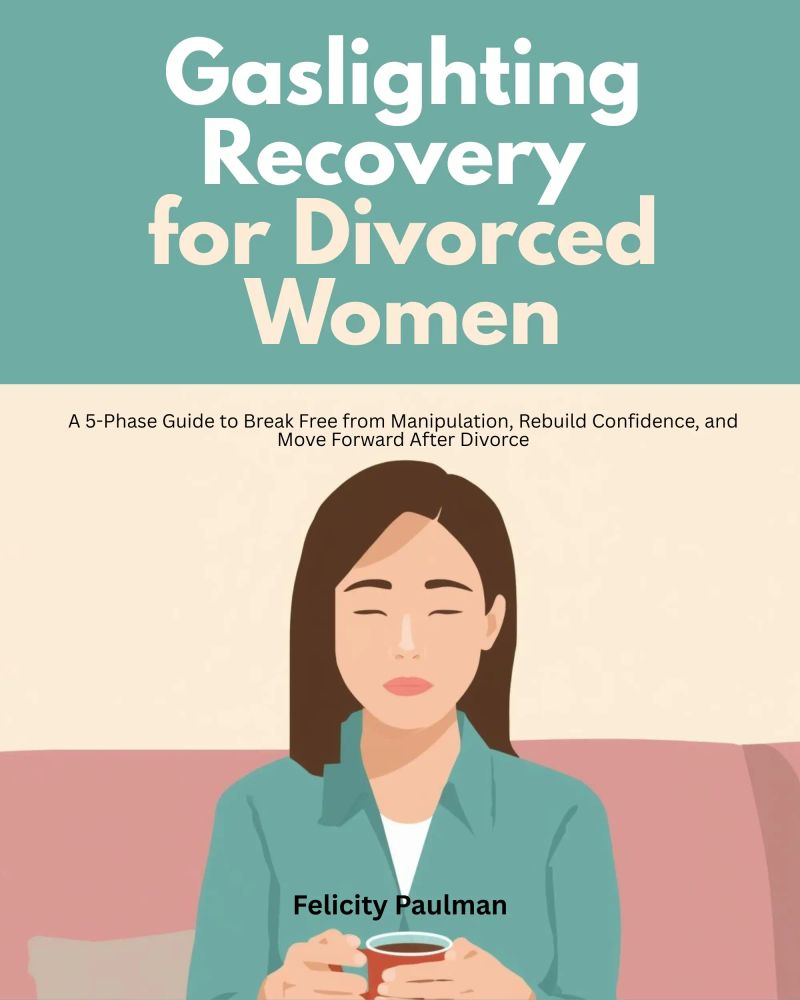
Gaslighting Recovery for Divorced Women
A 5-Phase Guide to Break Free from Manipulation, Rebuild Confidence, and Move Forward After DivorceBy Felicity Paulman


Length1h 41m
About this audiobook
Divorce is rarely a single loss. It’s an unraveling of shared memories, identity, and the safety once believed to exist within a relationship. But when that relationship has involved gaslighting—a persistent form of emotional manipulation designed to make someone doubt their own thoughts, perceptions, or sanity—the separation often brings an invisible layer of trauma that lingers long after the papers are signed.
For many divorced women, the end of a gaslighting relationship doesn’t bring immediate freedom. Instead, it can feel like waking up from a long fog—one where reality, self-trust, and emotional balance have all been tampered with.
You may find yourself asking: Was it really that bad? Did I imagine it? Am I overreacting? These doubts are not signs of weakness—they are the predictable aftershocks of psychological manipulation.
Gaslighting often leaves behind confusion and self-blame, especially when it occurs in marriage, where emotional intimacy blurs boundaries. The gaslighter’s tactics—denying your experiences, twisting your words, rewriting history—erode the foundation of self-trust that healthy relationships require.
This can lead to symptoms of chronic anxiety, hypervigilance, and difficulty making decisions. When the relationship ends, what’s left is not just grief for what was lost but uncertainty about who you are now.
In this guide, you will learn about the following:
How gaslighting operates and how it subtly influences self-perception.
Practical steps to dismantle its lingering effects and rebuild clarity.
The 5-Phase Healing Plan, which translates recovery into daily action: grounding in reality, rebuilding self-trust, releasing emotional residue, reclaiming personal power, and learning to thrive again.
Strategies for navigating post-divorce challenges, including co-parenting with a manipulative ex, maintaining boundaries within shared social circles, and protecting your children from emotional spillover.
Tools to help you move from survival mode to lasting strength, confidence, and self-respect.
Recovery from gaslighting is not about forgetting what happened; it’s about remembering who you are beyond the distortion. It’s a process of piecing together your story with accuracy and compassion—no longer filtered through someone else’s version of truth.
If you’ve felt unseen, doubted, or silenced, this guide is here to help you begin again—not as who you were before the marriage, but as the woman you are now: aware, resilient, and finally grounded in your own voice.
Audiobook details
GenreOther, General Fiction
Length1 hr 41 mins
Narrated byListen with 1,000+ voices
FormateBook with Audio
Publish dateDec 20, 2025
LanguageEnglish
Table of contents
1Disclaimer
2Understanding Gaslighting and Its Impact
3What Is Gaslighting?
4How Gaslighting Destroys Self-Trust
5Recognizing the Signs You Missed
Show all chaptersShow less
6Divorce and Gaslighting — A Unique Double Trauma
7The Emotional Toll of Leaving a Manipulative Partner
8Untangling Love, Control, and Guilt
9Why Divorced Women Often Blame Themselves
10Preparing for Your Healing Journey
11Creating Your Emotional Safety Plan
12Identifying Your Gaslighting Triggers
13Setting Boundaries with Your Ex (and Others)
14The 5-Phase Healing Plan
15Phase 1: Grounding in Reality
16Phase 2: Rebuilding Self-Trust
17Phase 3: Releasing Emotional Baggage
18Phase 4: Reclaiming Personal Power
19Phase 5: Thriving in Your New Chapter
20Reimagining Love and Future Relationships
21Healing Attachment Wounds
22Red Flags to Watch For in Future Partners
23Opening Yourself to Healthy Love Again
24Embracing Your Empowered Identity
25Integrating the Lessons
26Celebrating Your Growth and Courage
27Living Authentically Going Forward
28Navigating Co-Parenting and Shared Networks
29Co-Parenting Structure & Communication
30Child-Centered Logistics & Safety Protocols
31Managing Mutual Networks & Periodic Review
32Conclusion
33FAQs
34References and Helpful Links

A Parent of Teens Happiness Reset GuideFelicity Paulman1h 54m$5.50

The Newborn Night-Shift Playbook for Two ParentsFelicity Paulman1h 53m$5.50

Tinnitus Retraining Therapy WorkbookFelicity Paulman1h 53m$5.50

Castor Oil for HairFelicity Paulman1h 58m$5.50

High-Conflict Co-Parenting PlaybookFelicity Paulman2h 1m$5.50

Talking to Aging Parents Who Refuse HelpFelicity Paulman2h 2m$5.50
Sobriety for High-Achieving WomenFelicity Paulman1h 35m$5.50

Boundaries for Adult Children of AlcoholicsFelicity Paulman1h 36m$5.50

Inner Child Healing for Highly Sensitive PeopleFelicity Paulman1h 38m$5.50
Pranic Healing for BeginnersFelicity Paulman1h 27m$5.50

Neuro-Linguistic Programming for WomenFelicity Paulman1h 35m$5.50

Happiness for Busy ParentsFelicity Paulman1h 33m$5.50

Swedish Death Cleaning for Adult ChildrenFelicity Paulman1h 29m$5.50

Manifestation for Women Over 40Felicity Paulman1h 32m$5.50

Child Anxiety & Screen TimeFelicity Paulman1h 35m$5.50

Daughters of Narcissistic MothersFelicity Paulman1h 32m$5.50

Vagus Nerve Healing for Women with AnxietyFelicity Paulman1h 26m$5.50

Memory Improvement for Seniors Over 50Felicity Paulman1h 31m$5.50

Highly Sensitive Woman Over 40Felicity Paulman1h 29m$5.50

Mere ChristianityC. S. Lewis7h 7m4.4 (519.7K)$24 · $0.00

Her Daily BreadKate Wood12h 57m4.6 (153)$33 · $0.00

The Holy Bible - 1 SamuelKing James2h 13m4.8 (1.6K)$3 · $0.00

The American Standard Bible — The Gospel of MatthewMatthew3h 56m4.7 (3K)$2 · $0.00

Bad Fat Black GirlSesali Bowen6h 32m4.7 (2.8K)$24 · $0.00

The King James Audio Bible New Testament CompleteChristopher Glyn20h 2m4.7 (2.6K)$12 · $0.00

Faiths CheckbookCharles Spurgeon12h 44m4.7 (3.2K)$11 · $0.00
Ten Things I Wish You Knew About Your Child's Mental HealthDr. Billy Garvey4h 53m4.7 (2.4K)$20 · $0.00

Designing Terry Pratchett’s DiscworldPaul Kidby3h 52m4.7 (343)$20 · $0.00

The Chosen Book OneAmanda Jenkins, Kristen Hendricks, Dallas Jenkins3h 8m4.6 (4.9K)$10 · $0.00

The Lives of BrianBrian Johnson9h 45m4.6 (3.5K)$29 · $0.00

Expository Thoughts on the Gospel of LukeJ.C. Ryle27h 13m4.7 (536)$18 · $0.00

CrossroadsKaleb Dahlgren7h 56m4.6 (4.9K)$26 · $0.00

Across the RiverKent Babb11h 40m4.6 (927)$29 · $0.00

Brain Training for RidersAndrea Monsarrat Waldo5h 56m4.7 (550)$19 · $0.00

My Effin' LifeGeddy Lee17h 11m4.6 (13.1K)$40 · $0.00

Kings and PawnsHoward Bryant10h 9m4.6 (678)$29 · $0.00

The Elementia Chronicles #2: The New OrderSean Fay Wolfe11h 17m4.6 (841)$29 · $0.00

The ActsLuke2h 55m4.6 (19.7K)$12 · $0.00

New Testament - Easy NavigationWorld English Bible19h 35m4.6 (1.3K)$1.30 · $0.00

WhistlerAnn Patchett10h 45m4.6 (4.6K)$29 · $0.00

Demon CopperheadBarbara Kingsolver21h 3m4.5 (949.4K)$46 · $0.00

To Kill a MockingbirdHarper Lee12h 18m4.5 (7.4M)$29 · $0.00

Remarkably Bright CreaturesShelby Van Pelt11h 17m4.4 (1.7M)$29 · $0.00

The Old Man and the Sea (Annotated)Ernest Hemingway4h 27m4.6 (1.4K)$2 · $0.00

White HotIlona Andrews13h 18m4.5 (136.9K)$5 · $0.00

The Ghost by the Billabong (The Matilda Saga, #5)Jackie French14h 58m4.6 (773)$33 · $0.00

Cast in BloodMichelle Sagara16h 35m4.6 (607)$33 · $0.00

The Captain Blood Trilogy (Annotated)Rafael Sabatini29h 20m4.6 (1K)$3 · $0.00

Ship of the Line (Annotated)Cecil Louis Troughton Smith11h 13m4.6 (1K)$2 · $0.00

The George Orwell CollectionGeorge Orwell24h 46m4.5 (14.4K)$12 · $0.00

Time RegainedMarcel Proust15h 38m4.5 (9.2K)$2 · $0.00

Driving ForceElle James4h 58m4.6 (407)$20 · $0.00

When God Calls the HeartBrian Bird, Michelle Cox3h 24m4.6 (439)$10 · $0.00

Five Little IndiansMichelle Good10h 34m4.5 (64.5K)$29 · $0.00

Lolth's WarriorR. A. Salvatore13h 20m4.6 (2.4K)$33 · $0.00

The Things We Cannot SayKelly Rimmer13h 48m4.5 (359.1K)$33 · $0.00

The Love Songs of W.E.B. Du BoisHonoree Fanonne Jeffers29h 49m4.5 (58K)$8 · $0.00

Going PostalTerry Pratchett11h 23m4.5 (189.9K)$29 · $0.00

Glen AffricKarine Giebel22h 51m4.5 (3.2K)$46 · $0.00
You may also like
Things No One Taught Us About LoveVex King5h 55m4.2 (2.8K)$24 · $0.00

This Is Your Brain on DepressionFaith G. Harper PhD1h 49m3.9 (1.4K)$15

Unf*ck Your AnxietyFaith G. Harper PhD2h 45m4.0 (2K)$15

Breakup BootcampAmy Chan8h 44m4.2 (1.7K)$26 · $0.00

John Lennon 1980Kenneth Womack10h 32m4.4 (925)$20

The Year of the HorsesCourtney Maum6h 50m4.0 (1.4K)$17 · $0.00

FearThich Nhat Hanh4h 18m4.5 (11.9K)$6 · $0.00

But You Seemed So HappyKimberly Harrington7h 10m3.9 (2.1K)$24 · $0.00

Love UnleashedVictoria The4h 17m4.1 (617)$6.40 · $0.00
RebootJerry Colonna7h 34m4.0 (3.3K)$26 · $0.00

To Have and to HoldMolly Millwood9h 1m4.4 (4.9K)$29 · $0.00

The Inner SecretWilliam Walker Atkinson4h 32m4.3 (264)$2 · $0.00

What Your Body Knows about GodRob Moll5h 57m4.0 (393)$17

How To Make Friends And Influence PeopleDale Carnegie22h 1m4.3 (1.3M)$1 · $0.00
13 Things Mentally Strong Parents Don't DoAmy Morin10h 10m4.2 (4.7K)$29 · $0.00

The Social ParadoxWilliam von Hippel8h 37m3.8 (348)$5 · $0.00

Essays in medical sociology, Volume 1Elizabeth Blackwell8h 11m$1 · $0.00

Stop!Nathan Dane Urner1h 10m$2 · $0.00

Free from Compulsion to Happiness – The Self-Help Book: How to Overcome All Intrusive Thoughts and Fears, Control Your Thoughts and Establish Positive Thinking – incl. The 7 Best Immediate Help TipsKaspar Wendland3h 55m$17 · $0.00
How to Decide When to End a Long-term RelationshipSteve Pavlina19m2.9 (27)$4 · $0.00